-
-
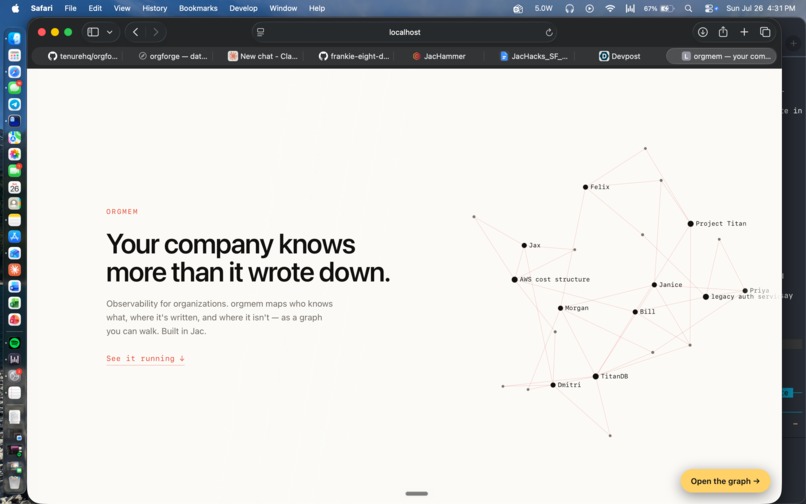
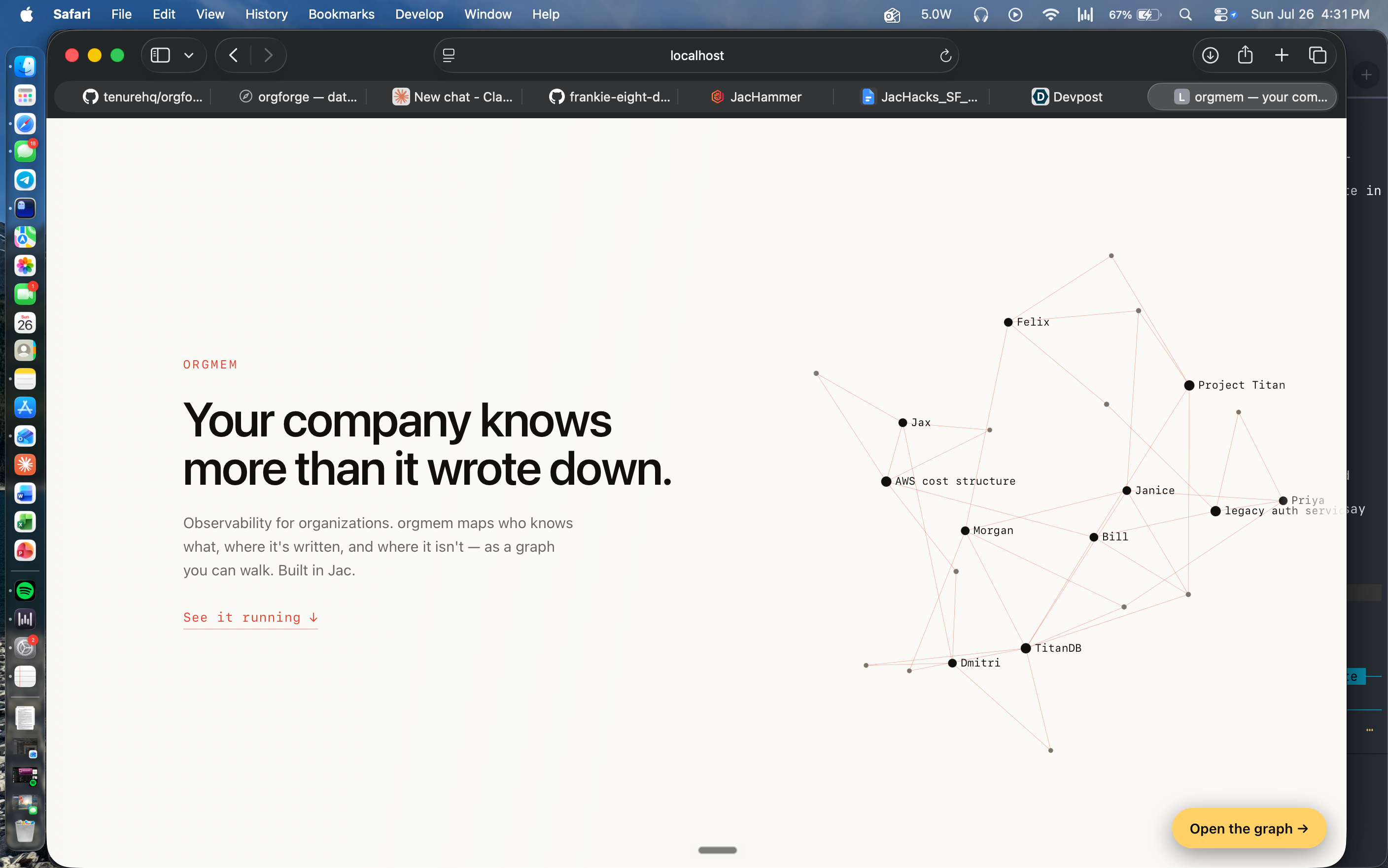
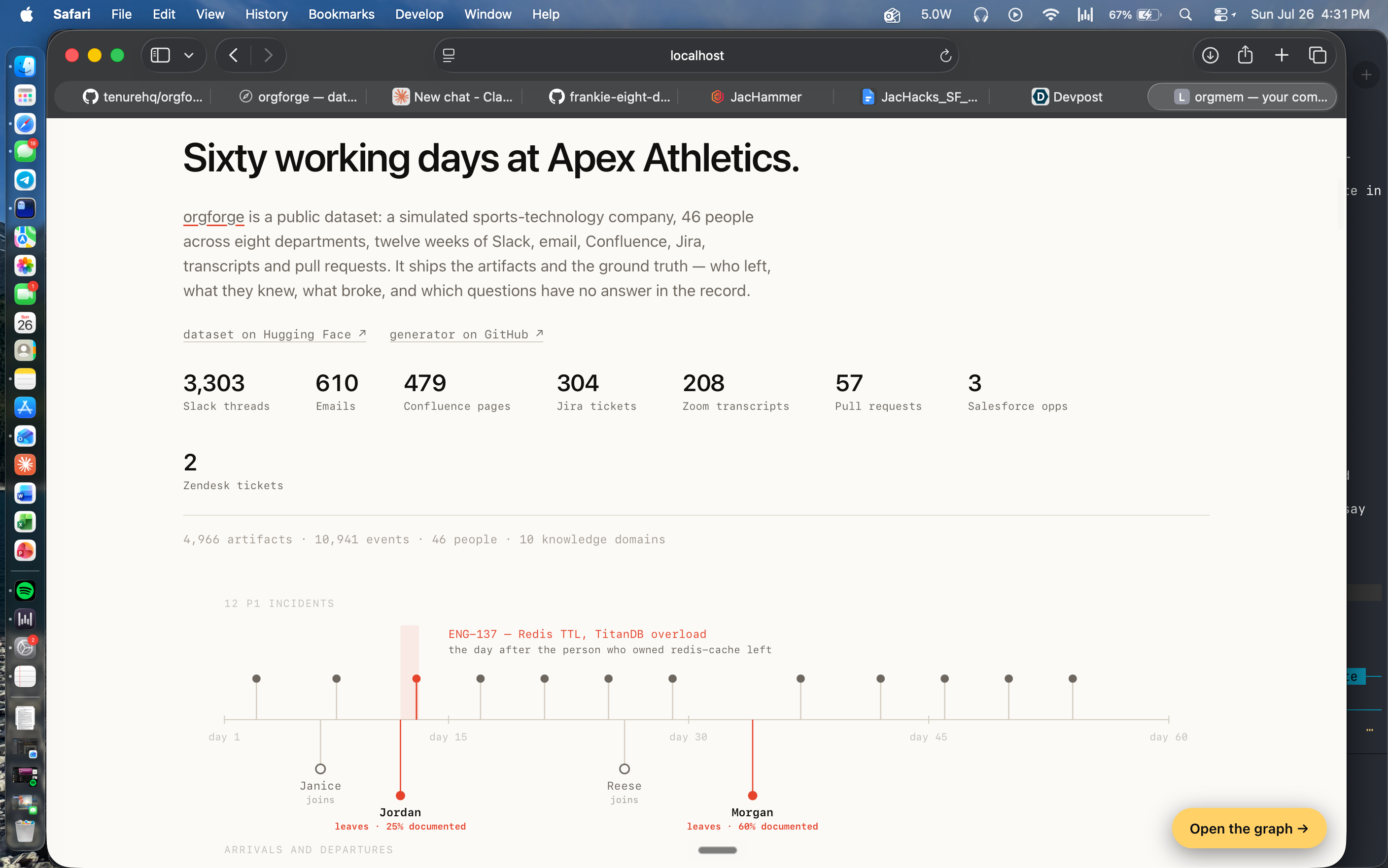
Marketing Site - Hero
-
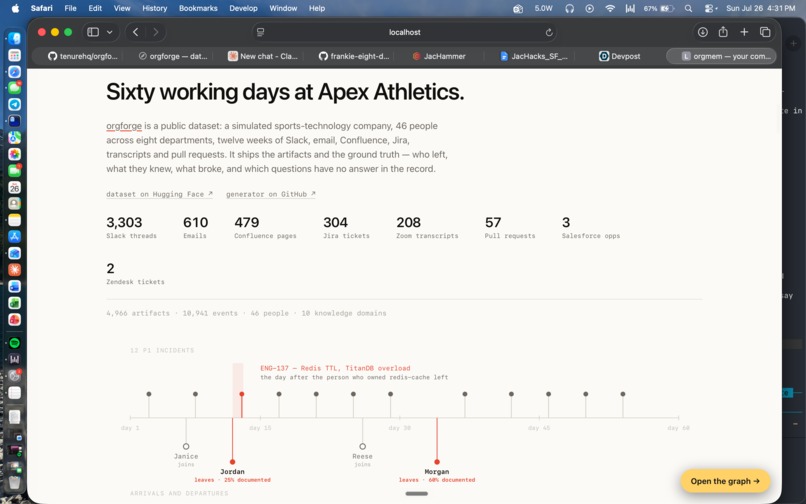
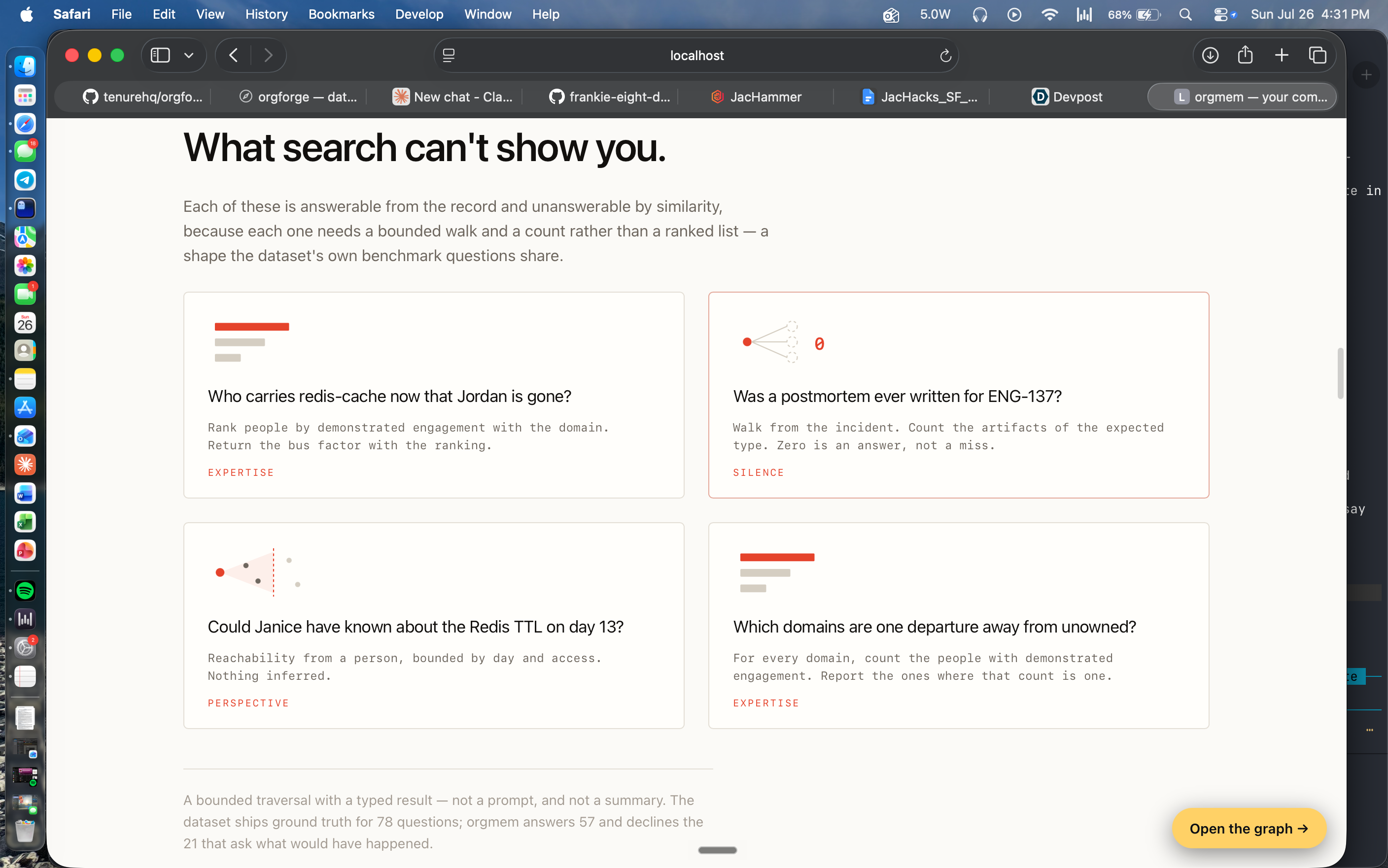
Marketing Site - Dataset Explainer
-
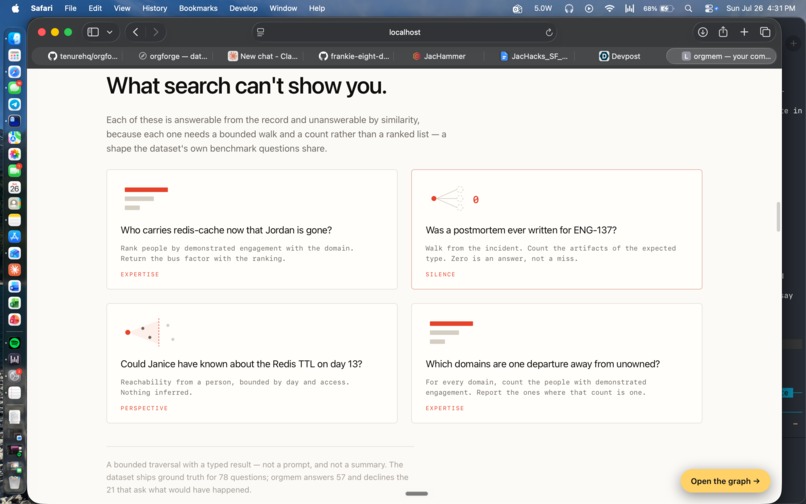
Marketing Site - Graph vs RAG Reasoning
-
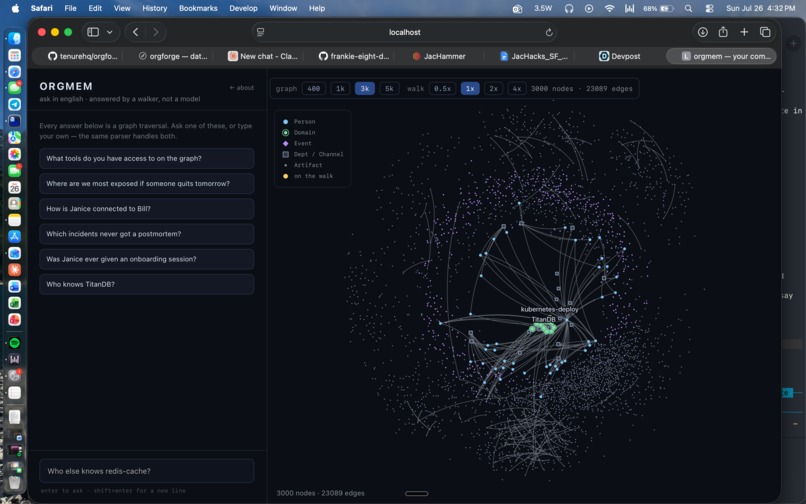
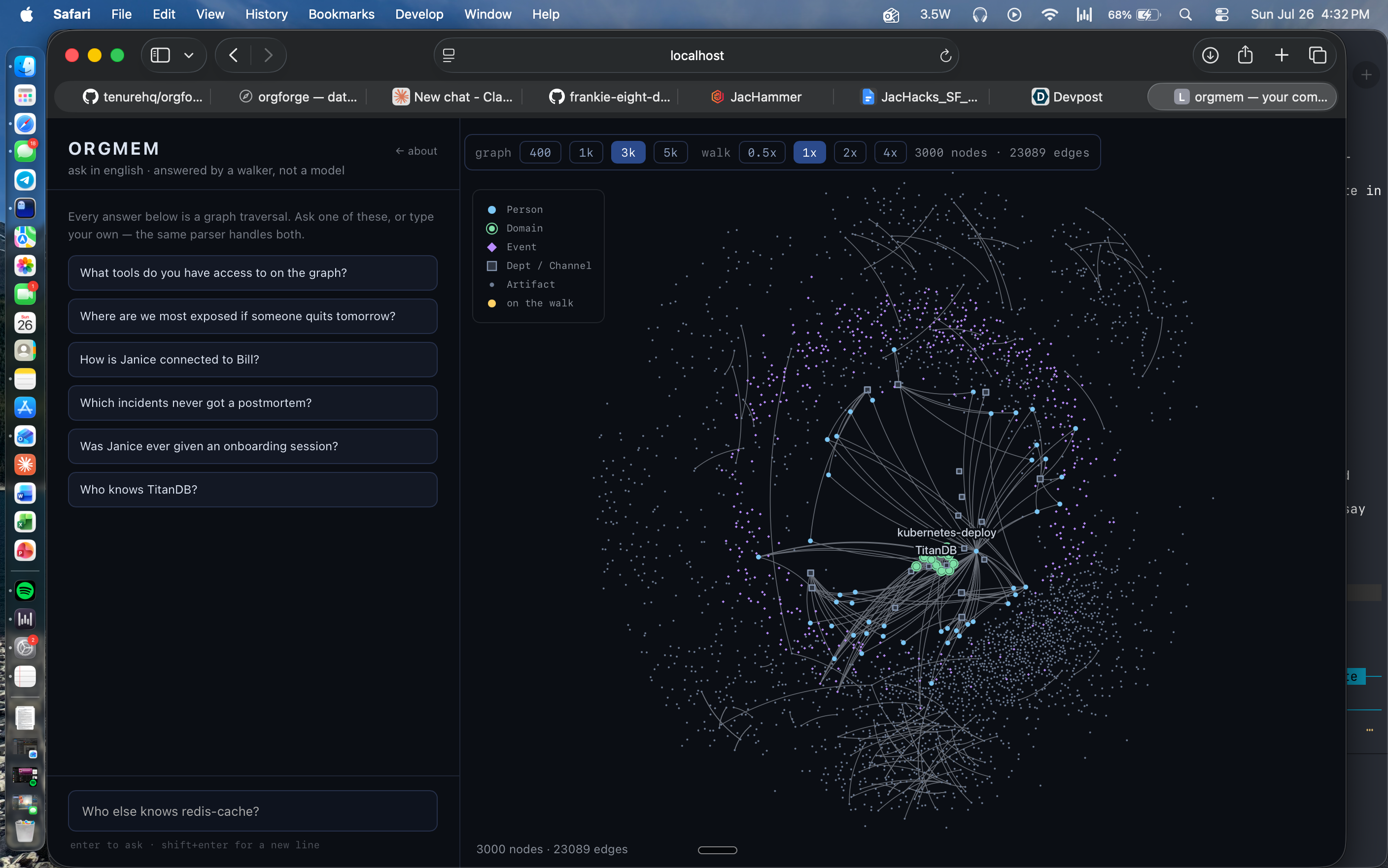
App - Default Graph View
-
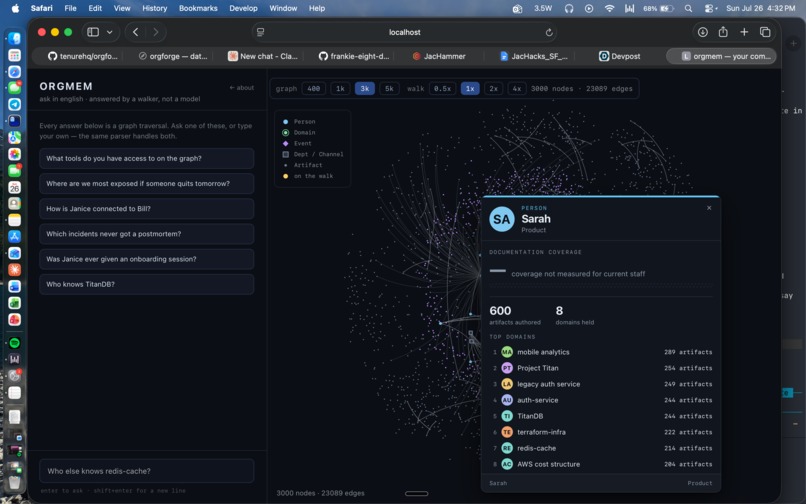
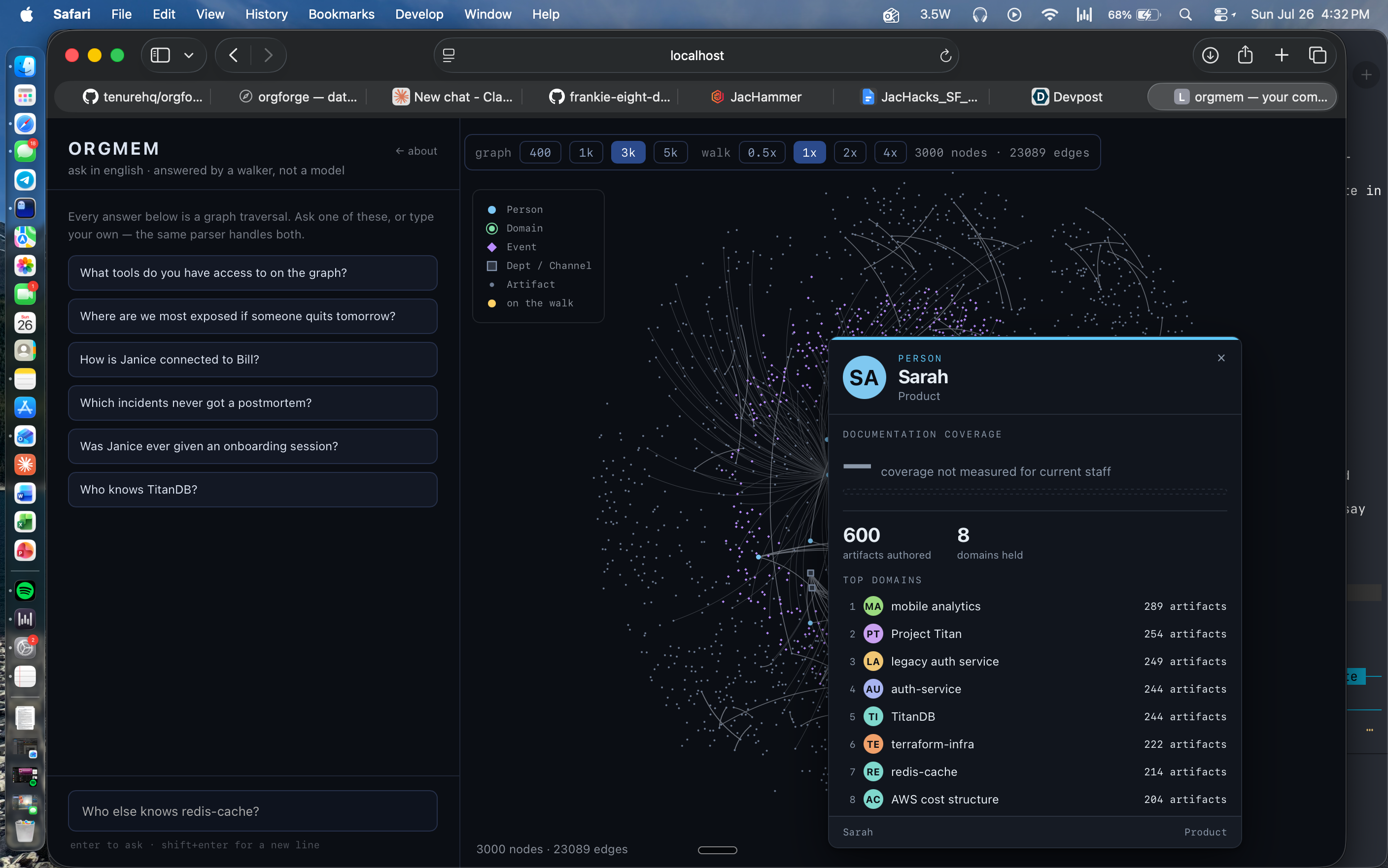
App - Node Artifact Rendering
-
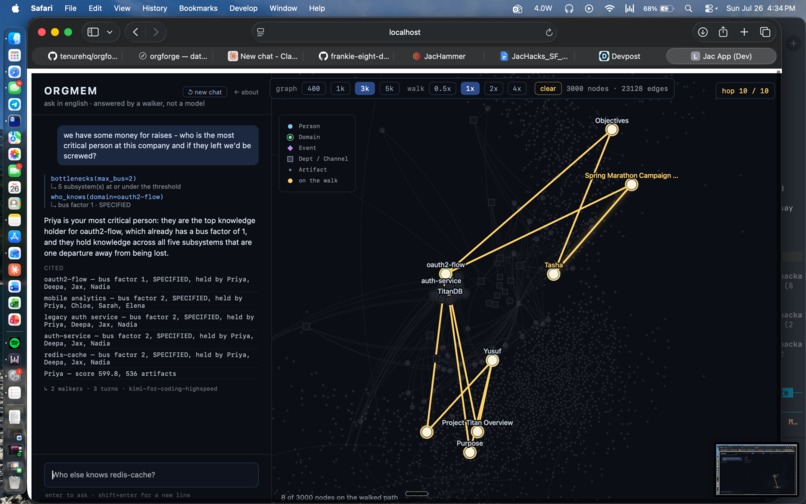
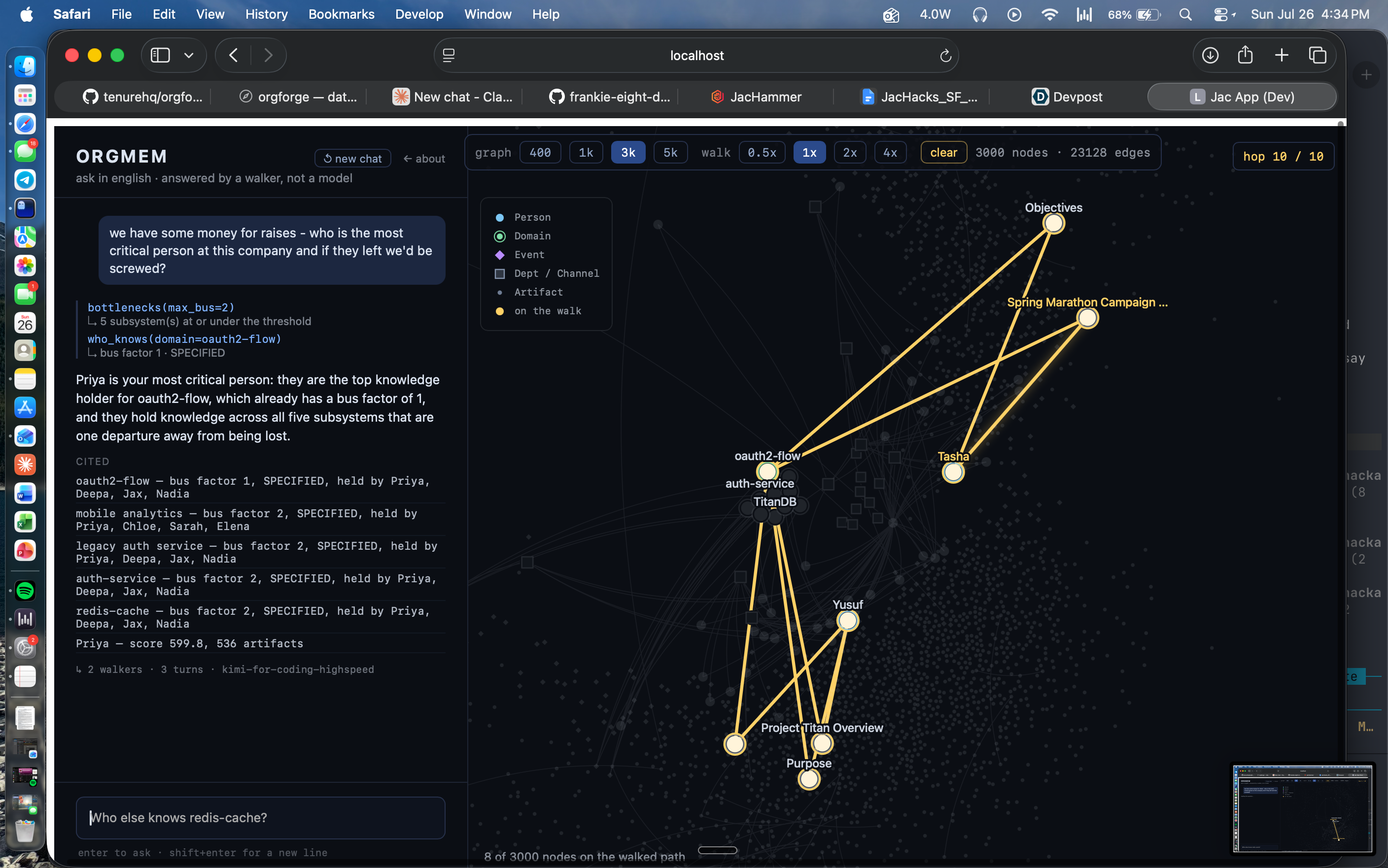
App - Graph Walker/Traversal
-
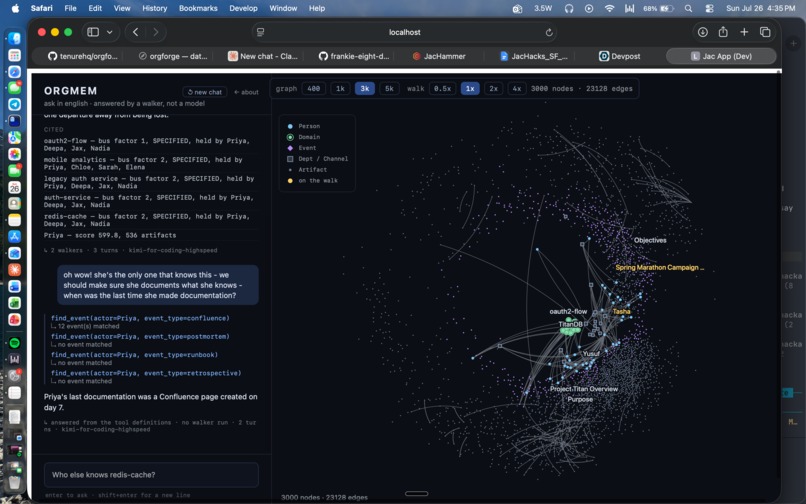
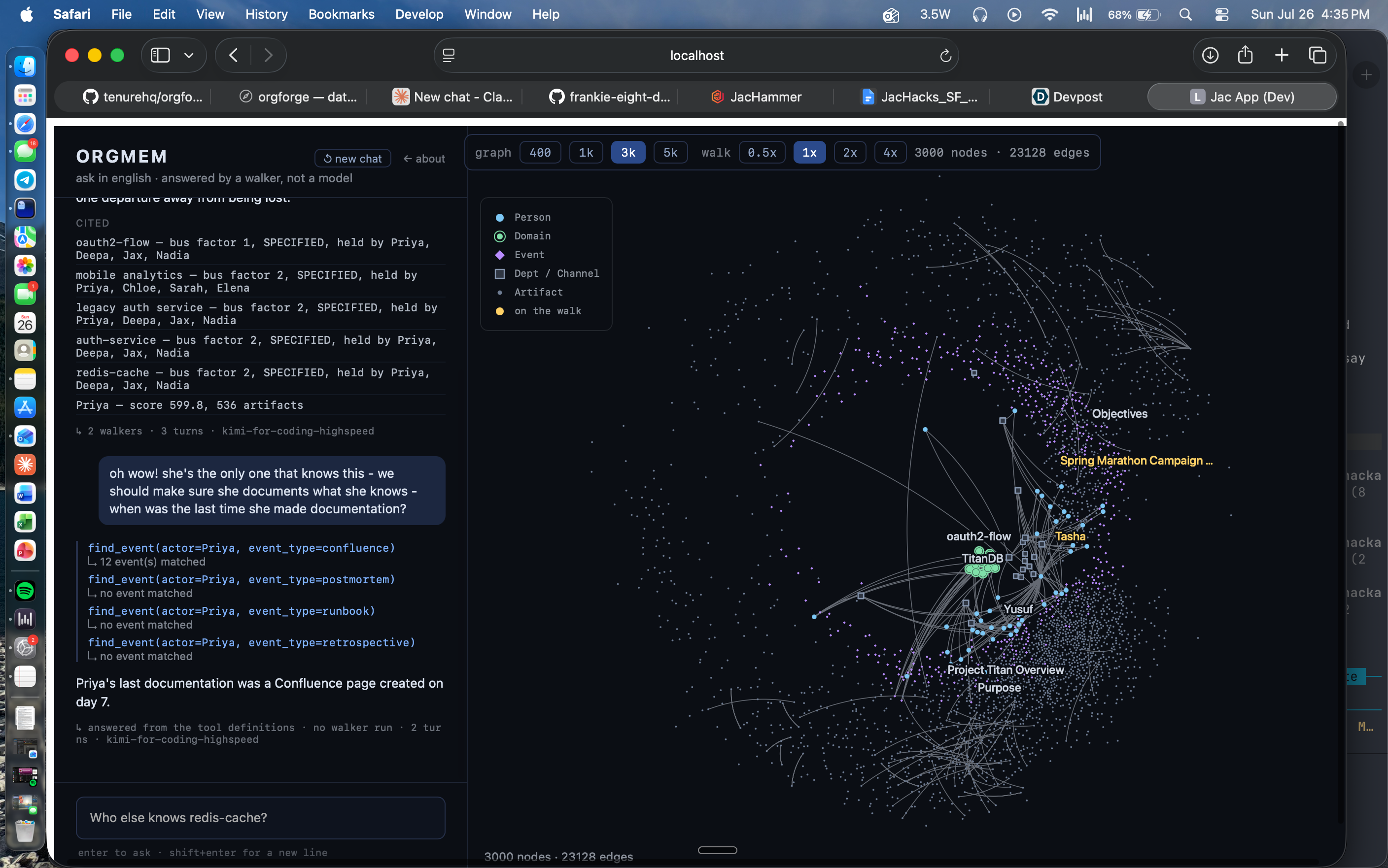
App - LLM Chat/Memory System
orgmem: Devpost story
Tagline: Organizational memory for agents. Retrieval finds what your company wrote down. orgmem proves what it never did.
Inspiration
I recently onboarded at a Fortune 5 company, and the thing that struck me wasn't that the documentation was bad. The documentation is good. There's a lot of it. It still wasn't enough, because the part I actually needed lives in people's heads: what happened, when, and who was in the room.
A huge amount of the work is reconstructing sequence. Why does this system look like this? Who decided that? Was there a handoff when the person who built it left? That's a PM-shaped question, and no amount of well-written documentation answers it, because nobody writes down the thing they assume everybody already knows. It's tribal knowledge, and the tribe doesn't know it's a tribe.
What I wanted was to see the whole thing as a graph, with people, documents, systems, and events and the edges between them, so I could look at it myself instead of asking six people and triangulating. That's orgmem.
What it does
orgmem ingests a company's artifacts (Slack, email, Confluence, Jira, Zoom transcripts, pull requests) into a persistent graph of people, documents, systems, and events. Then it answers questions retrieval structurally cannot:
- Did the expected follow-up ever happen? Janice was hired on day 7 to take over TitanDB from someone who left 19 months earlier owning four systems with 20% of his knowledge documented. Was an onboarding session ever created? No. Nobody noticed, because nobody was looking for a thing that didn't happen.
- What could this person have known on this date? Bounded by their access and by what actually existed at that moment. That separates "they were blocked by permissions" from "the meeting happened and nobody wrote anything down."
- Who actually knows this system? Ranked by demonstrated engagement rather than by org chart, including the people who already left.
The core claim is narrow and I think it's right: a graph can prove a negative and top-k similarity cannot. Vector search can only ever fail to find something. It can never establish that nothing is there, because when the answer doesn't exist it returns the nearest thing instead and the model confabulates from it. A node with no outgoing edge of the expected type is a fact, not a miss.
How I built it
The first problem was data. I needed a corpus that looked like a real organization's exhaust: multi-channel, with people and time and enough mess to be honest. That turned out to be genuinely hard to find. I landed on orgforge and pulled its default dataset from Hugging Face.
The real design work was the schema, deciding how to turn a pile of artifacts into a graph worth querying. What's a node, what's an edge, what's an event versus a document, and where the time dimension lives. That decision determines every question you can ask afterward, and it's the part I'd spend more time on if I did it again.
Everything load-bearing is Jac:
node/edgearchetypes model the domain. Each artifact type is its own node type, so behavior attaches per type through dispatch-on-arrival rather than a switch statement.- Ten public walkers do graph slicing, visibility-cone reachability, gap scanning, expertise ranking, event search, inheritance, expansion, node detail, stats, and evaluation.
- Persistence is reachability from
root. No database, no ORM, no save call. The graph is the storage. - The UI is Jac client components and the client/server RPC is generated. There is no JavaScript.
Final graph: 76,787 edges over 46 people, 4,966 artifacts, and 10,941 events, built in ~6 seconds.
After the graph came the demo and the marketing site, then iterating on the demo until it looked like something instead of a debug view.
Challenges I ran into
The biggest challenge was that the models don't know Jac. Jac is a fast-moving language and the training data is stale or simply wrong, so every assistant I used confidently generated syntax that doesn't exist. I built a knowledge base up front, a distilled wiki of the language read directly out of the compiler source, about 49k words, with the places where the official docs and the actual implementation disagree called out explicitly. It helped. It was not enough. Retrieval over docs is a much worse substitute for knowing a language than I expected, and what this ecosystem really wants is a fine-tuned model that writes Jac natively.
So I found the sharp edges the slow way. A sample:
- Omitted optional arguments arrive as strings over the RPC bridge. A
Nonedefault arrives as'None', and a= []default arrives as['[', ']']. Both are truthy, soif argfallbacks silently never fire. - Typed locals compile to
const, so rebinding one throws "Attempted to assign to readonly property", and only on the branch that rebinds. - Walkers register only for the entry module, so with the wrong entry point every
/walker/*route 405s and the source looks perfectly correct. - Incremental rebuilds silently drop
globexports.defexports survive.
Twelve more are written up in the repo's HANDOFF.md. The meta-lesson was harsher than any single
bug: verify the artifact, not the status message. Three separate times a build reported success
while serving a stale bundle, and once a git push correctly reported "up to date" while pushing a
branch that didn't contain the work.
Accomplishments that I'm proud of
I'm trained as an electrical engineer, not a software engineer, and I didn't know anything about graphs when I started. Getting from there to a working graph model of an organization, and picking up a language built around object-spatial programming on the way, is the part I'm actually stoked about. Jac made full-stack development dramatically more approachable than I expected it to be.
On the numbers: 94.7% overall on the dataset's 78 ground-truth questions, and 96.3% (26/27) on the SILENCE class against a 55.6% constant baseline. That's the class that asks whether something never happened, which is the whole thesis.
And one deliberate non-accomplishment: I don't score the COUNTERFACTUAL class at all. Those questions ask what would have happened, and I can't verify a causal claim from artifacts alone. Skipping 21 questions costs me a higher headline number. Claiming causal reasoning I can't back up would cost more.
What I learned
Graphs, mostly. How to think in nodes and edges instead of tables and joins, and how much a schema decision constrains every question you can ask later. Beyond that: persistence-by-reachability genuinely removes an entire layer of the stack, a language can make full-stack work feel small, and when the tooling is newer than the model's training data you have to build your own ground truth and then distrust every success message you get.
What's next for orgmem
A real-time ingest engine. The current graph is built from a static corpus, and the obvious next step is a live one that updates as artifacts land.
The goal that pulls everything forward is a digital twin of an organization: a continuously updated graph that executives and senior leaders can query directly. Right now, understanding what's happening inside a large company means passing information up through layers, and every layer is lossy. Things get summarized, softened, and dropped, and what didn't get written down disappears entirely. orgmem measures that loss today. The version I want to build removes it.
Built With
- jac
- orgforge


Log in or sign up for Devpost to join the conversation.