-
-
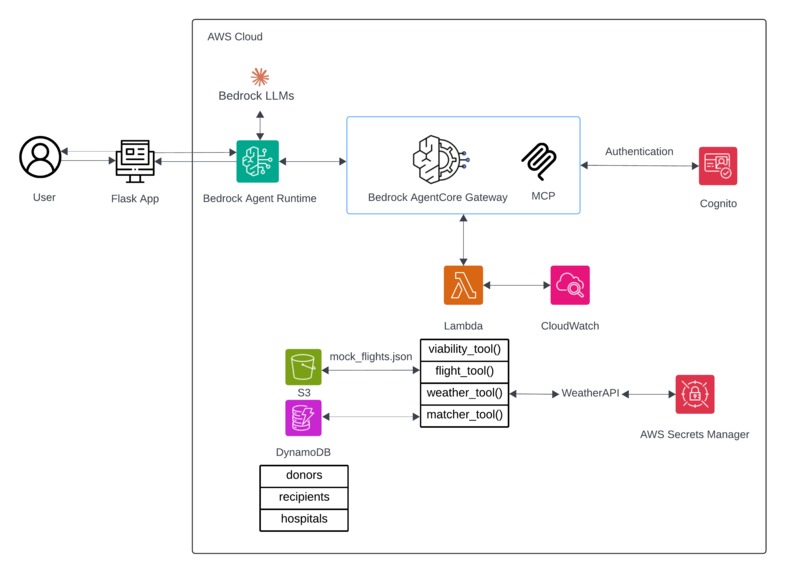
Architecture Diagram
-
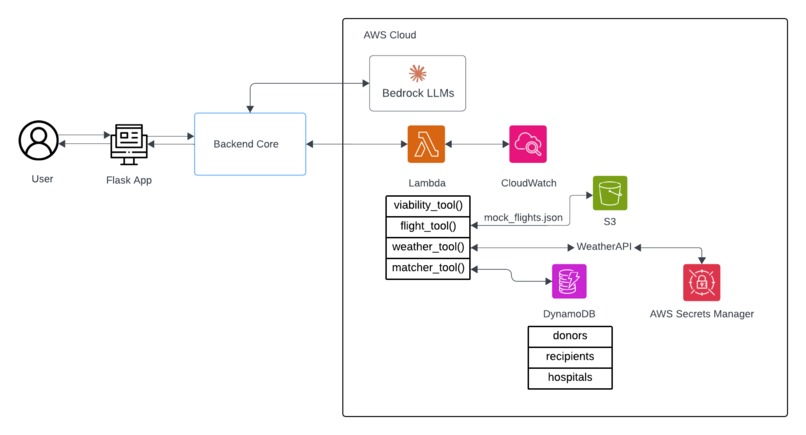
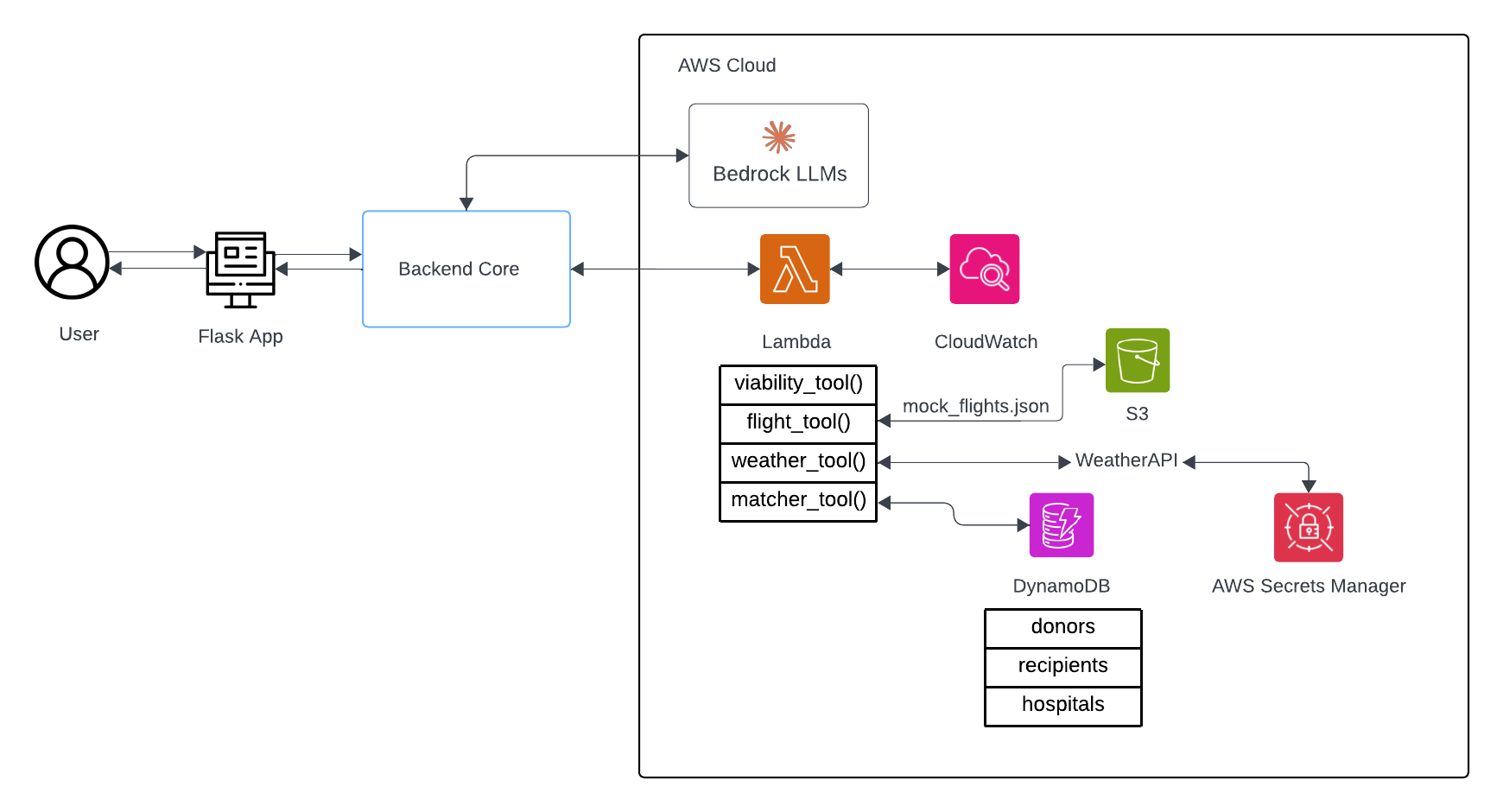
Fallback for if AgentCore fails to load
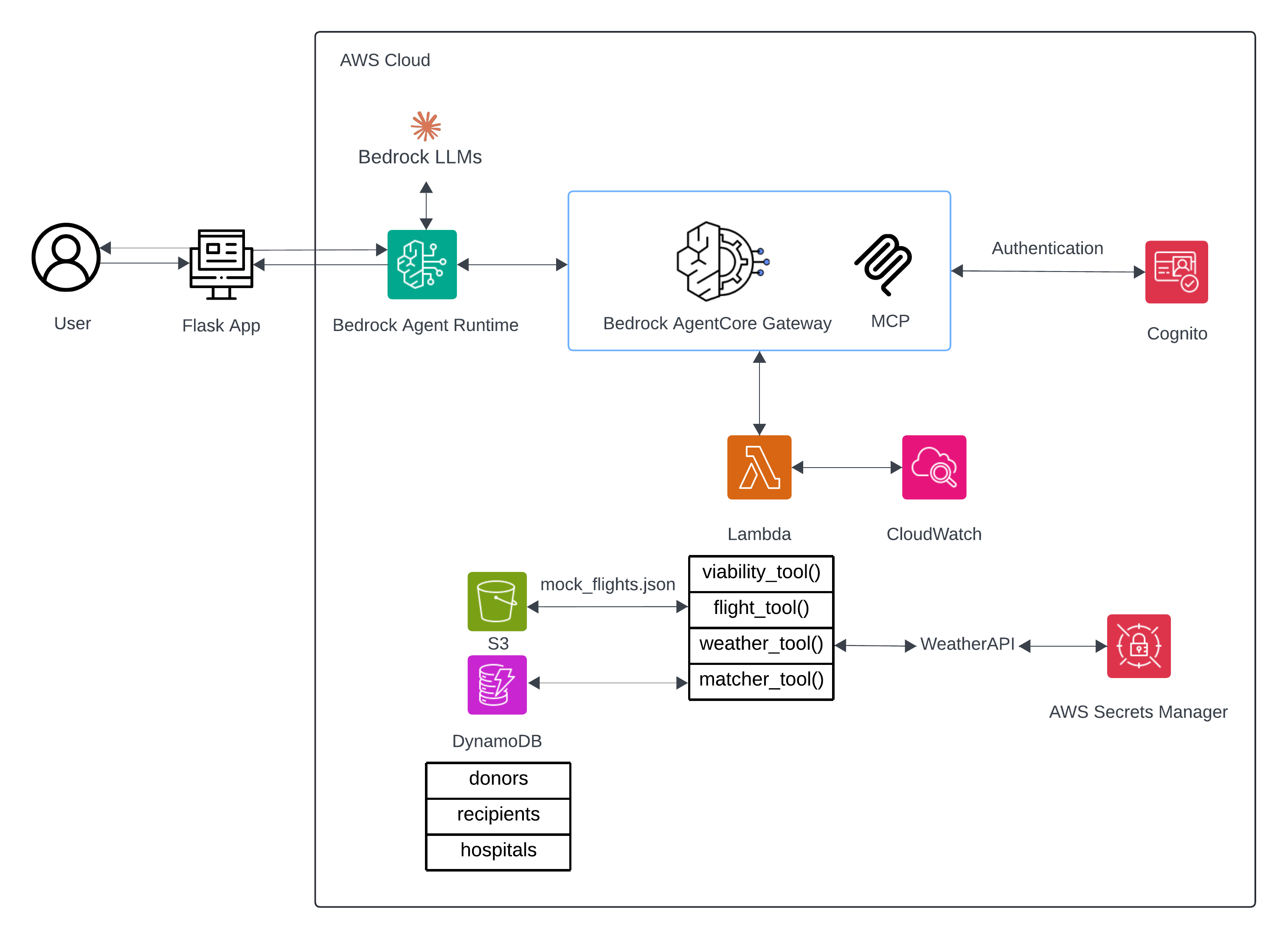
OrganMatch: End-to-End Organ Donation and Logistics Platform
Author: Sherin Thomas
Event: AWS AI Agent Global Hackathon, October 2025
Problem Statement
Organ recovery and transplantation is one of the most complex and time-sensitive processes in healthcare, requiring seamless coordination across multiple organizations and systems. However, today’s national allocation process remains fragmented and highly manual. Organ procurement organizations (OPOs) must contact transplant centers sequentially, slowing down decision-making and reducing the likelihood that viable organs reach recipients in time.
At the same time, the number of recovered but unused organs - especially kidneys - continues to rise due to a growing pool of medically complex donors and the absence of modern, data-driven tools to guide recovery timing and logistics. OPOs lack a unified system that integrates real-time data on matching, transport, and organ viability, leaving critical decisions to be made with incomplete information.
These inefficiencies lead to delayed placements, missed opportunities, and ultimately, preventable loss of life. A modern, intelligent platform that unifies the matching and logistical workflow is urgently needed to optimize utilization, improve equity, and save more lives through faster, more informed coordination.
Proposed Solution
The proposed solution is an AI-powered intelligent agent that automates and optimizes the organ donation and distribution process from end to end. The system will:
- Serve as a centralized portal for donors, recipients, and hospitals to register, manage, and track organ donation workflows.
- Use AI models to analyze medical and logistical data to match donors with recipients in real time based on viability, compatibility, and urgency.
- Incorporate an automated transportation module that integrates with flight data and weather APIs to determine the fastest and safest organ transport routes.
- Provide an ethical and transparent allocation framework to ensure fairness and compliance with medical standards.
Impact
Solving this problem would transform the nation’s organ donation and transplantation system by enabling faster, more efficient, and more equitable placement of organs. A unified, intelligent platform would allow organ procurement organizations, transplant centers, and transport partners to operate from the same real-time data—eliminating communication delays and reducing the likelihood that viable organs are discarded.
By optimizing organ matching and transportation based on viability timelines, this innovation could significantly increase the number of successfully transplanted organs—particularly kidneys, which account for the majority of unused recoveries. Improved coordination would shorten cold ischemic times, enhance graft survival, and expand access to transplants across geographic and demographic boundaries.
Ultimately, this solution could directly help reduce the 13 daily deaths of individuals waiting for transplants in the United States. Beyond clinical impact, the platform would generate a comprehensive national dataset on organ recovery and utilization, guiding policy, improving performance, and driving long-term systemic change.
Objectives
The primary objectives of OrganMatch are:
- End-to-End Organ Donation Portal: Build a unified web platform for all stakeholders—donors, hospitals, and recipients—to interact within one system, improving traceability and reducing delays.
- Connect Donors to Recipients: Automatically match donors and recipients based on organ type, blood group, tissue compatibility, and proximity.
- Ensure Ethical and Equitable Distribution: Enforce transparent, data-backed decision-making to eliminate bias.
- Transportation Portal: Integrate transport logistics, flight data, and weather for timely delivery.
- AI Assistant for Matching: Develop an AI assistant that evaluates organ viability, computes match scores, and suggests logistics in real time.
Key Features
1. Donor and Recipient Registration
Users register as donors or recipients by entering demographic, medical, and hospital information. Records are stored securely in AWS DynamoDB.
2. AI-Based Matching Algorithm
The matching module uses ML algorithms to assess:
- Blood type and Rh compatibility
- HLA match percentage
- Organ condition and urgency
- Geographic proximity
Each donor-recipient pair receives a match score to prioritize high-success matches.
3. Organ Viability and Ethics Engine
A Lambda-based tool evaluates organ health using temperature, time, and condition score. It ensures medical and ethical compliance.
4. Transportation and Flight Portal
The system connects with real-time weather API to recommend optimized routes for fast, safe organ transport.
5. AI Assistant Integration
An intelligent Bedrock AgentCore-based assistant manages workflows, answers queries, predicts outcomes, and unifies all modules.
Methodology
Overview
The OrganMatch platform is a cloud-native AI-agent system that optimizes transplantation logistics using automation, viability prediction, and AI-driven matching. It integrates AWS infrastructure, decision models, and modular endpoints for speed and reliability.
Architecture and Technology Stack
Backend Framework:
- Flask 3.0.3 – RESTful backend with blueprints and CORS.
Cloud Infrastructure:
- Amazon Bedrock Agent Runtime – AI orchestration engine.
- AWS Lambda – Serverless microservices for viability, matching, weather, and flight tools.
- DynamoDB – NoSQL database for organ and hospital data.
- Amazon S3 – Object storage for mock flight data.
- AWS Secrets Manager – Secure API key management.
- Amazon Cognito – Authentication and authorization.
- Amazon CloudWatch – Logging and monitoring.
External API:
- WeatherAPI.com – Real-time weather data.
Backend Logic and Tools
Each AWS Lambda function acts as a microservice, accessed through Flask endpoints via the Bedrock Agent Gateway.
Viability Assessment Tool
Calculates organ health based on time, temperature, and condition.
Formula:
$$ \text{Viability Score} = \frac{(\text{Adjusted Time} - \text{Elapsed Time})}{\text{Adjusted Time}} $$
If ( \text{Viability Score} > 0.3 ) and ( \text{Condition Score} > 50 ), the organ is considered viable.
Donor-Recipient Matcher Tool
Matches based on organ type, blood type, HLA overlap, urgency, and condition.
Formula:
$$ \text{Match Score} = 50 + 0.3(\text{Condition}) + 3(\text{Urgency}) + 5(\text{HLA Overlap}) $$
Flight Search Tool
Fetches flight data from Amazon S3 and filters based on origin and destination airports.
Returns shortest-duration options for transport optimization.
Weather Intelligence Tool
Retrieves live weather data (temperature, humidity, wind speed) using WeatherAPI.com, ensuring safe flight conditions.
Flask API Endpoints
| Endpoint | Function | Description |
|---|---|---|
/api/check-viability |
backend.check_viability() |
Calculates organ viability score. |
/api/match-compatibility |
backend.match_donor_recipient() |
Identifies best donor–recipient pairs. |
/api/search-flights |
backend.search_flights() |
Fetches flight options between cities. |
/api/get-weather |
backend.get_weather() |
Retrieves weather data for routes. |
Metrics and Optimization Criteria
| Category | Metric | Description |
|---|---|---|
| Viability | Viability Score (0–1) | Measures organ survival probability post-retrieval. |
| Matching | Match Score (0–100) | Weighted biological and logistical compatibility. |
| Transport | Shortest Flight Time | Based on flight duration and weather feasibility. |
| Automation | Lambda Execution Time (s) | Indicates serverless performance efficiency. |
Optimization and Automation Workflow
- Input Collection: Fetch donor and recipient details from DynamoDB, organ data from APIs.
- Parallel Lambda Execution: Run Viability, Matching, Flight, and Weather tools concurrently via Gateway.
- Result Aggregation: Rank results by viability, match score, and transport time.
- Output Delivery: Display results via Flask routes on
/viability,/matching, and/transportpages.
Summary
The OrganMatch system uses a modular, multi-agent design integrating viability scoring, compatibility analytics, transport logistics and AI Recommendation. Through AWS Bedrock AgentCore, Lambda microservices, and Flask orchestration, it achieves high automation, transparency, and rapid decision support—crucial for saving time and lives.
Expected Outcomes
Organ Viability Assessment
Automatically evaluates organ health to ensure only viable organs proceed, improving accuracy and reducing manual effort.
Donor–Recipient Matching
Computes a weighted match score combining biological and geographic data, reducing allocation time and improving success rates.
Transport Optimization
Uses flight and weather data to find the safest, shortest route, minimizing travel time and environmental risks.
Conversational AI Assistant
Powered by Claude 3 Haiku (AWS Bedrock), interprets natural-language queries and triggers Lambda tools for AI-driven decision support.
Future Work
Gateway Integration
Currently, Lambda functions are registered in AWS AgentCore Gateway, but the bedrock-agentcore client is not yet fully supported in boto3.
Future Goal: Enable full AgentCore–Gateway integration for native tool orchestration and improved reliability.
Deployment and Scalability
The system currently runs locally via Flask and AWS.
Future Goal: Deploy to AWS Elastic Beanstalk or ECS, add CI/CD pipelines, and enable real-time monitoring via CloudWatch.
Real Flight Data Integration
Currently uses mock data (mock_flights.json).
Future Goal: Integrate live APIs like SkyScanner APIGoogle Flights for real-time scheduling and automation.
Security and Compliance
Prototype uses IAM roles and Secrets Manager.
Future Goal: Implement Cognito-based authentication, encrypted data handling, and HIPAA-aligned security for clinical deployment.
Built With
- agentcore
- amazon-cloudwatch
- amazon-cognito
- amazon-dynamodb
- amazon-web-services
- aws-lambda
- aws-secrets-manager
- bedrock
- flask
- python
- weatherapi


Log in or sign up for Devpost to join the conversation.