-
-
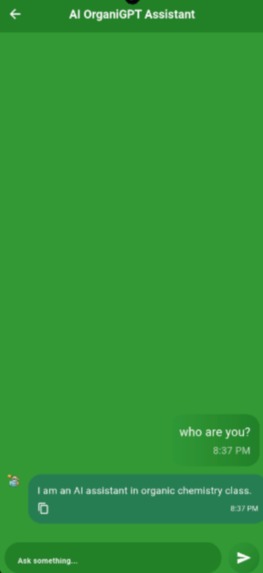
Chat Screen 2
-
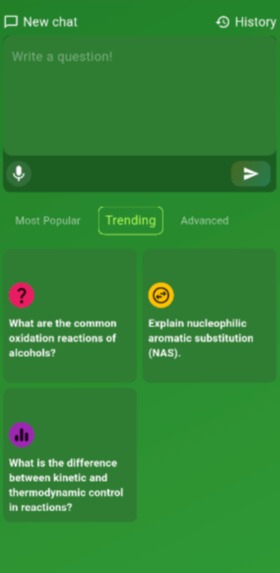
Home Screen 2
-
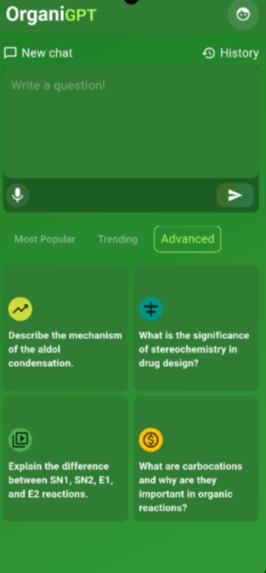
Home Screen 2
-
Splash Screen
-
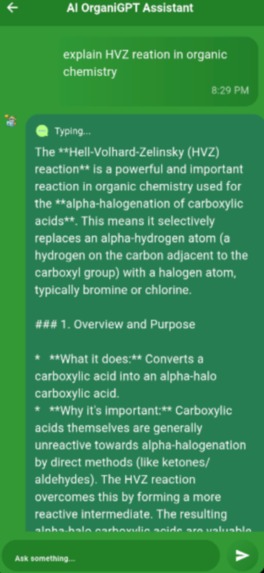
Chat Screen 1
-
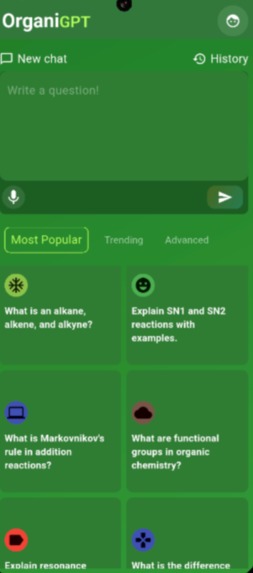
Home Screen 1


📖 About the Project – Organibot 🌿
Organibot – also known as OrganiGPT AI Bot – was born out of a simple observation: learning organic chemistry can be daunting and isolating. Students often struggle with memorizing reactions, understanding mechanisms, and getting instant feedback. We wanted to build a tool that makes learning interactive, fun, and collaborative.
💡 Inspiration
The idea came from our own experiences in chemistry classes. We realized that even with textbooks and tutorials, students often need real-time guidance. We wanted to harness AI to create a personalized tutor for organic chemistry.
The goal:
- Provide immediate answers to complex questions
- Visualize reaction mechanisms dynamically
- Allow students to collaborate and learn together
🏗 How We Built It
Organibot is built using Flutter for cross-platform deployment and Dart as the programming language. The core AI engine is powered by Gemini AI, which allows the bot to understand questions and provide accurate explanations.
Key steps in development:
- UI & UX Design – Designed an intuitive chat interface with animated text for a lively user experience.
- AI Integration – Integrated Gemini AI using Dio for network requests and
.envfor secure API key storage. - State Management – Implemented Riverpod to handle reactive states and ensure smooth multi-screen interactions.
- Internationalization – Added multi-language support for global accessibility.
- Testing – Conducted multiple rounds of testing to handle edge cases like ambiguous queries or long reaction mechanisms.
We also added LaTeX support to display chemical formulas elegantly. For example, a simple SN2 reaction is rendered as:
[ \ce{R-X + Nu^- ->[solvent] R-Nu + X^-} ]
🧩 Challenges We Faced
- Understanding student queries: Many questions were vague or incomplete, so we had to fine-tune prompt handling for Gemini AI.
- Rendering chemical equations: Displaying reactions dynamically while keeping the UI responsive was tricky.
- API limits: Ensuring smooth responses despite API call restrictions required caching and efficient request handling.
- Cross-platform issues: Some animations and layouts behaved differently on iOS vs Android, requiring careful testing and adjustments.
🌱 What We Learned
- How to integrate AI into a real-world educational app
- Best practices for Flutter state management in dynamic, data-heavy apps
- Handling asynchronous networking and API responses efficiently
- The importance of UX design in learning apps—even small animations can significantly enhance engagement
🚀 Outcome
Organibot is now a fully functional AI-powered learning assistant for organic chemistry. Students can:
- Ask questions about reactions, mechanisms, and concepts
- Receive step-by-step explanations
- Collaborate and discuss answers in a live environment
We hope this project not only helps students learn faster but also inspires developers to create AI-powered educational tools.
Built With
- dart
- dio
- flutter
- flutter-dotenv
- gemini-ai
- riverpod

Log in or sign up for Devpost to join the conversation.