Inspiration
Charlotte’s mom has lived with end-stage kidney disease since she was 17 and has undergone two kidney transplants, most recently after spending three years on dialysis and being told the wait could stretch to a decade. Her last transplant required coordinating a deceased-donor kidney from out of state, underscoring how rare these organs are—and how stressful and life-limiting it is to wait without knowing when a kidney will come.
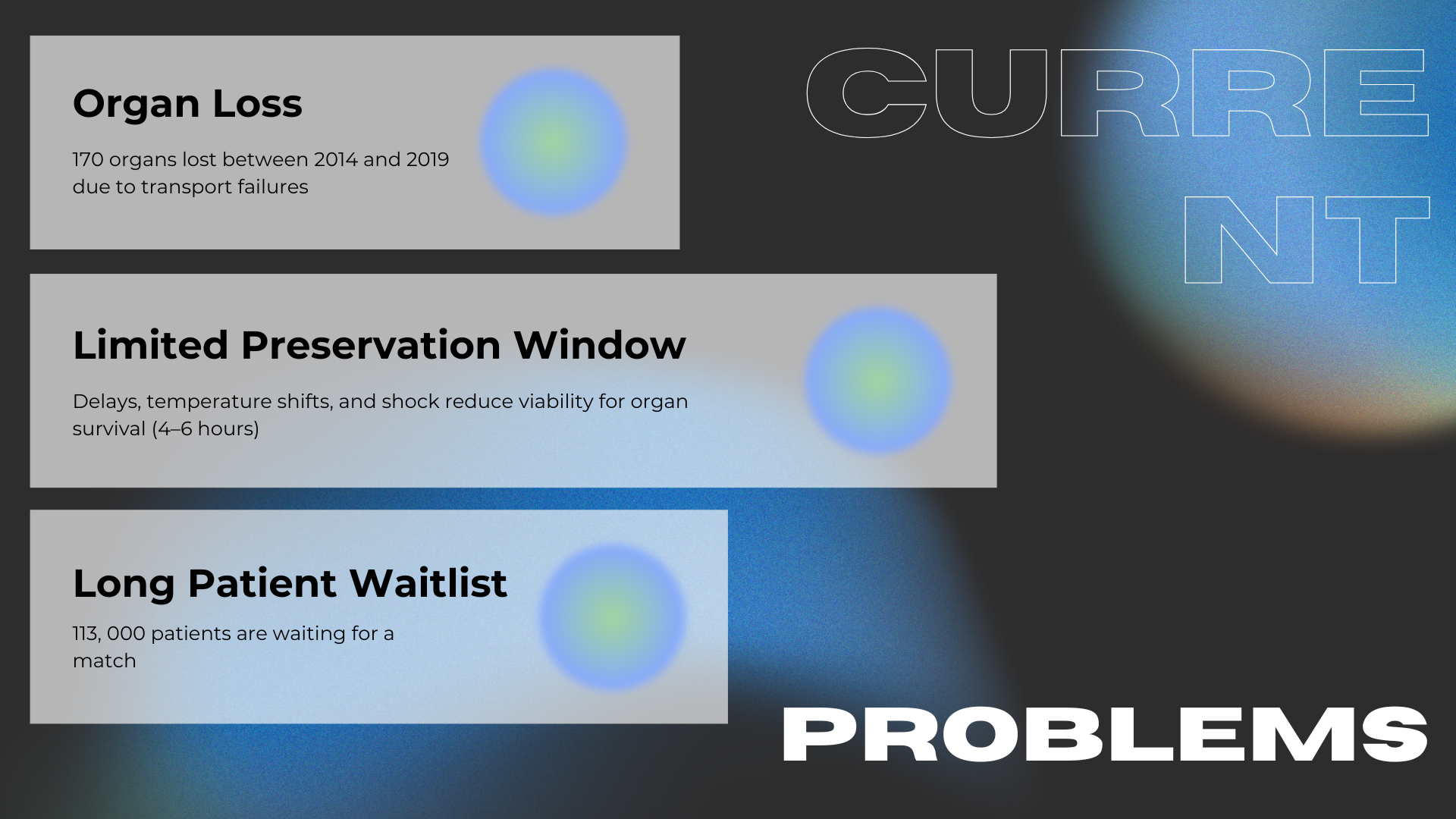
Between 2014 and 2019, nearly 170 donated organs were never transplanted and hundreds more faced dangerous delays due to transportation failures. Today, over 113,000 people in the U.S. are waiting for a transplant, yet viable organs are still declined because they don’t arrive on time. Government reports confirm that the most fragile point is the final stretch between donor hospital and transplant center, where visibility drops and delays occur.
OrganTrail tackles this gap by detecting transport risk in real time and leveraging routing APIs to recommend the fastest, most reliable delivery path. By strengthening the last mile, we aim to prevent avoidable organ waste and give more patients a second chance at life.
What it does
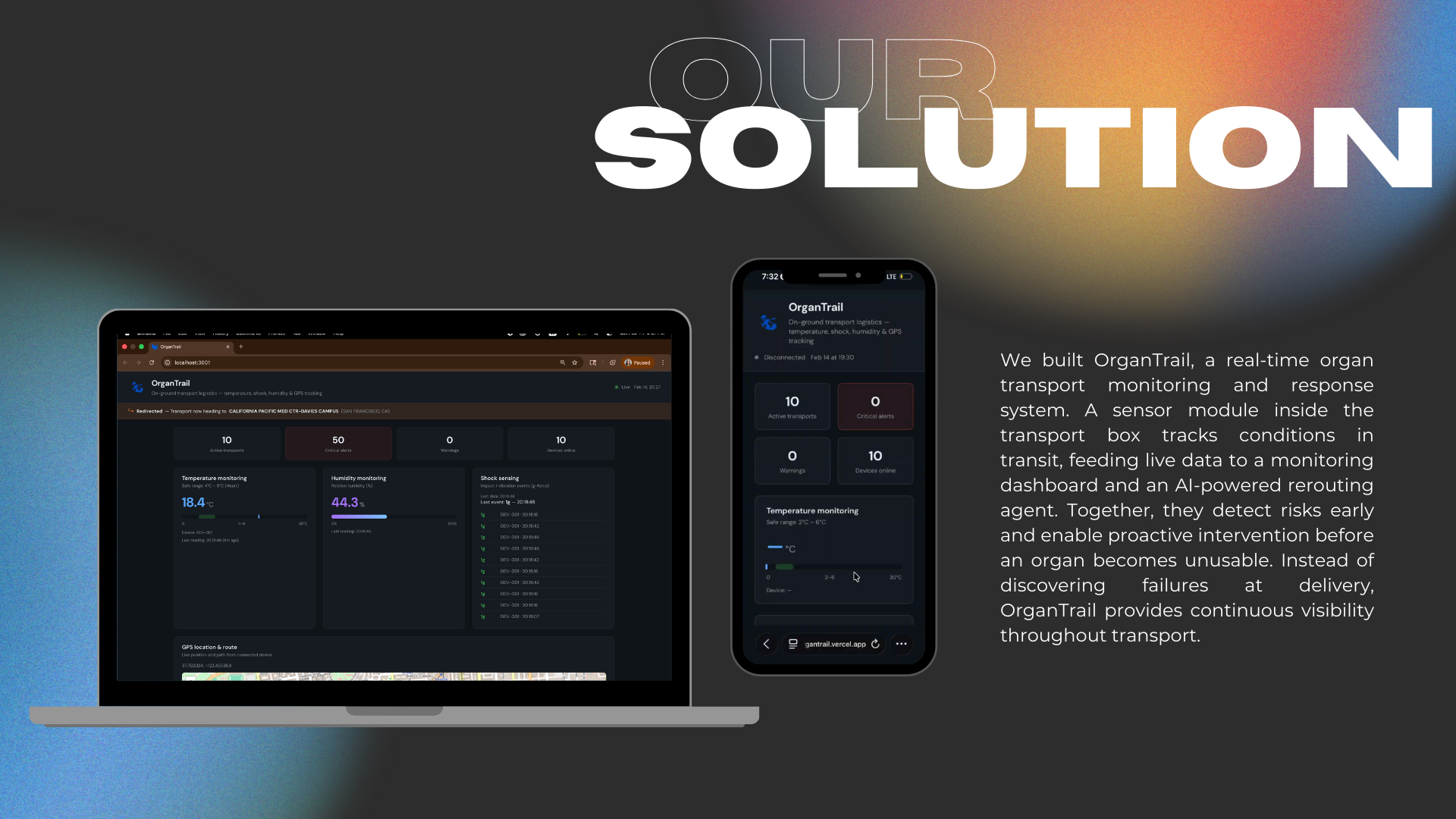
OrganTrail is a multi-component organ transport monitoring system that integrates a hardware sensor module, live dashboard, clinical data layer, and AI-enabled rerouting agent:
Hardware Module
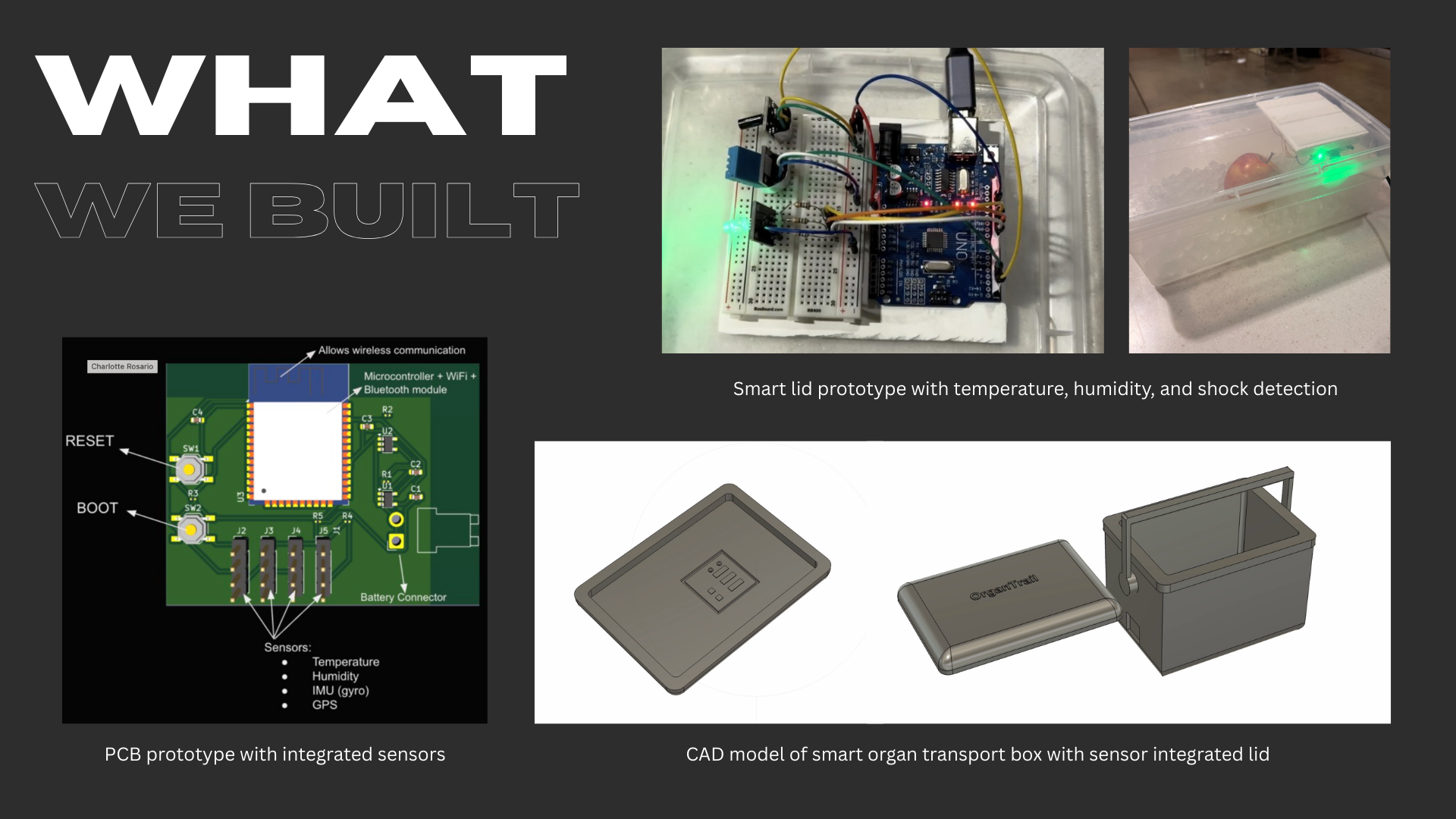
- Built with temperature, humidity, and shock sensors clipped inside existing organ transport boxes.
- LED display system signals when shock events or extreme temperatures exceed organ-specific clinical thresholds.
- Custom PCB design ensures portability and direct integration into existing transport boxes, sealed by a Hydrophobic ePTFE vent patch + a recessed vent cavity for the sensors.
- Low-cost, compact, and fully self-contained for practical deployment.
Live Dashboard
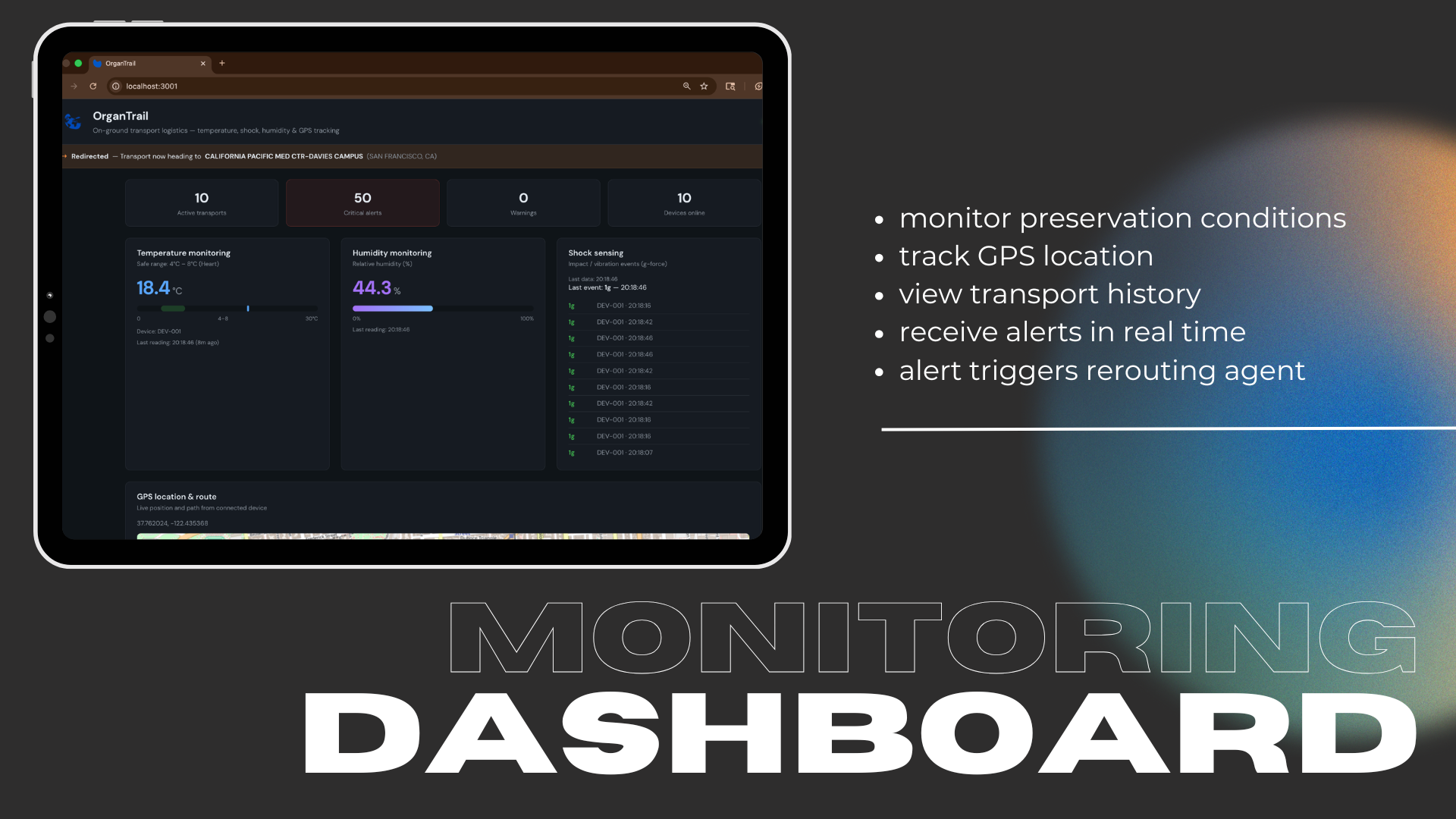
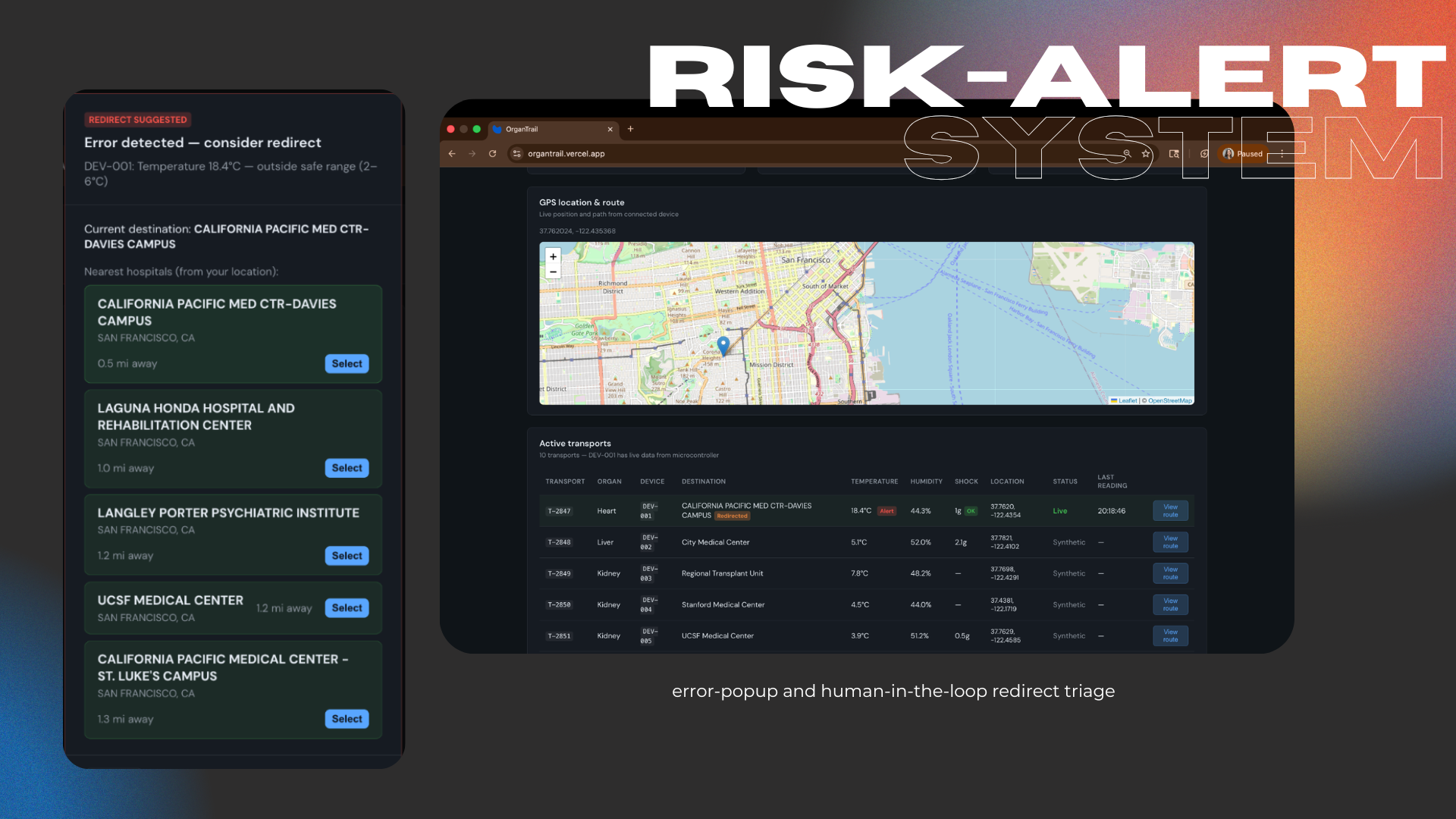
- Displays live sensor metrics: temperature, humidity, and shock readings in real time.
- Includes GPS-based mapping to visualize the current location and route of the organ.
- Provides an at-a-glance overview of transport conditions for all monitored organs.
Clinical Data Integration
- Incorporates organ-specific preservation guidelines and ideal storage conditions.
- Uses historical and clinical data to contextualize sensor readings, highlighting deviations from safe thresholds for each organ type.
Error Response & Rerouting Agent
- Detects abnormal sensor readings and triggers immediate alerts to the transport team.
- Uses organ donation databases and Google Maps APIs to identify and rank the next five optimal recipient destinations.
- Computes the most suitable patient for rerouting based on proximity, organ compatibility, and preservation urgency.
- Supports proactive decision-making to minimize organ spoilage due to transport delays or inefficiencies.
How we built it
Hardware Module
- Arduino Uno, KY-002 shock sensor, DHT11 temperature & humidity sensor, and RGB LED continuously read sensor data.
- Compact, portable design clips inside existing organ transport boxes.
- Custom PCB and enclosure reduce bulky wiring and enable direct integration.
- RGB LED provides immediate visual alerts when readings exceed organ-specific safe thresholds.
Live Dashboard
- Node.js bridge server ingests sensor readings over serial or via API, broadcasting updates via WebSocket.
- React dashboard visualizes real-time metrics: temperature, humidity, and shock events.
- Leaflet/OpenStreetMap maps display live organ location, path history, and planned route snapshots.
- Configurable safe ranges trigger warnings and critical alerts when exceeded.
- Redirect triage flow suggests nearest hospitals based on critical sensor events; operators can confirm or reject rerouting.
Synthetic Data & Clinical Integration
- Generated realistic transport streams using global hospital locations.
- Researched existing clinical and research data to determine optimal preservation conditions for each organ type.
- Alerts and rerouting decisions are informed by organ-specific temperature, ischemic time limits, and risk thresholds.
Sensor Event Logging & Monitoring
- Shock events logged with timestamps to capture mishandling risks.
- Temperature and humidity deviations tracked to ensure preservation compliance.
- Continuous monitoring enables real-time assessment, structured data trails, and predictive analytics for future optimization.
Challenges we ran into
- Sensor Limitations: Mechanical, low-cost sensors (temperature, humidity, shock) aren’t perfectly precise or robust, making it difficult to fully validate measurements under real organ-transport conditions.
- Mechanical & Mounting Constraints: Without access to real organ transport boxes, we couldn’t directly test mounting, condensation behavior, or thermal gradients, which are critical for accurate monitoring.
- Limited Clinical Data: Clinical transport and outcome datasets are restricted, so we relied on synthetic data streams to demonstrate end-to-end behavior, workflow, and alert logic rather than real-world validation.
Accomplishments that we're proud of
- Compact, manufacturable PCB design for low-cost sensors that integrate directly into existing organ transport boxes.
- AI-informed rerouting algorithm leveraging Google Maps APIs to optimize organ turnaround and reduce spoilage risk.
- Real-time hardware and software dashboard displaying temperature, humidity, shock, GPS location, and alert status for live monitoring.
What we learned
- Workflow matters as much as sensors – clear alerts and intuitive UX are critical; raw data alone isn’t enough.
- Data scarcity is real – standardized organ transport datasets are limited, making even synthetic data streams valuable.
- Prioritizing signals is essential – working under hardware and cost constraints taught us to focus on the most meaningful metrics for decision-making.
- Integration is non-trivial – combining hardware, live dashboards, clinical thresholds, and rerouting logic requires careful design to be reliable in real-time.
What's next for OrganTrail
- Environment-Optimized Hardware Explore materials and enclosure designs suited for cold, wet, and condensation-prone organ transport conditions.
- Custom PCB Manufacturing – Produce a single compact PCB integrating current sensors and adding accelerometer/gyroscope for richer handling data.
- Wireless Connectivity – Transition from serial-only communication to Bluetooth and Wi-Fi for more flexible, real-time data streaming.
- Real-World Testing – Iterate on sensor placement and durability inside actual transport boxes.
- Clinical & Operational Validation – Collaborate with hospitals, clinicians, and the UNOS to validate the workflow and leverage collected data to build predictive models for safer, optimized organ transport.
Built With
- arduino
- autodesk-fusion-360
- express.js
- google-directions-api-(proxied)
- leaflet/openstreetmap
- node.js
- react
- vercel
- ws-(websocket)

Log in or sign up for Devpost to join the conversation.