-
-
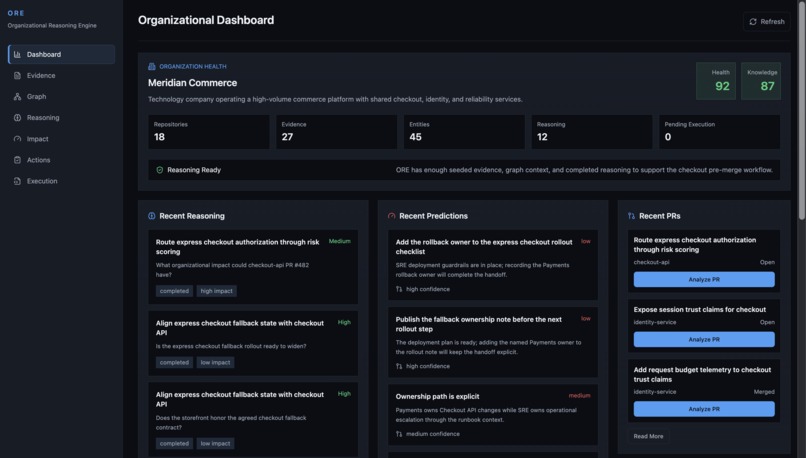
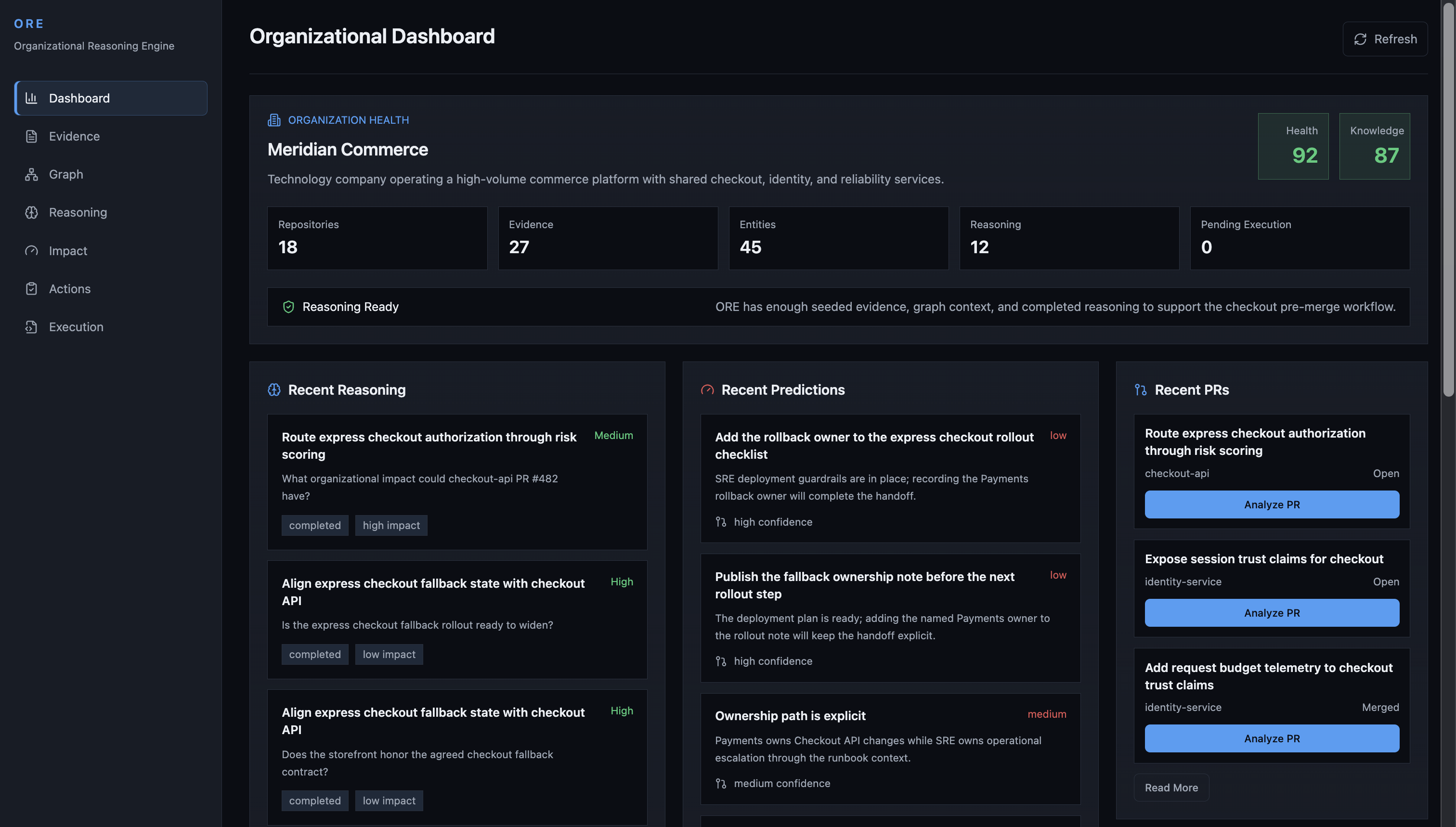
Organisational Dashboard - I
-
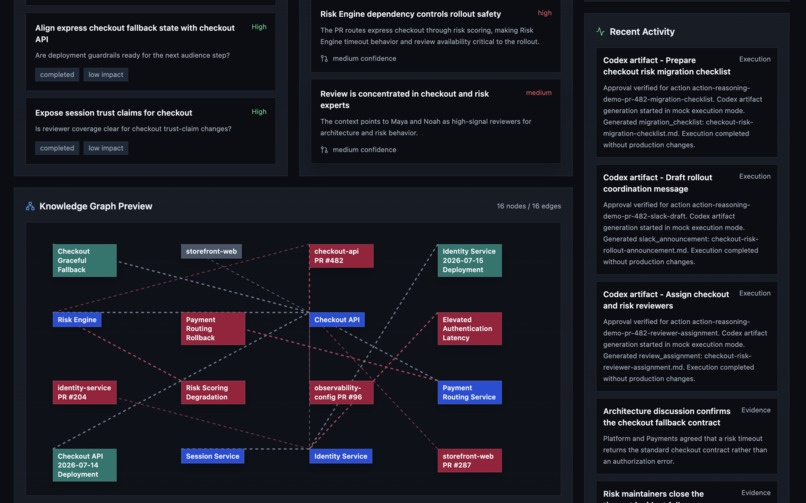
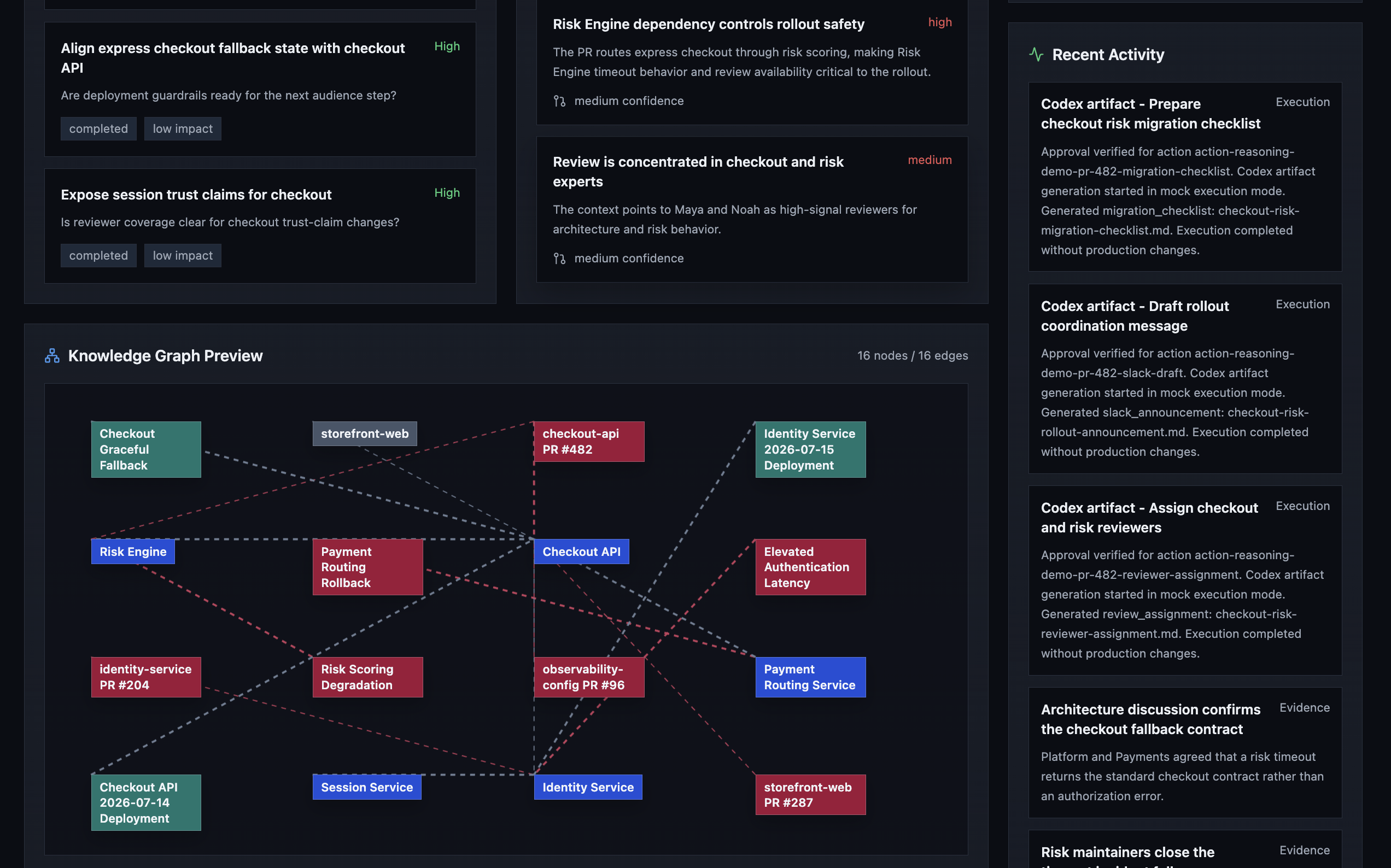
Organisational Dashboard - II
-
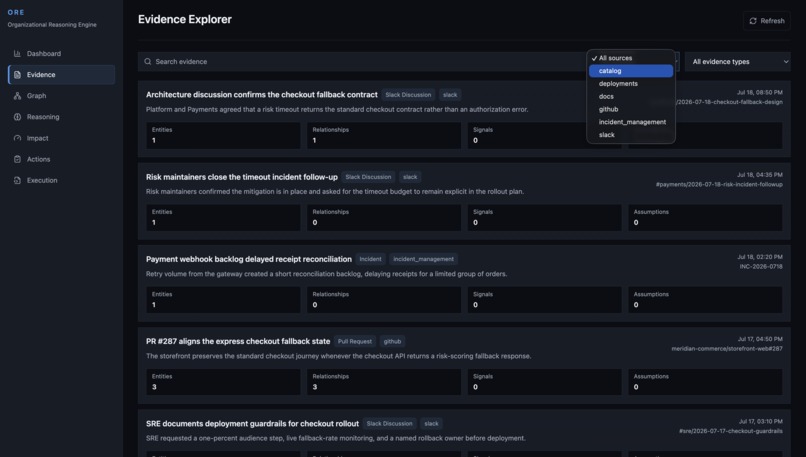
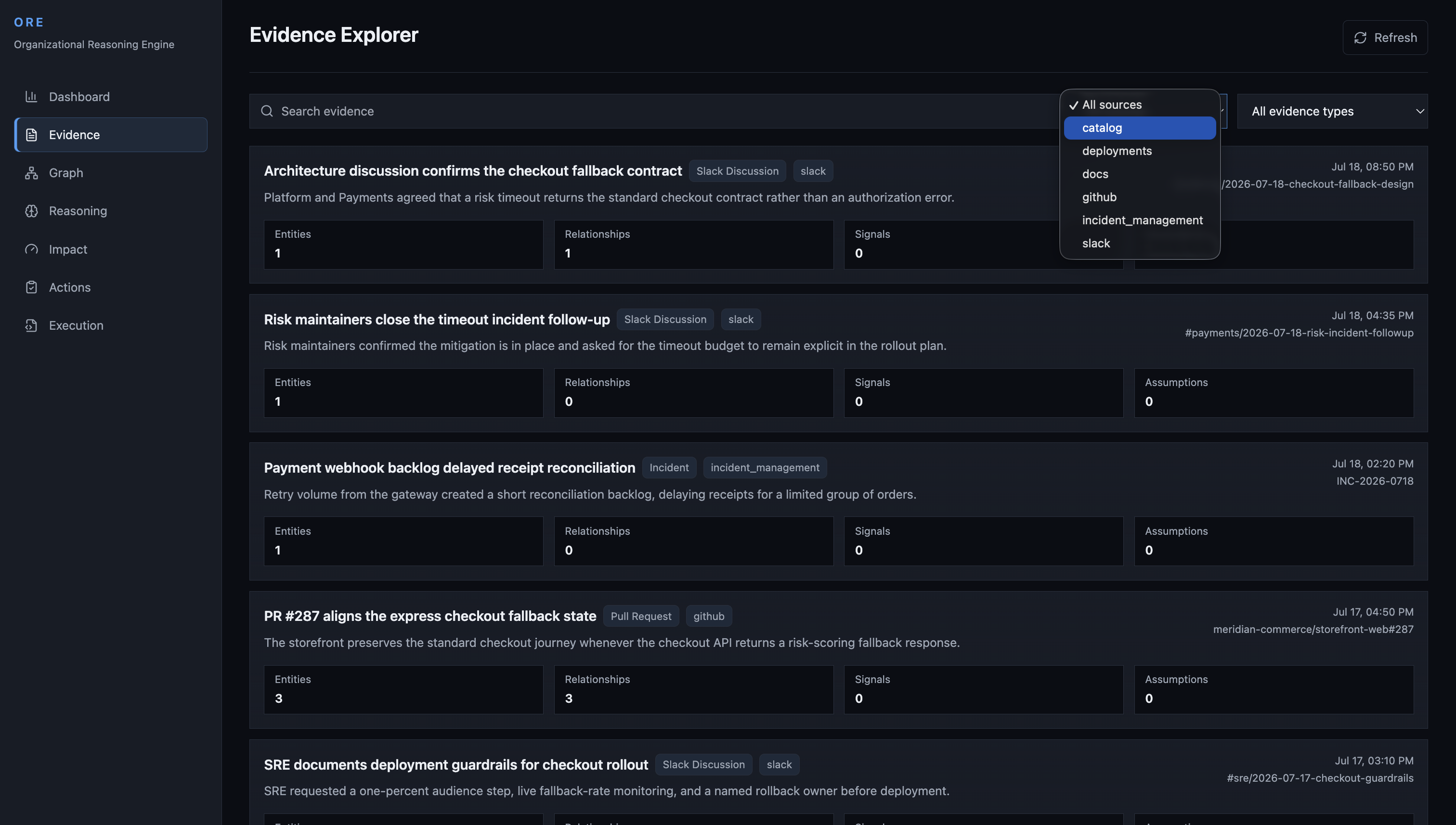
Evidence Explorer
-
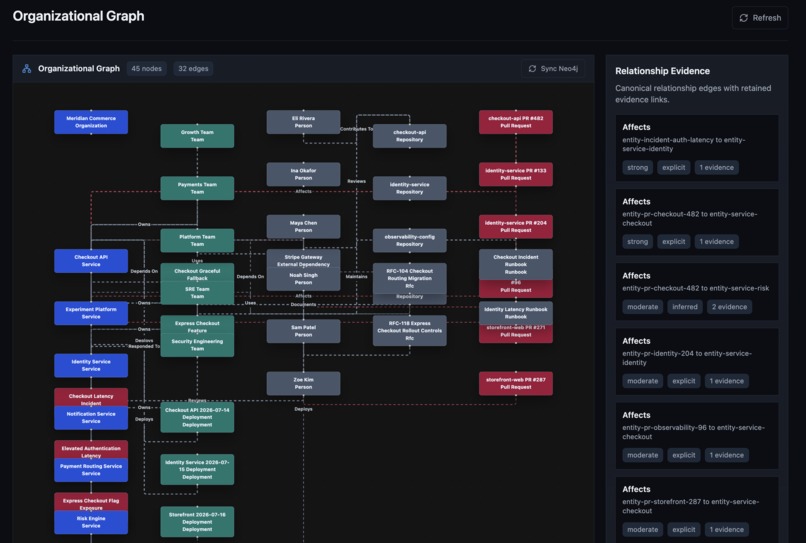
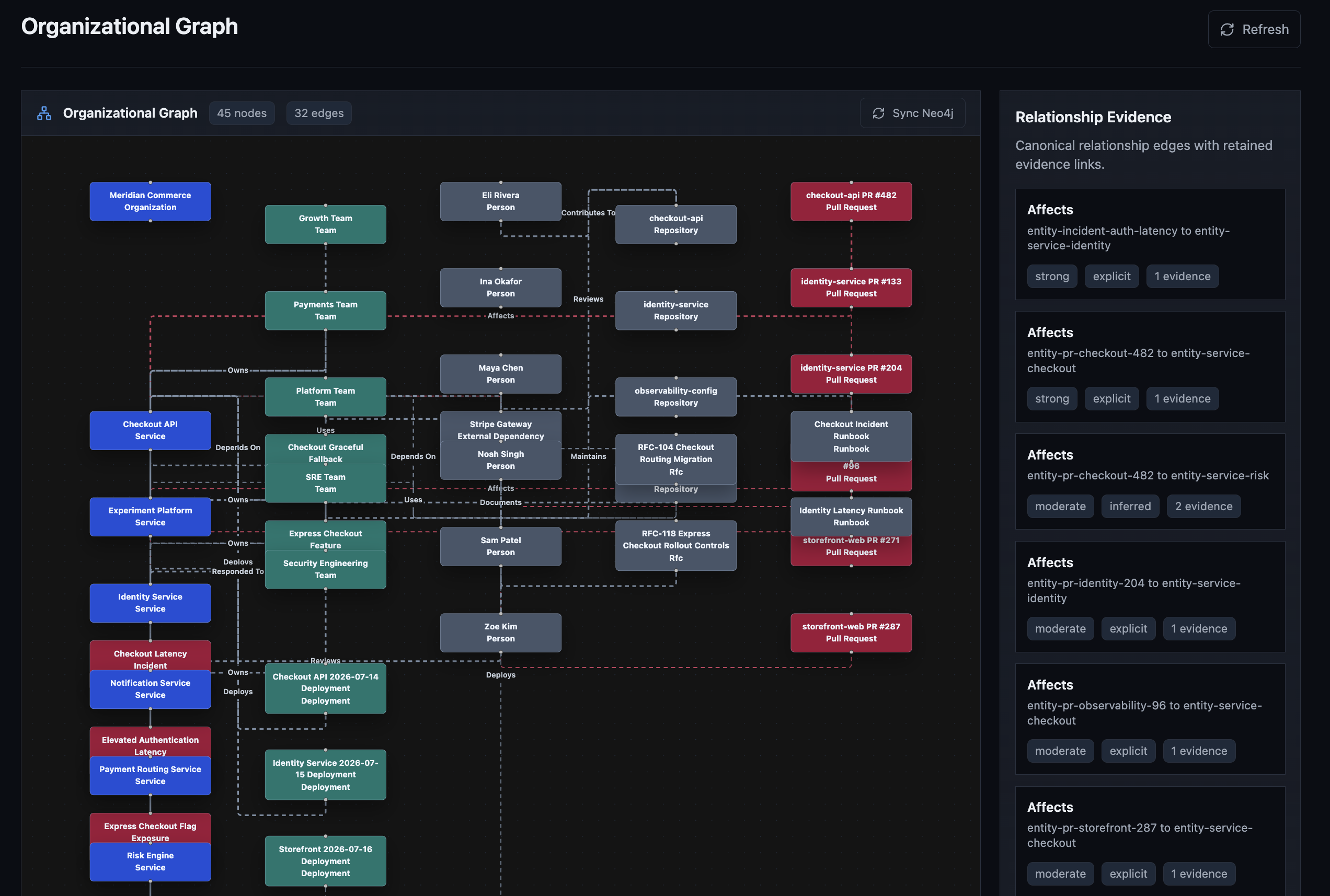
Organizational Graph
-
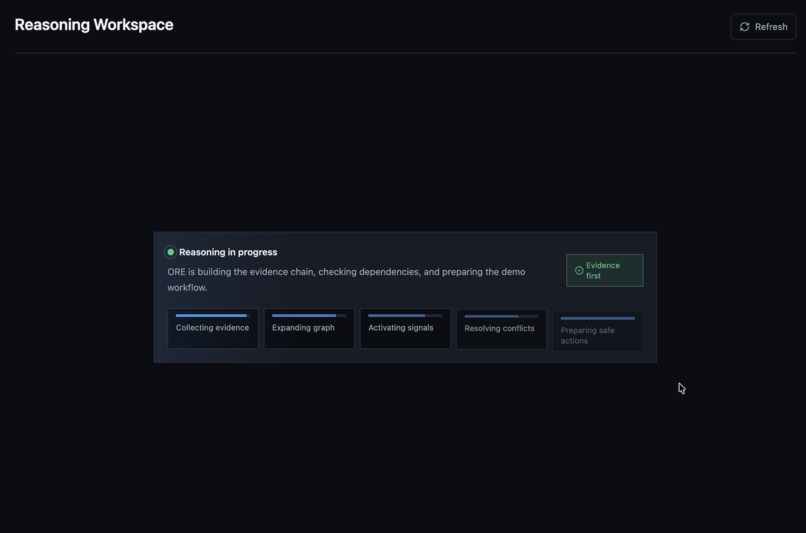
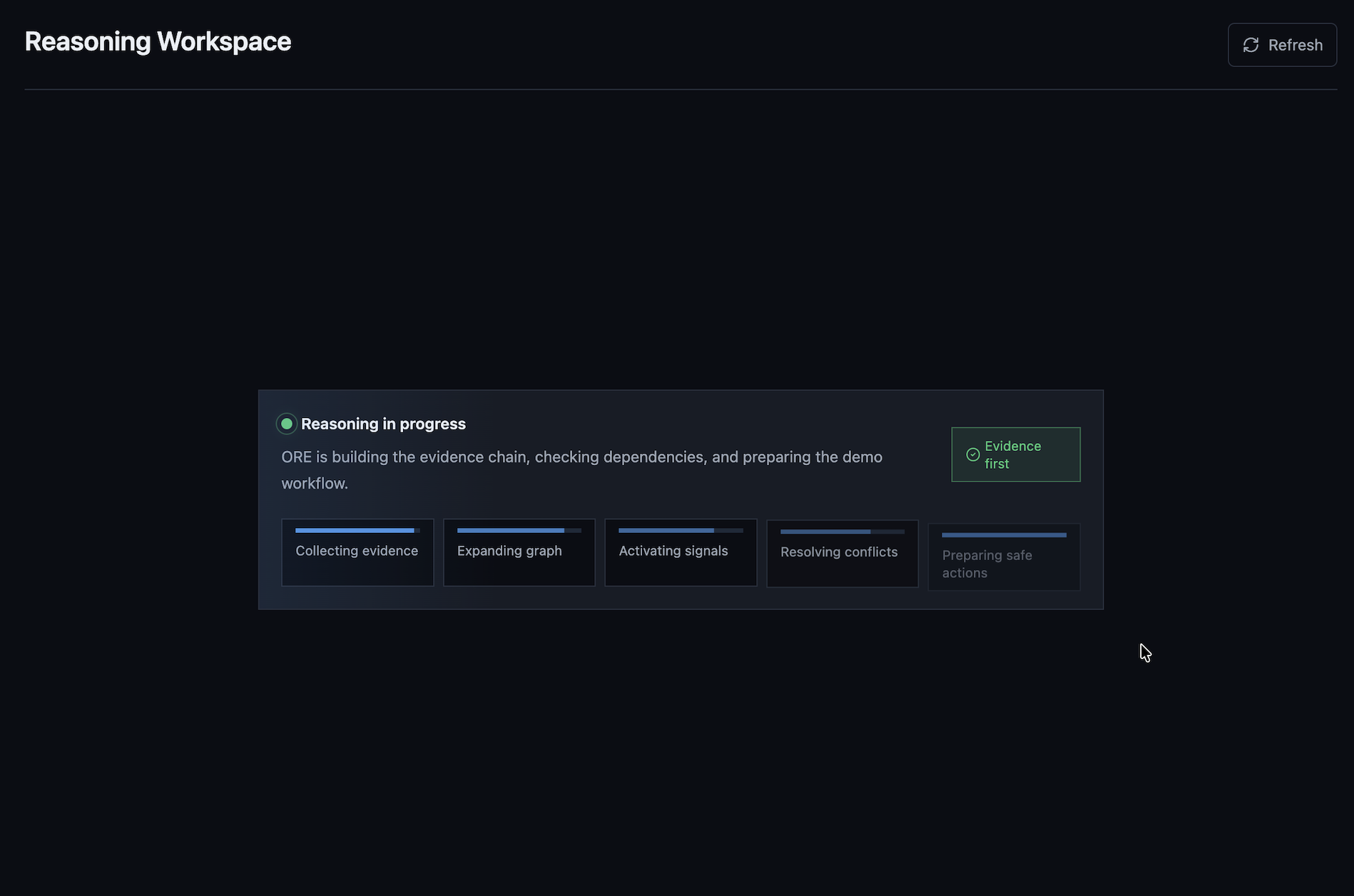
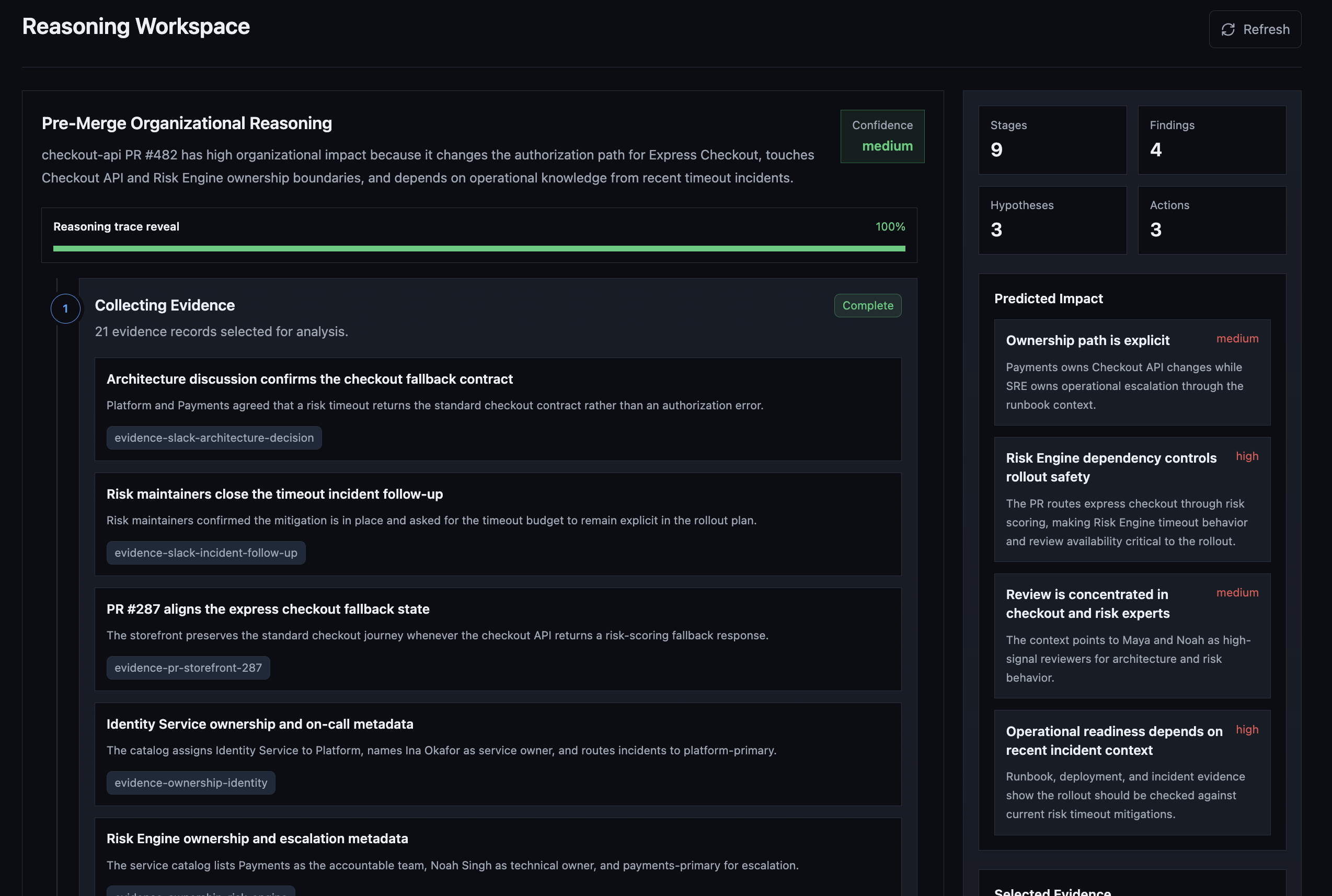
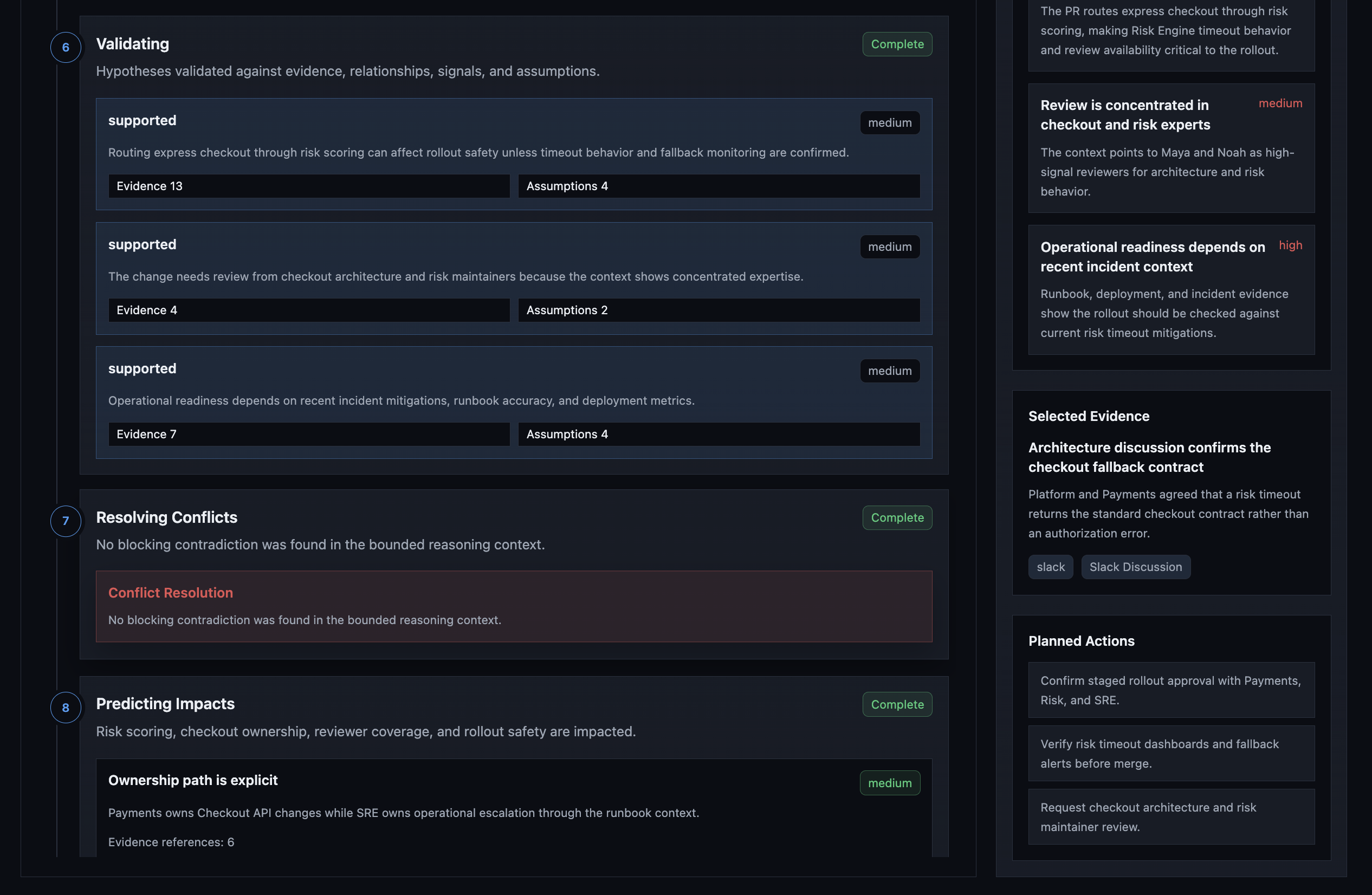
Reasoning Process
-
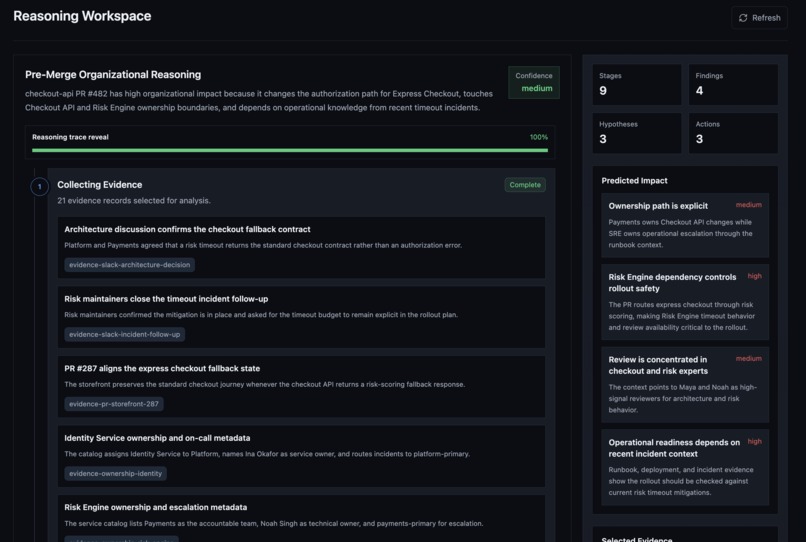
Reasoning Workspace - I
-
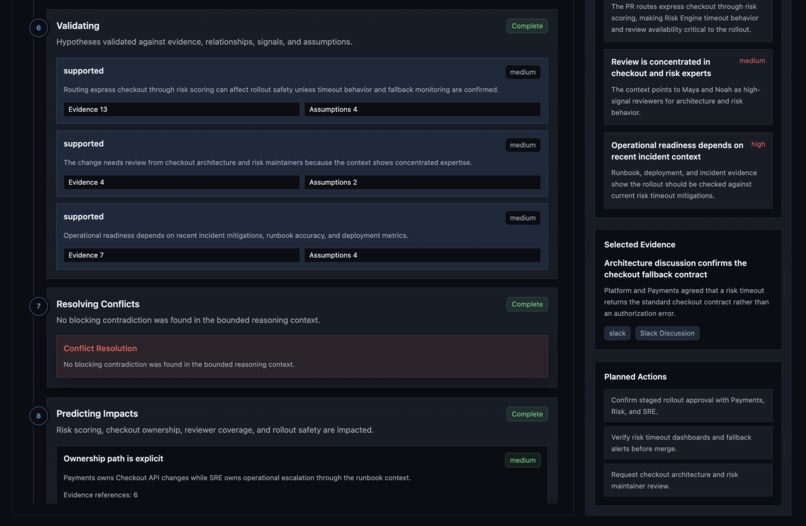
Reasoning Workspace - II
-
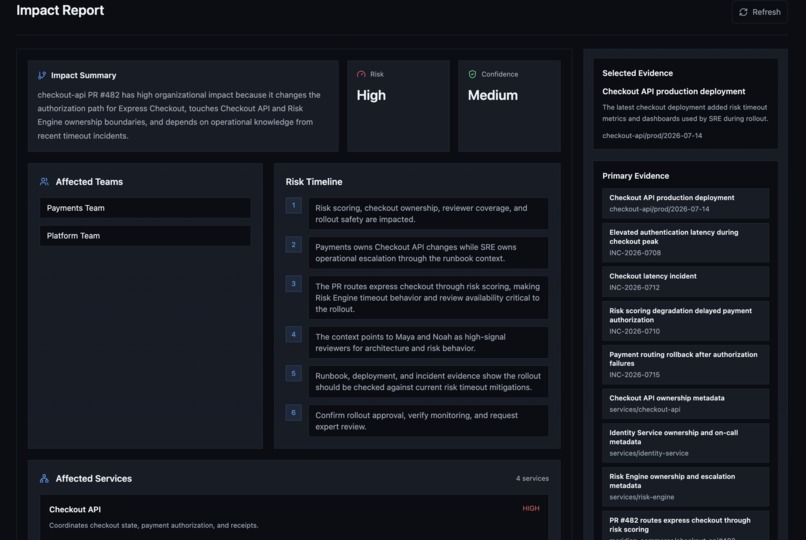
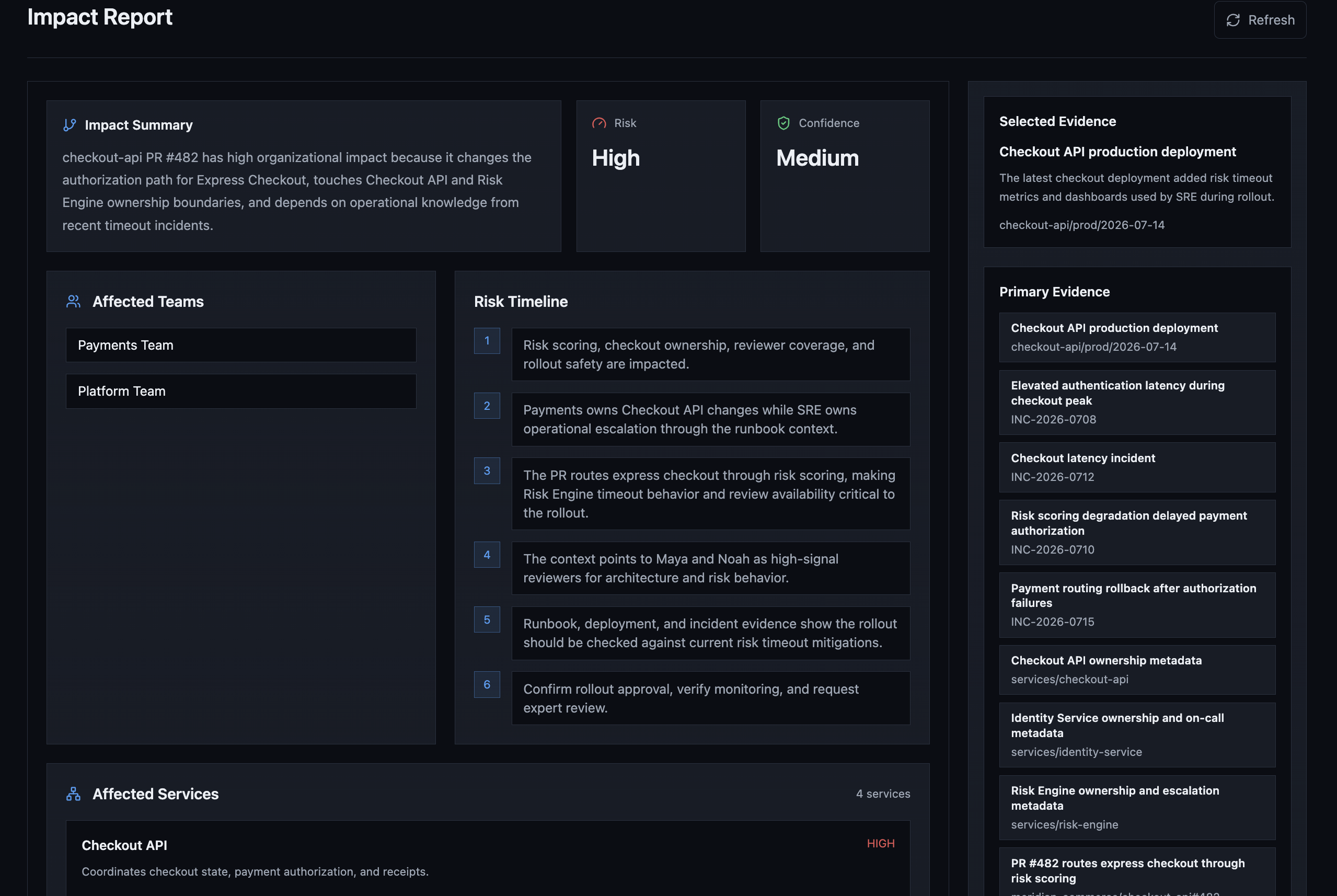
Impact Report - I
-
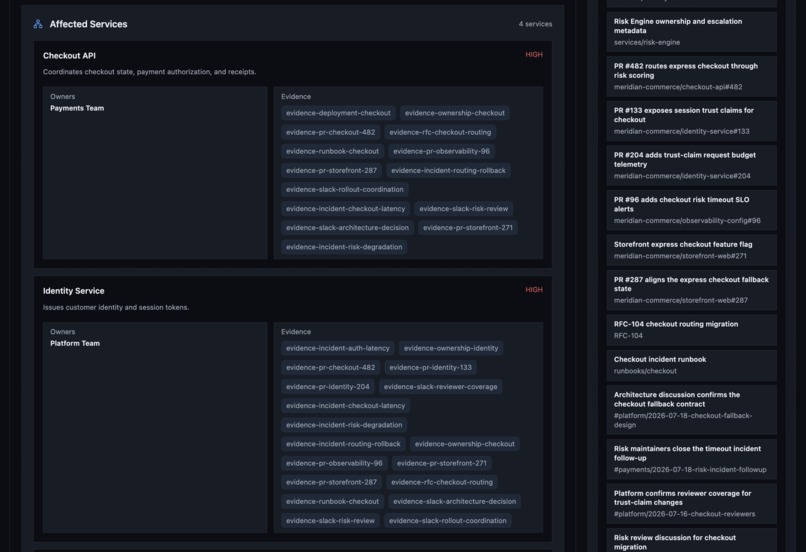
Impact Report - II
-
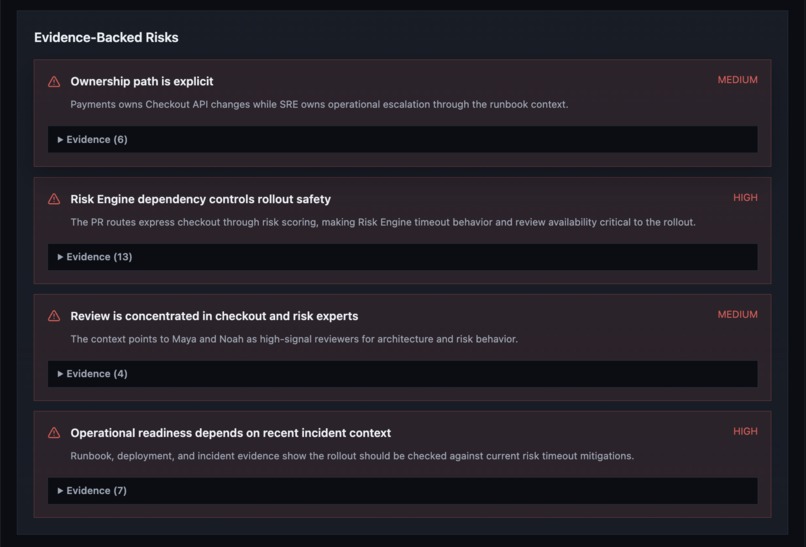
Impact Report - III
-
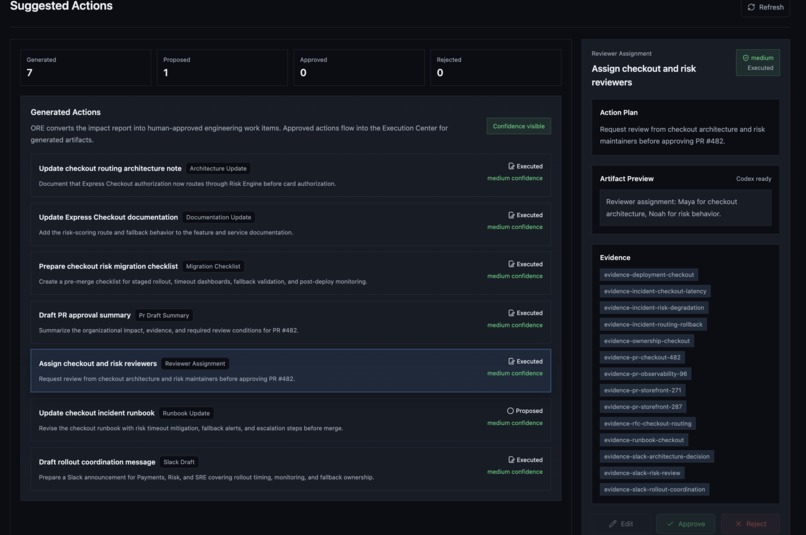
Suggested Actions
-
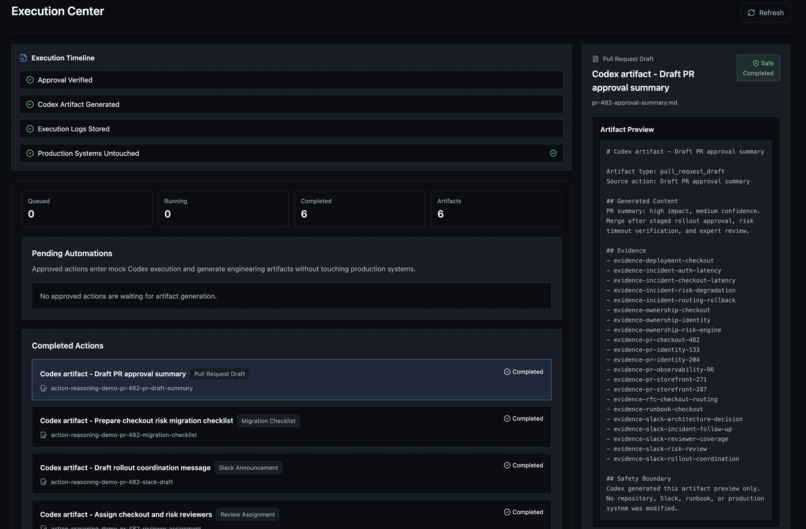
Execution Center
💡 Inspiration
Modern organizations don't have an information problem. They have an understanding problem.
Every day, engineering teams produce thousands of pieces of knowledge: pull requests, architecture documents, RFCs, incident reports, runbooks, deployment logs, ownership files, design discussions, and technical conversations.
Individually, each artifact tells a small part of the story.
But engineering decisions are never made using a single document.
A pull request that appears safe may quietly affect another team's deployment, invalidate a runbook, require additional reviewers, introduce operational risk, or depend on years of undocumented institutional knowledge. None of those consequences are obvious when information is scattered across disconnected systems.
Today's AI assistants are remarkably good at retrieving information and answering questions.
But retrieval is not reasoning.
That realization became the foundation of ORE — the Organizational Reasoning Engine.
Instead of asking:
"What does this document say?"
ORE asks a fundamentally different question:
"Given everything this organization knows today, what is most likely to happen if this change is merged?"
That single shift—from retrieving information to reasoning about organizations—shaped every design decision behind ORE.
Rather than treating documentation as isolated context, ORE builds a living understanding of the organization by connecting evidence across people, teams, repositories, services, architecture, operational history, and technical decisions.
AI shouldn't reason over documents. It should reason over organizations.
🧠 What ORE Does
GPT-5.6 is the reasoning engine of ORE.
At the center of that reasoning process is GPT-5.6.
But I didn't want GPT-5.6 to reason over raw documents or disconnected prompts.
Instead, I built an entire reasoning framework around it.
Before GPT-5.6 is ever invoked, ORE gathers organizational evidence, expands relationships through a knowledge graph, identifies organizational signals, and constructs a structured representation of how the organization currently works.
Only then does GPT-5.6 begin reasoning.
Instead of receiving isolated pieces of information, it receives an evidence-backed organizational model that enables it to evaluate competing hypotheses, identify hidden dependencies, challenge assumptions, predict downstream consequences, and explain every conclusion with supporting evidence.
Its ability to synthesize evidence, weigh competing hypotheses, and produce structured explanations made it possible to move beyond retrieval and build an AI system centered on organizational reasoning.
In ORE, GPT-5.6 isn't just generating text. It is the reasoning engine of the product.
Rather than hiding AI behind a chat interface, ORE makes its reasoning visible. Engineers can inspect the evidence, relationships, assumptions, confidence, and supporting rationale behind every recommendation before taking action.
For me, explainability wasn't an interface feature. It became the architecture.
From reasoning to action
Reasoning alone doesn't improve software.
It has to lead to action.
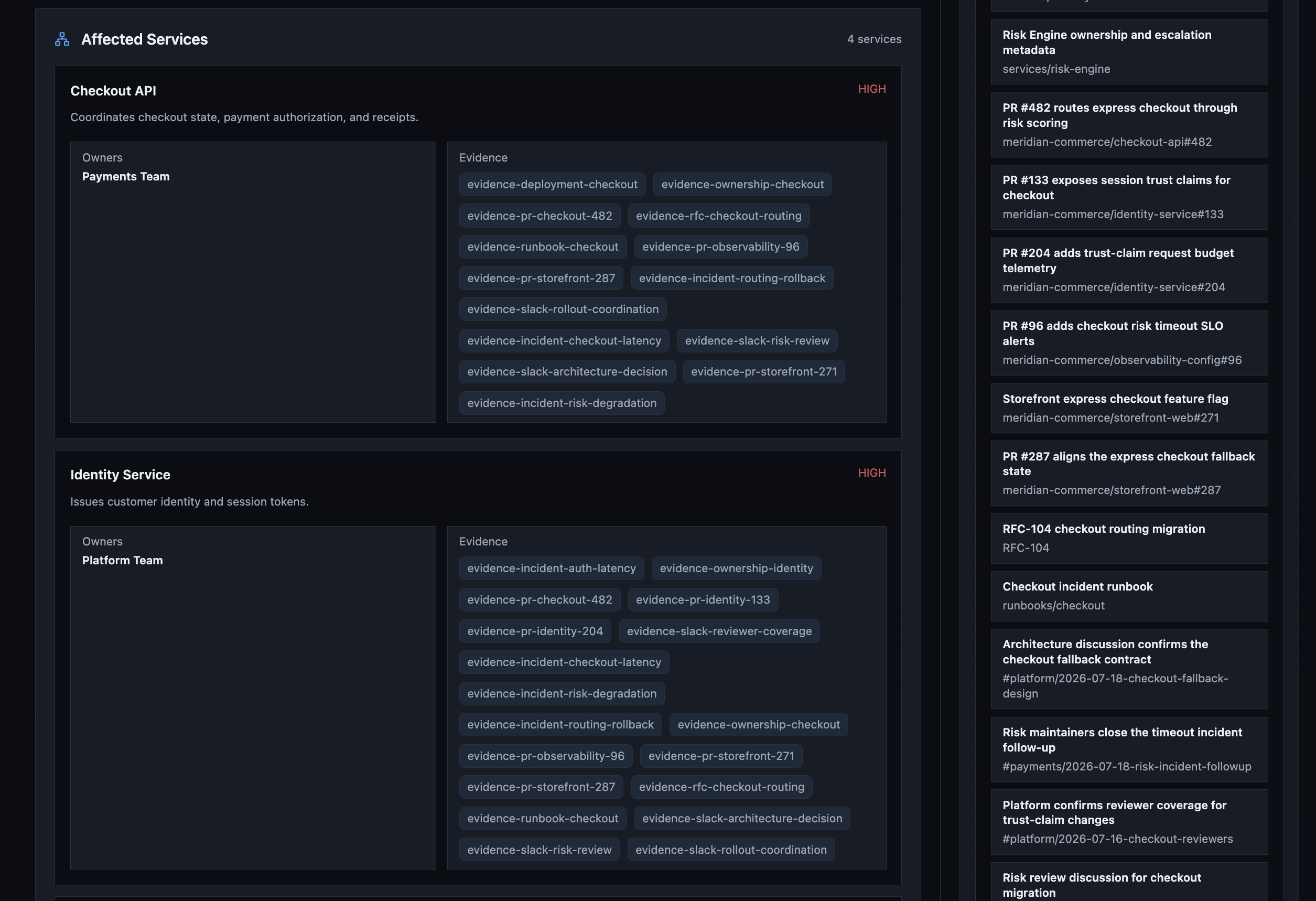
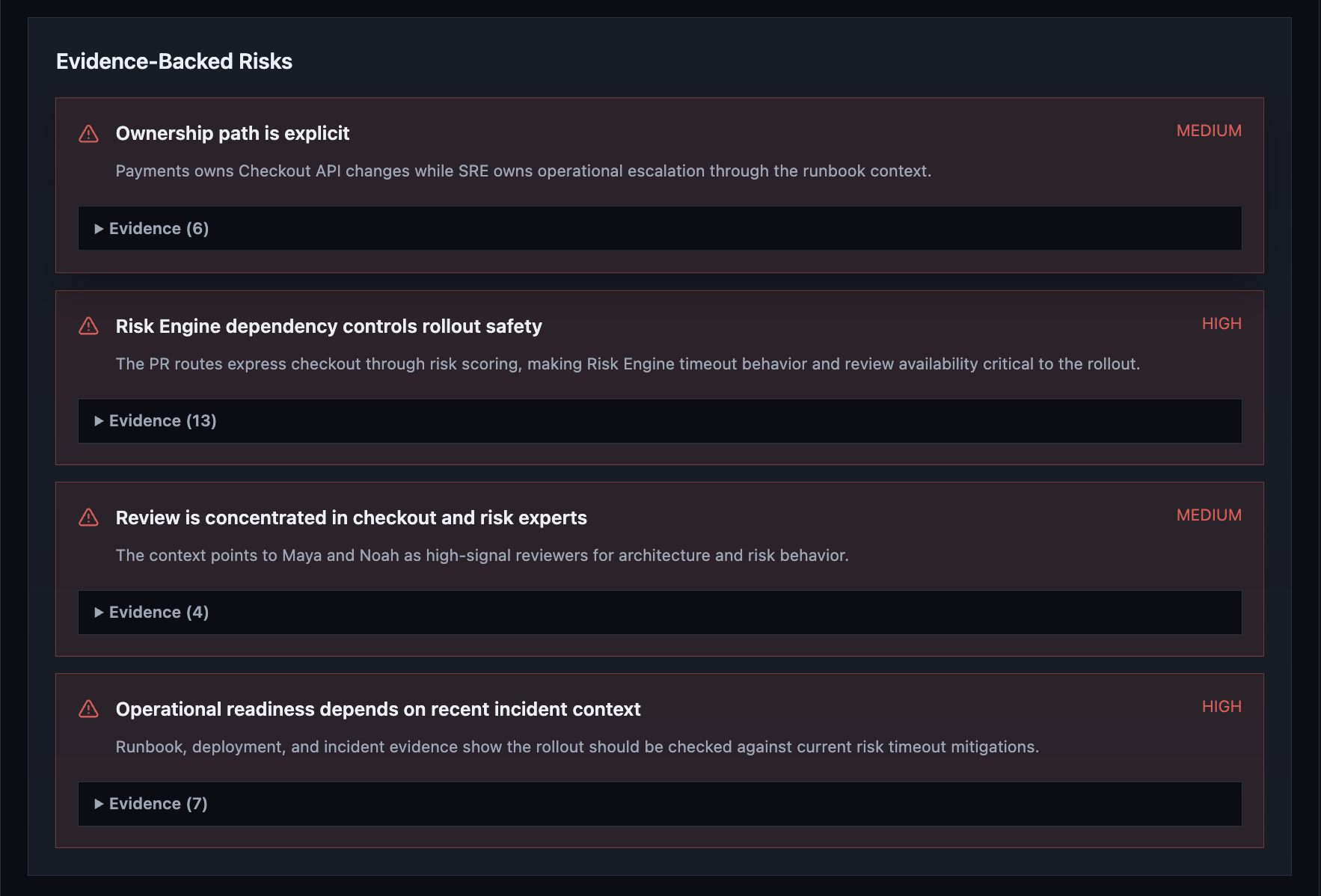
Once GPT-5.6 completes its reasoning, ORE generates an explainable Impact Report that shows affected teams, services, repositories, documentation, deployment workflows, operational risks, confidence levels, and the evidence supporting every conclusion.
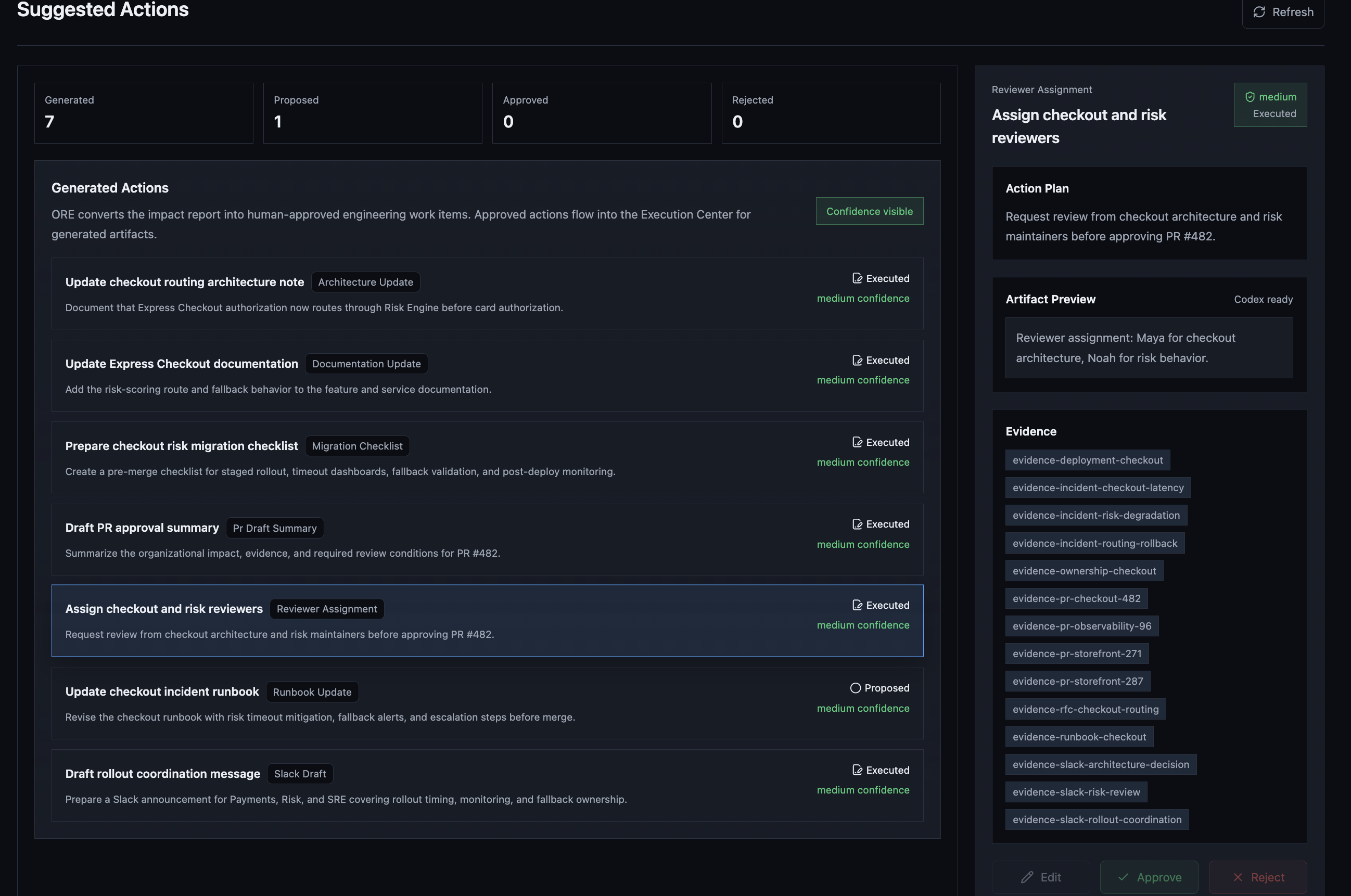
From there, ORE produces practical engineering recommendations such as rollout strategies, migration checklists, reviewer suggestions, documentation updates, communication drafts, and operational tasks.
Every recommendation remains transparent and human-controlled.
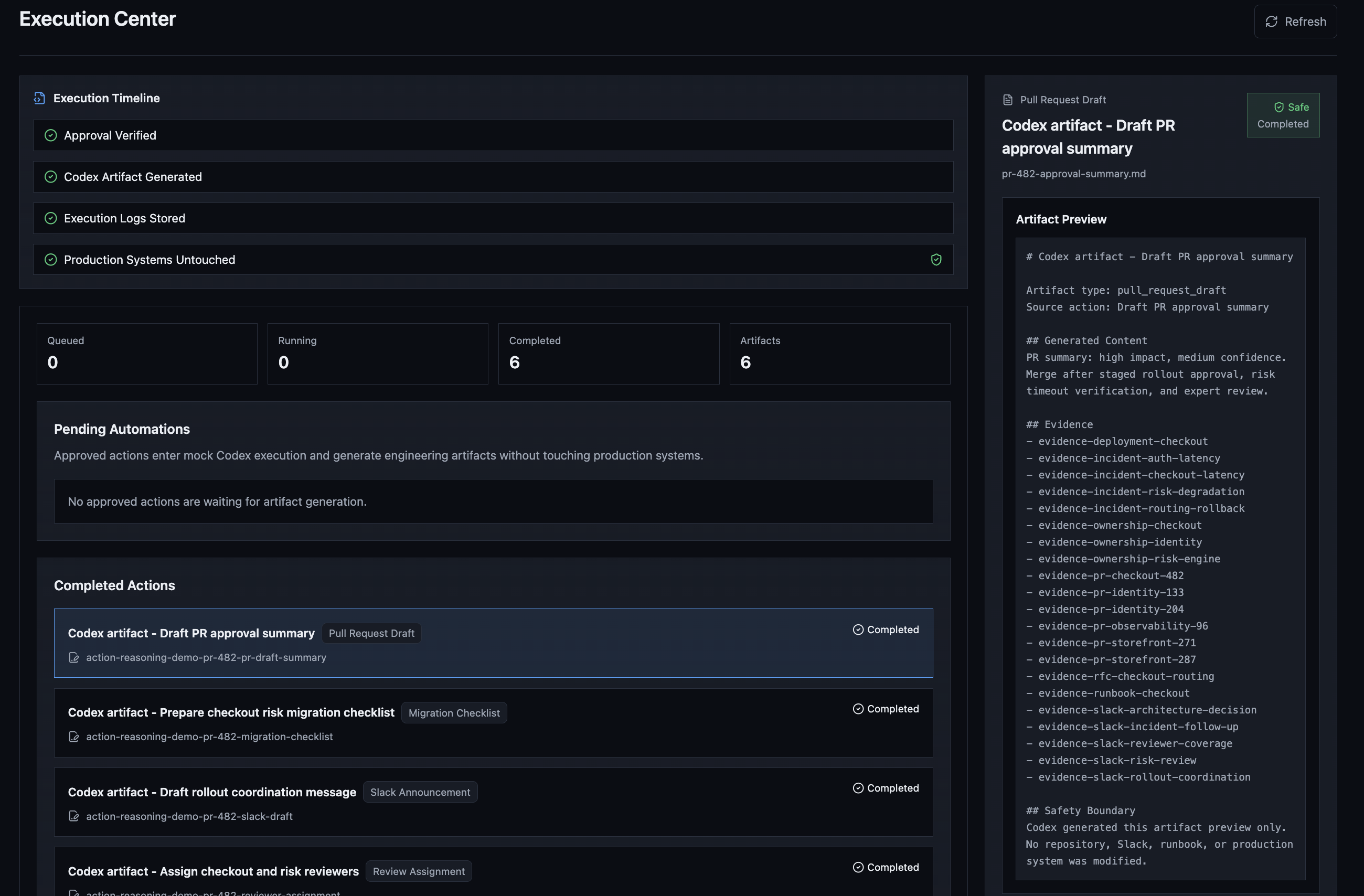
Only after explicit approval does Codex execute the final step by transforming approved decisions into implementation-ready engineering artifacts.
This separation was intentional.
GPT-5.6 determines what should happen.
Codex helps implement how it happens.
Together they create a complete reasoning-to-execution workflow while keeping engineers firmly in control.
Reasoning Pipeline
Evidence → Relationships → Signals → Assumptions → Reasoning → Impact → Actions → Safe Execution
🏗️ How I Built ORE
One decision shaped the entire project.
I designed the reasoning system before writing implementation code.
Before writing implementation code, I deliberately resisted building features.
I first designed the reasoning system.
I spent a significant amount of time defining ORE's reasoning philosophy, evidence model, organizational entities, relationship graph, signal model, confidence framework, user experience, and end-to-end workflow.
Only after those pieces fit together did implementation begin.
That foundation allowed every screen, every API, and every interaction to reinforce the same core idea instead of becoming a collection of disconnected AI features.
To bring that workflow to life, ORE combines:
- Next.js + React for a reasoning-first user experience
- FastAPI for orchestration
- PostgreSQL for structured operational data
- Neo4j for the organizational knowledge graph
- GPT-5.6 as the organizational reasoning engine
- Codex for engineering execution after human approval
Throughout development, I repeatedly returned to one question:
Does this help AI understand the organization better?
If the answer was no, it didn't belong in ORE.
How GPT-5.6 and Codex shaped this project
This wasn't a project where GPT-5.6 was added after the architecture was complete.
The architecture exists because of what GPT-5.6 makes possible.
I designed ORE specifically to give GPT-5.6 something traditional AI systems lack: structured organizational context.
Outside the product, GPT-5.6 became my design partner. I used it to challenge assumptions, refine the reasoning philosophy, explore architectural trade-offs, pressure-test product decisions, and continuously evolve the core idea behind ORE.
Codex became my engineering partner throughout development. Rather than using it only for code generation, I collaborated with it across the entire software lifecycle—implementing features, reviewing architecture, refactoring complex components, debugging integrations, validating milestones, improving reliability, and accelerating iteration while preserving architectural consistency.
Inside ORE, those same roles remain intentionally distinct.
GPT-5.6 performs organizational reasoning.
Codex performs engineering execution.
The result wasn't just software built with OpenAI tools.
It was software whose product vision, engineering process, and core reasoning capabilities were all shaped by GPT-5.6 and Codex.
🏆 Accomplishments I'm Proud Of
Instead of building another retrieval or chat application, I built an Organizational Reasoning Engine—a system where GPT-5.6 reasons over an evidence-backed model of an organization rather than isolated documents or prompts.
More importantly, I'm proud of the design decisions that made that possible:
- Reasoning before prompting. GPT-5.6 doesn't receive raw documents—it reasons over structured organizational context assembled from evidence, relationships, organizational signals, and historical knowledge.
- Explainability by design. Every recommendation exposes the evidence, assumptions, confidence, and reasoning behind it so engineers can understand why, not just what.
- Reasoning separated from execution. GPT-5.6 determines what should happen. Codex helps implement how it happens, keeping humans in control throughout the workflow.
- One coherent product instead of many AI features. Every screen—from organizational reasoning to Impact Reports, Suggested Actions, and Execution—supports a single end-to-end workflow.
- Starting with the product, not the features. I designed the reasoning philosophy and user journey before implementation so every engineering decision reinforced one clear vision.
Above all, I'm proud that ORE demonstrates something I genuinely believe is exciting:
GPT-5.6 doesn't have to be another AI assistant.
It can become the reasoning engine that helps an organization understand itself before making its next engineering decision.
⚠️ Challenges I Ran Into
The hardest challenge wasn't implementing the technology.
It was resisting the temptation to build "just another AI assistant."
Several early ideas naturally drifted toward retrieval, summarization, or chat.
Each time that happened, I stepped back and asked a simple question:
Does this help AI reason about the organization, or merely search it?
That question became my compass.
It forced me to simplify, remove unnecessary features, and focus relentlessly on one coherent workflow rather than many disconnected capabilities.
Another challenge was balancing sophistication with explainability.
Engineering teams need more than accurate recommendations—they need to understand why those recommendations exist.
That requirement shaped every part of ORE's architecture, from evidence-backed reasoning and visible confidence scores to inspectable reasoning steps and human approval before execution.
🎓 What I Learned
Building ORE fundamentally changed how I think about AI.
I learned that the next leap for engineering AI isn't simply larger context windows or better retrieval.
It's giving AI the ability to reason over an organization's collective knowledge instead of isolated pieces of information.
Organizations already contain the answers.
The challenge is connecting them.
I don't believe the future of engineering AI is another assistant.
I believe it's AI that understands how an organization works before helping engineers change it.
🚀 What's Next for ORE
This hackathon version demonstrates the core vision of organizational reasoning, but I see it as the foundation for something much larger.
My next goals include:
- Supporting additional engineering knowledge sources beyond the current evidence model.
- Continuously learning organizational patterns from historical engineering activity.
- Expanding the reasoning engine to model organizational trade-offs and long-term engineering impact.
- Integrating more deeply into software development workflows so organizational reasoning becomes part of every engineering decision.
- Continuing to push GPT-5.6 and future OpenAI models beyond retrieval toward transparent, explainable organizational reasoning.
Ultimately, I envision a future where AI doesn't simply answer questions about an organization.
It understands how the organization works, predicts the hidden consequences of change, and helps engineering teams make better decisions before those decisions reach production.
ORE is my first step toward that future.
❤️ Closing Note
Some projects answer a question. ORE began by asking one.
Perhaps the most meaningful ideas aren't the ones that have all the answers but the ones that change the questions worth asking.
Thank you for taking the time to explore ORE.
Built With
- ai-agents
- codex
- developer-tools
- devops
- docker
- docker-compose
- explainable-ai
- fastapi
- gpt-5.6
- graphrag
- impact-analysis
- knowledge-graph
- llm
- neo4j
- next.js
- openai-api
- organizational-intelligence
- organizational-reasoning
- postgresql
- python
- react
- software-engineering
- tailwind-css
- typescript
- workflow-automation

Log in or sign up for Devpost to join the conversation.