Inspiration
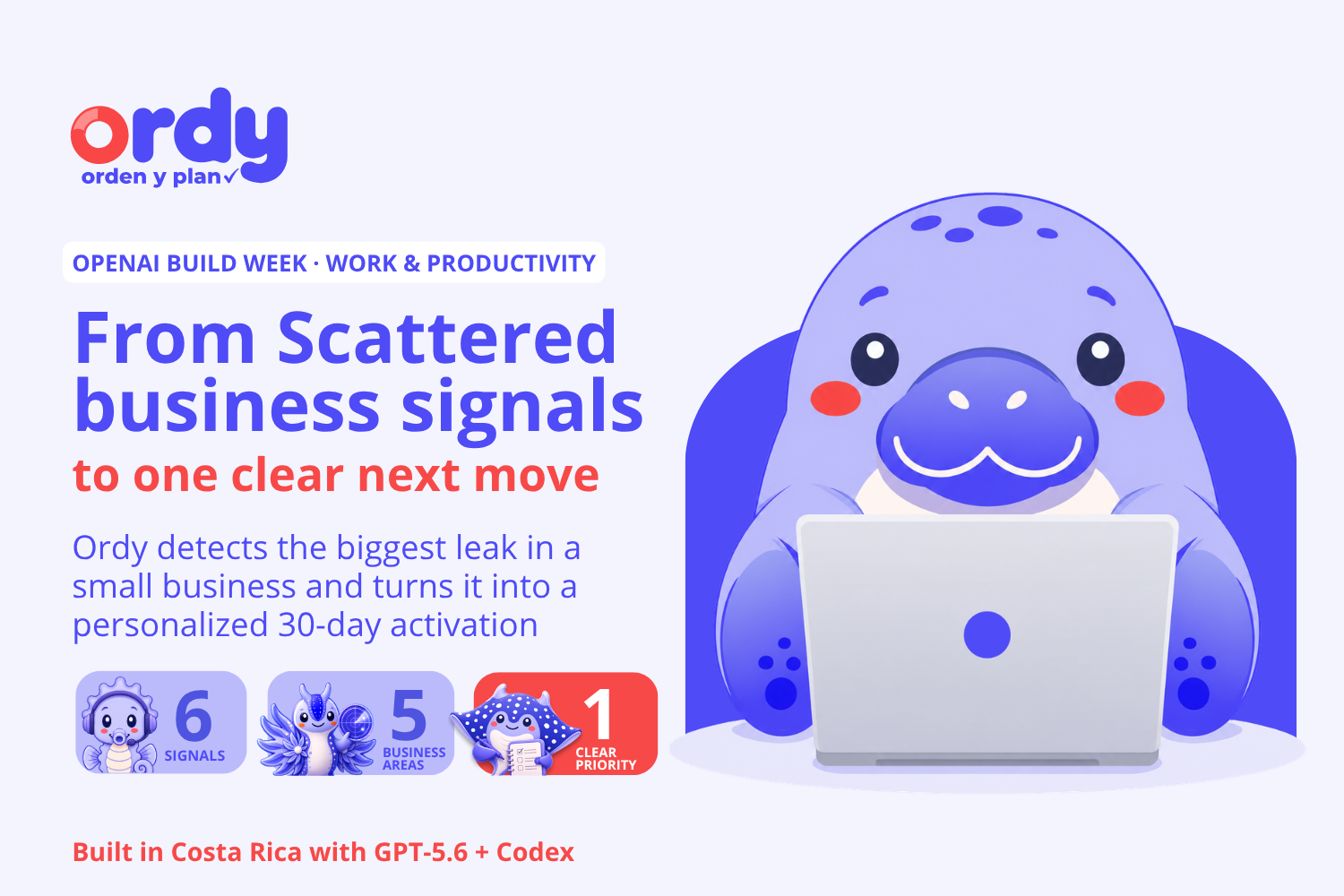
Most productivity tools start with a blank page. Small business owners start with a head full of client history, prices, unfinished processes, urgent decisions, WhatsApp conversations, and unwritten knowledge.
Through my work with small businesses in Costa Rica, I kept seeing the same pattern: these owners did not lack effort, ideas, or ambition. Their business knowledge was scattered, and they had no single place where the business could understand and remember itself.
AI made this gap more visible. Owners were told to “use ChatGPT,” but useful AI depends on useful context. When a business cannot explain what it does, what is leaking, or what deserves attention first, even powerful tools produce generic recommendations.
Before Build Week, Ordy existed as a guided methodology, personalized business dashboards, and 30-day activations structured through Ordy's advisor framework. Build Week became the opportunity to answer a new question: could that methodology become a product that a business owner could enter and start using immediately?
The problem
Task managers assume that the owner already knows what the tasks should be. AI assistants assume that the owner knows what context to provide. Traditional consulting can create clarity, but that clarity often ends up inside a static presentation or document.
Ordy begins one step earlier. It helps a small business connect what its owner already knows, identify what deserves attention first, and convert that decision into a route that can actually be followed.
What it does
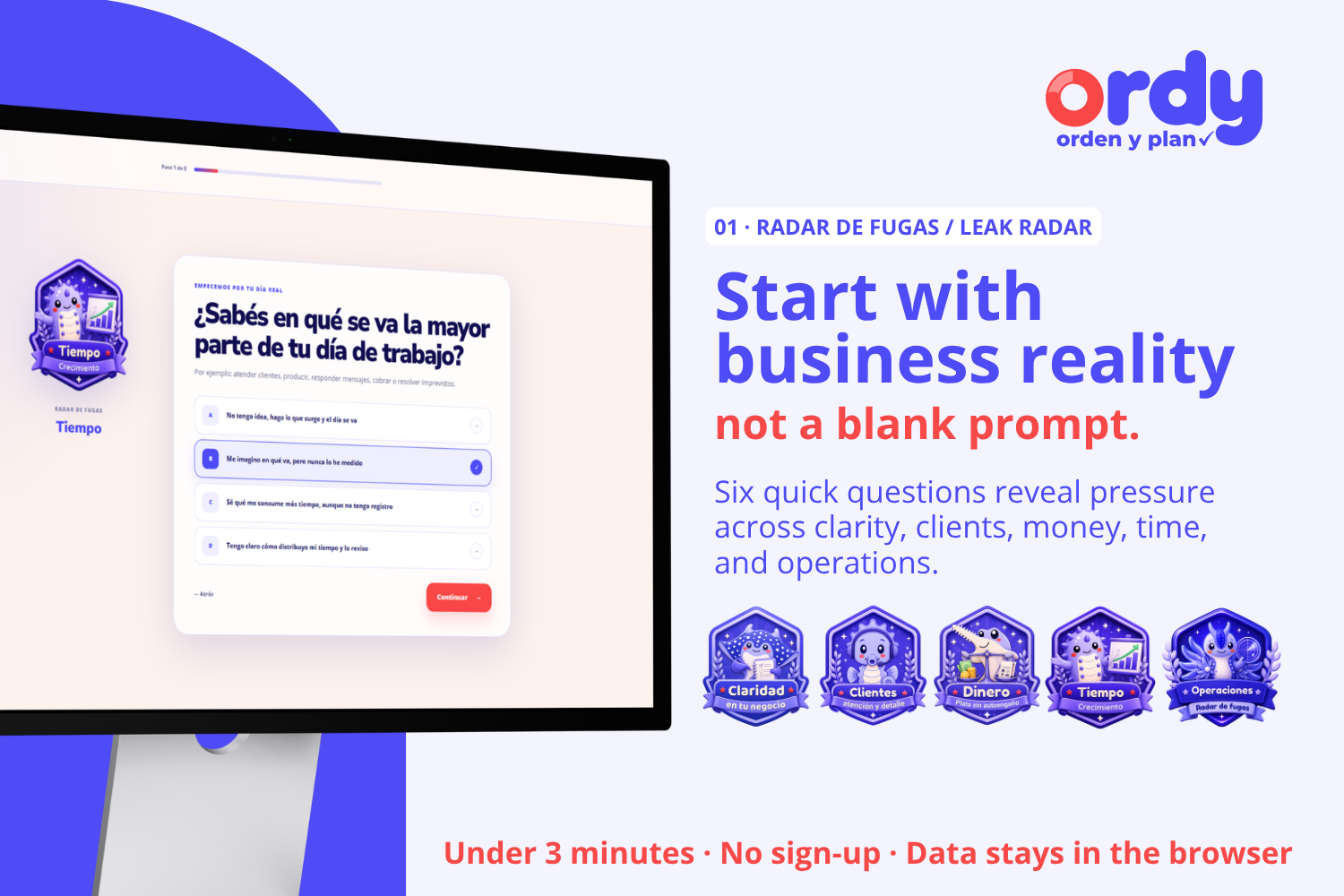
The Build Week beta demonstrates the smallest complete Ordy loop. The owner answers six Radar de Fugas questions about time, profit, pricing, clients, undocumented operations, and clarity. Ordy then adds the context that changes the meaning of those answers: what the business offers, its current stage, and how much time the owner can realistically dedicate each week.
The beta:
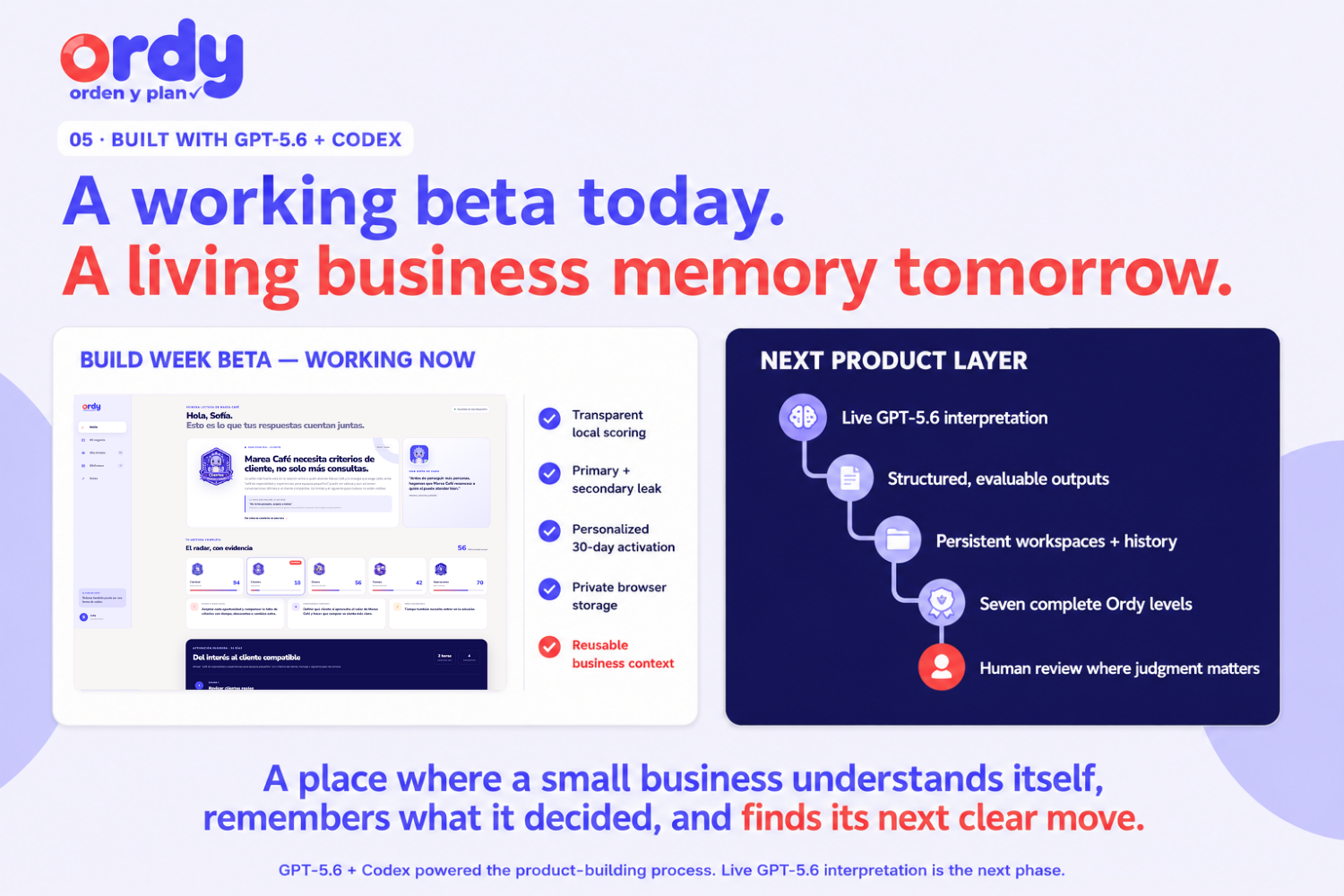
- Compares clarity, clients, money, time, and operations.
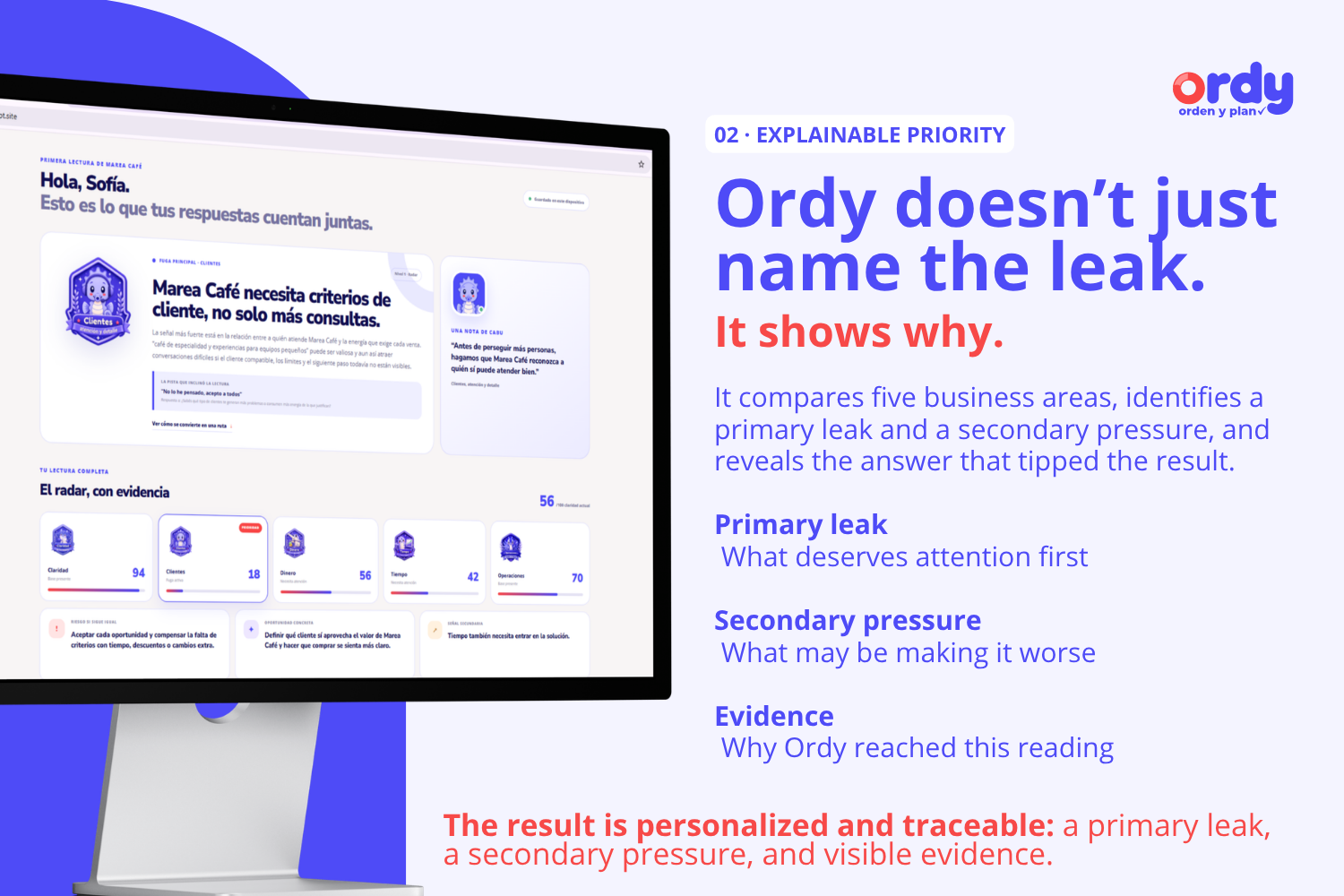
- Identifies a primary leak and secondary signal.
- Shows the answer that influenced the result.
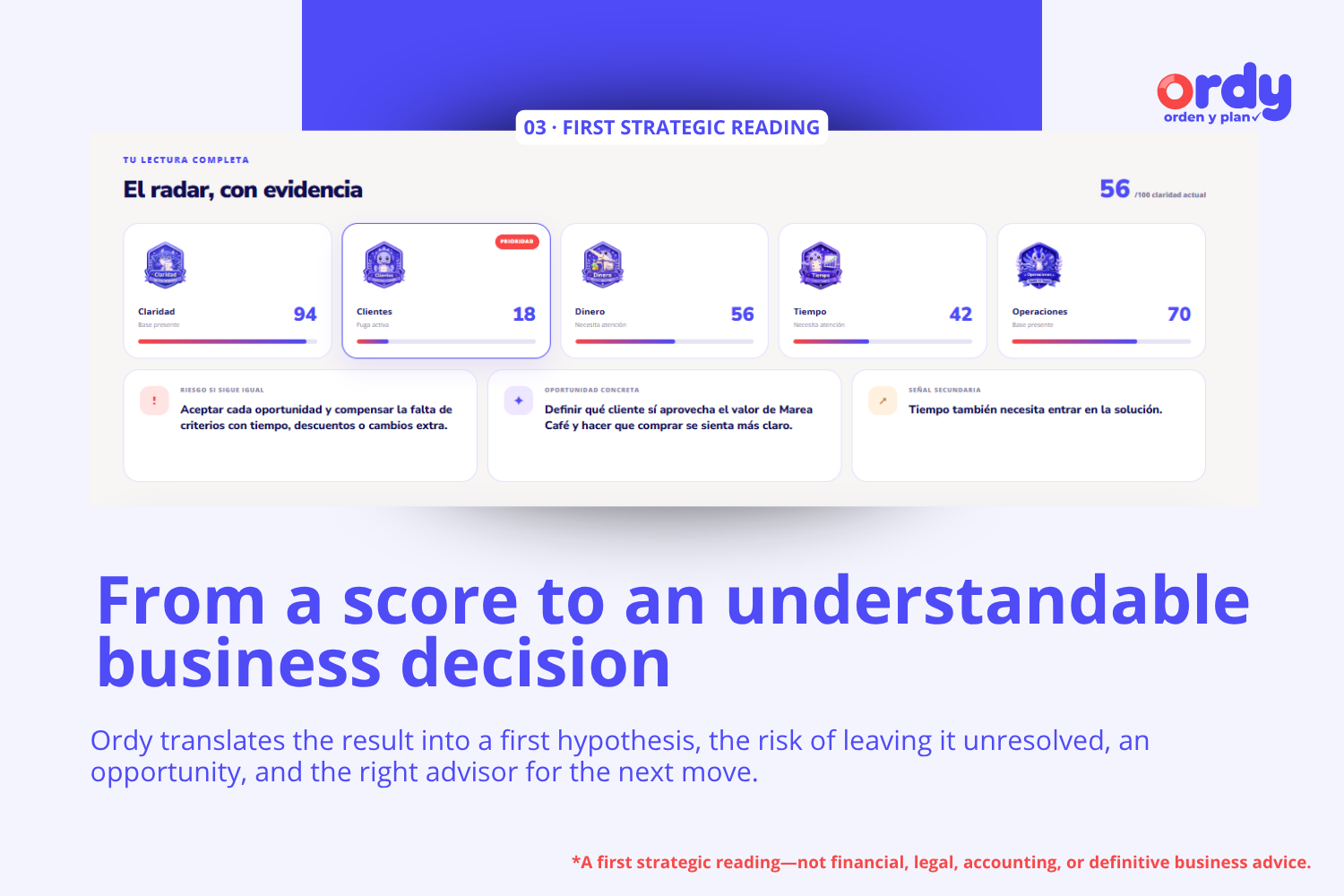
- Presents a first hypothesis, risk, opportunity, and relevant Ordy advisor.
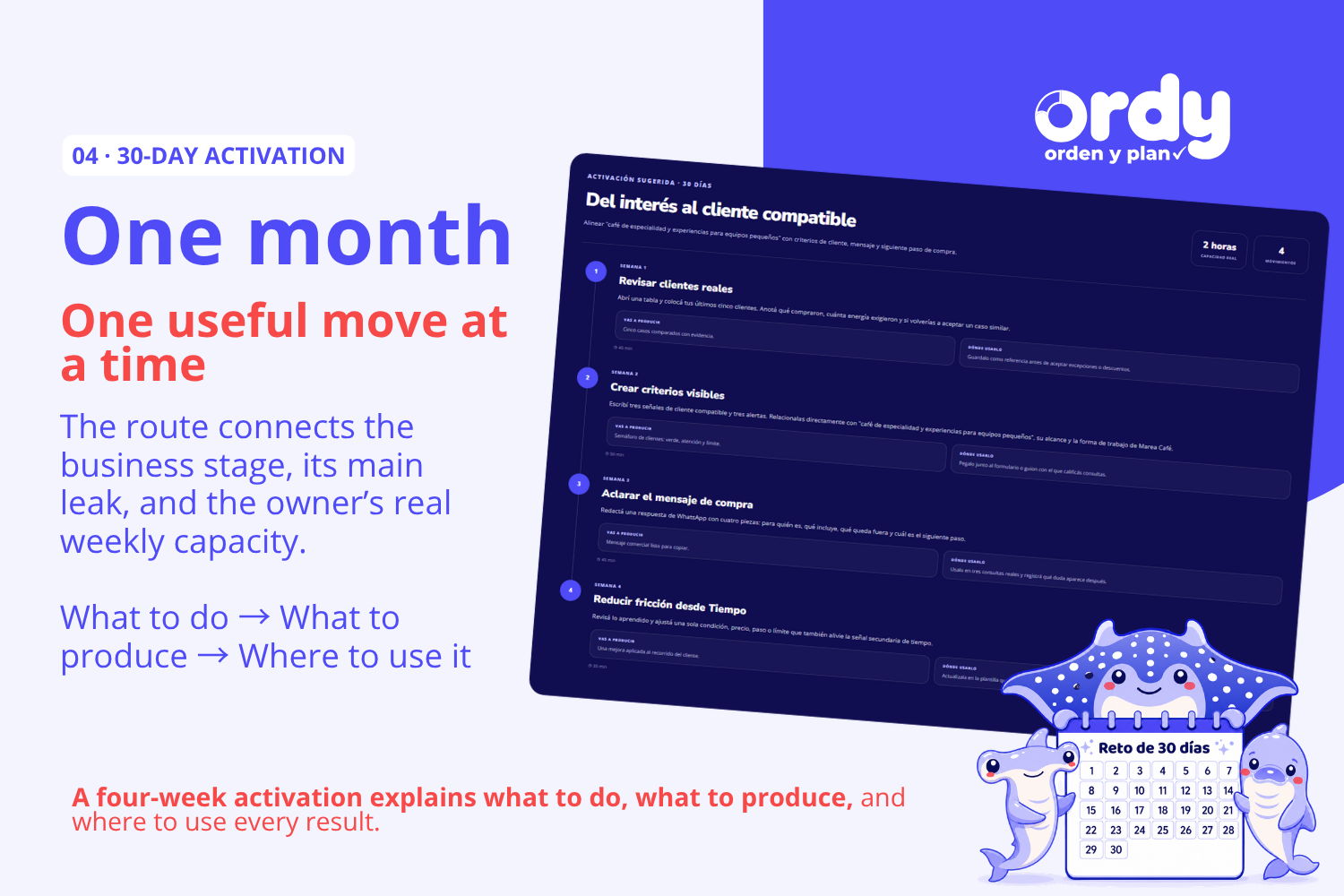
- Creates a four-week activation explaining what to do, produce, and where to use it.
- Creates reusable business context and a Radar summary for ChatGPT.
The experience works with a real business or a prefilled example. It requires no registration or API key. Form answers are not sent to an AI API, and the beta result is stored in the visitor's browser.
What makes Ordy different
Ordy is neither a generic task manager nor an autonomous business consultant.
- It starts with business reality. No polished brief or perfect prompt is required.
- It is traceable. The dashboard shows which answer influenced the priority.
- It prioritizes before adding tasks. Actions live inside one activation, not an endless checklist.
- It preserves context. Stage and weekly capacity become a reusable resource.
- It makes actions usable. Each movement names a deliverable and where to apply it.
Personalization in this beta is bounded and explainable: Ordy connects six signals, the business name and offer, a primary leak, and a secondary pressure. It does not simply insert a name into generic advice.
Early validation
The problem comes from direct work with real small businesses. In an early guided case, one owner reviewed Ordy's analysis and selected a concrete 30-day activation. That helped define a central product decision: the dashboard creates clarity, while tasks only appear inside a chosen route.
This is still an early product. The need and methodology have initial real-world validation; the self-service experience now needs to be measured for completion, usefulness, first-action completion, return usage, and conversion.
How we built it
I am a communications, design, and product strategy professional rather than a traditional software engineer. I built this working product slice in one time-boxed Codex session powered by GPT-5.6.
Codex reduced a much larger vision—including accounts, seven levels, living dashboards, business memory, human review, and integrations—to the smallest honest experience that could prove Ordy's core transformation. It helped translate the methodology into product logic, implement React and TypeScript, create traceable scoring, restore Ordy's visual identity, validate the journey, and deploy with OpenAI Sites.
The beta uses React 19, Next.js 16/Vinext, TypeScript, responsive CSS, and browser storage.
For this public version, I deliberately used a deterministic local interpretation layer. Six diagnostic answers are converted into five scores; the lowest-scoring area becomes the primary leak, the next becomes the secondary signal, and Ordy combines both with the business name and offer to create a first reading and four-week route.
GPT-5.6 currently supported the product-building process through Codex; it does not analyze visitor data at runtime in this beta. Live GPT-5.6 interpretation through the Responses API and Structured Outputs is the next implementation phase.
Challenges we ran into
The first challenge was scope. A login screen or simulated integrations could have made the prototype look larger, but they would not have demonstrated Ordy's value. I chose to prove one transformation: scattered signals become an understandable priority and route.
The second challenge was meaningful personalization. An early version produced routes that felt too generic. Testing exposed this quickly. I returned to the original Radar de Fugas, expanded it to six evidence-based signals, added a secondary pressure, and made every movement explain its output and use.
The third challenge was preserving trust. Business advice can sound authoritative even when the available context is limited. Six self-reported answers cannot replace complete business analysis, so the result is framed as a first strategic reading—not as financial, legal, accounting, or definitive business advice.
The first visual direction also did not feel like Ordy, so I rebuilt it with the original brand system, characters, typography, colors, and calm interaction language.
Accomplishments we are proud of
- It begins with a working product instead of a commercial landing page.
- A visitor reaches a complete result without registration or credentials.
- Six signals are connected across five areas, with visible evidence.
- A secondary pressure enters the solution instead of reducing the business to one score.
- Each action becomes a usable deliverable.
- The output remains useful through reusable ChatGPT context.
What we learned
I learned that personalization is not the amount of text a system generates. It is the quality of the connections it can explain. A recommendation feels personal when the owner can see the evidence, understand why one priority came first, and know where to use the output.
A deterministic prototype is also valuable before adding an AI runtime: it creates a transparent baseline, exposes methodology gaps, and can become an evaluation set for GPT-5.6 outputs.
Most importantly, small-business productivity is not only about completing more tasks. It is about reducing the number of unresolved decisions an owner must carry in their head and turning business knowledge into reusable context.
What's next for Ordy
The next version will add persistent business workspaces, version history, the seven complete Ordy levels, a living resource library, human-reviewed updates, and an internal operations panel.
GPT-5.6 will move from build partner to the product architecture through the Responses API and Structured Outputs. A stable schema will keep evidence, findings, risks, opportunities, priorities, and routes consistent enough to evaluate before publication. Human judgment will remain part of higher-impact recommendations.
Calendar and email integrations will come after the priority is defined, allowing Ordy to move a chosen activation into the owner's real schedule.
Ordy can scale without turning every user into a custom consulting project. The methodology standardizes what is captured and how outputs are structured; GPT-5.6 can interpret each owner's context within that structure, while human expertise is focused where judgment matters most. The next goal is a pilot measuring time to value, usefulness, first-action and route completion, and review time before expanding through small-business support organizations.
The commercial path follows the same logic: free tools help owners explore, the complete dashboard helps them build, 30-day Activations help them advance, and membership preserves history, resources, and updates without promising unlimited human analysis.
The long-term vision is not another place to store tasks.
Ordy is the place where a small business understands itself, remembers what it decided, and finds its next clear move.
It was built in Costa Rica, from real small-business experience, for the many businesses whose most valuable knowledge is still trapped inside one person.
Built With
- codex
- css3
- gpt-5.6
- html5
- next.js
- openai
- react
- sites
- typescript

Log in or sign up for Devpost to join the conversation.