-
-
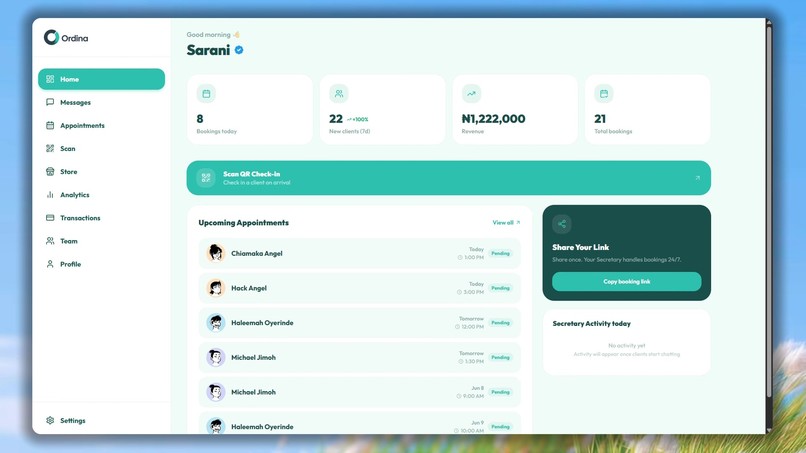
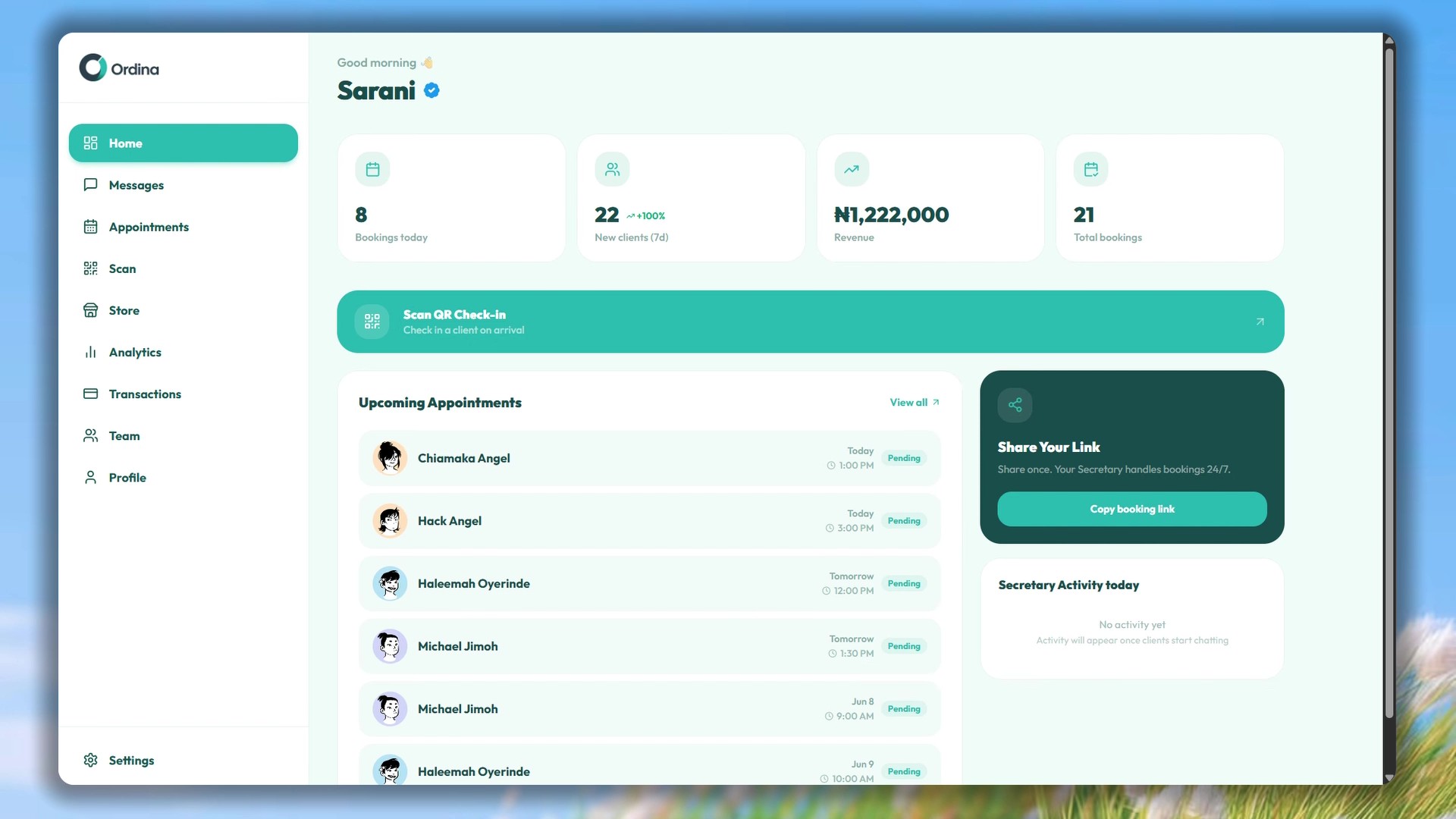
The Ordina Dashboard
Ordina
Inspiration
Ordina started from a simple observation: many professionals and service businesses spend a significant portion of their day handling repetitive administrative work instead of delivering value to customers.
Whether it was consultants responding to inquiries, agencies qualifying leads, or business owners managing schedules, the pattern was the same. Valuable time was being consumed by operational tasks that could be automated. Existing solutions felt fragmented one tool for scheduling, another for support, another for CRM updates. I believed AI could become a true executive secretary rather than just another productivity tool.
What We Are Building
Ordina is an AI Executive Secretary that helps professionals and service businesses manage customer communication, lead qualification, appointment scheduling, and operational workflows through natural conversations.
Instead of requiring users to learn multiple tools and dashboards, Ordina acts as a conversational layer that understands context and helps execute business processes autonomously.
Our long-term vision is to create an AI-native operating layer for businesses where conversations become the primary interface for getting work done.
How We Built It
The project started with customer interviews and workflow mapping. I spent time understanding how consultants, agencies, mentors, and service providers manage their daily operations and where the biggest bottlenecks existed.
From there, I developed an initial prototype focused on conversational interactions and workflow automation. The system combines AI models, business logic, scheduling capabilities, and integrations that allow it to perform useful actions rather than simply generate responses.
The product has gone through multiple iterations as feedback from potential users continuously shaped the experience.
What I Learned
One of the biggest lessons has been that building AI products is not primarily an AI problem—it's a workflow problem.
Users don't care about model architecture or prompt engineering. They care about outcomes. They want fewer missed opportunities, faster response times, and less administrative burden.
I also learned that trust is one of the most important aspects of AI adoption. Businesses are willing to automate tasks only when they feel confident the system understands context and behaves predictably.
Challenges
The biggest challenge has been balancing intelligence with reliability.
While modern AI systems are capable of impressive reasoning, business users require consistency. Building a system that can both understand nuanced requests and reliably execute workflows requires careful product design and engineering.
Another challenge has been educating users about a new category. Many people initially compare Ordina to chatbots, scheduling tools, or virtual assistants. In reality, the vision is much larger: creating an AI-native employee capable of handling operational responsibilities across an organization.
Looking Forward
My goal is to build a future where every professional and service business, regardless of size, has access to an intelligent executive secretary that works continuously, scales effortlessly, and allows people to focus on the highest-value aspects of their work.
Ordina is the first step toward that future.


Log in or sign up for Devpost to join the conversation.