-
-
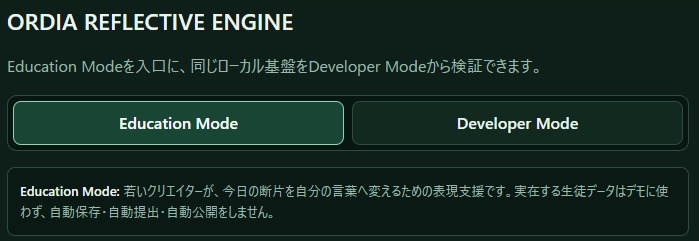
Ordia CLI 5.6
-
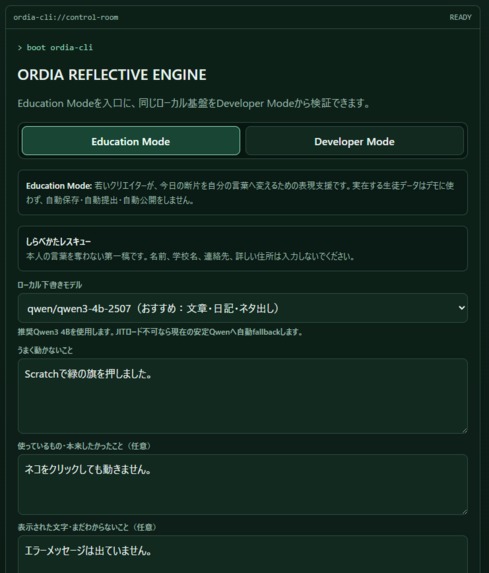
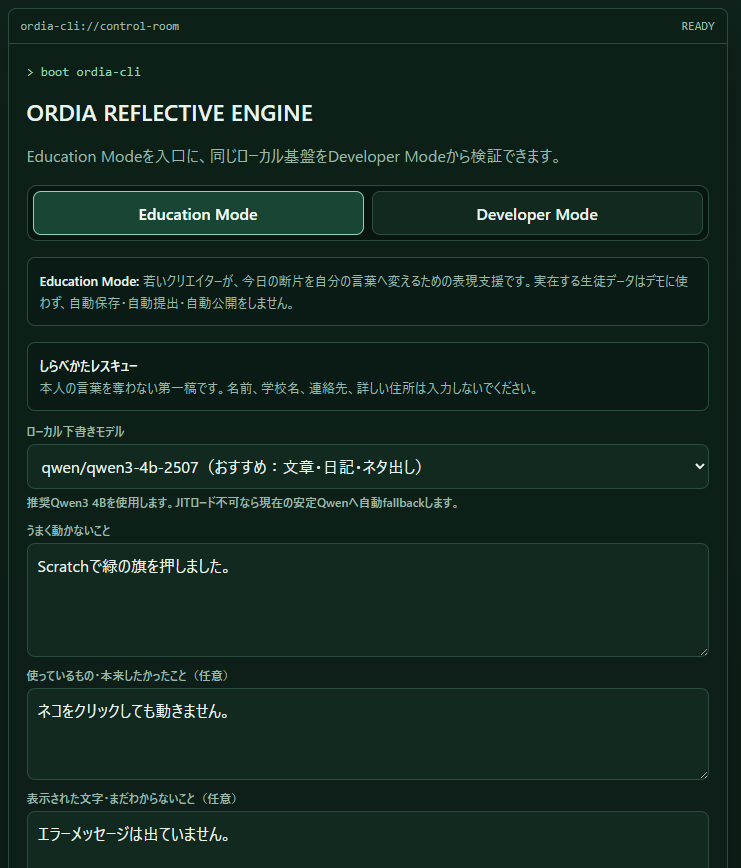
This is Search and Question Rescue.
-
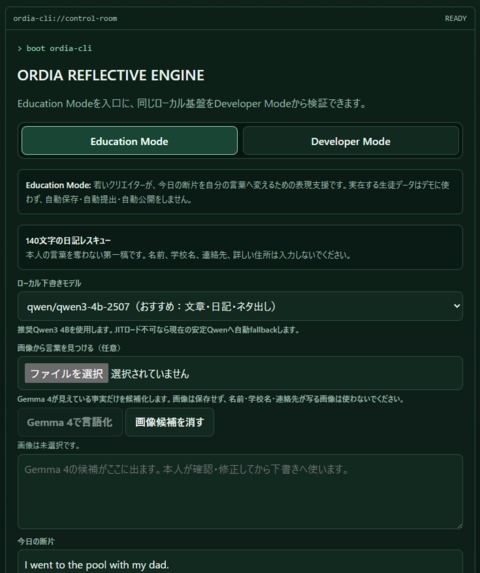
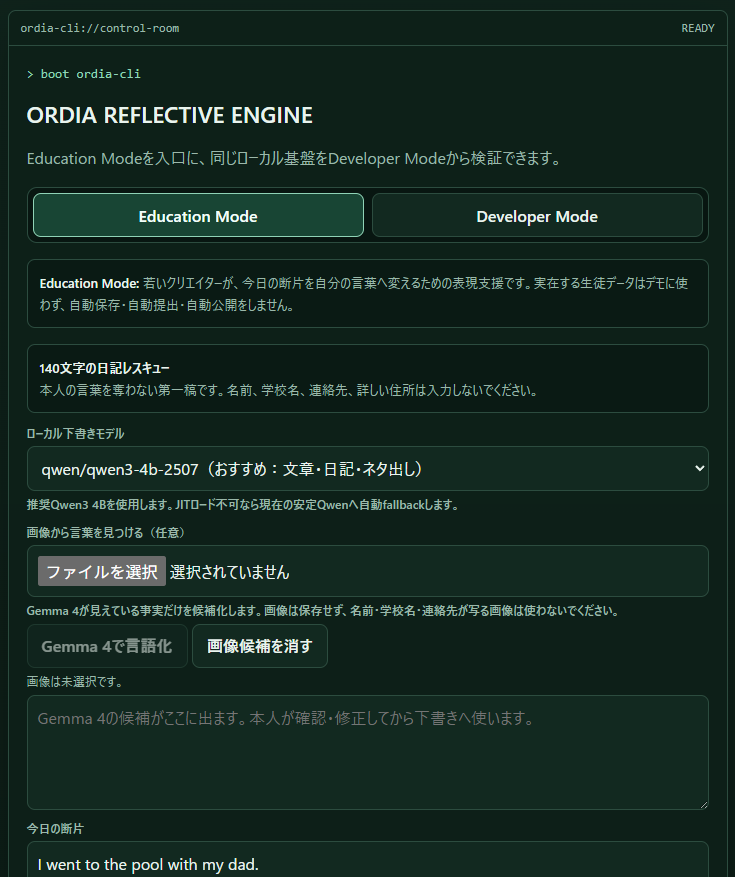
This is the 140-Character Diary Rescue.
Inspiration
In Scratch, Unity, and small HTML game projects, the first message I often hear from a child is, “Unotchi, it didn't work,” “It's not working,” or simply, “Something is wrong.”
Even adults often tell an expert only the result. The expert actually needs the operating system, version, error log, what was tried, and what happened instead. Asking children to do well what adults also struggle to do is harsh. If AI can lower that communication hurdle, that feels like a genuinely happy use of AI.
The same problem appears in writing. A child may remember a summer day but still face a blank diary page. If AI simply writes the answer, the page is filled, but the child's own words can disappear.
I built Ordia CLI 5.6 to lower the first hurdle without taking the final choice or authorship away from the learner.
What it does
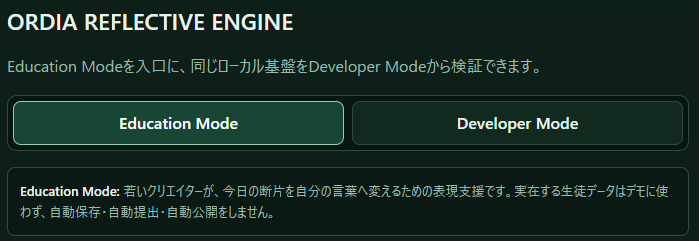
Ordia's Build Week experience starts with Education Mode:
- 140-character Diary Rescue asks up to three optional questions and creates a short first draft using only the learner's facts.
- Search & Question Rescue turns “something is wrong” in a programming project into a useful question for Google, an AI agent, or a trusted adult: what, when, where, what was tried, and what happened instead.
- Filtered Local Chat allows up to three short exchanges and closes with something the learner can choose to keep.
- Play Seed Lab mixes Roger Caillois' play categories to create a five-minute idea, while separating real-world play from game-making.
Every output ends with a human choice: keep it, revise one part, or do not use it. Ordia does not auto-submit, auto-publish, or treat a safety pass as approval.
How it works
The core loop is:
Learner input
  -> input guardrails
  -> small local model draft
  -> Hermes fixed audit
  -> limited regeneration when needed
  -> learner or adult final choice
- Qwen3 4B is the default local draft model through LM Studio.
- Qwen2.5 Coder 7B remains a stable fallback.
- Gemma 4 E4B is an optional image observation model that proposes visible facts only.
- Hermes is a fixed, inspectable audit layer. In Education Mode it checks both input and output, fails closed on unsafe or invented content, and never promotes its own pass into publication.
- Rejected model text is not shown after the limited retry budget is exhausted.
- Education conversations and drafts are not automatically saved.
- Real student data is not used for the demo, and direct cloud-AI use by children under 13 is not assumed.
A separate Developer/Publisher workflow supports my daily creator work, but its logs, quality reviews, calibration data, and repository actions are isolated from the public Education preview.
The line I did not want AI to cross
I did not want AI to replace every word a child offered.
An adult can listen, understand, and gently rephrase while staying in a relationship with the child. An AI replacing all of the child's words is not the same thing. Ordia therefore keeps the learner's facts visible, asks small optional questions, limits the number of exchanges, and leaves “do not use it” as a real final choice.
How I used Codex and GPT-5.6
Codex with GPT-5.6 was the builder, reviewer, and low-frequency calibrator, not the mandatory daily writing model.
Codex read the existing repository, implemented the Education experiences, added deterministic Hermes fixtures, created regression tests, and repeatedly checked that new Build Week work did not break my existing daily workflow. It also helped design the boundary between:
- local draft generation,
- deterministic inspection,
- human meaning and voice,
- and explicit repository actions.
For the Developer/Publisher workflow, the Codex SDK can act only after an explicit user action. It works in a dedicated clean worktree, is limited to one approved artifact, verifies Git identity and remote parity, and never publishes to social media.
This is the central idea of Ordia: GPT-5.6 does not replace the small local model. It helps make the small model safer, testable, and useful.
Privacy and public boundaries
The public preview runs on a separate local port and output root:
- Daily creator workflow: port 8787
- Public Education preview: port 8796
- Publisher, logs, Codex actions, and private review APIs: unavailable in the public preview
The public repository was generated from an explicit allowlist with a new Git history. Personal paths, Tailscale addresses, daily-post logs, PV data, internal operating documents, and experimental artifacts are excluded.
Ordia CLI 5.6 is released under the Apache License 2.0. The license permits use, modification, and redistribution while providing explicit patent and attribution terms.
Challenges
The hardest problem was not producing more text. It was deciding what the system must refuse to invent.
A small model can sound fluent while adding facts, emotions, causes, or unsafe real-world actions. A second model can repeat the same blind spots. I therefore separated generation from deterministic checks, limited regeneration, preserved failure evidence for adult review, and kept the learner's final decision outside the model.
Another challenge was developing the Build Week version without stopping the creator workflow I already use every day. The stable and public-preview ports, output roots, and actions are deliberately separated.
Accomplishments
- A working Japanese-first Education Mode with four experiences
- A 140-character diary flow that keeps authorship with the learner
- A three-step question-building flow for programming problems
- Input and output guardrails with fail-closed behavior
- Deterministic fixtures and smoke tests that do not require a live model
- Local Qwen and optional Gemma model routing
- Public-preview isolation from daily logs and Publisher APIs
- A human-approved, single-artifact Codex SDK workflow for creator publishing
- A clean standalone public repository under Apache-2.0
What I learned
The most valuable feature is sometimes a clear stopping point.
A short draft, one question, a three-turn limit, and a visible “do not use it” option can preserve more agency than an endlessly helpful chatbot. Guardrails also become more trustworthy when their reasons are visible and when a pass is explicitly not the final decision.
My favorite feature is 140-character Diary Rescue. It belongs to Education Mode, but I can honestly imagine adults using it for their everyday X posts too.
What's next
After Build Week, I want to package Ordia for local distribution, test it with fictional and consented samples, expand the fixture library through human review, and keep improving the separation between observation, drafting, auditing, and authorship.
Built With
- codex-sdk
- gemma-4
- git
- github
- gpt-5.6
- hermes
- javascript
- lm-studio
- node.js
- openai
- powershell
- qwen2.5-coder
- qwen3
- tailscale

Log in or sign up for Devpost to join the conversation.