-
-
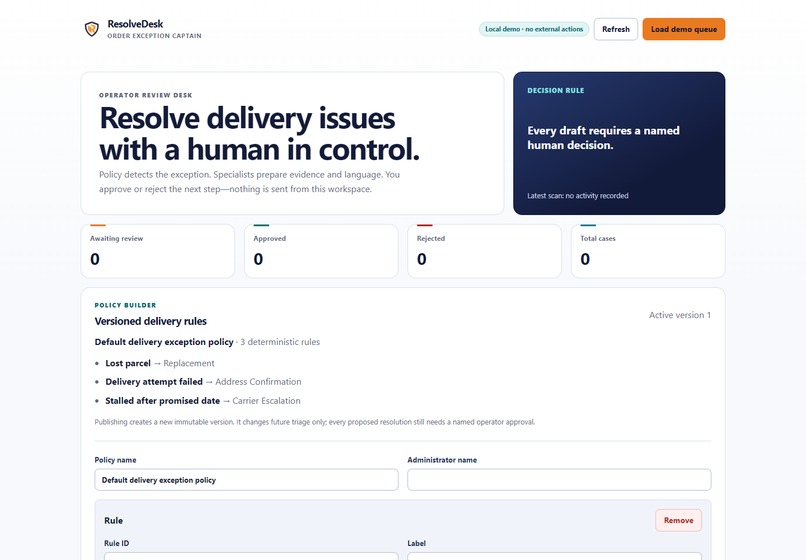
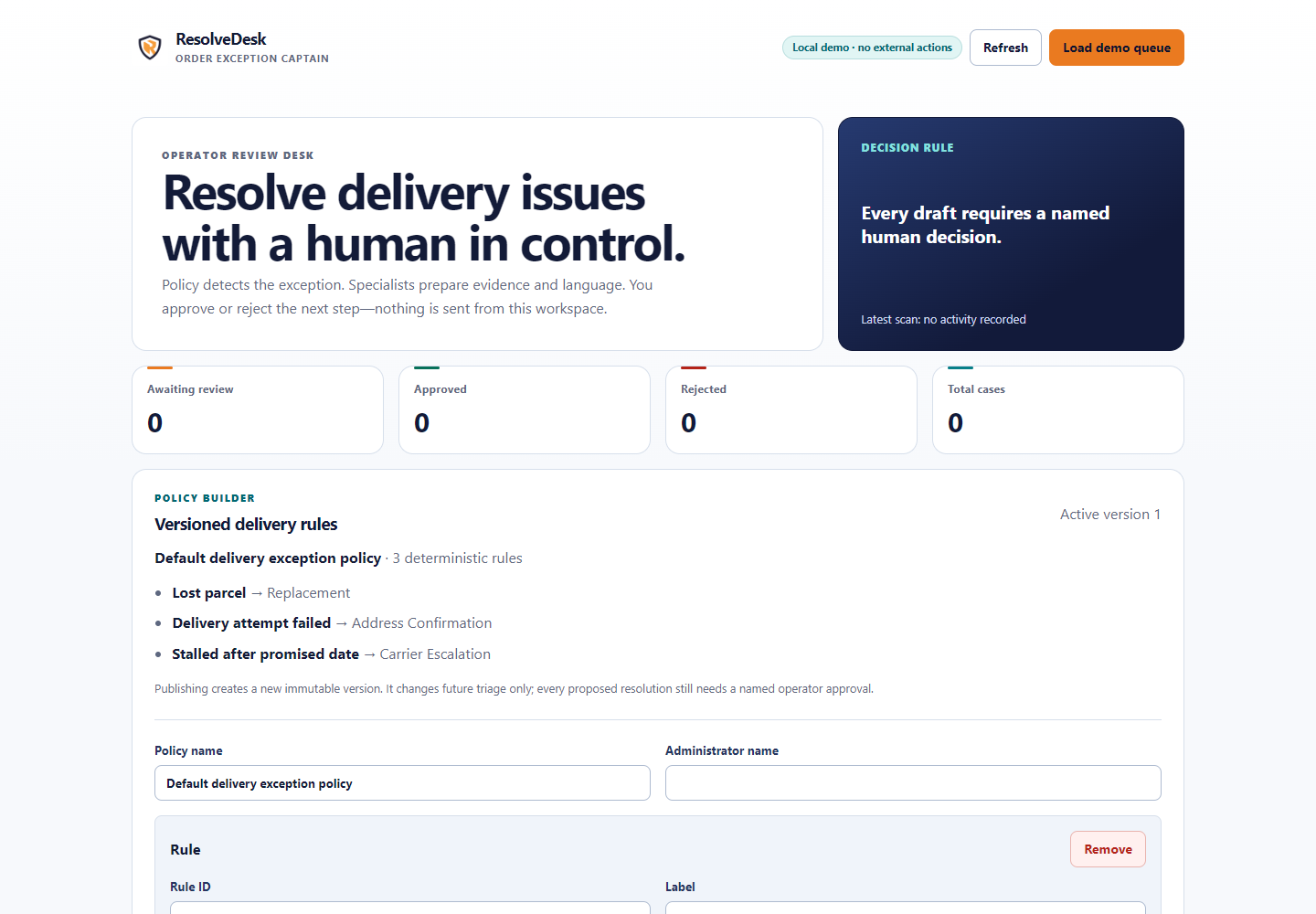
Empty Desk
-
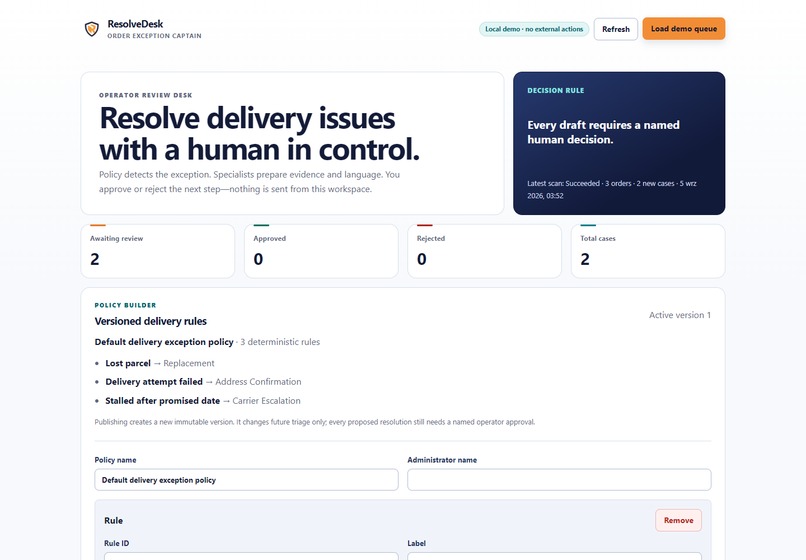
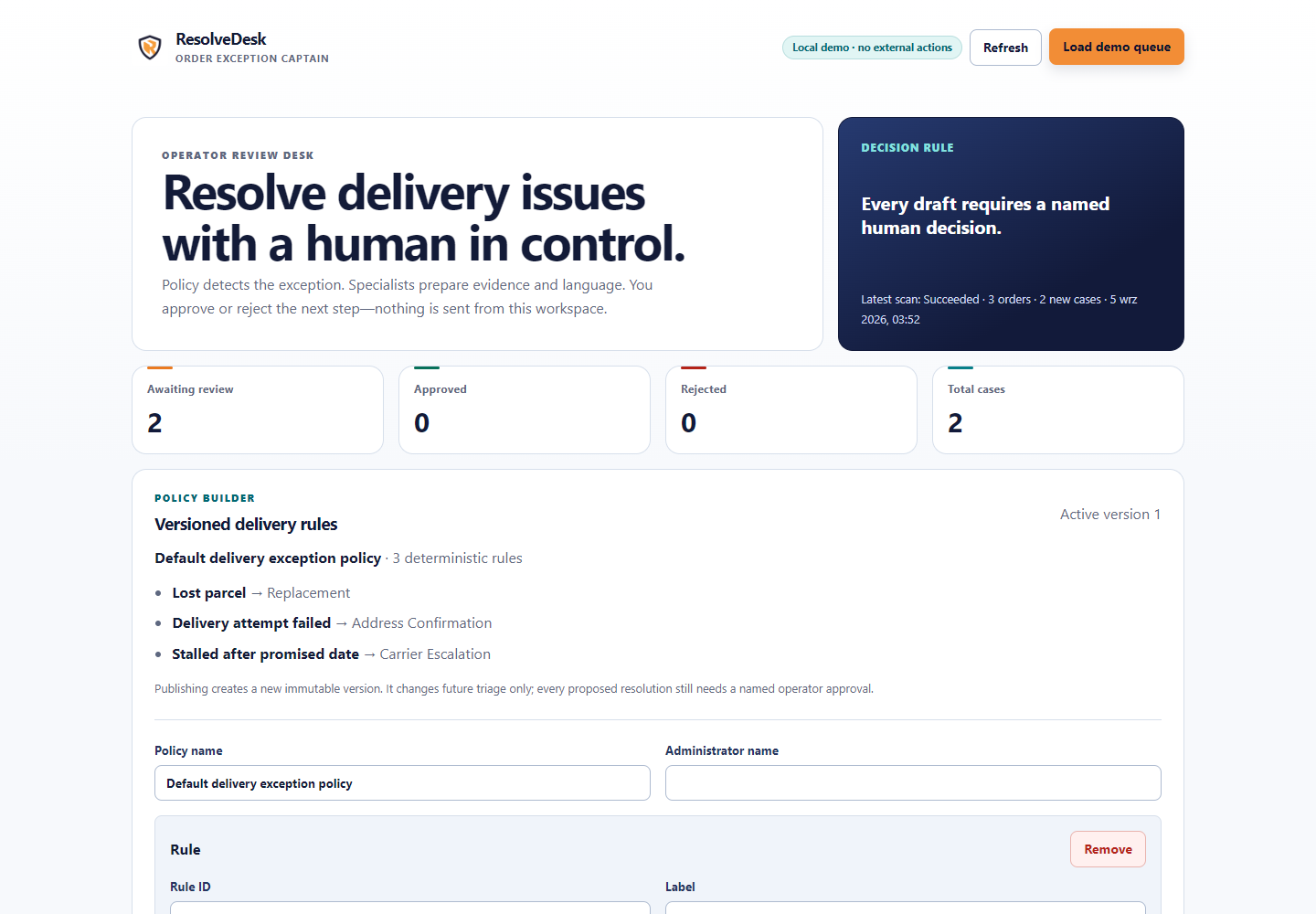
Synthetic queue
-
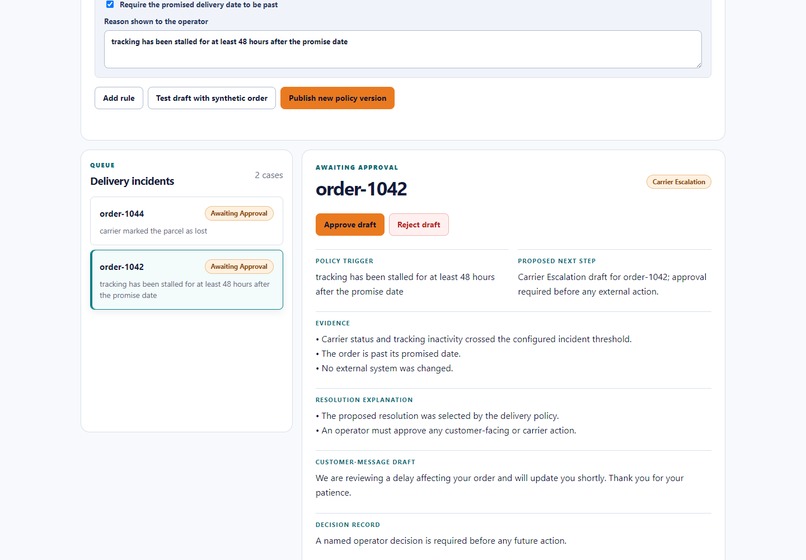
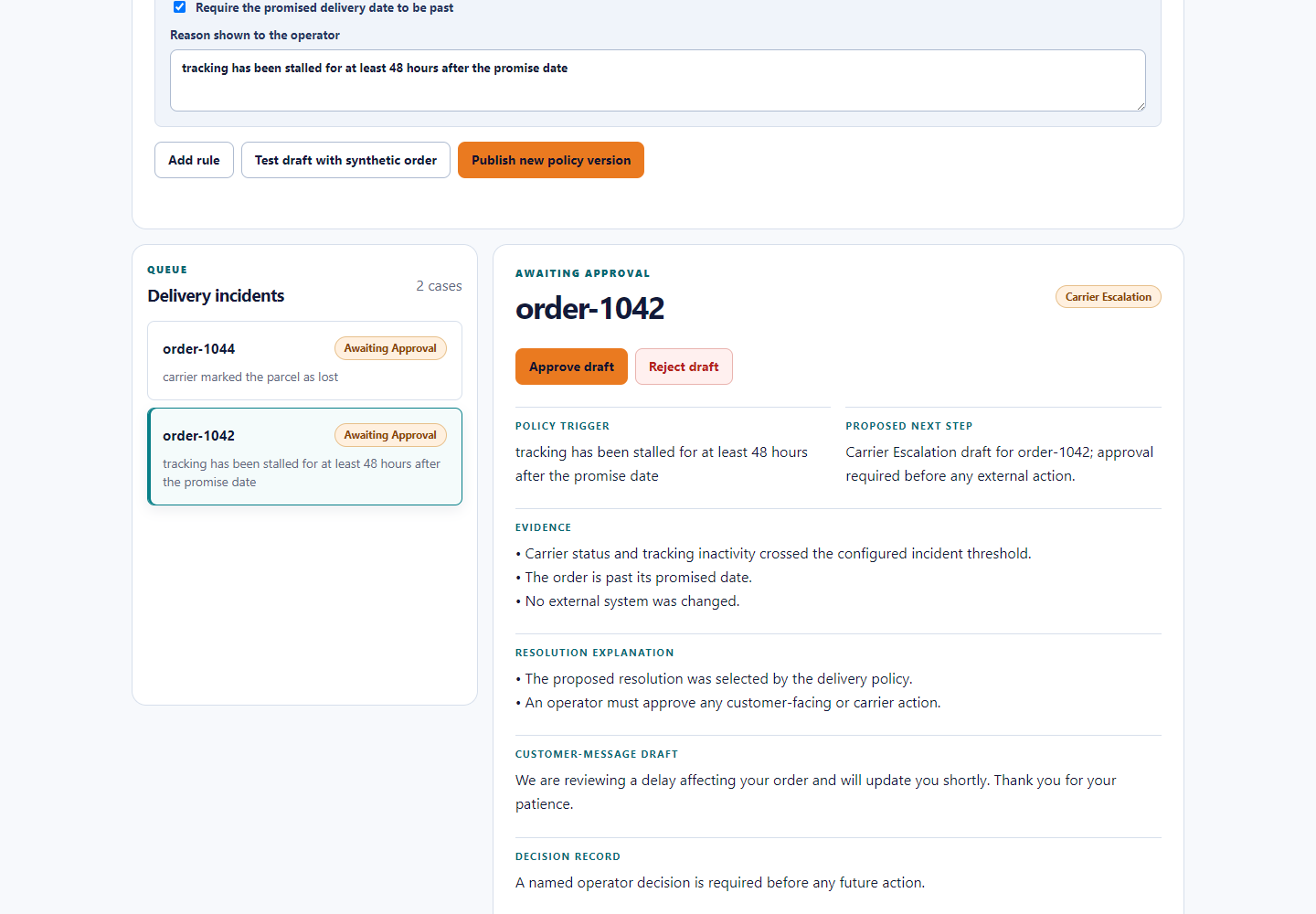
Operator workflow
-
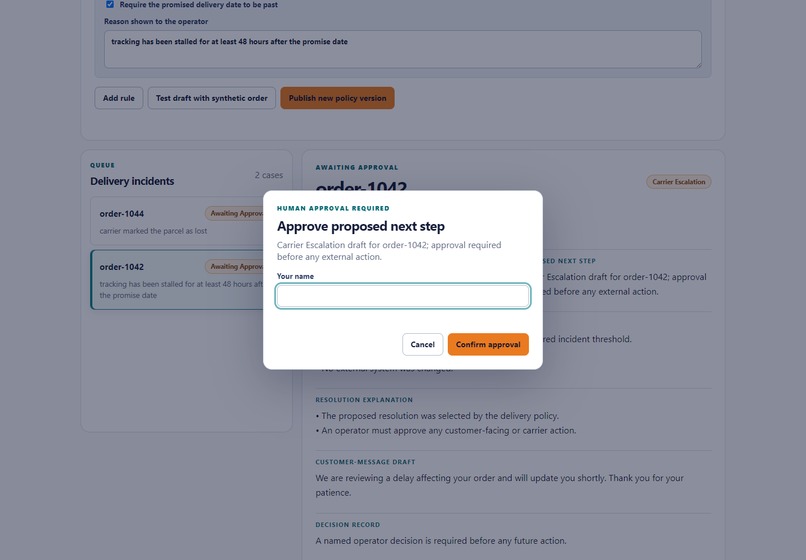
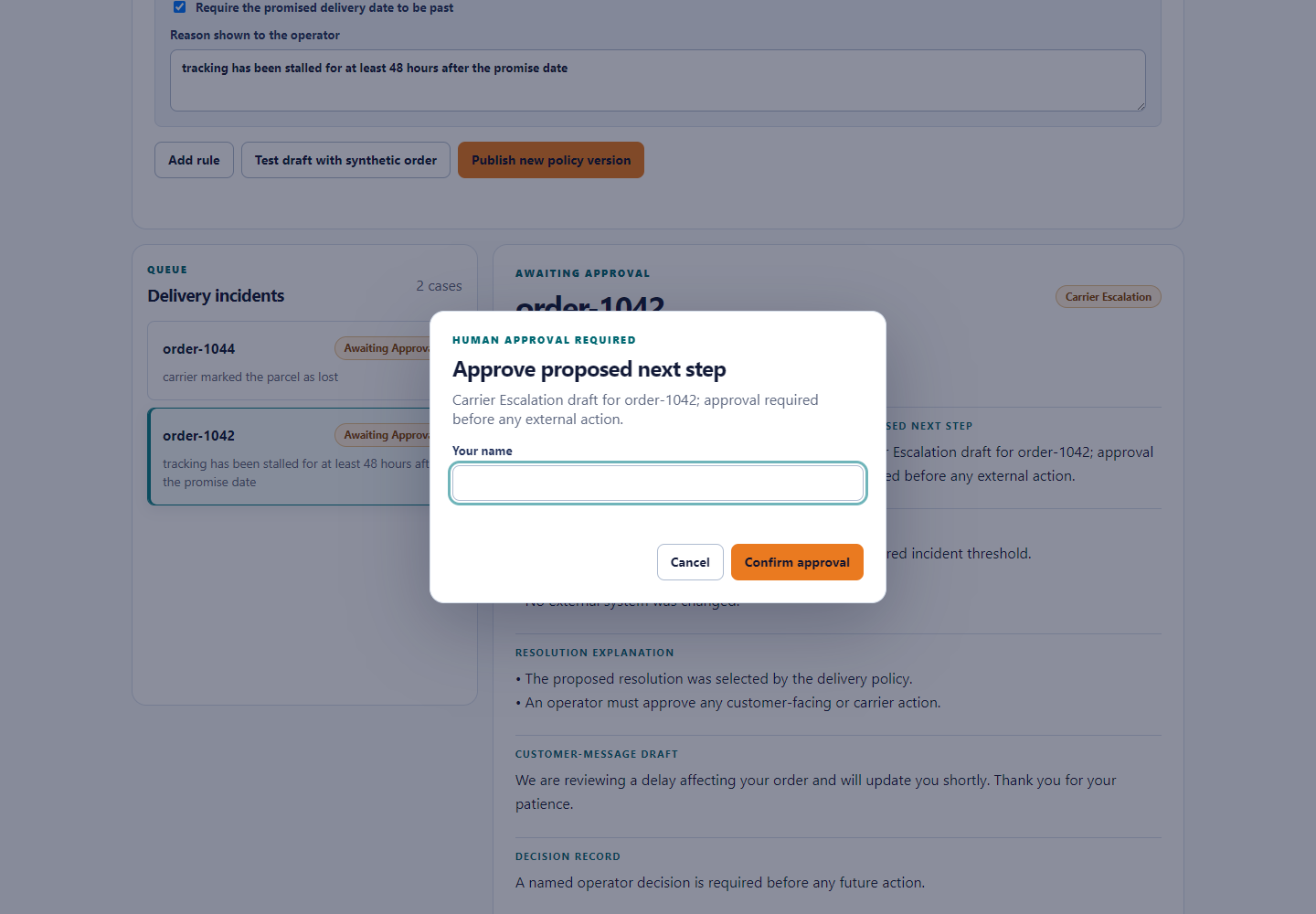
Human approval dialog
-
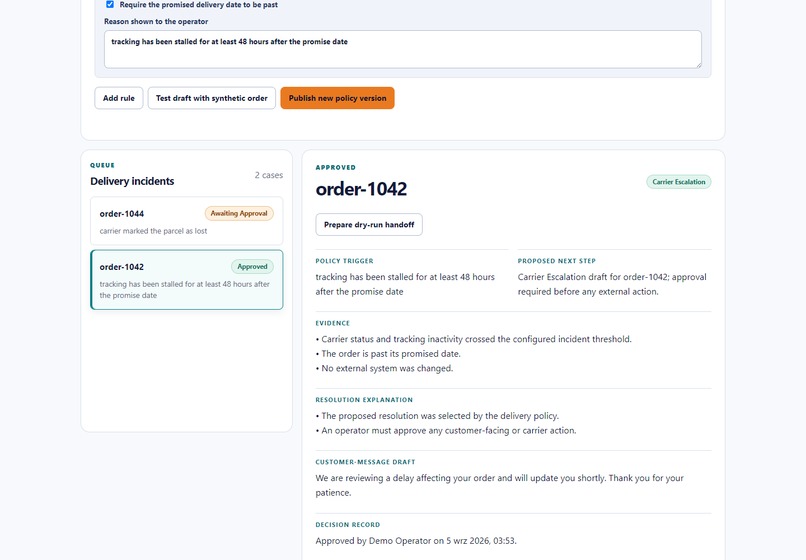
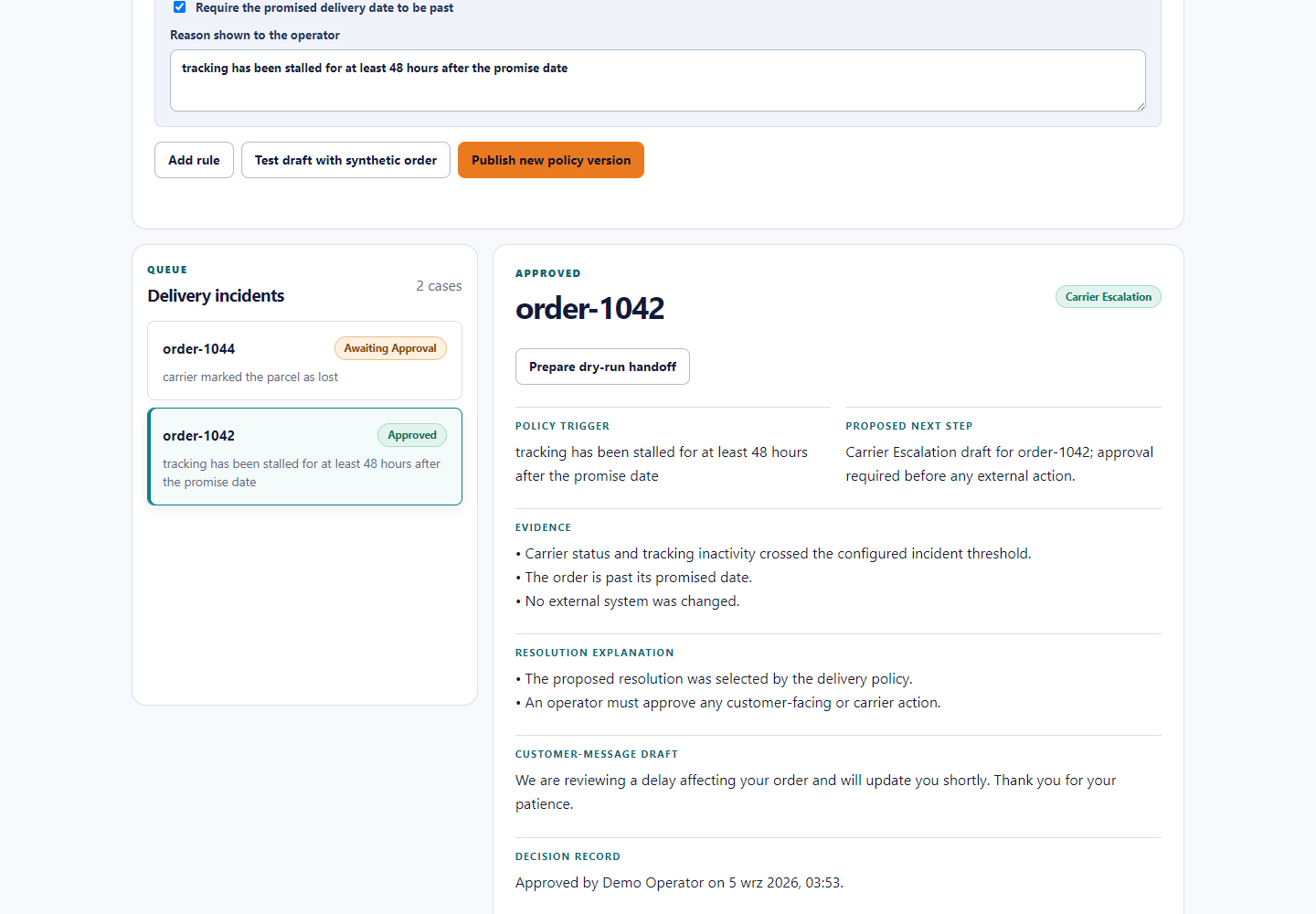
Approval edit
-
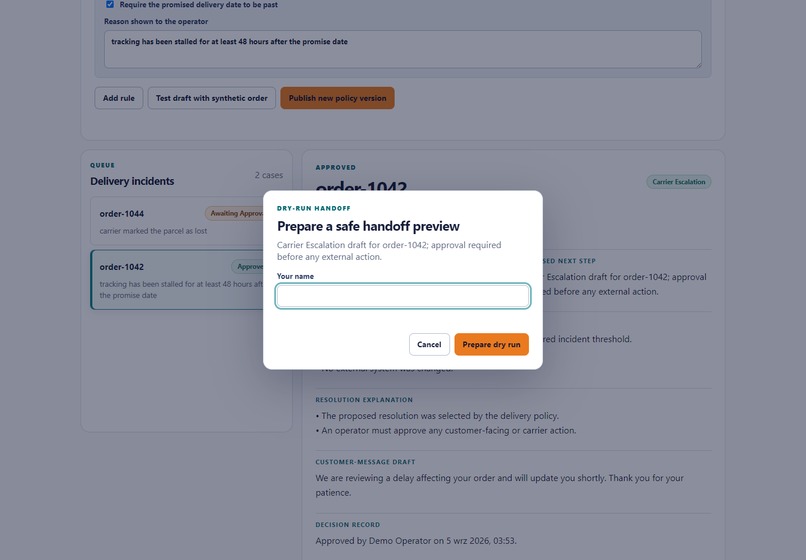
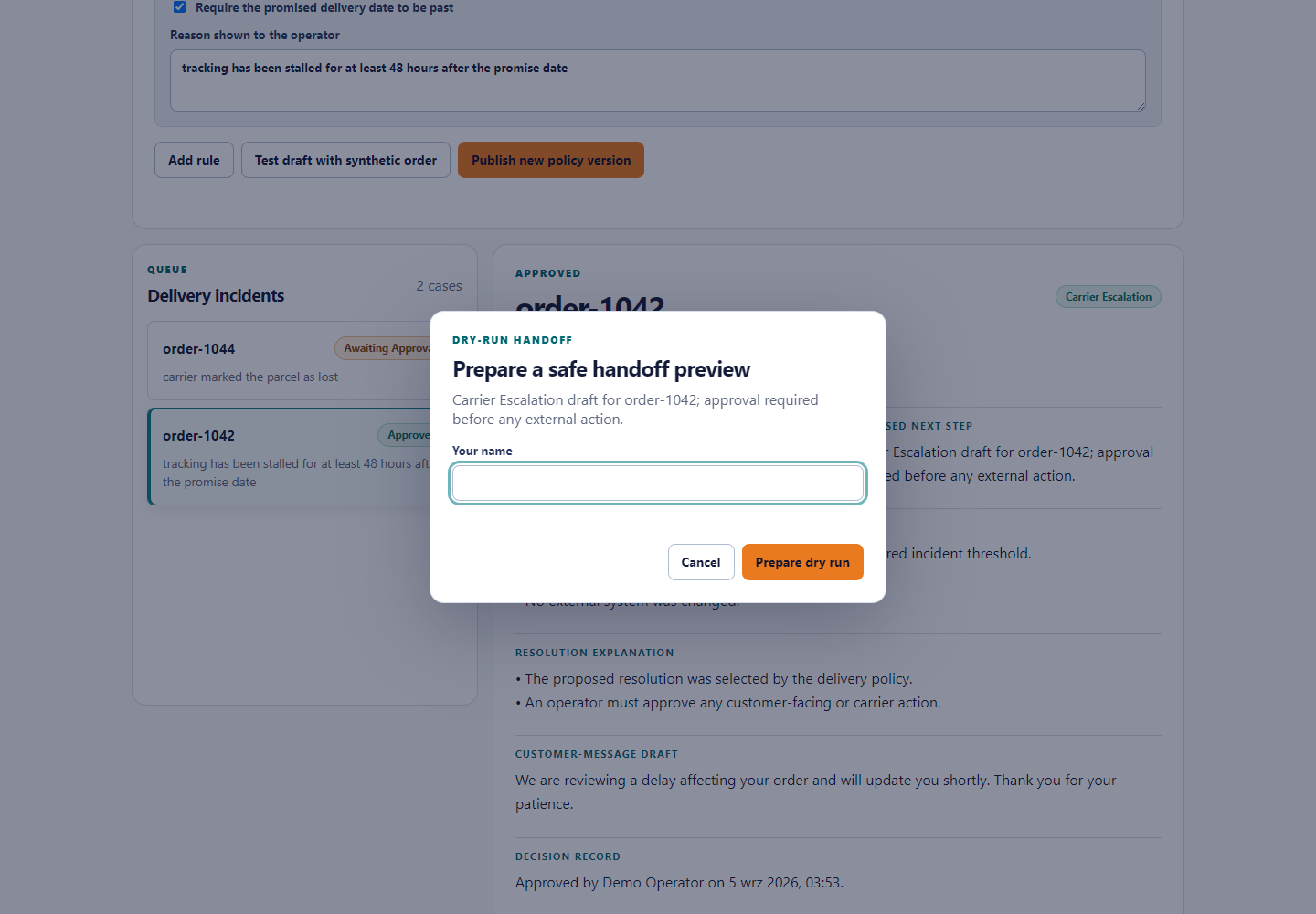
Dry run handoff dialog
-
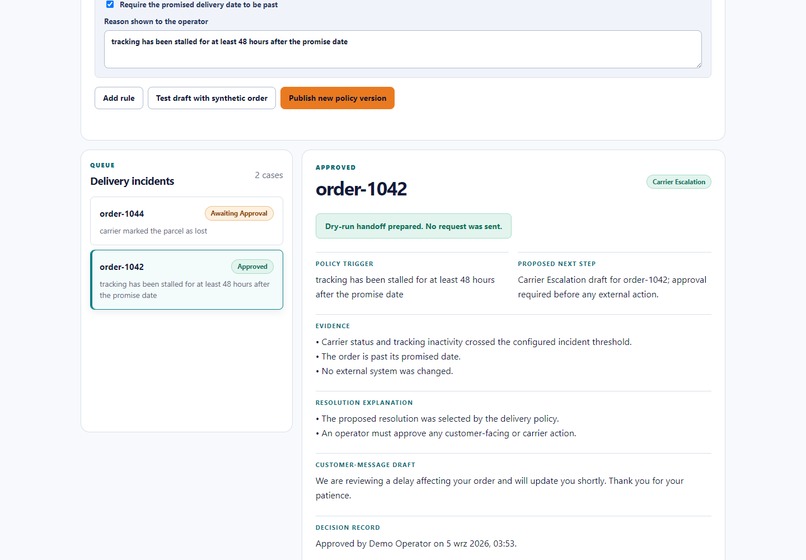
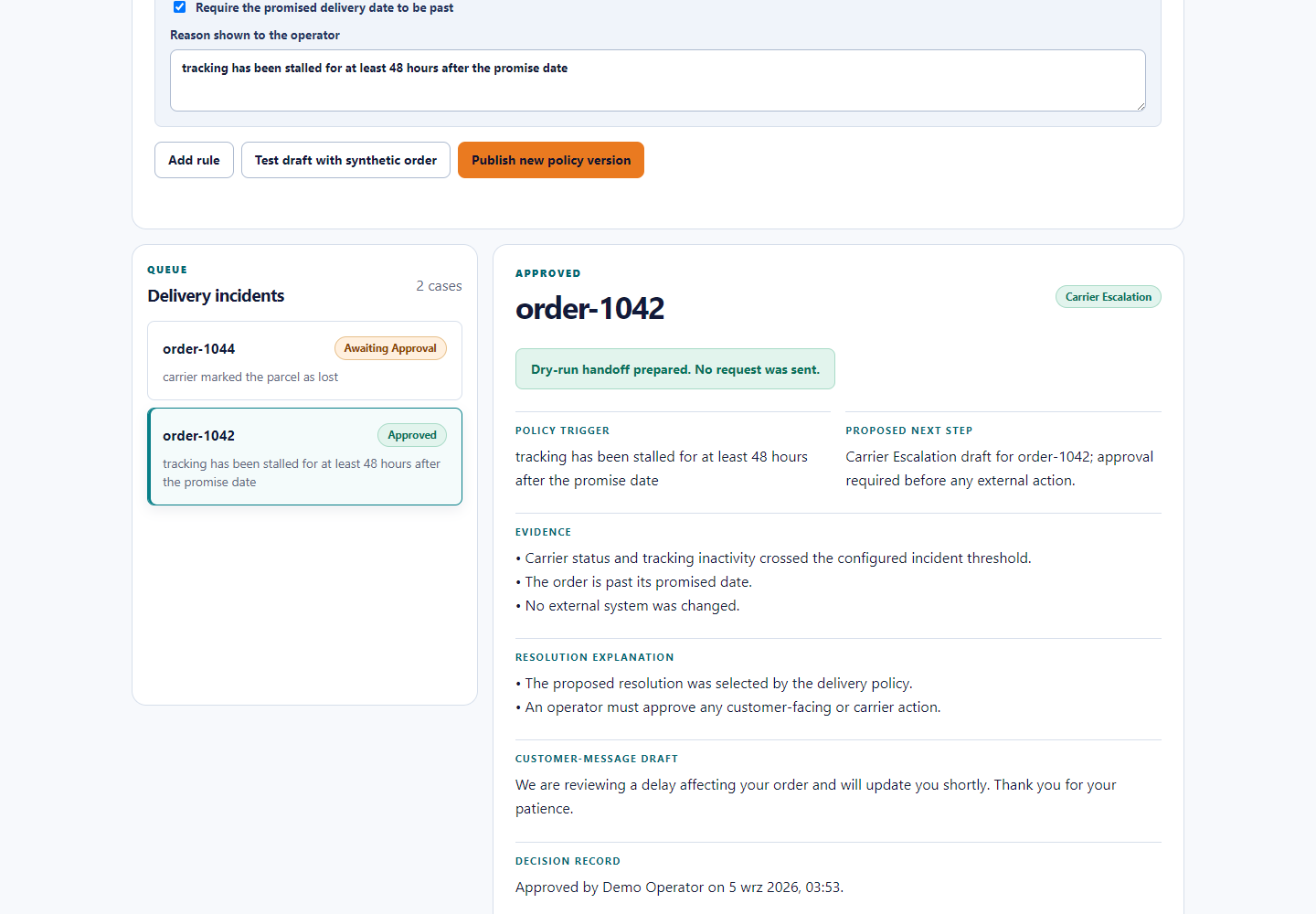
Dry run complete
-
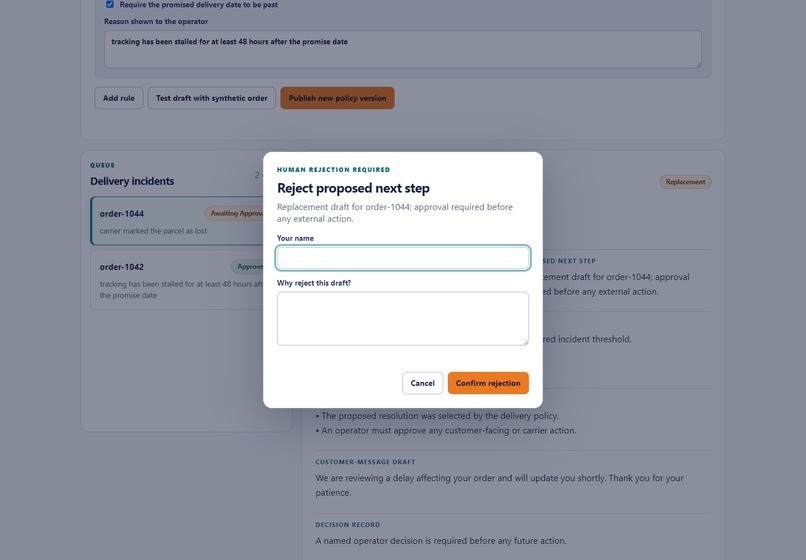
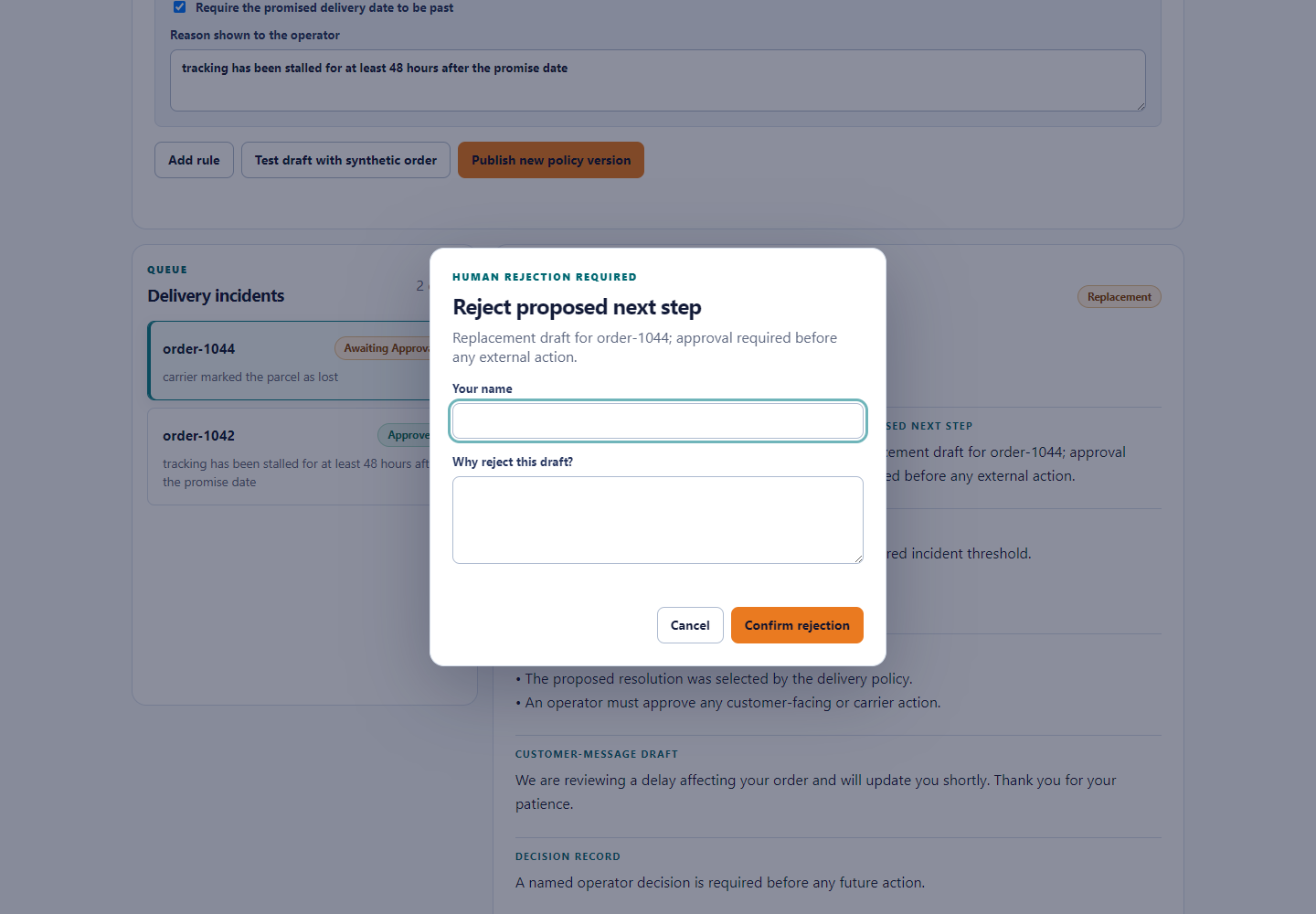
Human rejection dialog
-
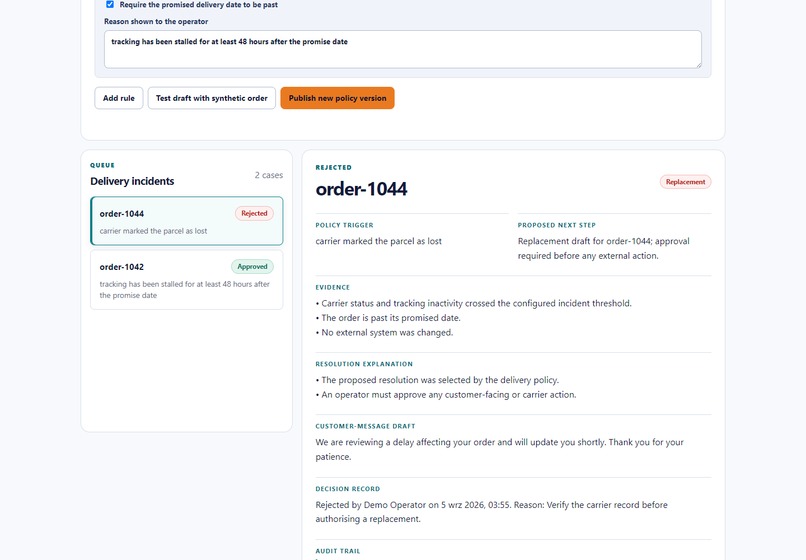
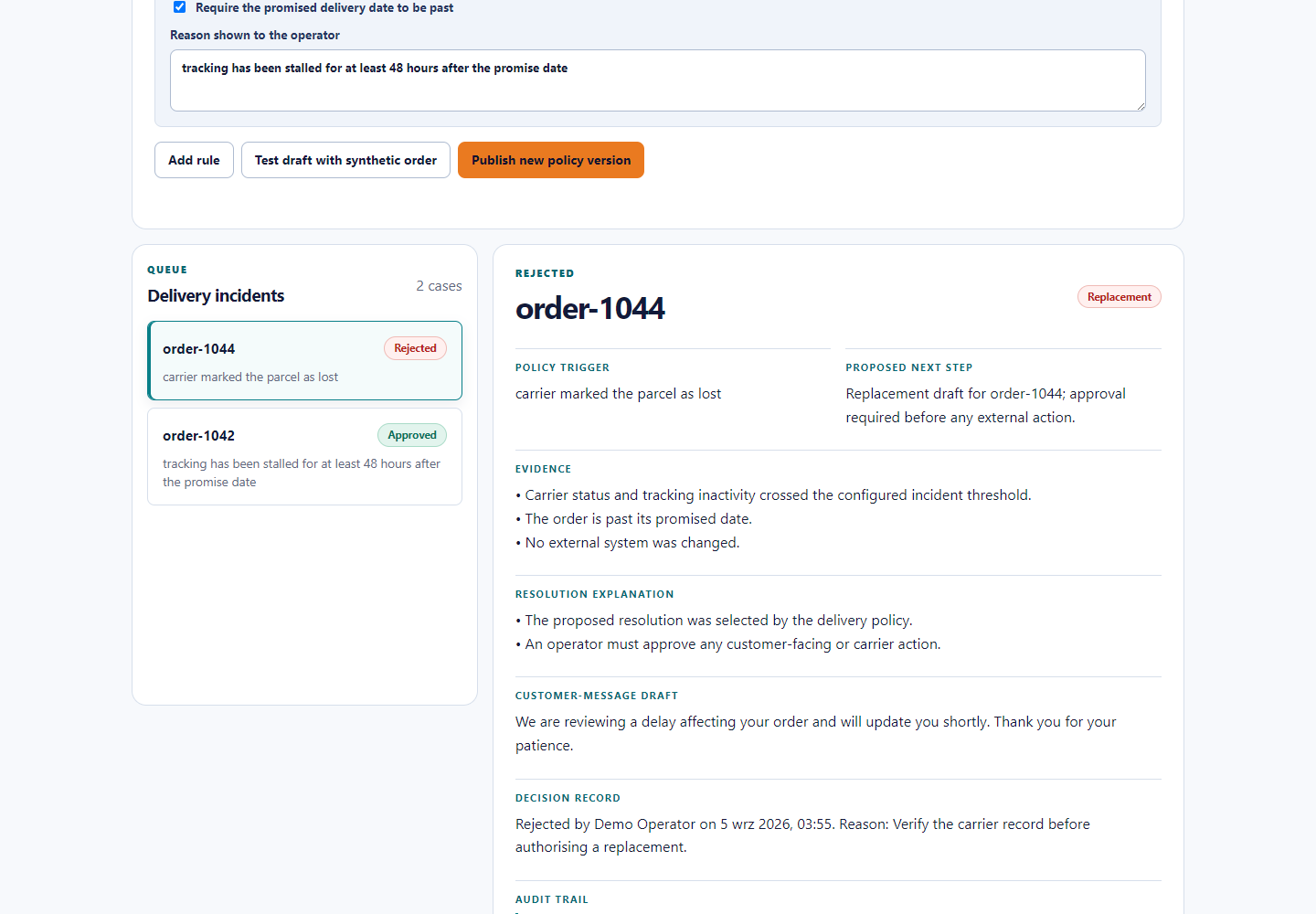
Rejection audit
ResolveDesk — Order Exception Captain — Devpost submission text
Tagline
An approval-gated Strands agent that turns delivery exceptions into safe, evidence-backed operator drafts.
What it does
Independent ecommerce operators often discover a stalled, lost, or failed delivery only after a customer has already had a poor experience. ResolveDesk — Order Exception Captain turns that repetitive exception-handling work into one clear, reviewable workflow.
It reads a delivery-status snapshot, applies deterministic policy to identify a specific exception, then runs three bounded Strands specialists in a fixed order: evidence, resolution explanation, and customer-message drafting. The result is an auditable draft for a named human operator. The agent cannot select the route, approve an action, issue a refund, contact a carrier, or message a customer.
Who it is for and why it matters
The project is for small ecommerce operations teams that need to respond to delivery problems quickly without turning customer communication or financial decisions over to an LLM. It makes the important facts, policy result, and proposed message visible before a human decides what happens next.
How it is built
- Python, FastAPI, SQLite, and the Strands Agents SDK.
- Deterministic routing and idempotency are ordinary code, not model decisions.
- Three role-specific Strands agents create bounded drafts only.
- Amazon Bedrock provides the final live-proof path. A synthetic Amazon Bedrock
Haiku 4.5 run completed in
eu-north-1after a recorded cost boundary and produced the fixed evidence → resolution → communications trace. - The local dashboard supports loading synthetic data, reviewing redacted drafts, named approve/reject decisions, an auditable dry-run handoff, a configurable bounded Policy Builder, and a configured, isolated read-only WooCommerce sample store.
Safety and privacy
The demo uses synthetic, reserved-domain data. Customer names and emails are
excluded from specialist prompts; common email and phone patterns are redacted
before drafts are persisted or displayed. The optional WooCommerce connector
uses only HTTPS GET with server-side Read credentials against an isolated
sample store containing three completed synthetic orders: stalled, lost, and
failed delivery attempt. No external write adapter exists. All outbound-shaped
activity is a visible, idempotent dry-run preview after named approval.
Testing instructions
The offline demo is free to run and needs only Python 3.11+ and uv:
uv sync --extra dev
uv run pytest
uv run order-exception-captain --approve
uv run order-exception-captain-api --database data/demo.sqlite3
Open http://127.0.0.1:8000/ to load the synthetic queue and approve or reject
a draft. The optional Bedrock proof is documented in
BedrockProofRunbook.md; it uses only synthetic data
and requires the evaluator's own AWS credentials and selected cost boundary.
The live synthetic demo is available at
https://oec.connect-the-dots.biz. The
dashboard shell is public, but operator and policy-editing access need separate
tokens; do not put those values in a public README or video. The deployment
guide explains their origin and secure administrator retrieval.
Provenance and third-party tools
This is a new project created during the submission period. It uses standard open-source libraries and AWS services. It is conceptually informed by prior agent experiments but contains no copied source code from them.
Built With
- amazon-web-services
- fastapi
- python
- sqlite
- strands
- strandsagentssdk
- woocommerce


Log in or sign up for Devpost to join the conversation.