-
-
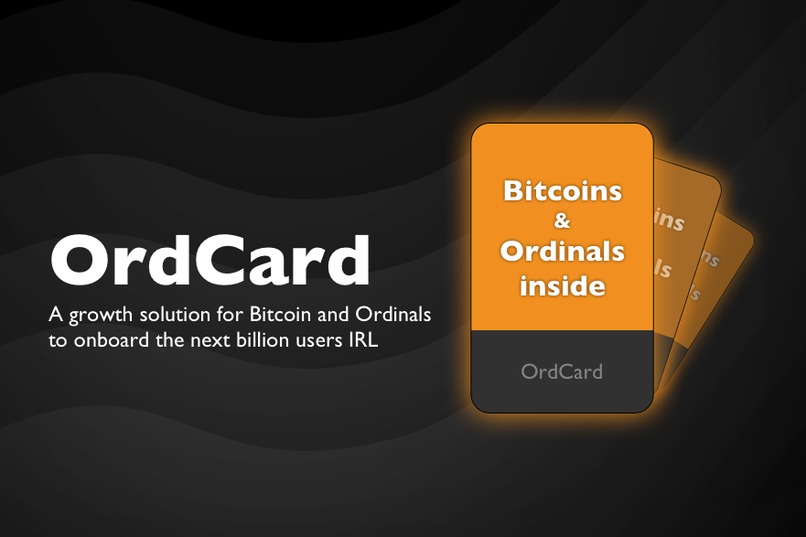
OrdCard - A growth solution for Bitcoin and Ordinals to onboard the next billion users IRL
Inspiration
We believe that blockchain technology, represented by Bitcoin, will have a significant impact on human society and economic development. However, currently, the high barrier to entry has resulted in a relatively small number of users who are able to experience blockchain technology. During our travels in some countries in Southeast Asia, South America, and Africa, we found that the local financial infrastructure was poor, and Bitcoin had the opportunity to fill the financial gap. In these countries, people recharge their phones by purchasing phone credit cards at street shops. So, isn't it cool to provide users with a wallet and Bitcoin service through a physical card with a chip? Moreover, users do not need to learn any complex wallet knowledge in advance and can immediately use a wallet that already has Bitcoin in it.
Problems
The current customer acquisition method is too complicated. Firstly, users need to search and install a wallet app from the app store. For Android users who do not use Google Play, it is easy to install an APK package with malicious code, but many users are not aware of this. Secondly, after installing the wallet, it needs to be created. During the creation process, users need to record 12 or 24-word mnemonic phrases and keep them properly. This process takes at least 3-5 minutes and requires a pen and paper, as well as a secure place to keep the mnemonic phrases. Finally, after creating the wallet, the wallet balance is zero. Users need to purchase BTC in a CEX and then transfer it to the wallet. Then they can use the BTC in the wallet to buy or mint ordinals. If everything goes smoothly, it will take about half an hour to get ordinals. Oh, by the way, not all wallets support ordinals. If a wallet that does not support ordinals is installed, the process needs to be repeated. Based on the current user process, it is impossible to achieve mass adoption of Bitcoin and ordinals.
What it does
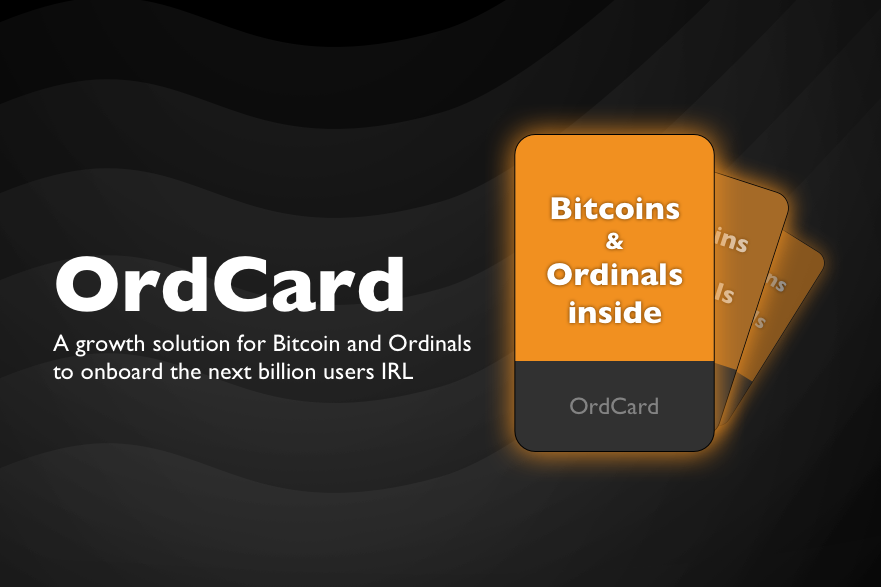
Firstly, it is an NFC card that can be activated by simply tapping it on the NFC prompt of currently popular smartphones, without the need to download an app. Secondly, it has a built-in multi-chain smart contract wallet that supports the Bitcoin network. As a smart contract wallet, users do not need to copy down the mnemonic phrase separately. At the same time, it supports the creation of wallet addresses in advance, and pre-emptively airdrops Bitcoin and the latest Bitcoin Ordinals into the wallet. Before the user receives the card, the wallet already has assets, reducing the waiting time for subsequent transactions. Finally, it is a self-custodial wallet, secured by a smart contract. After logging in through email, the user can obtain an activation code. Upon activating the wallet, the user gains complete and unique control over the wallet and can freely use the Bitcoin and Ordinals inside.
How we built it
We implemented the product functionality of the wallet using Rust and implemented the smart contract functionality through IC's Canister. The frontend functionality was implemented using JavaScript. The product is ultimately presented in a web-based format. Our product uses threshold ECDSA to solve the problem of private key storage. Related introduction: https://internetcomputer.org/capabilities/multi-chain-transactions/
Challenges we ran into
We need to support the wallet PoC implementation in a very short time and support the display and transfer of Bitcoin and the latest Ordinals protocol.
Accomplishments that we're proud of
We completed the product planning, feature design, code writing, and PoC implementation within 4 days. We found 50 offline users in Hong Kong to test it, and they all thought it was amazing: with just a tap on the phone, logging in and activating through email, they were able to obtain a lightweight and fully functional Bitcoin wallet in just 2 minutes, and it was completely self-custodial. From a novice to a Bitcoin holder, it only takes 2 minutes and does not require downloading any apps. Data Proof: https://docs.google.com/document/d/1atZtNYQdumZjIcjO0JXwMg8o9yQx6Do3e2iBeGmYFbo/edit?usp=sharing
What we learned
We found that the combination of this physical card and smart contract wallet is particularly suitable for exhibitions, offline scenarios, and areas with incomplete financial infrastructure. The card is a very visual product, and NFC is a widely used technology. The smart contract wallet eliminates the trouble of users having to remember the mnemonic phrase and ensures their self-custody and control over their assets. We believe that such a combination is very suitable for attracting more new users on a large scale in the future.
What's next for OrdCard
- Diversification of login methods. Currently, in order to quickly implement the product, only Google login (which is actually a type of email login) is supported. In the future, we will support email, phone number, third-party social account login, and even MetaMask and hardware wallet login methods.
- Collaboration with many Ordinals projects, allowing artists to effectively utilize the appearance of the card and the UI customization of the wallet. This way, users will get a card, a Bitcoin wallet, and Ordinals that are as seen in the promotion.
- Collaboration with more offline event organizers, supermarkets, and convenience store channels in more regions to promote Bitcoin and Ordinals, allowing more users to easily access Web3.
Built With
- canister
- ic
- javascript
- rust


Log in or sign up for Devpost to join the conversation.