OrchestrateLive
Selected Track: 01 — Software & Technology
📌 Problem Statement
- What problem are you solving? As software development shifts from manual coding to managing autonomous AI CLI agents, developers face overwhelming terminal clutter. Running concurrent CLI tools produces unstructured walls of text, obscuring what each agent is actually executing.
- Who experiences this problem? Modern software engineers, AI developers, and technical builders orchestrating multi-agent systems and AI coding assistants (like Claude Code, Cursor, and custom CLI agents).
- Why is the problem important? Developers lose hours deciphering dense text logs, babysitting stalled agents, and suffering context fatigue. Without real-time visibility into generation speed, token consumption, and context saturation, workflows become inefficient and costly.
- Existing limitations & gaps: Current terminal environments lack visual state tracking, ambient progress feedback, and unified multi-agent interfaces. Most observability platforms require heavy SDKs or cloud integrations that pollute project repositories and risk leaking proprietary code to third-party servers.
💡 Your Solution
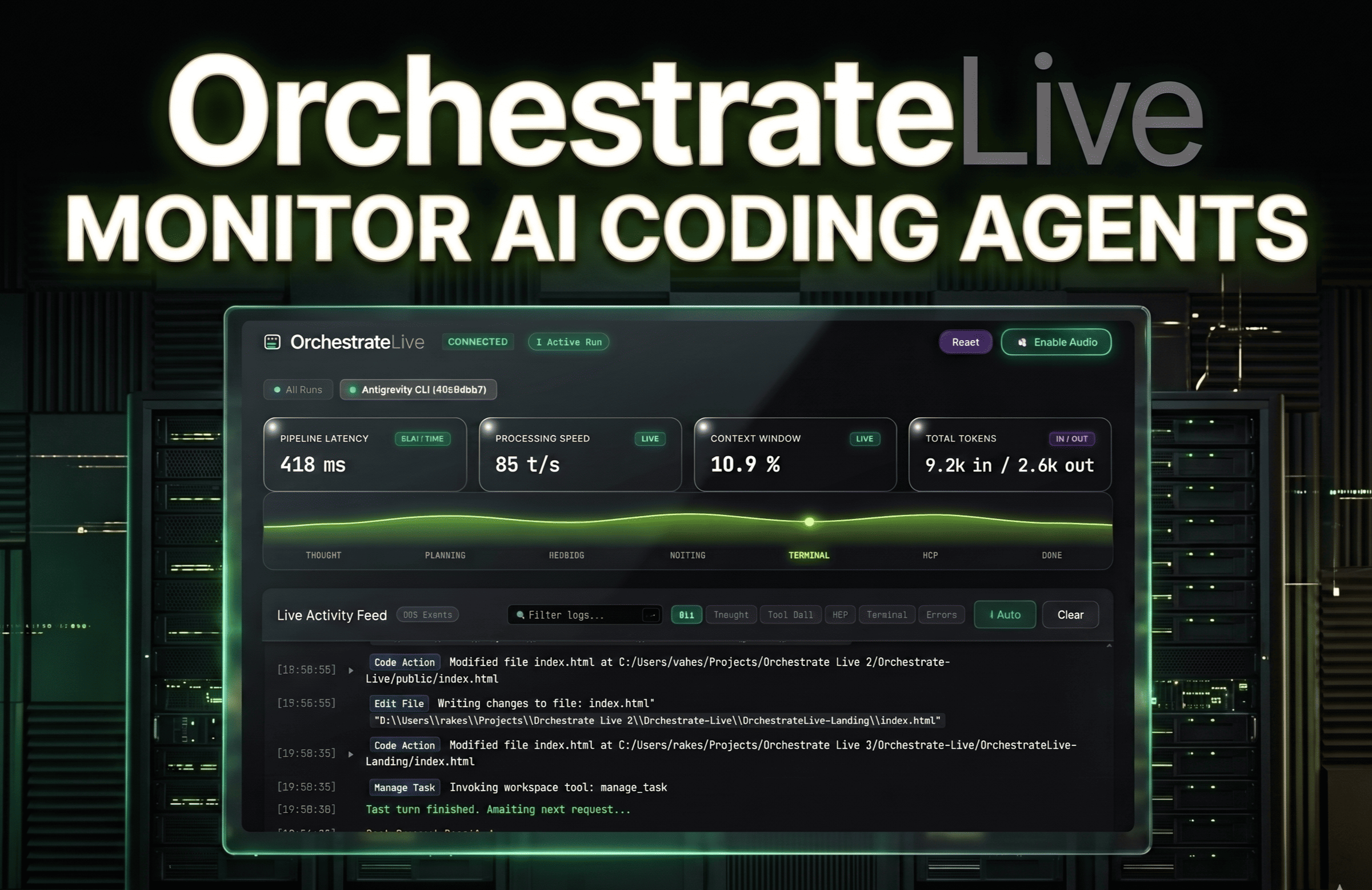
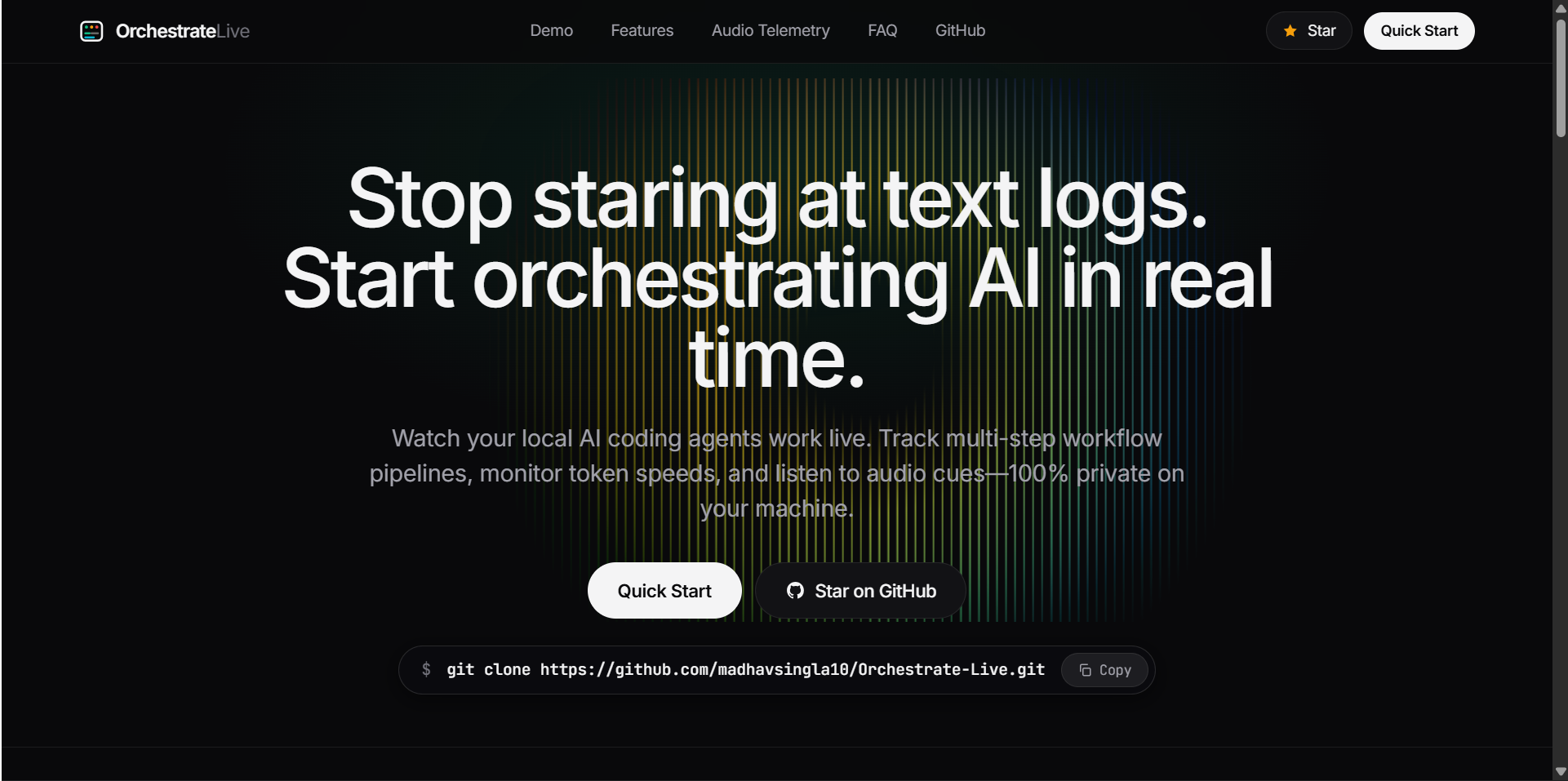
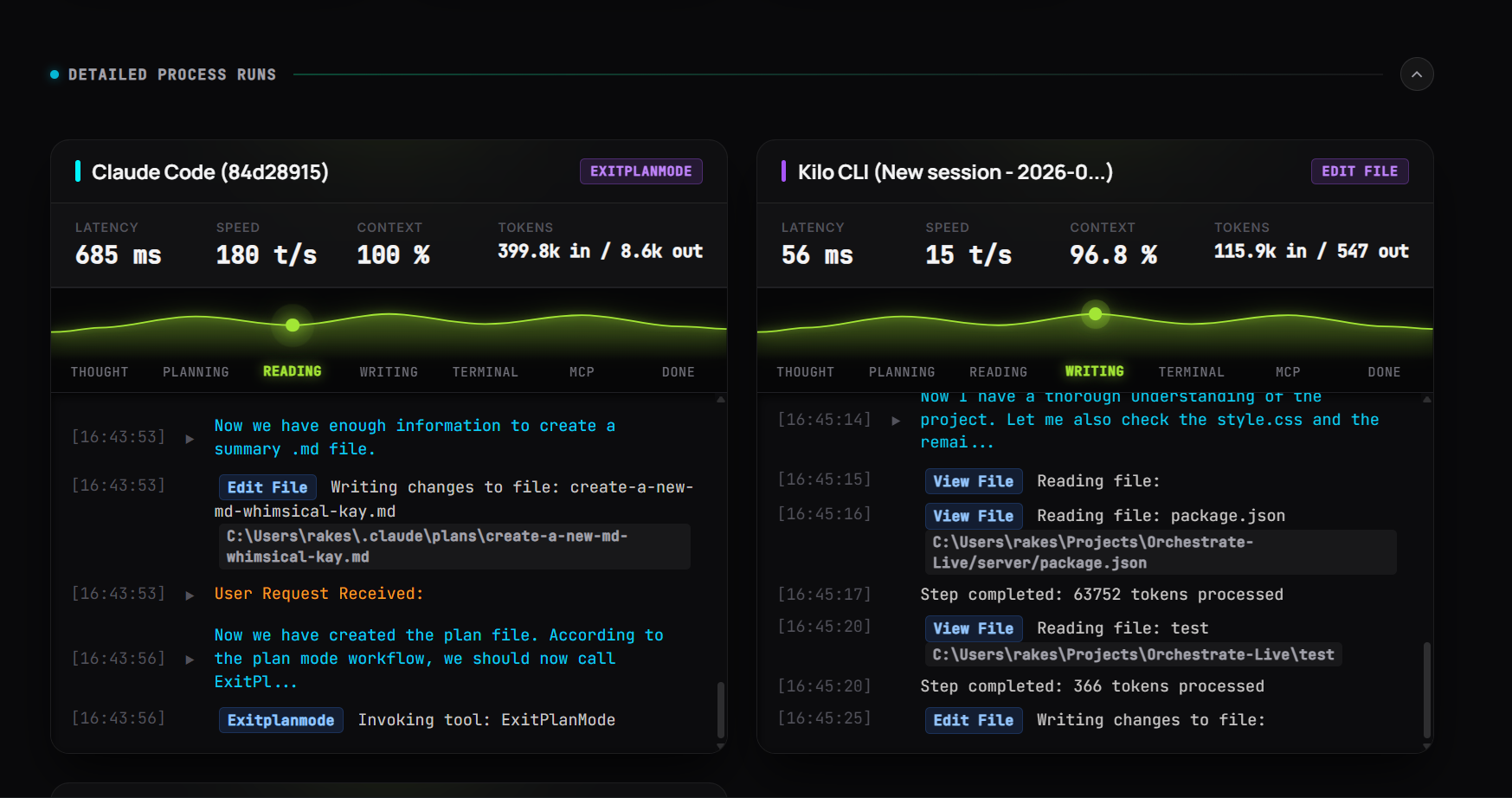
OrchestrateLive is a lightweight, zero-dependency, local-first observability command center that converts raw AI CLI outputs into an interactive visual dashboard with ambient audio telemetry.
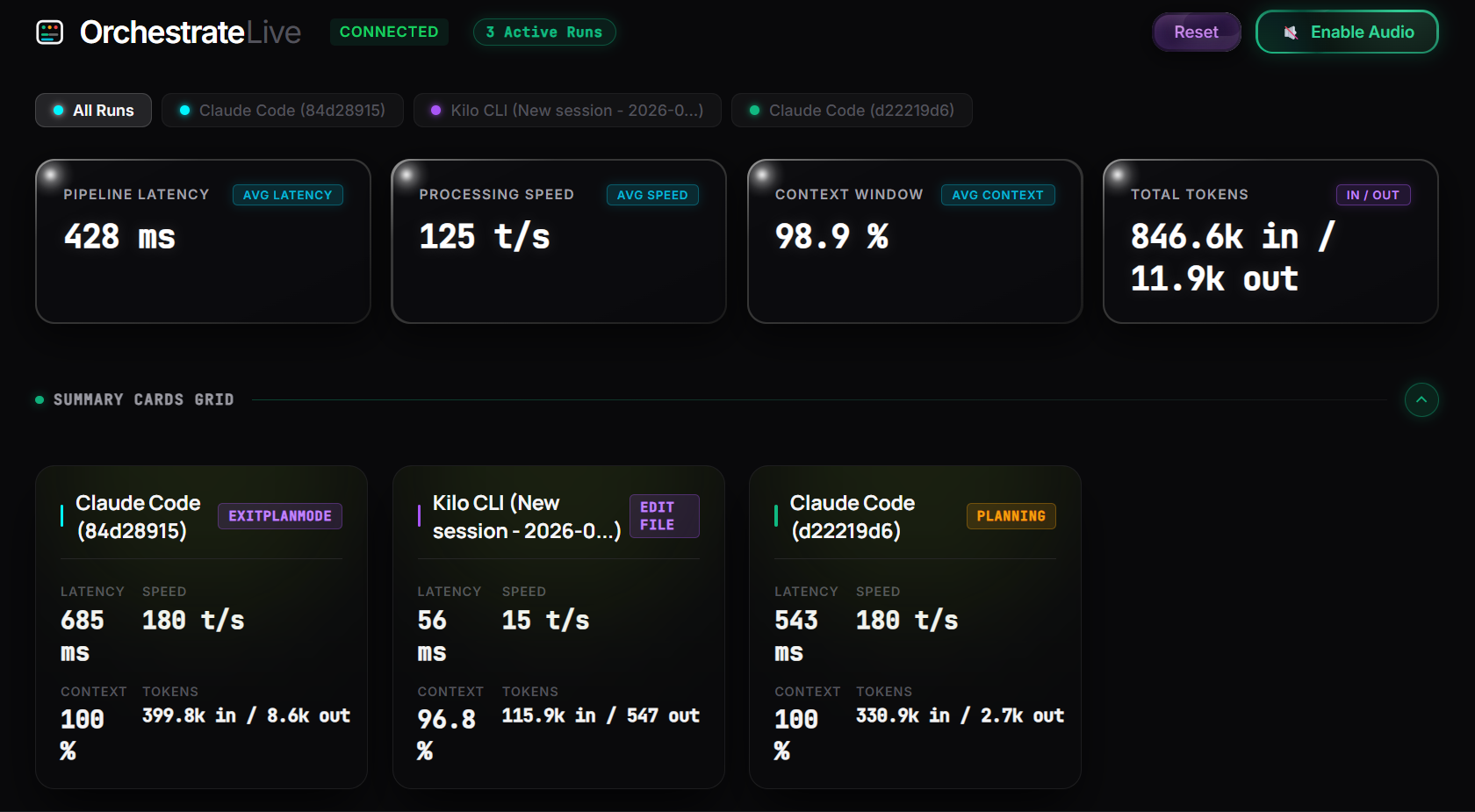
- Unified Multi-Agent Monitoring: Aggregates parallel agent runs into a single dashboard, allowing developers to switch between a bird's-eye view and focused, single-agent inspection tabs.
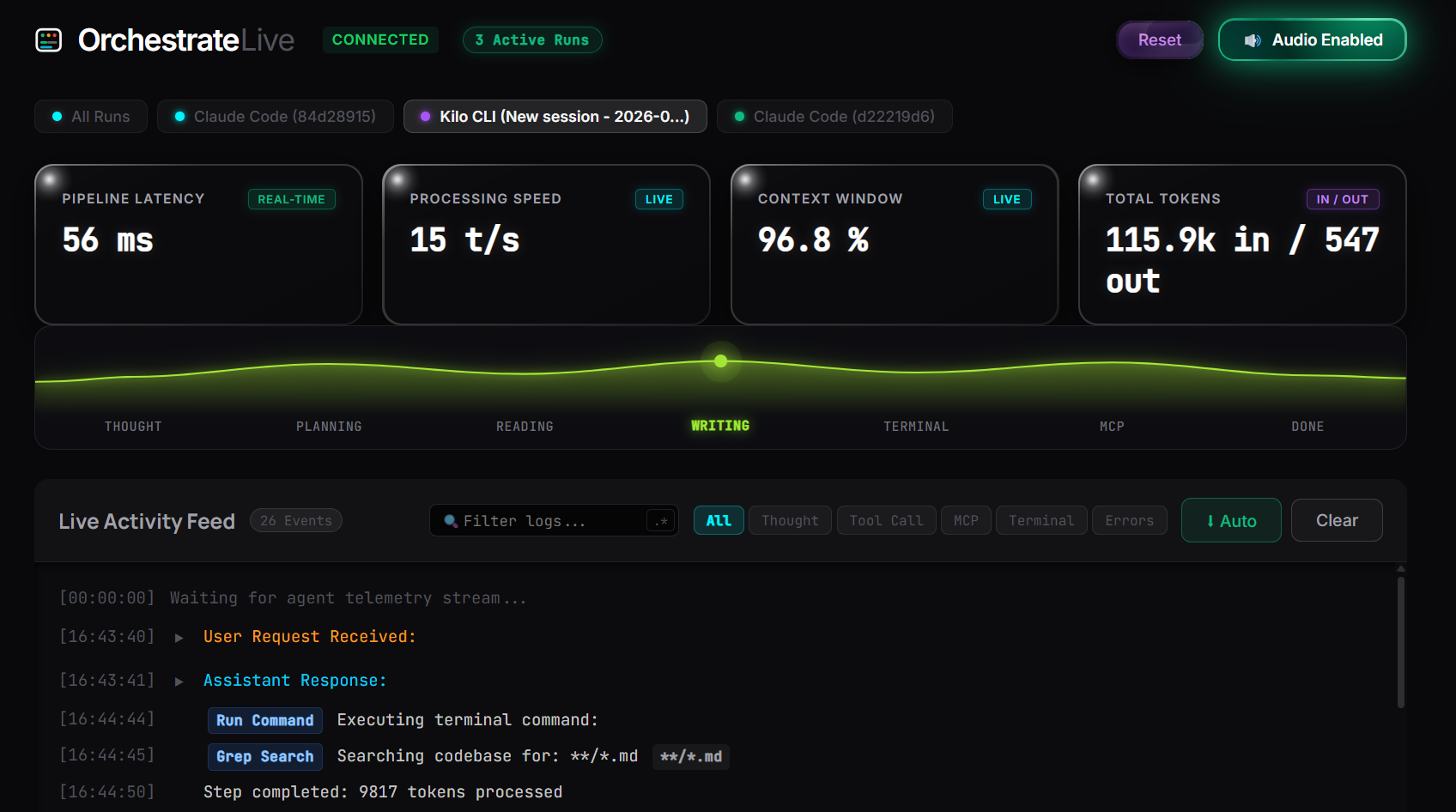
- Visual Lifecycle Tracking: Translates text streams into a dynamic visual flowchart mapping live execution states: Thought ➜ Planning ➜ Reading ➜ Writing ➜ Terminal ➜ MCP ➜ Done.
- Real-Time Telemetry & Token Metrics: Displays immediate metrics on pipeline latency, generation speed (tokens/sec), token usage (input/output), and context window limits.
- Synthesized Ambient Audio: Uses native Web Audio oscillators to generate programmatic audio cues for agent milestones, removing the need to stare at the screen.
- One-Click Diagnostic Filters: Isolates runtime errors, MCP tool invocations, and agent planning decisions instantly from the live feed.
- 100% Local & Privacy-Preserving: Runs standalone outside the developer's project directory via local storage and WebSockets, ensuring zero repository pollution and zero cloud exposure.
⚙️ How We Built It
- Frontend: Built using Vanilla HTML5, CSS3 (glassmorphic dark UI with real-time waveform animations), and native JavaScript with zero heavy framework overhead.
- Audio Engine: Developed a code-driven sound synthesizer using the native browser Web Audio API, generating ambient sci-fi feedback without external audio assets.
- Backend Broker: Implemented a lightweight Node.js and Express server with a high-throughput WebSocket (
ws) layer to process and stream agent telemetry at sub-millisecond latency. - Session Detection: Created a local workspace listener that automatically discovers active CLI agent sessions and routes their updates into structured JSON payloads.
⚠️ Challenges We Ran Into
- Accurate Live Token & Speed Counting: Agents output data in irregular bursts. Calibrating real-time token counts, context percentages, and generation speed without dropping packets or spiking CPU usage required extensive tuning.
- Keeping Agents in Sync: When running multiple agents at the same time, getting them all connected to the dashboard without data colliding or getting delayed was difficult. We had to build a clean message handler that receives updates from all active agents and lines them up smoothly before sending them to the screen.
- Capturing High-Frequency Actions: Balancing continuous file-reading, bash execution, and tool-call logging without imposing latency on the agent's primary task required fine-tuned event batching.
🏆 Accomplishments That We're Proud Of
- Unified Multi-Agent Integration: Seamlessly consolidated disparate AI coding CLI tools into a single command center with dynamic tab switching.
- Zero Repo Clutter: Built a fully decoupled architecture that runs in a standalone folder with a single command (
node server.js), requiring no dependencies or config files in the user's active codebase. - Instant Error & Step Isolation: Transformed chaotic terminal logs into an actionable, filterable activity feed for one-click debugging.
- Ultra-Lightweight Footprint: Avoided heavy libraries and complex build pipelines, allowing the dashboard to run smoothly with minimal CPU and RAM usage.
📚 What We Learned
- Power of Visual Scaffolding: Structuring raw terminal logs into visual meters and clear lifecycle phases drastically reduces cognitive fatigue during long coding workflows.
- Performance of Native Web Standards: Native JavaScript, CSS animations, and built-in browser APIs provide faster UI response times and lower resource footprints than heavy UI frameworks.
- Privacy-First Architecture: Storing session states directly in browser local storage and using local WebSockets proves that developer tools can deliver real-time observability without cloud data transmission.
🔮 What's Next for OrchestrateLive
- Dedicated VS Code & Cursor Extension: Embedding the live telemetry feed directly into the IDE sidebar.
- Smart Cost & Budget Alerts: Configurable threshold notifications before agents exceed token budgets or context limits.
- Interactive Agent Controls: UI controls to pause, steer, or terminate agent execution when loops or errors are detected.
- Ecosystem Expansion: Plug-and-play integrations for newly emerging CLI agents and frameworks.
- Session Replay & Export: One-click timeline exports to benchmark agent efficiency and share debugging traces.


Log in or sign up for Devpost to join the conversation.