-
-
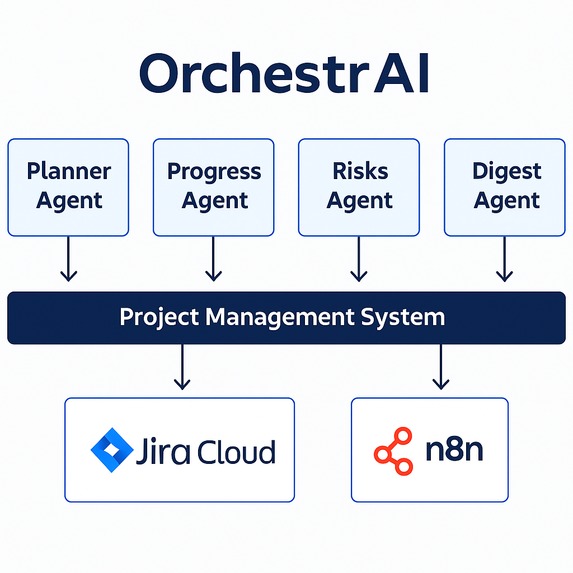
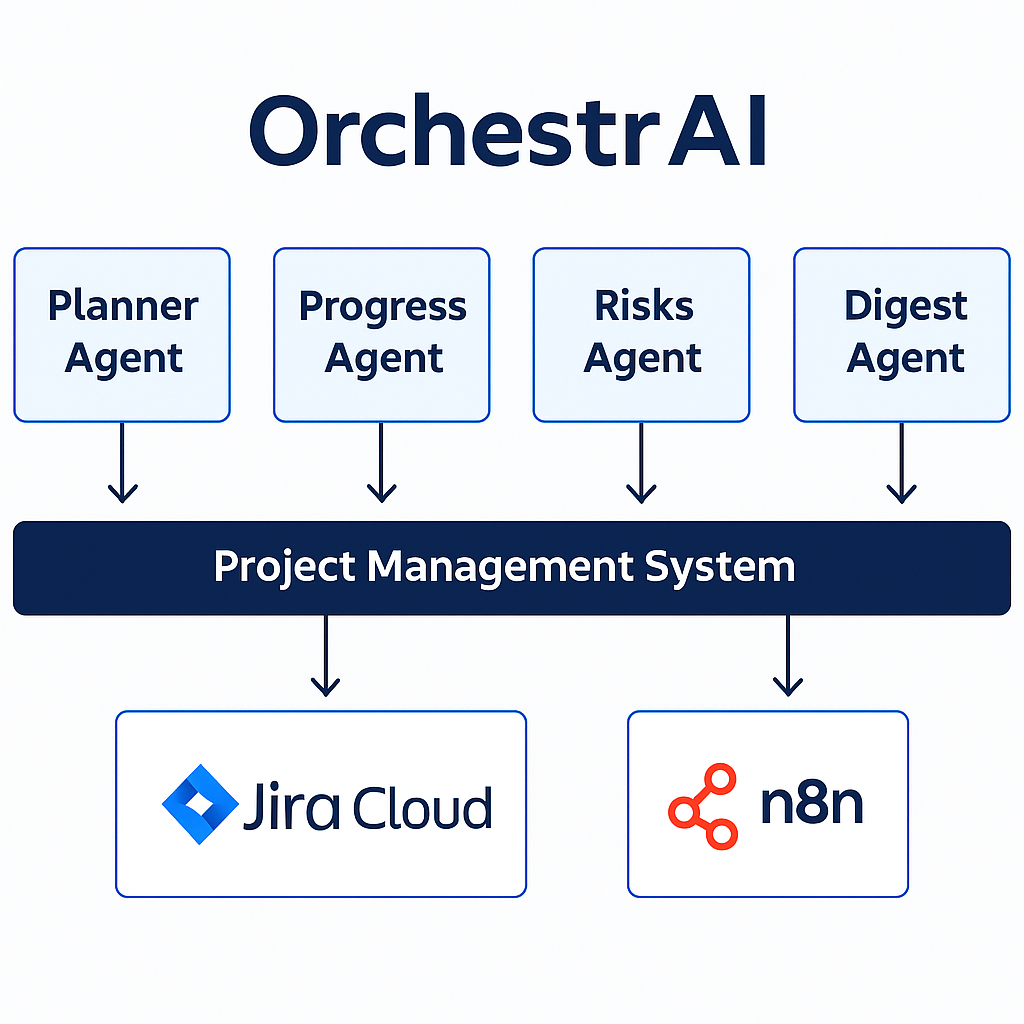
OrchestrAI Architecture
Inspiration
Software teams often lose 5–10 hours per week on repetitive project management tasks: breaking down epics, creating Jira tickets, tracking progress, and writing reports. While working with Jira, I repeatedly noticed how much time is spent on coordination instead of actual development.
I asked myself: what if AI agents could automate planning, tracking, and reporting — transparently and reliably? This question inspired OrchestrAI - a multi-agent system designed to reduce friction and save time in Jira-based workflows.
What I Learned
- How to design a multi-agent architecture with clearly separated responsibilities.
- Why transparent AI reasoning is critical for trust and evaluation - every decision must be explainable.
- How to integrate Groq LLM for fast and cost-efficient inference.
- How to orchestrate workflows using n8n and connect them with Jira Cloud.
- How containerized agents can be scaled and deployed independently using Docker Compose.
How I Built It
- FastAPI microservices for each agent (Planner, Progress, Risks, Digest).
- Groq LLM (Llama 3.3 70B) for task decomposition, analysis, and summaries.
- Jira Cloud API for automated ticket creation and progress tracking.
- n8n workflows for automation triggers and orchestration.
- Docker Compose for reproducible, self-hosted deployment.
- MCP protocol for consistent and extensible agent communication.
Each agent exposes its own API endpoint and health check, making the system modular and resilient.
Challenges I Faced
- Jira API authentication — handling tokens securely without exposing secrets in logs or repositories.
- Latency management — balancing LLM inference time with external API calls.
- Workflow reliability — ensuring n8n triggers worked consistently across containers.
- Reasoning transparency — structuring agent reasoning so it is visible without leaking sensitive prompts.
- Time constraints — delivering a stable, production-style demo within a short hackathon timeframe.
Fun with Math
I also estimated the potential time savings using a simple formula:
[ T_{saved} = (H_{manual} - H_{AI}) \cdot N_{teams} ]
Where:
- (H_{manual}) = average manual hours per week (≈ 8)
- (H_{AI}) = average hours with OrchestrAI (≈ 2)
- (N_{teams}) = number of teams using the system
For just 5 teams:
[ T_{saved} = (8 - 2) \cdot 5 = 30 \text{ hours/week} ]
That’s nearly a full work week saved across teams.
Conclusion
OrchestrAI is more than a hackathon demo — it is a practical exploration of AI-powered project management. By combining multiple specialized agents, automation, and transparent reasoning, the system helps teams focus on building software instead of managing tickets.


Log in or sign up for Devpost to join the conversation.