Inspiration
What it does
How we built it
Challenges we ran into
Accomplishments that we're proud of
What we learned
What's next for Orca
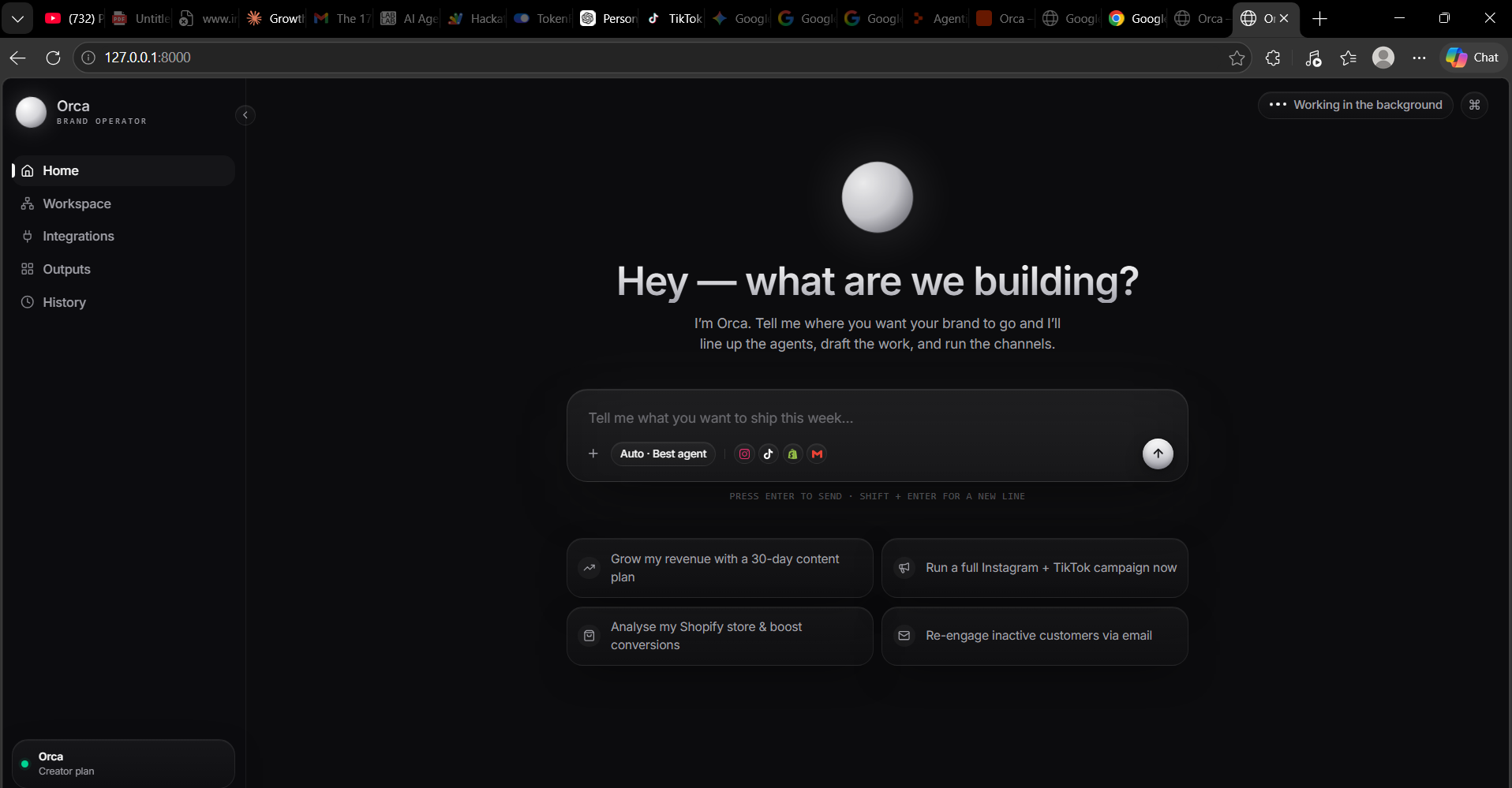
What Orca is Orca is an autonomous brand operator. Not a content tool. Not a dashboard. Not a chatbot. An operator — the AI equivalent of hiring a full marketing team, a revenue manager, a content director, and a business strategist, all in one system that runs 24/7 and gets smarter every week. The identity is the name. Orca does many things — just like a person does many things. The job titles are what it does, not what it is.
Who it's for Ecom brands and content creators who are doing $5K–$100K/month in revenue and spending too much money on agencies, too much time on content, and losing revenue to abandoned carts and lapsed customers with no system to recover them. These are people who work insane hours, make decisions based on vibes, post content and don't know why it worked or didn't, and have no institutional memory of what their brand has learned. Orca solves all of that.
What it actually does It starts from zero. Someone has a product idea but no brand — Orca researches the niche, finds the positioning gap competitors are missing, builds the brand identity, names it, defines the aesthetic and voice, builds a business plan with real unit economics, and researches suppliers on Alibaba. Then writes the negotiation email. It creates content that compounds. Every piece of content Orca creates is briefed from research — TikTok Creative Center for trending hooks, Meta Ad Library for competitor gaps, live market data through BrowserBase. It generates images with Flux, animates them with Higgsfield, adds voiceover with ElevenLabs, writes captions in brand voice, humanizes everything so it sounds like a person, then posts at the optimal time. It learns from every run. The memory system is the core differentiator. After every post is measured at 48 hours, Orca extracts what drove the result — was it the hook format? The posting time? The voiceover style? It stores that as a procedural rule with a confidence score. The next brief applies every high-confidence rule automatically. Run 1 might get 1.8% engagement. Run 5 gets 6.1%. Same brand. Smarter agent. It drives revenue, not just likes. Shopify abandoned cart webhooks fire within the hour — Orca drafts a recovery email in brand voice, humanizes it, and sends it. Browse recovery reaches visitors who looked but didn't buy. Post-purchase sequences run upsell, cross-sell, and loyalty flows automatically. Win-back campaigns target lapsed customers. All email is written by Claude, humanized, and sent via the brand's own Gmail. It uses your entire stack. Gmail for all outreach. Google Calendar for launch planning and follow-up reminders. Google Sheets for live revenue tracking and campaign logs. Shopify for full commerce data. Instagram and TikTok for publishing and analytics. BrowserBase as a real cloud browser for any research that isn't available through structured APIs — Alibaba, Reddit, competitor websites, any page on the internet.
How it works technically Hermes is the foundation — an open source agent framework with memory, tool calling, and a ReAct reasoning loop. Orca extends it with 20+ domain-specific tools and a four-layer memory system: episodic (what happened), semantic (brand knowledge), procedural (what works for this brand specifically), and working (active task state). The LLM is the router. There are no hardcoded if-statements, no rigid flows, no "if user says X then call tool Y." Claude reads the user's intent, decides which tools to call, in what order, and how many times. The system prompt is the business logic — written in natural language, not Python. Every creative task loads a skill before executing. Four expert skills encode professional knowledge: a hook writer trained on viral formats, a UGC director who's briefed thousands of videos, a direct response copywriter, and a content strategist. Skills aren't prompts — they're executable knowledge packages that ensure consistent, professional output every time. Guardrails prevent the agent from acting recklessly. Every tool call is classified as read-only, reversible, or irreversible. Irreversible actions — sending emails, posting content, spending money — require explicit human approval before executing. The plan-then-execute gate means Claude writes its plan first, checks for irreversible actions, and only proceeds when cleared.
What makes it different from everything else Most tools give you one thing. Email tools do email. Content tools do content. Ad tools do ads. You manage seven different platforms, none of them talk to each other, and you're still the one connecting the dots. Orca does all of it and the results compound. The memory from content performance informs ad creative strategy. Customer behavior from Shopify informs email sequencing. Supplier research informs the negotiation email. The longer a brand uses Orca, the more it knows about what works specifically for that brand — and the harder it becomes to leave, because the memory is proprietary. The switching cost grows over time. That's the moat.
Built With
- ollama
- python
- react-native

Log in or sign up for Devpost to join the conversation.