ORBYT — Where Memory Meets Music
Inspiration
I've always been interested in how music affects the way we think and remember things. Sometimes you hear a rhythm once and can repeat it almost immediately. Other times, even a simple pattern becomes surprisingly difficult to remember.
That got me thinking about building a game around musical memory.
I didn't want to create another rhythm game where players just follow instructions on a screen. I wanted something that made people actually listen, remember what they heard, and try to reproduce it themselves.
I also wanted to give players the freedom to make their own music instead of limiting the experience to completing challenges.
That's how ORBYT started. The idea was to combine a musical memory game with a simple music-making experience, using an interactive instrument in a virtual environment.
What It Does
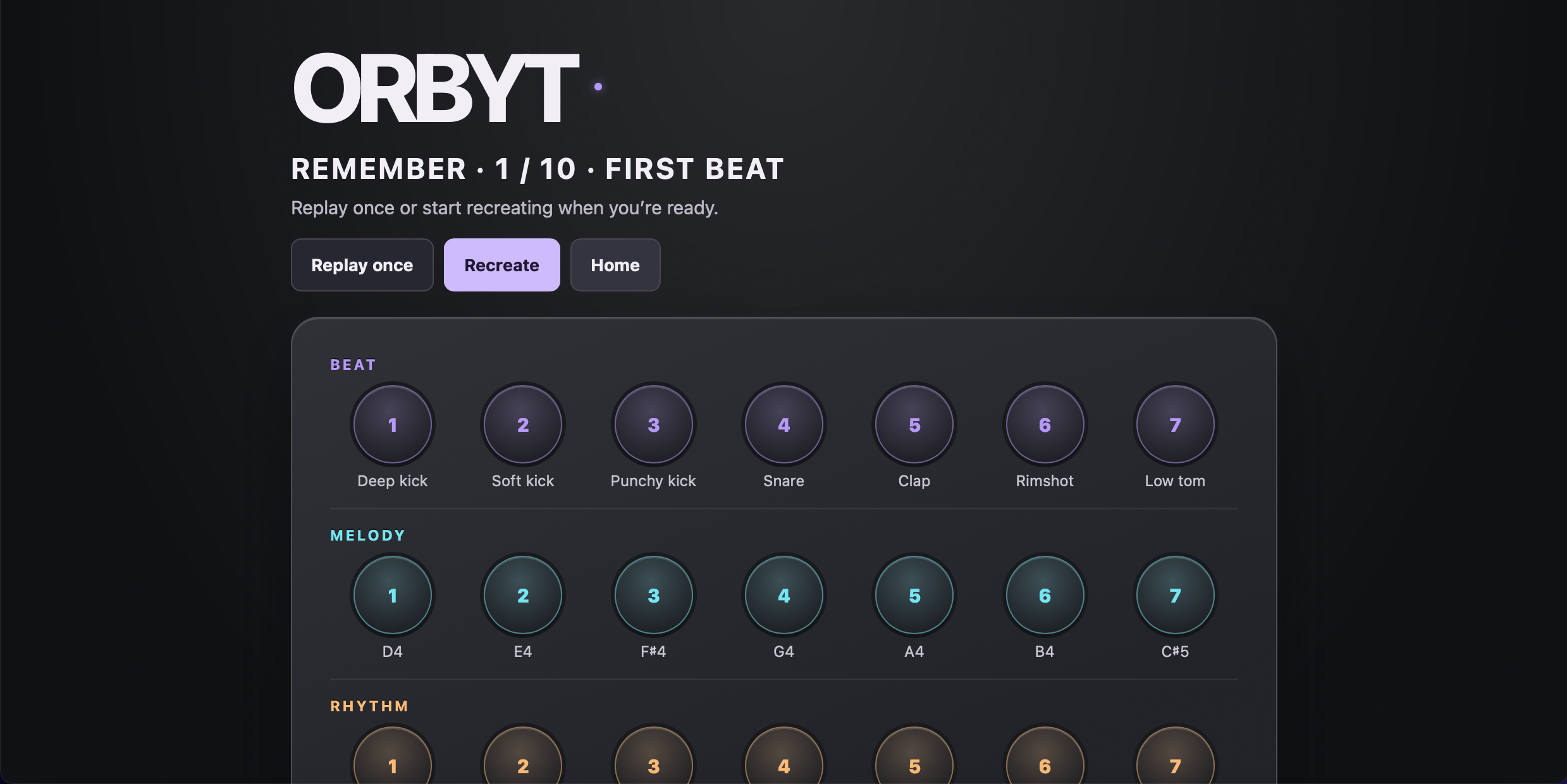
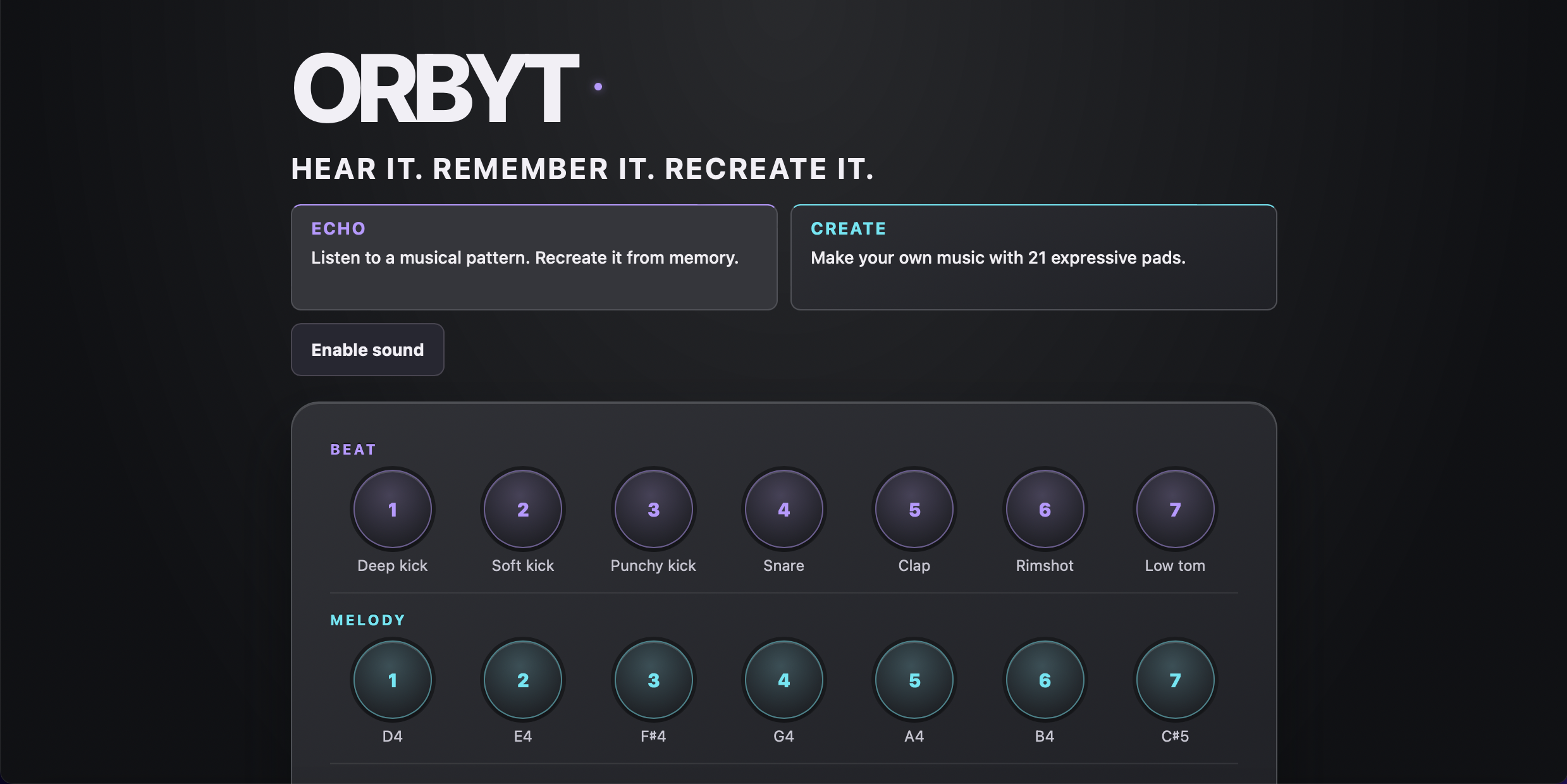
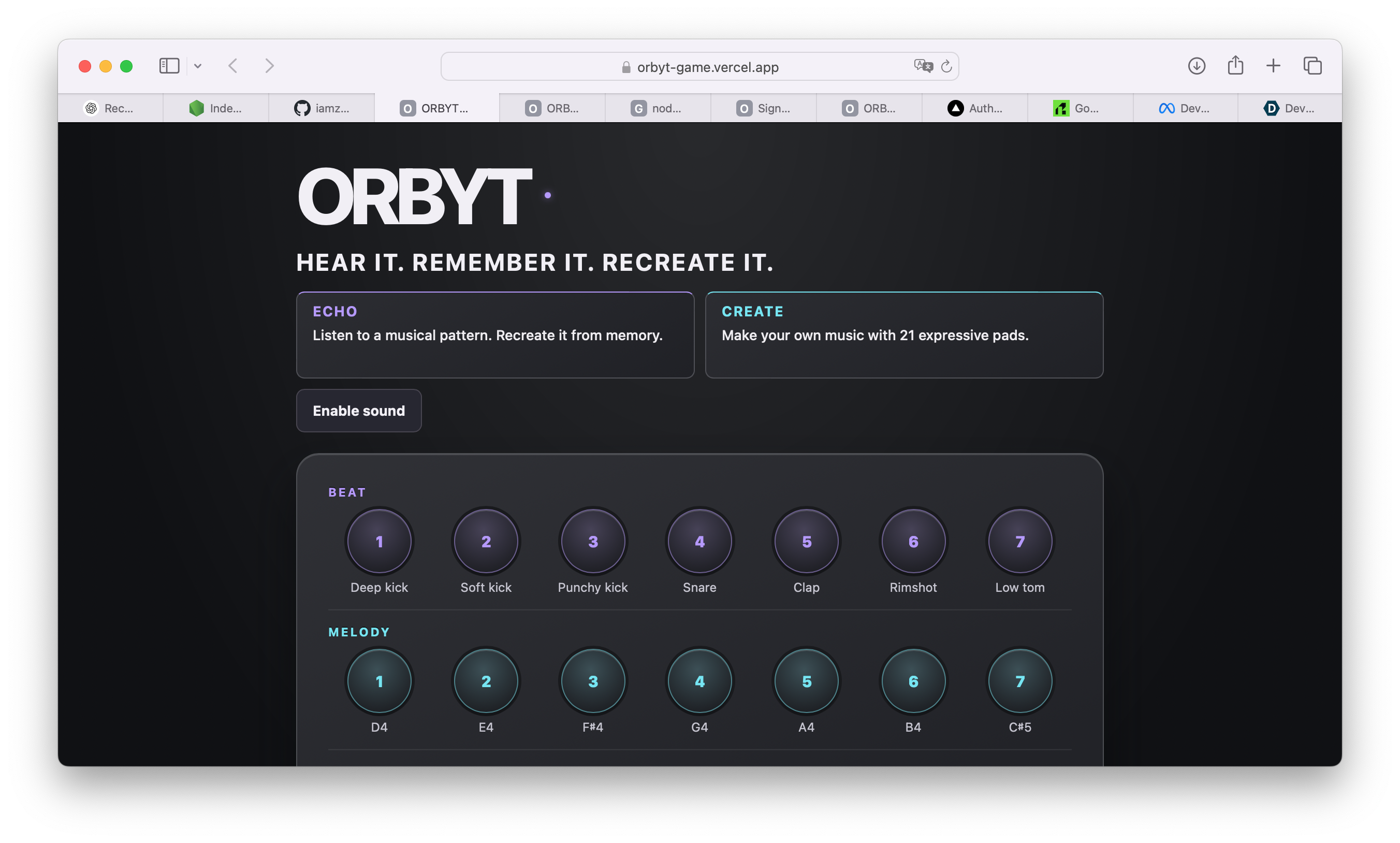
ORBYT is a browser-based VR music game built around 21 interactive pads arranged in three rows.
There are two main modes: ECHO and CREATE.
ECHO
ECHO is the memory game.
The player listens to a musical sequence while the pads light up. Once the sequence ends, they have to recreate what they heard from memory.
One thing I wanted to do differently was make the recreation stage silent. When players press the pads during this stage, they don't hear the notes immediately. They have to rely on what they remember.
After completing their attempt, they receive feedback and can listen to their recreation.
There are 10 levels, starting with simple patterns and gradually introducing longer and more complicated sequences.
CREATE
CREATE is where players can experiment with making their own music.
The same 21 pads become a small virtual music studio. Players can make drum patterns, explore different sounds, record what they play, and listen to their compositions.
There are two main sound categories.
BEATS focuses on drums, percussion, and bass.
SOUNDS includes three different sound profiles: AFTERGLOW, SOLSTICE, and NOCTURNE. I wanted these to have different musical personalities, drawing from atmospheric Afro House, summer house, and lo-fi music.
Players can also adjust tempo, undo changes, and save their compositions.
I liked the idea of someone starting with ECHO to understand musical patterns and then moving into CREATE to experiment with their own ideas.
How I Built It
I built ORBYT using TypeScript, Three.js, Meta's Immersive Web SDK, the Web Audio API, and Vite. The project is hosted on Vercel.
I started by working on the main instrument. I wanted a simple layout that would work for both the memory game and the music creation mode.
Once the 21-pad instrument was in place, I worked on the interaction system, musical sequences, playback, and game logic.
For ECHO, I created the level sequences and built the system that records a player's inputs, checks their attempt, and provides feedback.
For CREATE, I worked on the audio engine, different sound profiles, recording, playback, and saving compositions.
Most of the sounds are generated using the Web Audio API. This allowed me to experiment with different sounds without having to rely entirely on prerecorded samples.
I also made ORBYT playable on desktop browsers, partly because I wanted people to be able to try the game even without a VR headset.
Challenges I Faced
Building without a VR headset
This was easily my biggest challenge.
I don't own a Meta Quest headset, and getting access to one during development wasn't possible for me.
I was building a VR experience without being able to put on a headset and test it myself, which made certain parts of development more difficult than I expected.
I had to rely on browser testing, development tools, and XR simulation to understand how the game might behave in an immersive environment.
I eventually integrated IWER, a browser-based XR emulator, so I could simulate headset and controller or hand interactions.
Even with that, I knew testing in a simulator wasn't the same as testing on a real Quest.
I reached out to the VR development community to see if someone with a Quest 2, 3, or 3S could help me test the game. I shared the link and explained that I mainly needed someone to check the controls, audio, and immersive mode.
Unfortunately, I didn't receive any responses before preparing my submission.
That was disappointing because I really wanted feedback from someone using the actual hardware.
I decided to continue with the testing options available to me rather than leave the project unfinished. I also want to be transparent that ORBYT hasn't yet been fully tested on a physical Quest headset.
Getting the sound right
Another challenge was the music itself.
At first, some of the sounds felt too much like basic electronic tones. They worked technically, but they didn't feel like something someone would enjoy playing.
I spent time working on the sound profiles, experimenting with different textures, rhythms, and synthesis settings.
I was particularly interested in creating sounds influenced by Afro House, summer house, and lo-fi music.
I wanted CREATE to feel like an instrument people could actually enjoy experimenting with, not just a collection of buttons that make noise.
Making ECHO work properly
ECHO also took some thought.
I wanted the player to hear a sequence, remember it, and reproduce it without relying on audio feedback during their attempt.
Getting the listening, silent recreation, and reveal stages to work together was an important part of the development process.
I also had to think about how the levels should progress so that the game becomes more challenging without immediately overwhelming someone playing for the first time.
Working with limited hardware
My development setup was another limitation.
I was working with older computers, and some of the development tools weren't compatible with my operating system.
For example, I ran into issues trying to use Playwright's Chromium browser on macOS Monterey. I had to look for another way to test the XR experience.
That eventually led me to browser-based simulation, which helped me continue without changing my entire development setup.
What I Learned
I learned quite a lot from building ORBYT, especially about developing for XR.
Before this project, I hadn't fully appreciated how different spatial interaction can be from building a normal website.
Something as simple as pressing a button becomes more complicated when you have to think about controllers, hand tracking, the player's viewpoint, and the position of objects in a 3D environment.
I also learned more about audio programming than I expected. Working with timing, synthesis, recording, and playback gave me a better understanding of how much goes into making even a small musical experience feel responsive.
One of the biggest lessons was learning how to work around limitations.
Not having a headset and using older hardware made development harder, but it also pushed me to explore tools and approaches I probably wouldn't have considered otherwise.
There's still a lot I want to improve, but I'm happy I was able to turn the original idea into something people can actually open and play.
What Makes ORBYT Different
The main thing I wanted to achieve with ORBYT was to bring two experiences together.
ECHO challenges players to listen carefully and remember music.
CREATE gives them the freedom to experiment and make something of their own.
Both modes use the same instrument, so players don't have to learn an entirely different interface when switching between them.
I also wanted ORBYT to be accessible to people who don't have any experience making music.
You don't need to understand music theory or know how to play an instrument to get started. You can listen, experiment, make mistakes, and gradually figure things out.
For me, that's the most interesting part of the project.
What's Next
The first thing I want to do is get ORBYT tested properly on a physical Meta Quest headset.
I want to see how the controls feel, whether the instrument is positioned comfortably, and how people respond to the experience when they're actually inside VR.
After that, I'd like to improve the sound engine, add more ECHO levels, and expand the creative tools.
I'm also interested in exploring multiplayer features where people can challenge each other's musical memory or create music together in the same virtual space.
ORBYT is still an early version of what I have in mind, but it's a starting point I'm excited to keep developing.
I started with a simple idea about remembering music, and it eventually became a project that taught me about game development, audio programming, and immersive technology.
I'm looking forward to seeing where it goes.
Project Links
Live game: https://orbyt-game.vercel.app
XR simulator: https://orbyt-game.vercel.app/?simulateXR=1
Built With
- 25
- add
- allowed
- are
- at
- built
- can
- characters
- following
- not
- of
- parse
- start
- tags.
- tags:
- the
- to
- up
- with
- you
