-
-
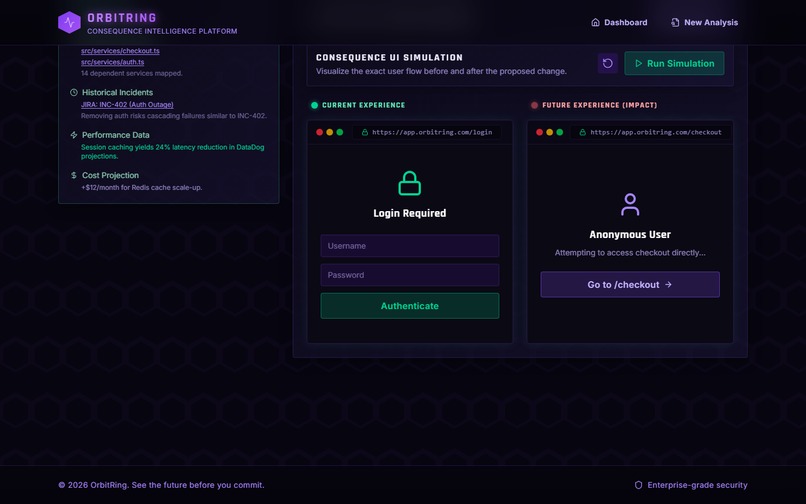
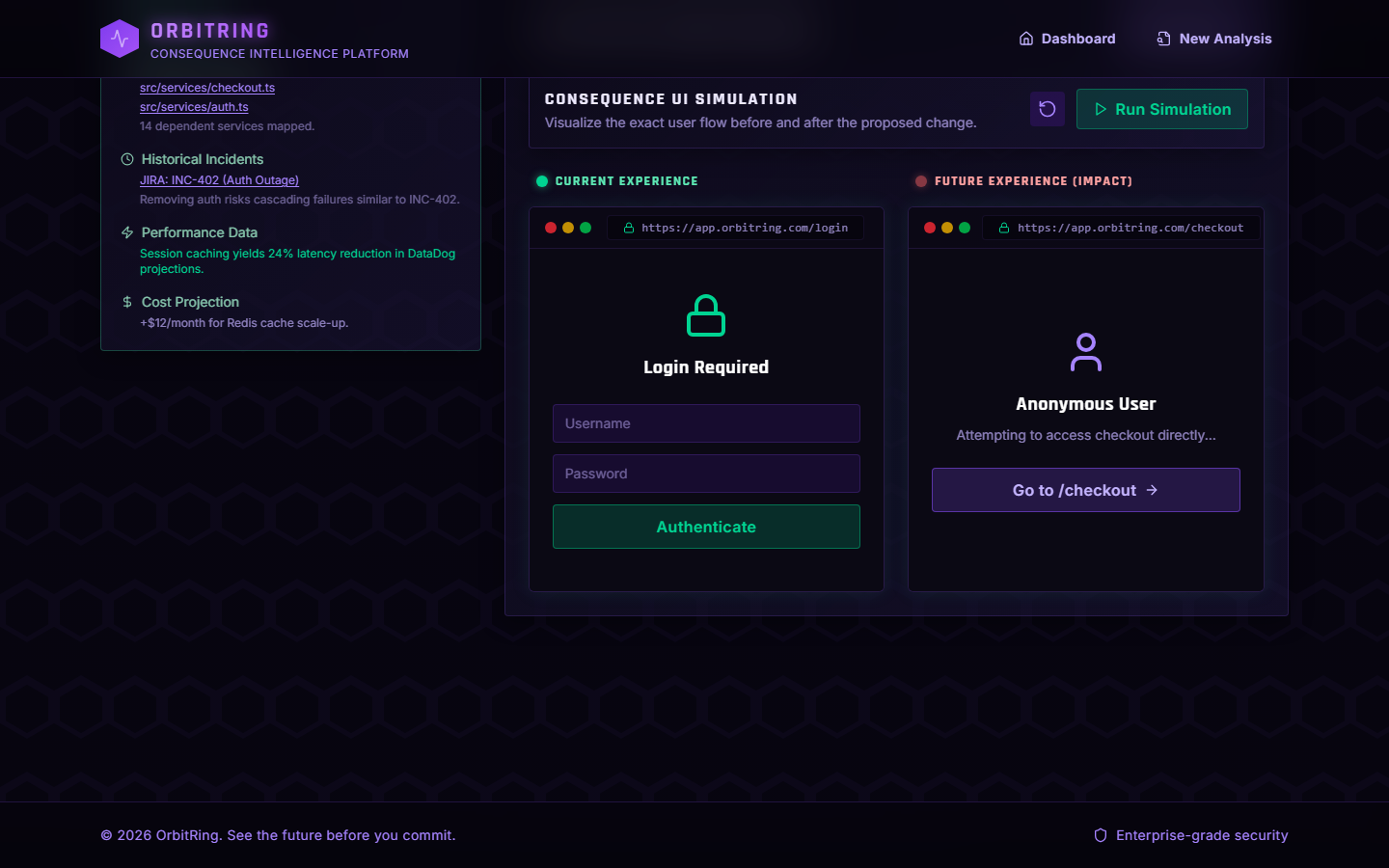
Ui Simulation
-
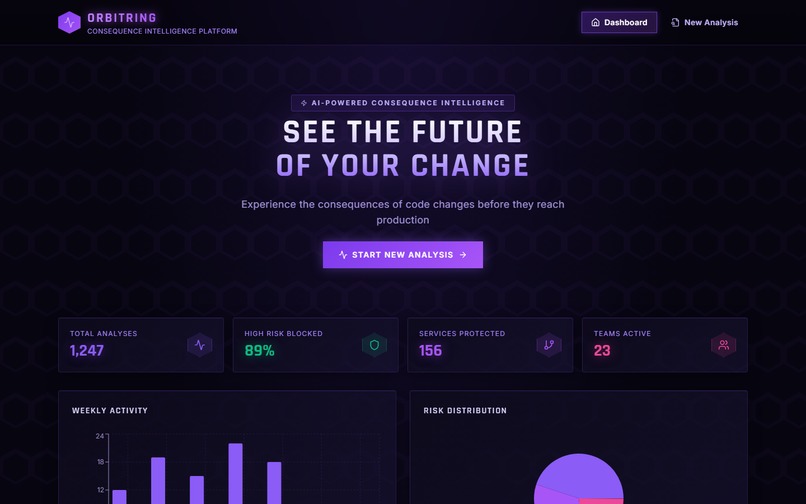
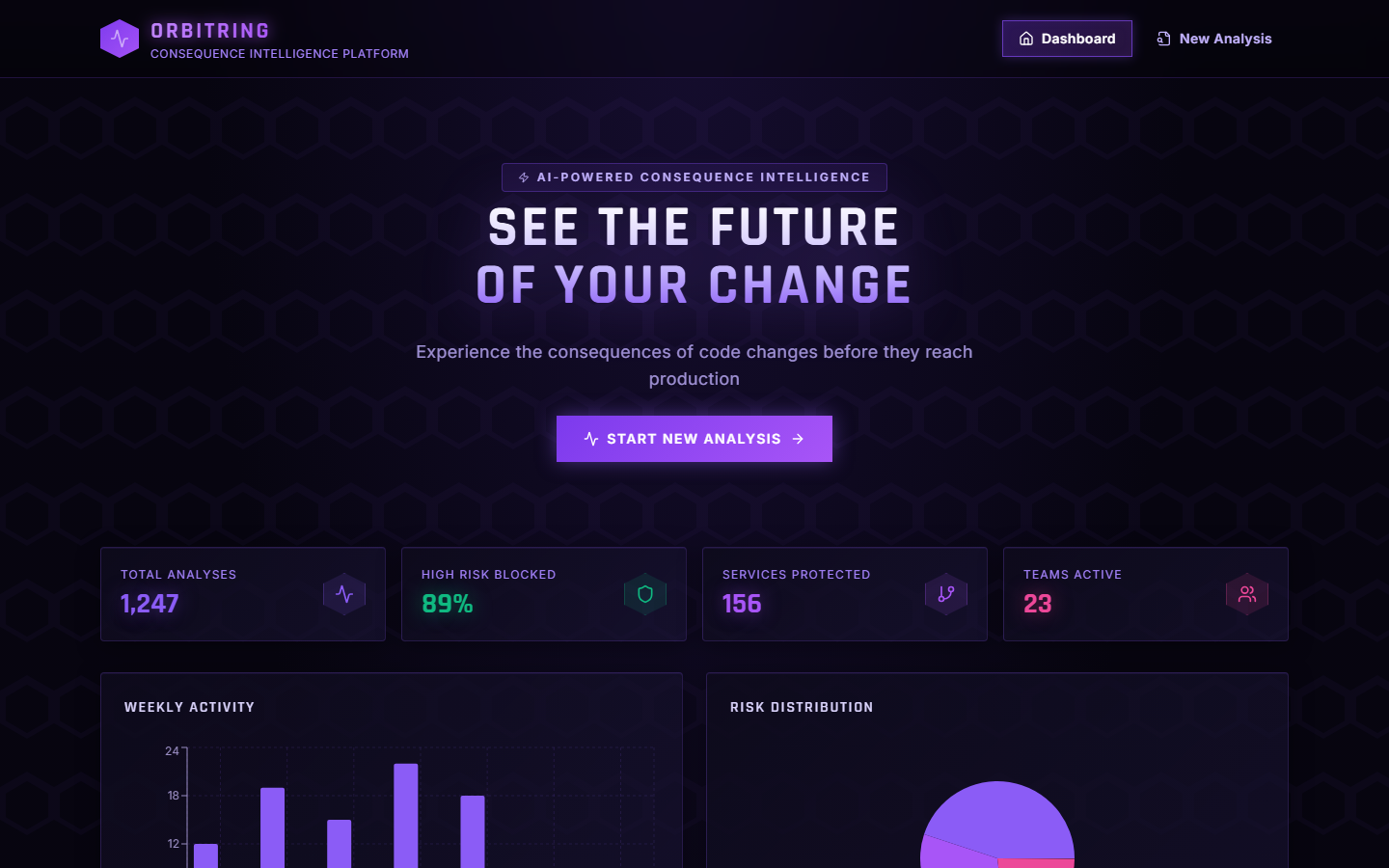
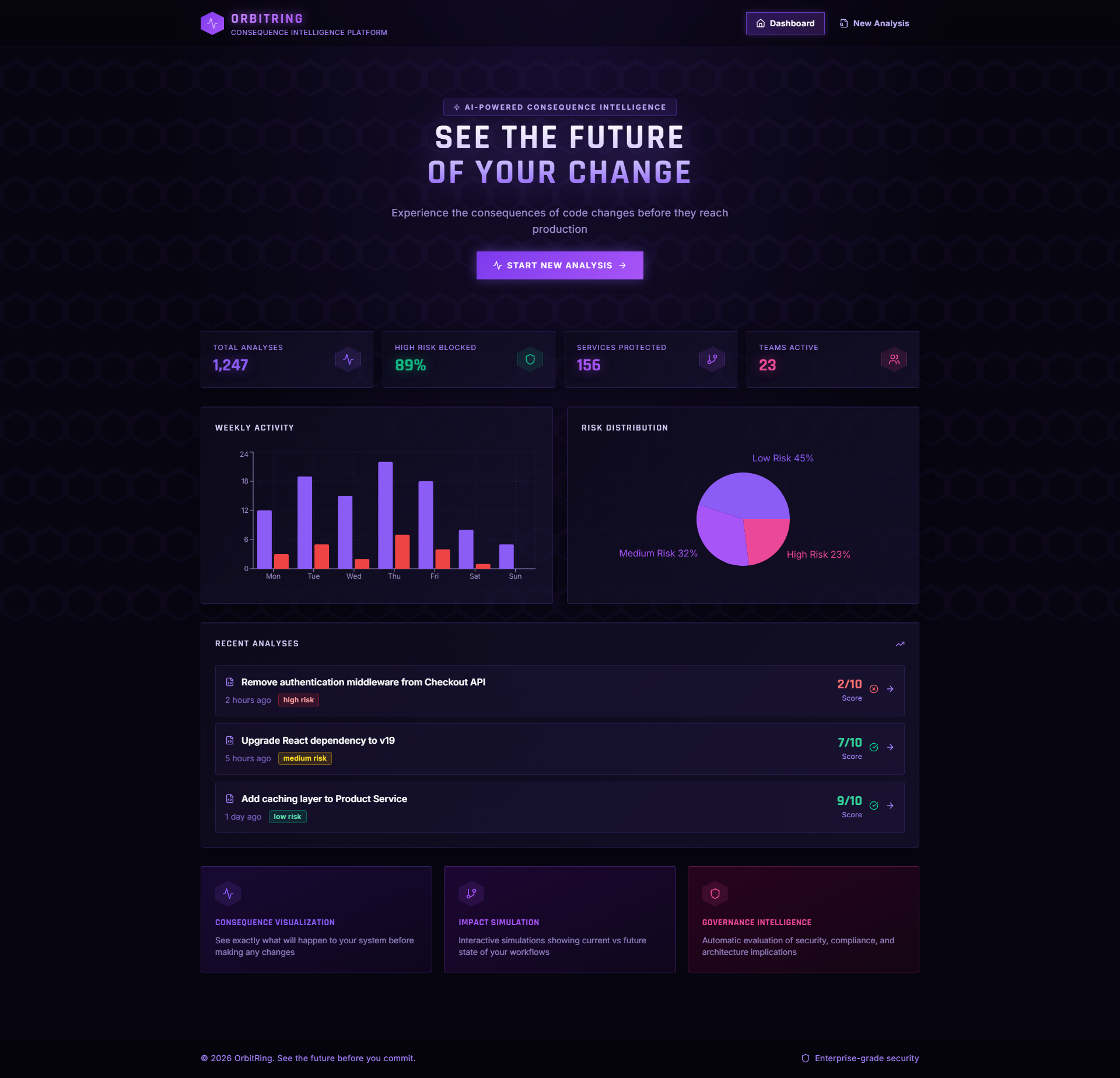
Dashboard
-
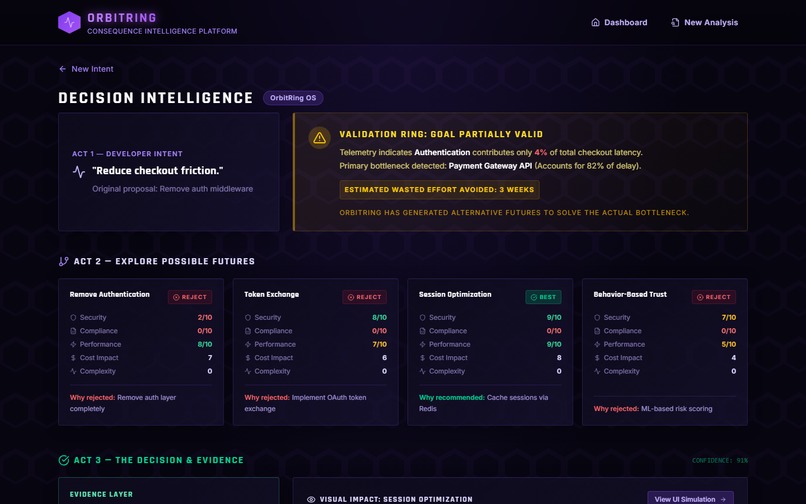
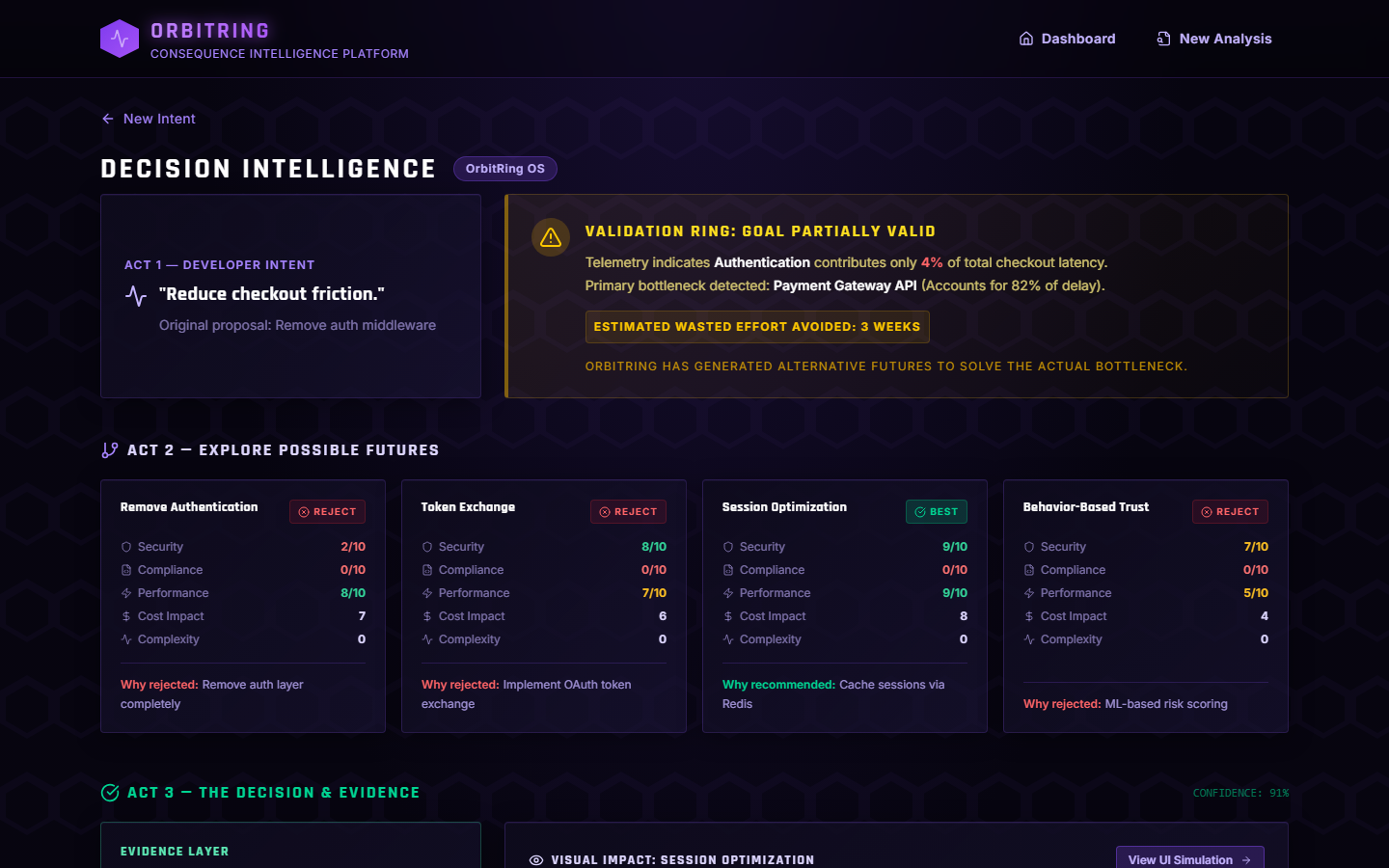
Possible Futures
-
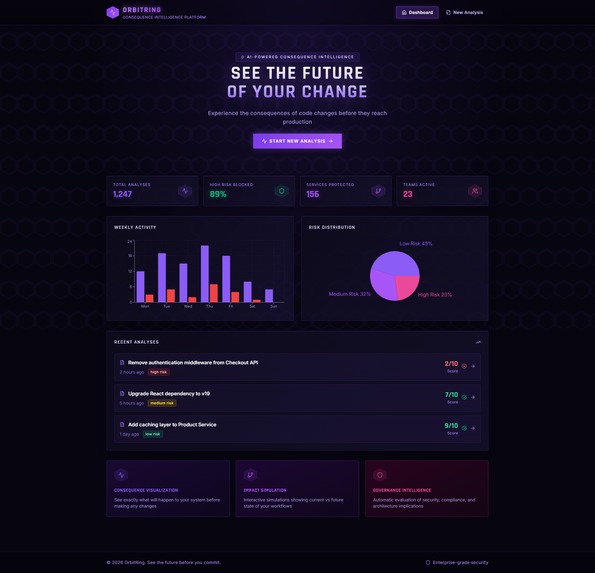
Analysis
Inspiration
Modern software teams can generate code faster than ever, but engineering decisions remain difficult. Teams still spend days debating architectural changes, evaluating trade-offs, and discovering unintended consequences after implementation.
Today's AI tools help answer questions such as:
- What code should I write?
- How do I fix this bug?
- Is this vulnerable?
- How can I optimize this implementation?
But they rarely answer a more fundamental question:
Are we solving the right problem?
OrbitRing was inspired by the belief that many engineering failures begin with poor assumptions rather than poor code. We wanted to explore how GitLab Orbit could be used to help teams validate ideas, compare alternatives, and understand consequences before implementation begins.
What it Does
OrbitRing is an Engineering Consequence Intelligence Platform built using GitLab Orbit repository context.
Rather than producing a single answer, OrbitRing helps teams explore multiple implementation paths and understand the trade-offs behind each one.
Given an engineering objective such as:
Reduce checkout friction
OrbitRing:
- Captures the engineering intent.
- Validates assumptions against available repository context.
- Generates multiple implementation alternatives.
- Uses GitLab Orbit context to understand dependencies, relationships, and architecture boundaries.
- Evaluates potential consequences across multiple dimensions.
- Compares alternatives using structured scoring.
- Supports recommendations with repository-derived evidence.
- Visualizes affected components, dependencies, and architectural impact.
The workflow follows a decision-first approach:
Intent
 ↓
Validation
 ↓
Options
 ↓
Consequences
 ↓
Decision
 ↓
Evidence
How We Built It
OrbitRing was designed as a GitLab Orbit-powered engineering decision workflow.
Core Components
OrbitRing Flow
A Python-based workflow engine that orchestrates the decision intelligence pipeline.
GitLab Orbit Integration
OrbitRing connects to an Orbit-compatible DuckDB knowledge graph and dynamically discovers repository structure through schema inspection. Repository relationships and contextual metadata are then used to support validation, consequence analysis, and evidence generation workflows.
Six-Ring Architecture
- Intent Ring
- Validation Ring
- Future Ring
- Context Ring
- Consequence Ring
- Decision Ring
Evidence Layer
Recommendations are supported using contextual information derived from:
- Files
- Services
- Dependencies
- Repository relationships
- Architectural context
Technology Stack
- Python
- DuckDB
- GitLab Orbit
- React
- TypeScript
- GitLab Duo Agent/Skill structure
Workflow
orbitring inspect
        ↓
Discover Repository Context

orbitring review
        ↓
Generate Decision Intelligence Report
Challenges We Ran Into
Understanding GitLab Orbit
One of the biggest challenges was learning how repository intelligence is represented within Orbit and how to interact with the local graph representation effectively.
Avoiding Assumption-Driven Development
Early on, we risked building around assumptions regarding Orbit schemas and future GitLab AI Catalog requirements.
Instead, we shifted toward an evidence-driven approach by:
- Dynamically inspecting available schemas
- Discovering repository entities at runtime
- Validating integrations before building workflows
Balancing Innovation and Practicality
Generating alternative engineering futures sounds straightforward conceptually, but presenting options in a way that is explainable, actionable, and useful required designing a workflow centered around trade-offs rather than answers.
Accomplishments That We're Proud Of
Exploring a New Category
Rather than creating another coding assistant, we explored the concept of:
Engineering Consequence Intelligence
A workflow focused on helping teams make better engineering decisions before implementation begins.
Orbit-Powered Context
OrbitRing doesn't simply consume prompts.
It connects to an Orbit-compatible knowledge graph and uses repository relationships, dependencies, ownership information, and contextual metadata to support consequence analysis and recommendation workflows.
Evidence-Oriented Recommendations
OrbitRing is designed to connect recommendations to repository artifacts and supporting evidence derived from Orbit context and repository relationships.
Decision-Centric Thinking
Most engineering tools focus on implementation.
OrbitRing focuses on decision quality.
Alternative Future Exploration
Instead of presenting a single path forward, OrbitRing generates multiple implementation approaches so teams can compare trade-offs before committing engineering effort.
What We Learned
Building OrbitRing reinforced several important lessons.
Context Is More Valuable Than Generation
Generating code is increasingly accessible.
Understanding the consequences of decisions remains significantly harder and often more valuable.
Validation Matters More Than Optimization
Teams frequently optimize solutions before validating whether they are solving the correct problem.
Trust Requires Evidence
Developers are naturally skeptical of AI-generated recommendations.
Supporting recommendations with contextual evidence significantly improves explainability and confidence.
Better Decisions Create Better Software
Many engineering problems originate from incorrect assumptions rather than incorrect implementations.
What's Next for OrbitRing
OrbitRing is intended as the foundation for a broader Engineering Decision Intelligence platform.
Future directions include:
Architecture Intelligence
Compare architectural changes and migration strategies before implementation.
Security Intelligence
Evaluate security implications and trust-boundary changes across systems.
Compliance Intelligence
Assess governance, regulatory, and policy impacts of engineering decisions.
FinOps Intelligence
Estimate infrastructure and operational costs across alternative implementation paths.
Reliability Intelligence
Analyze operational risk, resilience, and failure propagation.
AI Agent Governance
Evaluate the potential consequences of autonomous agent actions before execution.
Deeper GitLab Duo Integration
Explore tighter integration with GitLab Duo workflows and future agent-driven engineering experiences.
Ultimately, our vision is simple:
A future where engineering teams don't just build faster.
They make better decisions before code is ever written.
Built With
- css
- duckdb
- fastapi
- gitlab
- html
- javascript
- python
- react
- typescript

Log in or sign up for Devpost to join the conversation.