Inspiration
Orbitra began as a research project in mid-2024 focused on one question: why can’t people monetize the data they generate?
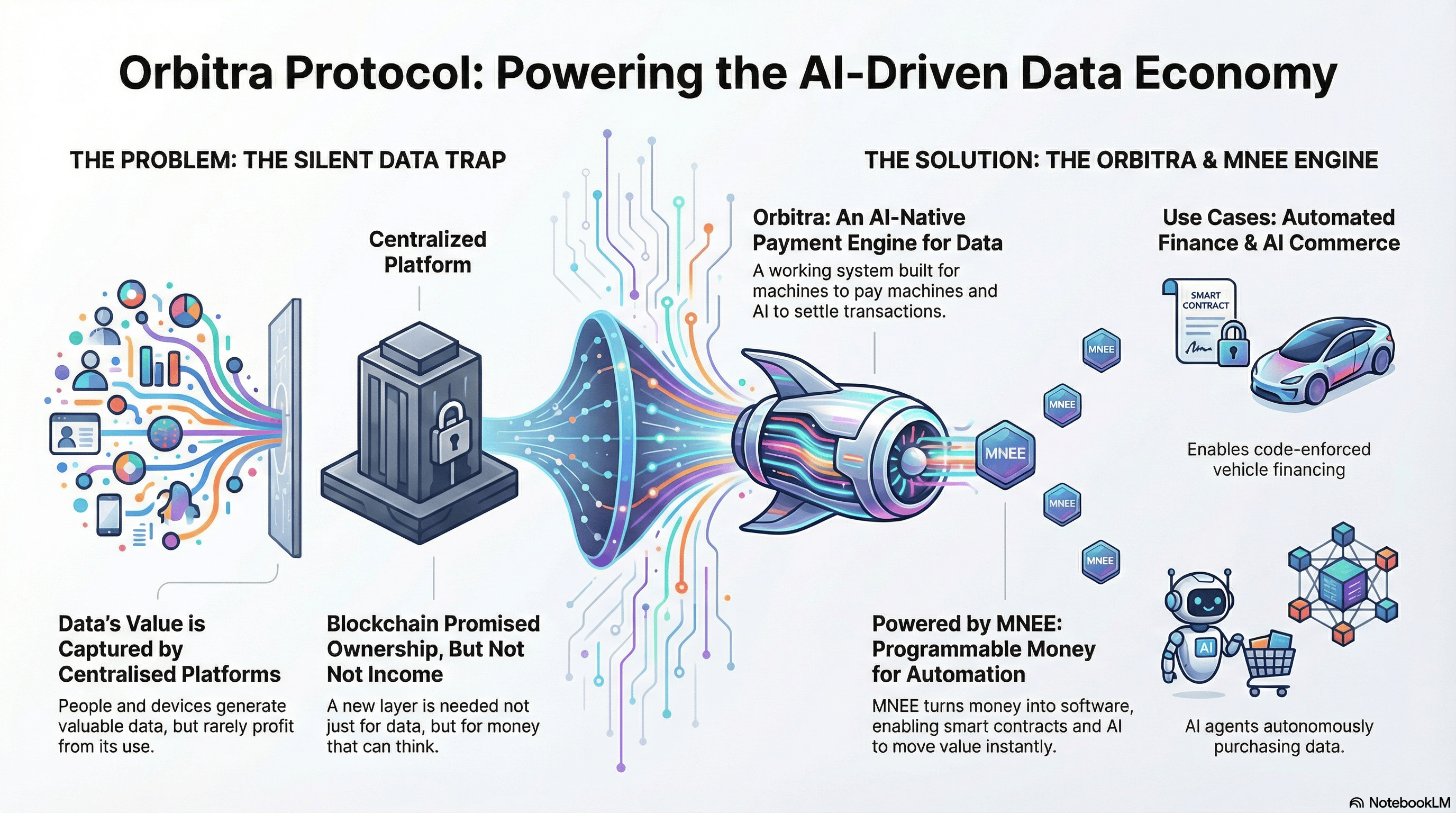
Real-world data powers agriculture, logistics, IoT, AI, and finance, yet its value is captured almost entirely by centralized platforms. Blockchain promised ownership, but not income.
Orbitra proposes a new layer where real-world data can be verified, tokenized, and used directly inside financial systems.
This hackathon provided the missing piece: programmable money. Using MNEE, I built an MVP that includes a data marketplace, AI-agent payment logic, and a real-world vehicle finance module. The system currently operates in demo mode with wallet integration and smart-contract based architecture, and is designed to transition to full on-chain production deployment in the next phase.
What it does
Orbitra is an AI payment engine that enables real-world data to be priced, exchanged, and settled using programmable money.
It provides a smart-contract based data marketplace where data providers can list datasets, AI agents or applications can purchase access, and payments are executed automatically using MNEE.
The platform also demonstrates how traditional financial workflows can be automated through its vehicle finance module, where loan logic, repayments, and settlement are handled programmatically instead of manually.
In its current form, the system operates in demo mode to showcase the full architecture, user flows, and automation logic, and is designed to transition to full on-chain production deployment in the next phase.
In short, Orbitra turns data into a financial primitive and enables AI-driven, machine-to-machine economic activity.
Example: Automated Car Seizure (Concept)
Orbitra can also support automated enforcement scenarios such as vehicle seizure in case of loan default.
For example, if a borrower misses repayments beyond a predefined threshold, the smart contract can automatically:
- Mark the loan as defaulted
- Freeze ownership transfer of the vehicle’s digital title
- Notify the lender and borrower on-chain
- Trigger an off-chain oracle or authorized service provider to initiate physical recovery of the vehicle
- Update the vehicle’s ownership status once recovery is confirmed
This removes manual paperwork, legal delays, and opaque processes, replacing them with transparent, rule-based execution.
While the current MVP demonstrates the financing workflow in demo mode, this scenario shows how programmable money and smart contracts can extend into real-world asset enforcement in production deployments.
How we built it
I come from a non-technical background and am formally trained as a lawyer. Building this required learning Solidity, smart-contract design, and Web3 frontend integration under extreme time constraints.
The project was built using Ethereum smart contracts, React for the frontend, wallet integration for MNEE, and a modular architecture to support AI-driven payments and data markets.
This MVP represents both a technical and personal execution milestone.
Challenges we ran into
Building Orbitra was technically demanding, especially coming from a non-technical background as a lawyer. I had to learn Solidity, smart contract design, and blockchain tooling while simultaneously building the product. Designing contracts flexible enough to support AI agents and future data markets, handling real-world token standards such as MNEE decimals, and maintaining a clean user experience with real wallet connections and on-chain transactions added further complexity. On top of this, structuring the frontend to support both demo mode and testnet execution without breaking flows, and compressing a long-term protocol vision into a functional MVP within hackathon time constraints, made execution particularly challenging.
Accomplishments that we're proud of
Despite these constraints, the project resulted in a working MVP of an AI-driven payment and data-settlement system running on Ethereum Sepolia. I implemented a smart-contract based data marketplace, an AI-agent payment controller, and a vehicle finance module, all integrated with MNEE programmable money and real wallet support. The frontend is operational in demo mode today and architected to transition cleanly to full mainnet execution. Most importantly, this project translated a research-level protocol concept into a tangible, testable product, built end-to-end as a solo founder without a formal engineering background.
What we learned
This project reinforced that tokenization alone does not create real utility; settlement infrastructure does. Programmable money enables automation that traditional finance cannot support, and real-world data becomes economically meaningful only when it is composable with DeFi systems. I also learned that production-grade Web3 applications require tight coordination between smart contracts, frontend logic, and wallet experience. Finally, using AI tools extensively proved critical in accelerating development, debugging, and system design while working outside my primary domain.
What's next for Orbitra Protocol: AI Payment Engine
The next phase is to deploy the full contract stack to testnet and then mainnet and transition from demo mode to production execution. From there, the AI agent framework will be expanded to support autonomous service purchasing, subscriptions, and data licensing. The protocol will introduce data-backed financial products such as automated lending, insurance, and revenue-sharing mechanisms, while onboarding real-world data sources across agriculture, logistics, and IoT. A developer SDK is planned to enable third-party applications to build AI-native financial workflows on Orbitra, progressing toward the long-term goal of making real-world data a liquid, programmable financial asset class.
Built With
- aiagentcontroller-(solidity-0.8.19+
- css-frameworks:-react-18
- erc-20-(mnee-token)
- languages:-typescript
- lucide-react-blockchain:-ethereum-(sepolia-testnet)
- metamask-wallet-integration-smart-contracts:-datamarketplace
- openzeppelin
- react-router
- recharts
- shadcn/ui
- solidity
- tailwind-css-libraries:-ethers.js
- tanstack-query
- vehiclefinancemanager
- vite

Log in or sign up for Devpost to join the conversation.