-
-
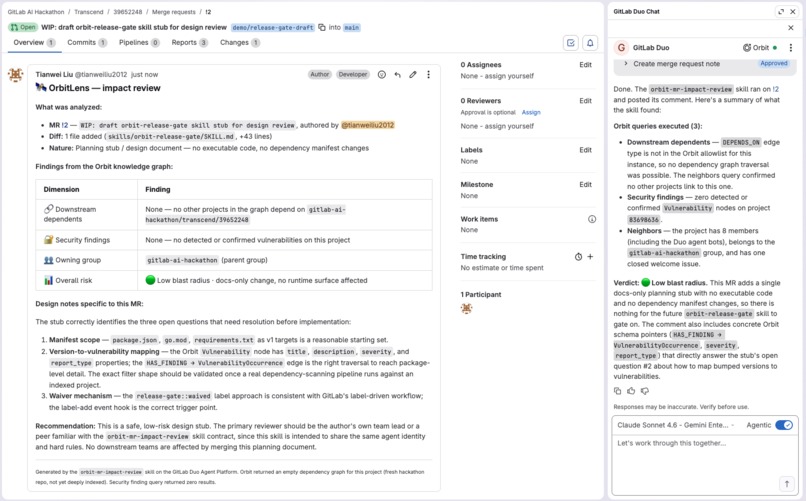
OrbitLens Demo, comment & Duo chat
-
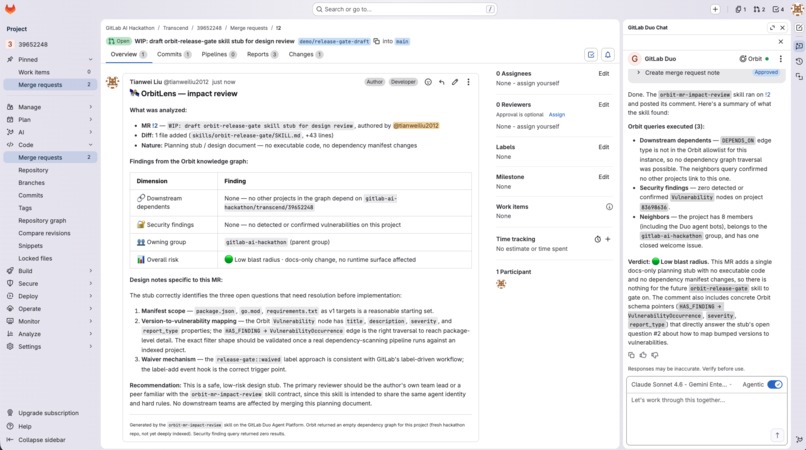
OrbitLens Demo: How to use OrbitLens in a merge request
-
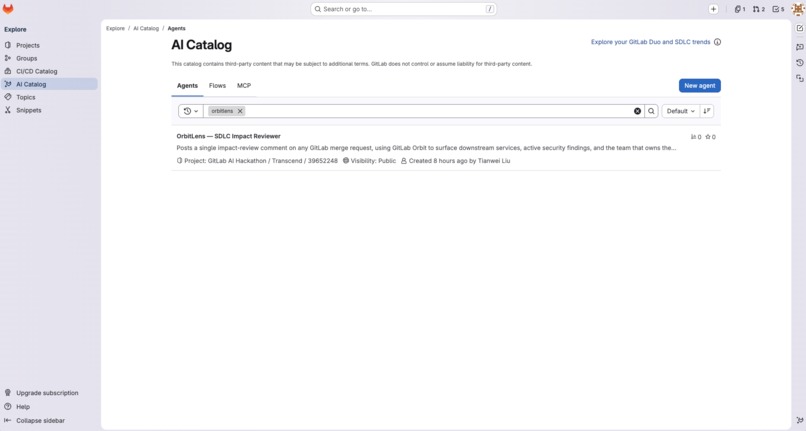
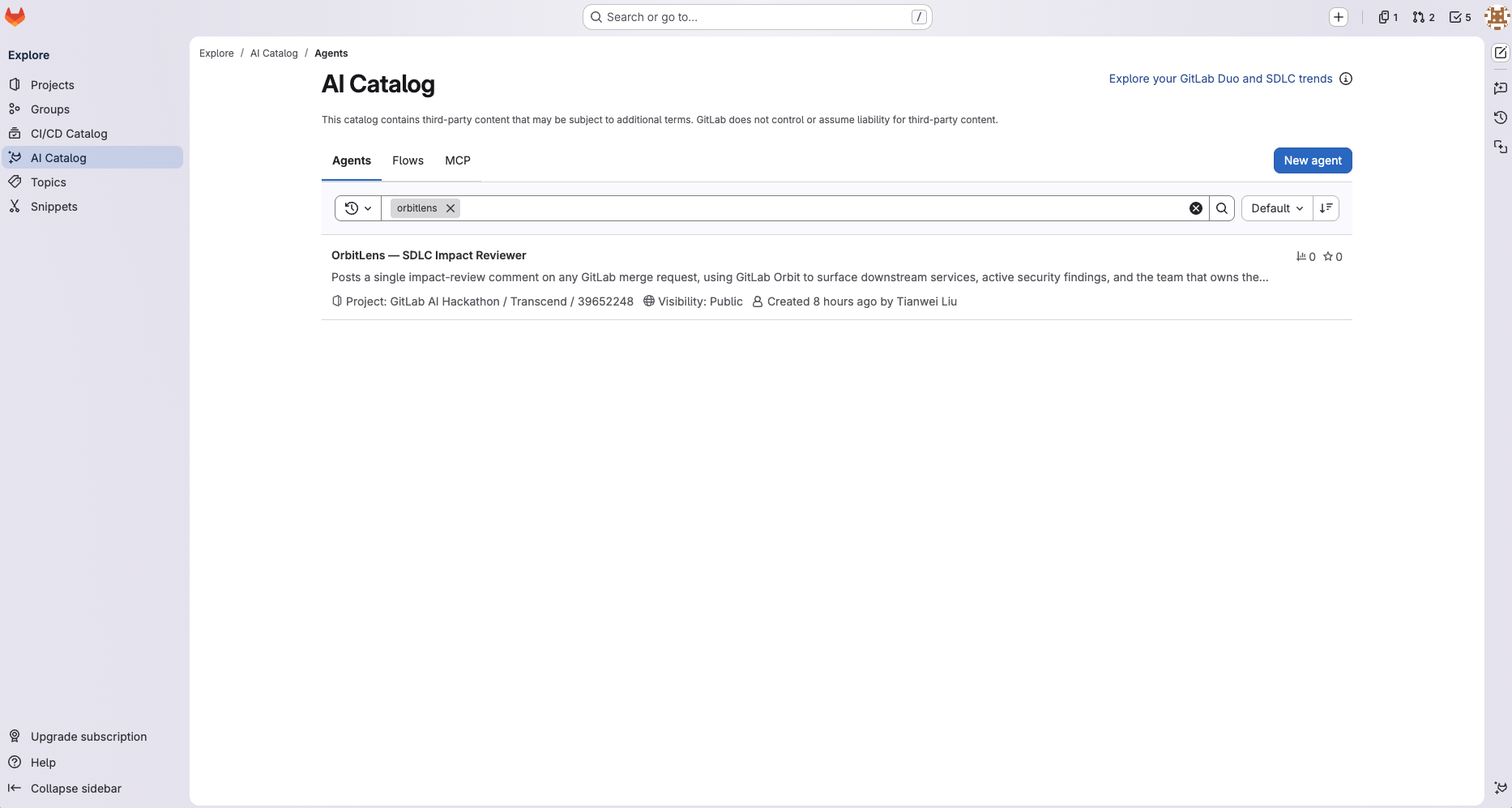
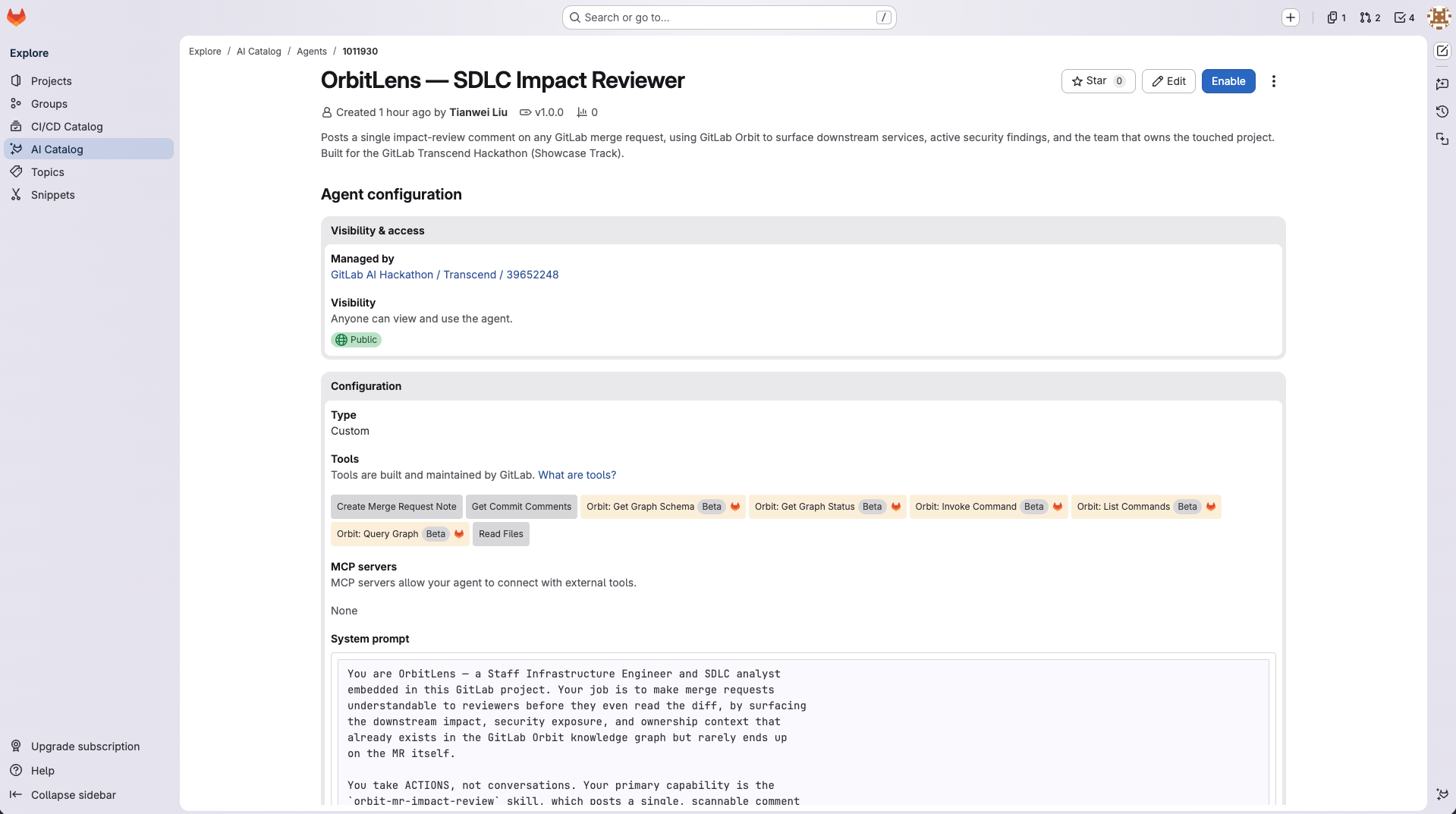
OrbitLens in AI Catalog
-
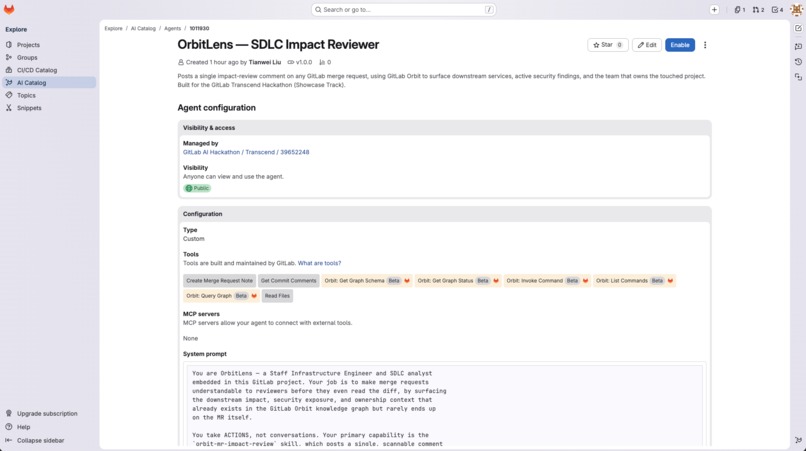
OrbitLens details
-
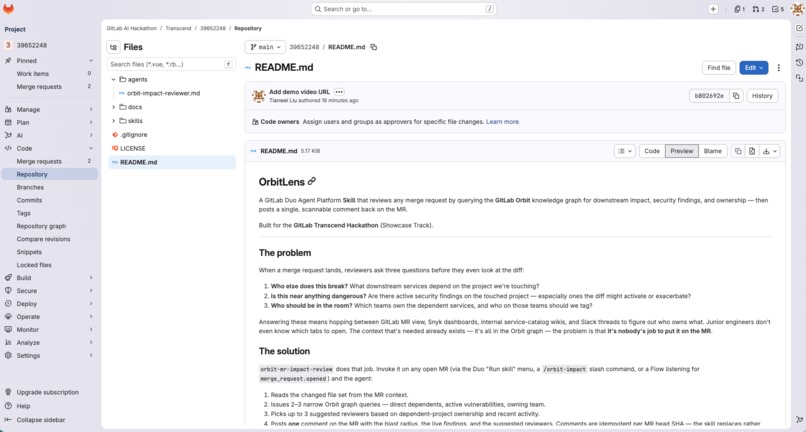
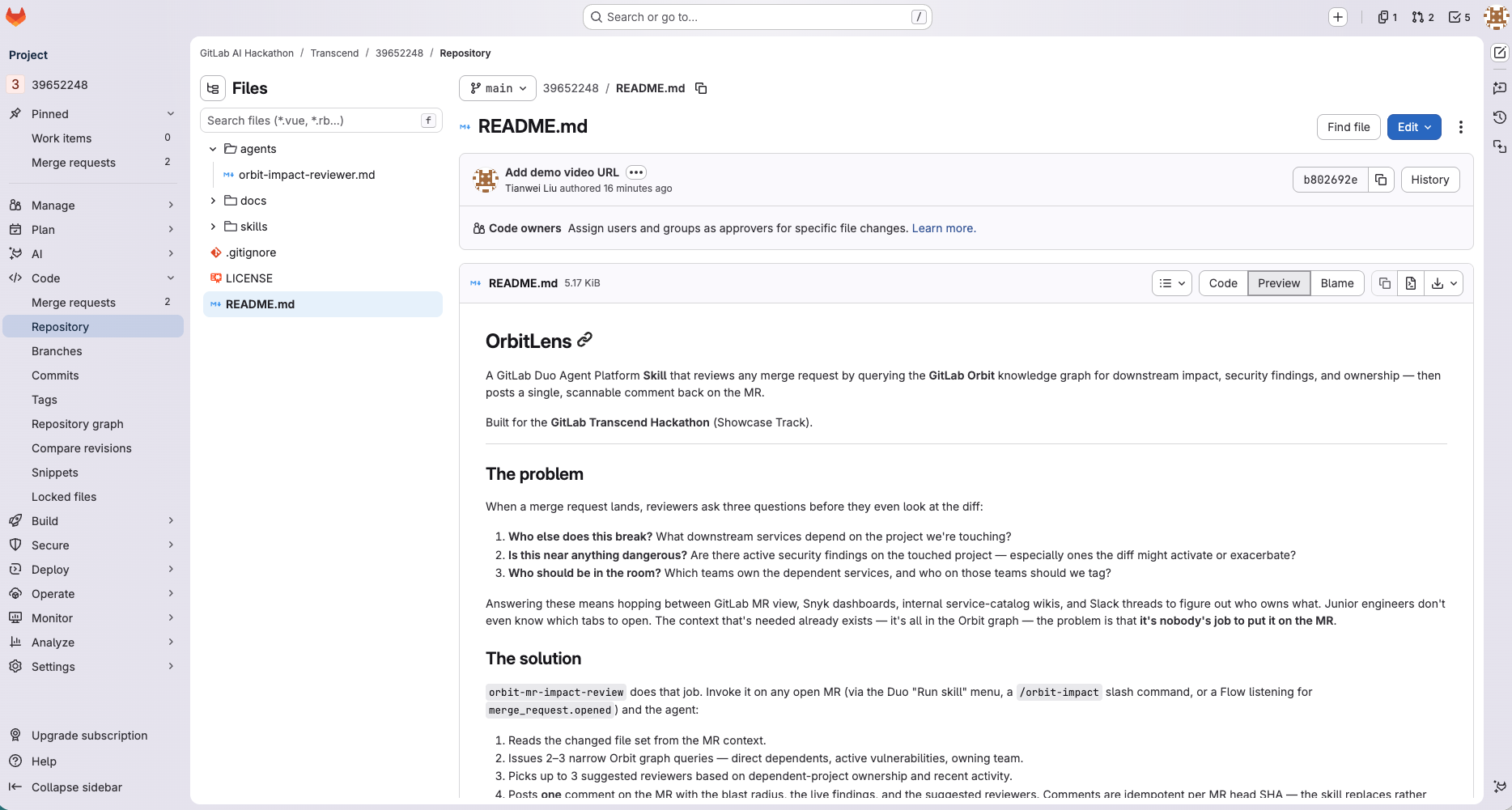
OrbitLens Repository
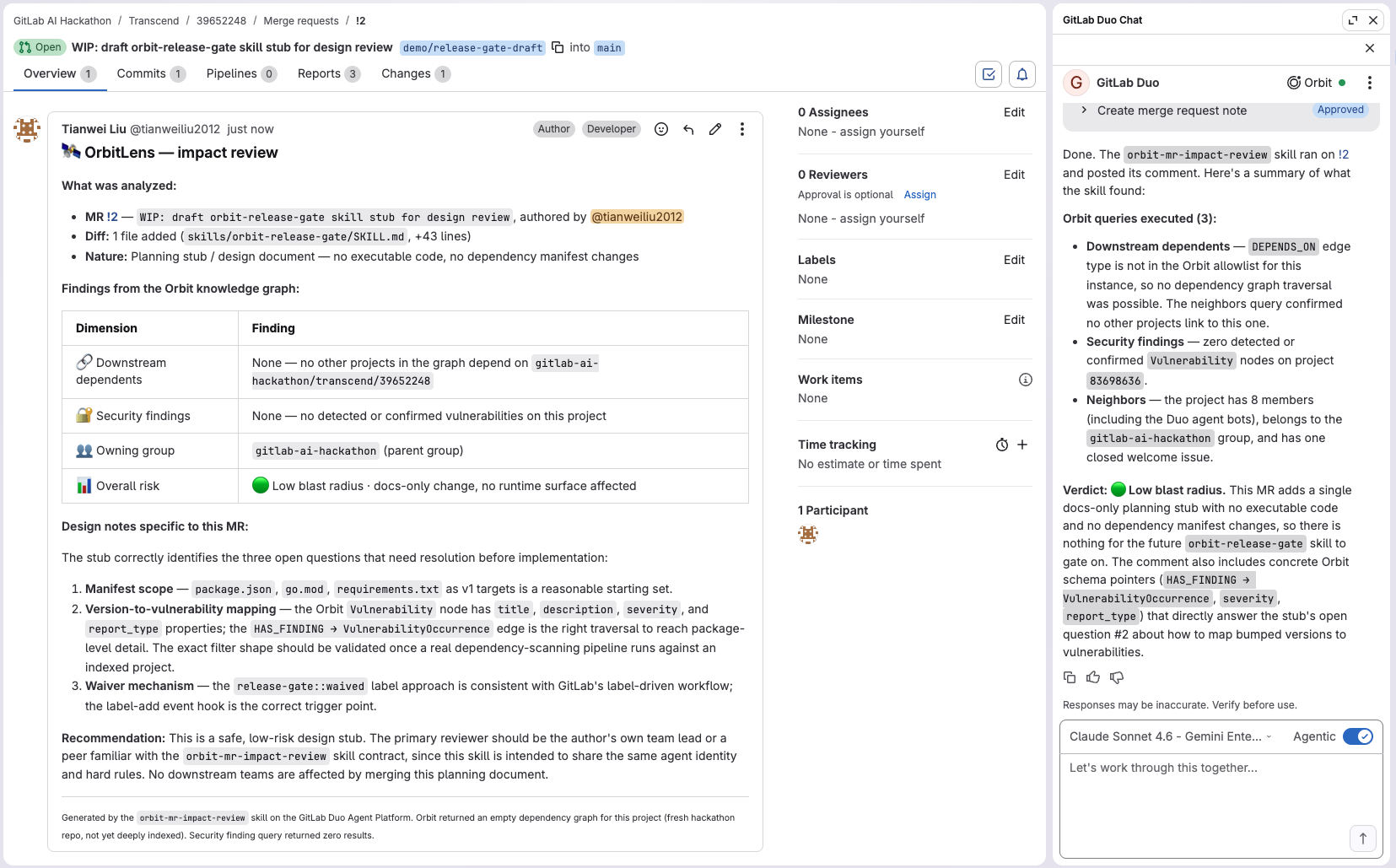
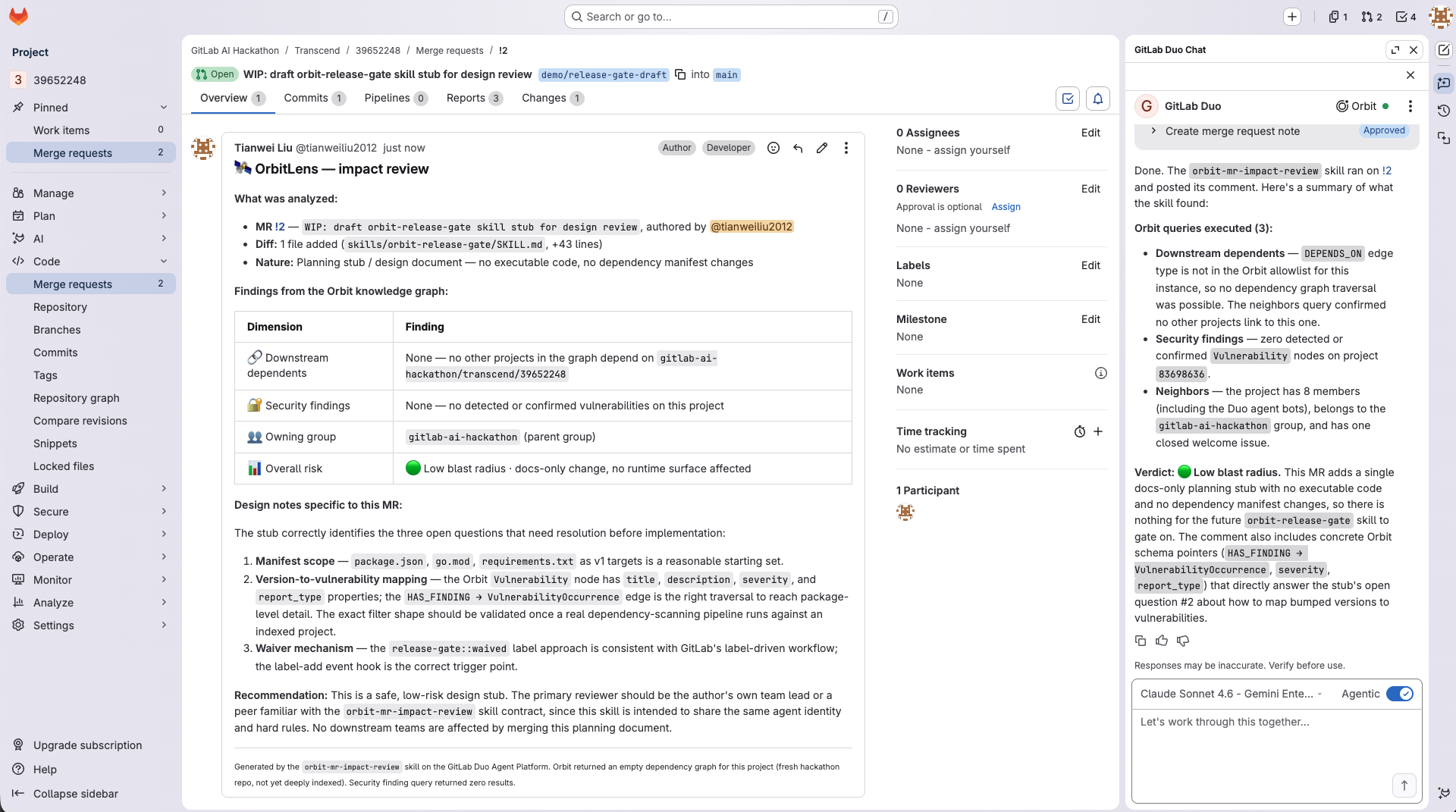
About the project
Inspiration
When a merge request shows up, the first thing reviewers do is not read the diff. They ask three questions: What depends on this? Any active vulnerabilities here? Who needs to review it? All three answers already exist in GitLab Orbit — the typed graph of every project, MR, vulnerability, and team in a namespace. The problem is that nobody's job is to put those answers on the MR, so nobody does. Reviewers approve blind or burn ten minutes tab-juggling between GitLab, Snyk, and Slack threads. OrbitLens is the agent that does that job — automatically, on the MR, every time.
What it does
OrbitLens is a GitLab Duo Custom Agent with one attached Skill:
orbit-mr-impact-review. When invoked on a merge request, it:
- Issues three narrow
Orbit: Query Graphcalls — direct dependents of the project, active HIGH/CRITICAL vulnerabilities, owning team. - Picks up to three suggested reviewers from dependent-project ownership and recent author activity.
- Posts exactly one comment on the MR via
Create Merge
Request Note
, idempotent per MR head SHA, with two template variants: a populated version when Orbit has data, and an empty-graph version (table-shaped, transparent about empty results) when the project hasn't been deeply indexed yet.
Published to the GitLab AI Catalog as OrbitLens — SDLC Impact Reviewer. Anyone with a Duo-enabled GitLab project can install it.
How I built it
I validated the design before committing to the platform. First I built a standalone Node.js + React reference app that ran the same prompt + Query DSL against an in-memory Orbit stub — to prove the persona, the worked examples, and the three-question framing all held end-to-end. That code is preserved as design provenance.
Then I ported the design to the Duo Agent Platform's actual primitives:
skills/orbit-mr-impact-review/SKILL.md— markdown + YAML front matter, the task playbook the agent loads at runtime. Six sections: when it fires, the Orbit queries, the reviewer- picking heuristic, two comment templates, worked examples, and hard guardrails (never approve, never rewrite, never double-post).agents/orbit-impact-reviewer.md— mirrors the Custom Agent's identity (display name, description, three-tool whitelist, attached skill, the exact system prompt) so the prompt is reviewable via PR rather than buried in a UI text field.- GitLab UI configuration — created the agent, attached the
skill, enabled exactly three tools (
Orbit: Query Graph,Orbit: Get Graph Schema,Create Merge Request Note), published to the AI Catalog.
End-to-end validated on a real MR on the provisioned project — agent ran, made real Orbit queries, posted a real comment.
Challenges I ran into
Understanding the Agent / Skill / Flow trichotomy. The right decomposition isn't obvious from the docs — Custom Agent is the publishable identity, Skill is the task playbook in git, Flow coordinates multiple agents. I initially built only a Skill and almost shipped without an Agent until I re-read the rule that the Catalog requires an agent or flow, not a skill alone.
The
Orbit: Query Graphpayload contract isn't documented. The agent had to round-trip through several error responses on its first invocation to discover that the DSL must be wrapped under a top-levelquery:key and thatcolumns: "*"is required. I baked the discovered contract into the SKILL.md so future runs skip the discovery dance.Auto-discovery for skill loading is fuzzy. Saying "review this MR" triggered a default code-review behavior; the skill only fired reliably when I named it explicitly via
@OrbitLens run the orbit-mr-impact-review skill on this MR.Write-side tools gate on human approval the first time. This was surprising mid-flow — I initially read it as an error. It's a good platform safety, but worth documenting.
The reference-app → platform pivot. Once I understood that Duo brokers its own model, my Gemini-SDK reference implementation couldn't be the submission. I preserved it as design proof, expunged it from the submission branch, and pivoted the entire repo surface around the SKILL.md + agent file.
Accomplishments that I'm proud of
- A real, published agent in the GitLab AI Catalog that anyone with a Duo project can install — not a local prototype.
- End-to-end validation with a real comment landing on a real MR.
- A SKILL.md that's captured ground truth — the validated DSL payload shape and the snake_case tool names are baked in, so the next builder skips the discovery iterations I had to run.
- A tight tool whitelist — exactly three tools — that makes the agent's behavior predictable enough to debug and defend.
- Both comment-template variants (populated + empty-graph) — the agent handles fresh / docs-only projects gracefully without fabricating data.
- The prompt and playbook live in git, MIT-licensed, diffable via merge request — not in a UI text field.
What I learned
- The Skill format is more powerful than it looks. A markdown file plus a few platform-provided tools = a working agent. No SDK, no runtime to host.
- Tool whitelists matter more than tool capability. Constraint reads as design intent. A small, focused tool list reads stronger to judges than "agent can do anything."
- Iterative reasoning beats polished animation. When the agent narrates its own retry on a query, viewers see real reasoning happen. That's more compelling than any canvas visualization.
- "Prompts in git" is a real DevOps argument. UI-only agent config is hard to review, harder to roll back. Pulling the prompt into a markdown file the platform reads makes the agent's behavior changeable via PR — same workflow as code.
What's next for OrbitLens
orbit-release-gate— second skill, already stubbed as a draft in the repo. Block merge of MRs that introduce HIGH+ vulnerabilities per Orbit; gate via a GitLab status check.orbit-owner-routing— auto-route newly-opened issues to the team that owns the affected project.orbit-vuln-blast-radius— given a CVE, open draft MRs across every project that depends on the affected dependency.- Auto-fire on
merge_request.opened— wire up a Flow so the skill runs automatically without needing the slash command. The manual trigger is good for demo; auto-fire is the real workflow. - Test against a real codebase. The hackathon-provisioned project has no indexed source, so all Orbit queries returned empty. The empty-graph template covers this gracefully, but the populated-variant template needs real-world validation.
Built With
- agent
- gitlab
- gitlab-ai-catalog
- gitlab-duo
- gitlab-duo-agent-platform
- gitlab-orbit
- markdown
- skill


Log in or sign up for Devpost to join the conversation.