-
-
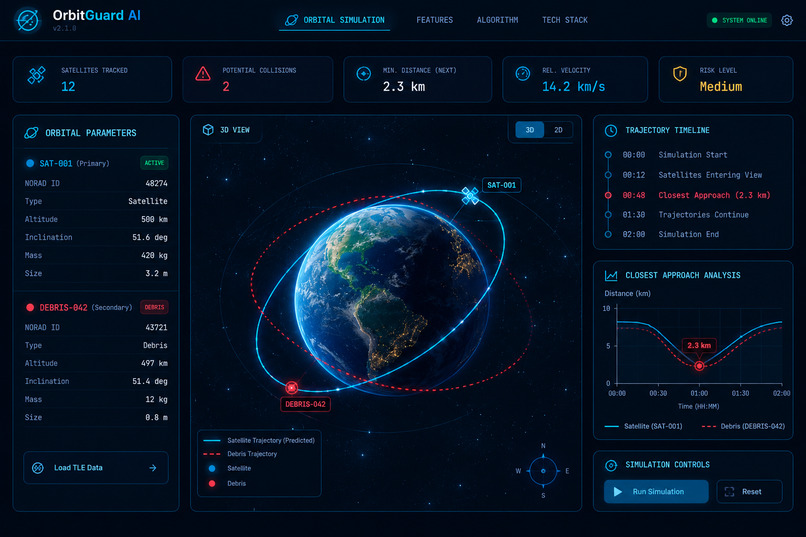
dashboard
-
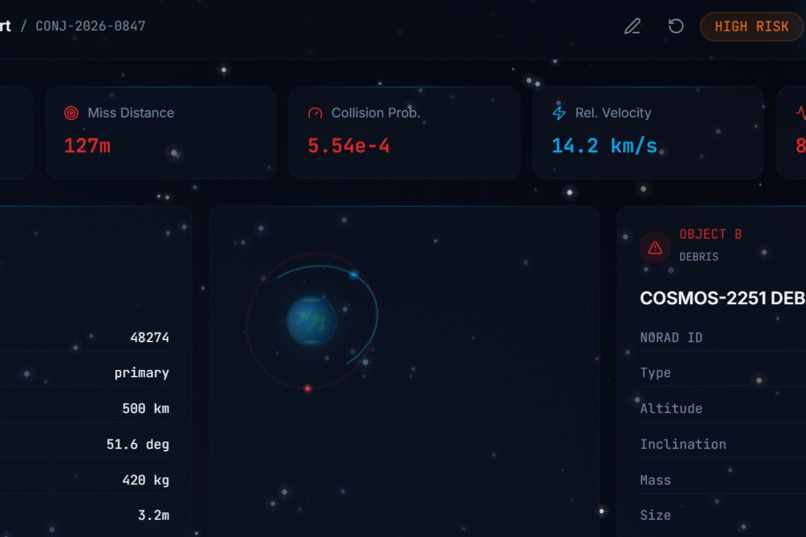
analysis
-
frontpage
Inspiration
What it does
How we built it
Challenges we ran into
Accomplishments that we're proud of
What we learned
What's next for OrbitGuard AI
🛰️ OrbitGuard AI: Making Space Safer with Intelligent Collision Prediction
💡 Inspiration
Space is becoming increasingly crowded with satellites, rocket fragments, and orbital debris. Every object travelling around Earth contributes to a complex environment where even a small piece of debris can pose a serious threat to an operational satellite.
This inspired us to explore an important question:
What if we could anticipate potential satellite collisions, understand the risks, and identify safer orbital maneuvers before a dangerous encounter occurs?
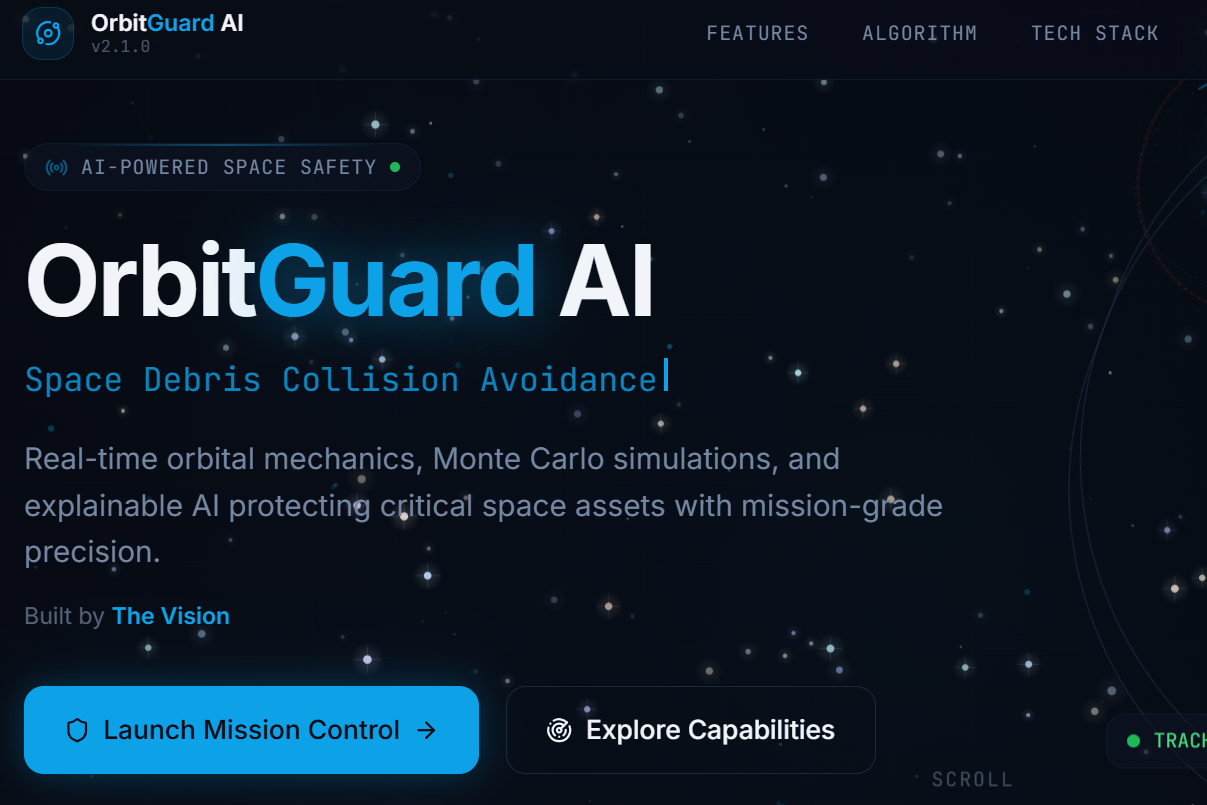
That question led to OrbitGuard AI, a space-safety concept that combines artificial intelligence, orbital simulation, and collision-risk analysis to help make satellite operations safer and smarter.
🚀 What We Built
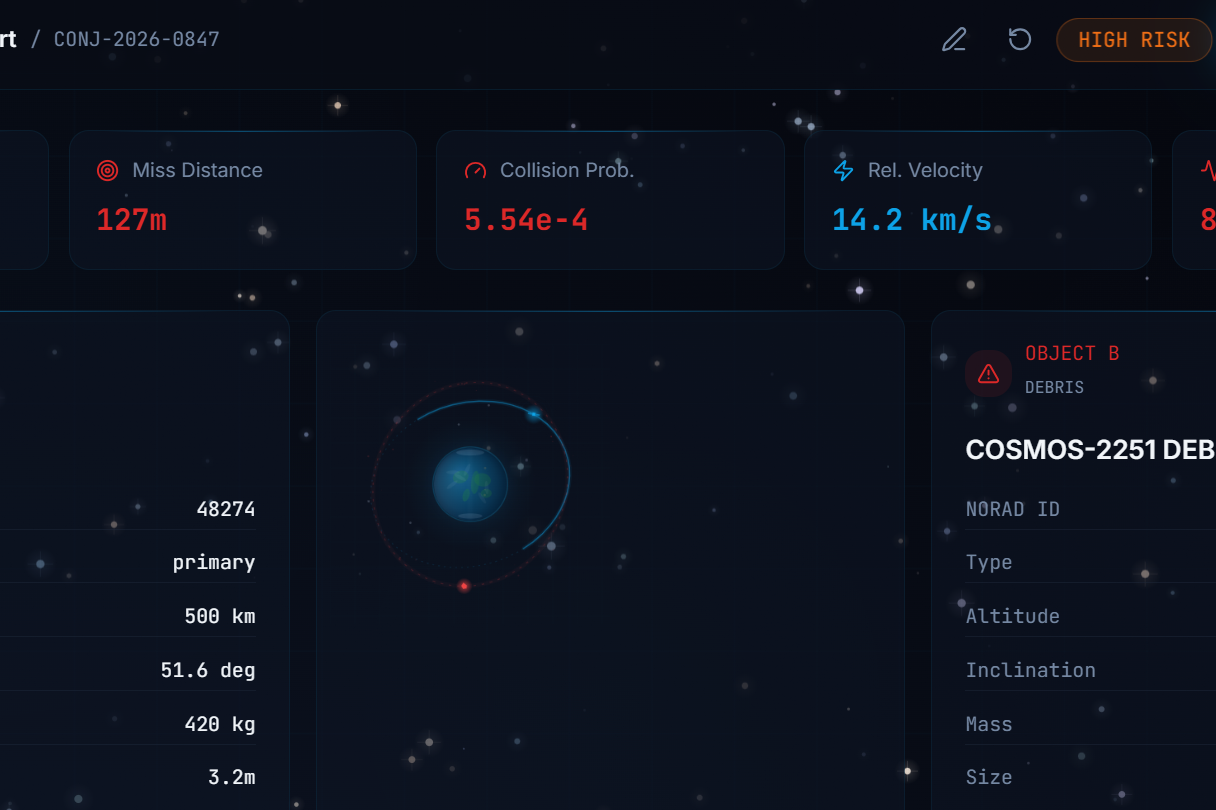
OrbitGuard AI is designed to provide a unified platform for understanding satellite collision risks and exploring possible avoidance strategies.
The project brings together several key capabilities:
- Collision Detection: Identify potentially dangerous close approaches between satellites and orbital debris.
- Orbital Simulation: Explore satellite trajectories and understand how objects move through space.
- AI-Assisted Risk Assessment: Analyze relevant information to help assess potential collision threats.
- Uncertainty Analysis: Explore how variations in orbital data may affect predicted close approaches.
- Maneuver Planning: Evaluate potential orbital adjustments that could help reduce collision risk.
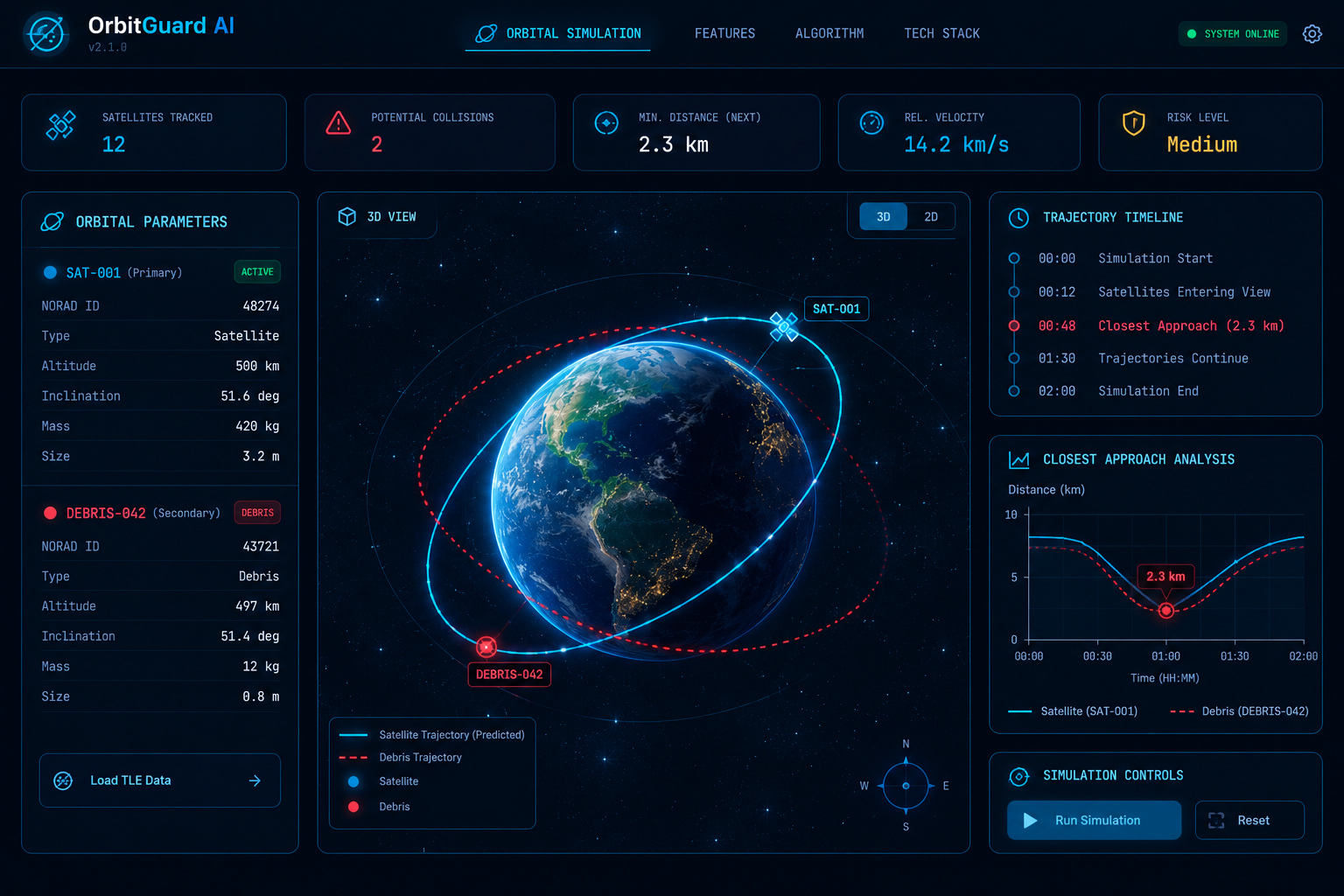
- Interactive Dashboard: Present complex space-safety information through an accessible, space-themed interface.
Our vision is to transform complex orbital information into clearer, more actionable insights for satellite operators.
⚙️ How We Approached the Problem
We explored how scientific computing and modern web technologies could work together to address a real-world space-safety challenge.
The intended workflow follows several stages:
- Orbital Data: Work with satellite orbital information, such as Two-Line Element (TLE) sets.
- Trajectory Prediction: Use orbital propagation techniques, including SGP4, to estimate satellite positions over time.
- Close-Approach Screening: Compare predicted trajectories to identify encounters that may require further investigation.
- Risk Analysis: Examine separation distances and relevant uncertainty factors.
- Simulation and Planning: Explore possible avoidance maneuvers and their potential effects.
- Visualization: Present the analysis through a dashboard designed to make the results easier to understand.
The project explores Python-based scientific computing alongside technologies such as NumPy, SciPy, FastAPI, React, and Three.js.
🧠 What We Learned
Working on OrbitGuard AI helped us appreciate that solving a complex problem requires much more than building an attractive interface.
We explored the importance of:
- Understanding the underlying scientific problem before applying AI.
- Working with structured data and numerical calculations.
- Connecting computational workflows with a user-facing dashboard.
- Communicating technical information through visualizations.
- Considering uncertainty when making predictions about real-world systems.
- Distinguishing between a promising prototype and a scientifically validated solution.
One of our biggest takeaways was that AI should support sound scientific reasoning, not replace it. Reliable collision assessment requires appropriate orbital calculations, meaningful data, and rigorous validation.
🧩 Challenges We Faced
Satellite collision prediction is a challenging problem because orbital motion, measurement uncertainty, and the number of objects in space make accurate assessment difficult.
Some of the key challenges we explored were:
1. Understanding orbital mechanics
Predicting where satellites will be requires more than plotting points on a map. Orbital elements must be interpreted correctly, and propagation methods must be used appropriately.
2. Handling uncertainty
Predicted trajectories are not perfectly certain. Understanding how uncertainty affects estimated close approaches is essential when evaluating potential collision risks.
3. Integrating different technologies
Combining scientific calculations, backend services, and an interactive frontend requires a clear architecture and reliable communication between components.
4. Making complex information understandable
Orbital data can be difficult to interpret. We wanted the interface to communicate potential threats and possible responses in a clear, visual format.
These challenges reinforced the importance of testing, validation, and careful engineering when developing AI-assisted systems.
🌍 Why OrbitGuard AI Matters
As humanity becomes more dependent on satellites for communication, navigation, weather forecasting, and Earth observation, protecting orbital infrastructure becomes increasingly important.
OrbitGuard AI explores how intelligent analysis and simulation could help people better understand orbital risks and investigate potential responses.
The project is a step toward a future where space operations can become more informed, proactive, and safety-focused.
🔭 What's Next?
We envision several improvements for future development:
- Integrating reliable, up-to-date orbital datasets.
- Building and validating an end-to-end collision-analysis pipeline.
- Improving uncertainty estimation and collision-probability calculations.
- Benchmarking AI-assisted approaches against established mathematical methods.
- Testing maneuver-planning algorithms in reproducible simulations.
- Expanding the dashboard with clearer explanations, interactive orbital views, and detailed analysis reports.
Our long-term goal is to develop OrbitGuard AI into a reproducible, evidence-driven platform for satellite collision analysis and decision support.
✨ Our Vision
OrbitGuard AI — Turning Space Threats into Smart Decisions.
We believe that the future of space exploration depends not only on launching more satellites, but also on protecting the infrastructure already orbiting our planet.
By bringing together scientific computing, intelligent analysis, and accessible visualization, OrbitGuard AI aims to contribute to a safer and more sustainable space environment.

Log in or sign up for Devpost to join the conversation.