Inspiration
Interplanetary space exploration is becoming all-to prevalent in the modern day. We wanted to design a simulator that allows the general public and kids to explore and gain understanding of some of the basic orbital mechanics and challenges facing space travel.
What it does
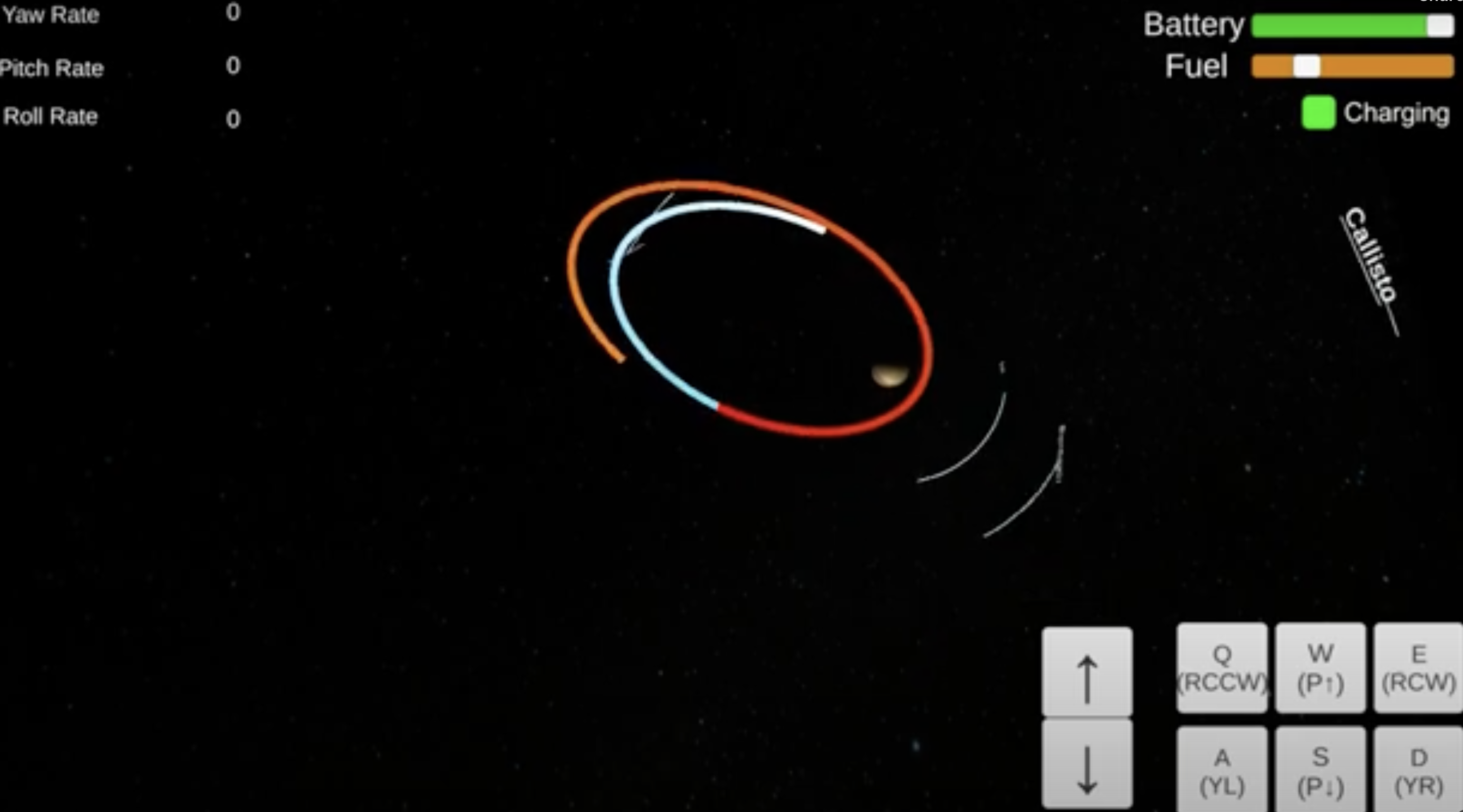
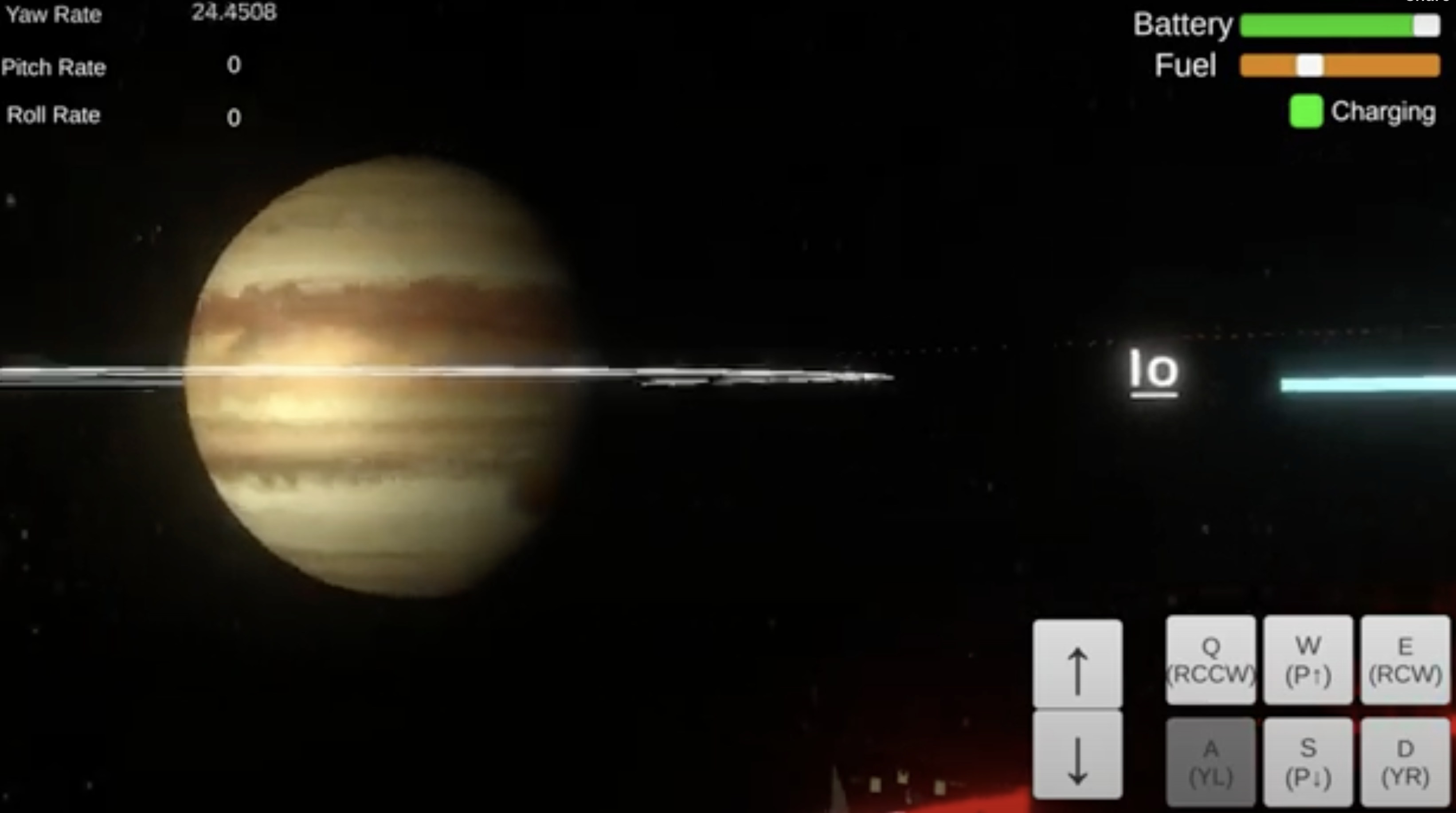
The simulator allows you to fly a spacecraft around Jupiter and its moons, accurately simulating gravitational dynamics and controls. For example, any change to your angle is added as thrust, using fuel and battery, and giving you angular velocity, meaning you have to reverse your thrust when you are pointing in the right direction. The batteries charge based on whether the solar panels can see the sun (including effects from Jupiter's shadow), and you can both change your orientation and fire thrusters to change your trajectory (with real-time n-body orbital prediction generated through an RK4 numeric propagator).
How we built it
The app was built in the Unity game-engine, which allowed for rapid development and quick iteration of 3D designs. 3D Models were produced in OnShape and Blender, and the textures for Jupiter were acquired from NASA. GitHub was used to manage commits and changes.
Challenges we ran into
The primary challenge for the design was building something that was a reasonable compromise between being realistic and not painful to play. This meant the addition of some unrealistic features (which could be toggled on/off depending on user's skill-level) like adding angular drag to slow down rotation speed for easier control.
Accomplishments that we're proud of
We are very proud of the real-time simulation for spacecraft dynamics, and the detailed control system and UI we implemented. A lot of testing went into designing controls for the most elegant use and optimizing the orbital propagator for the highest frame-rate possible.
What we learned
- How to use Unity, C#, and Git, which several of our members had never used before.
- The value of trying new things, even if they don't work as expected.
What's next for Orbital Sandbox
Hopefully, after the completion of AuburnHACKS, we will continue to work on the simulator, adding more intuitive visual feedback, improved texturing and models, and adding additional gameplay elements like objectives or a tutorial mode.


Log in or sign up for Devpost to join the conversation.