Inspiration
The recent anomalies we’ve seen with major NASA missions serve as a strong reminder that gravity isn't the only thing holding us back. While we often view a scrubbed launch as a failure, it is actually a safety triumph in an environment with zero margin for error. Launching a rocket is like threading a needle at 17,500 mph while the eye of the needle is moving and the thread is on fire. It’s not just about the hardware working; the environment itself is a minefield. So we decided to try and simplify this problem by being able to predict when the risk is low, allowing for more successful rocket launches also whilst educating people on the complexities behind rocket launches.
What it does
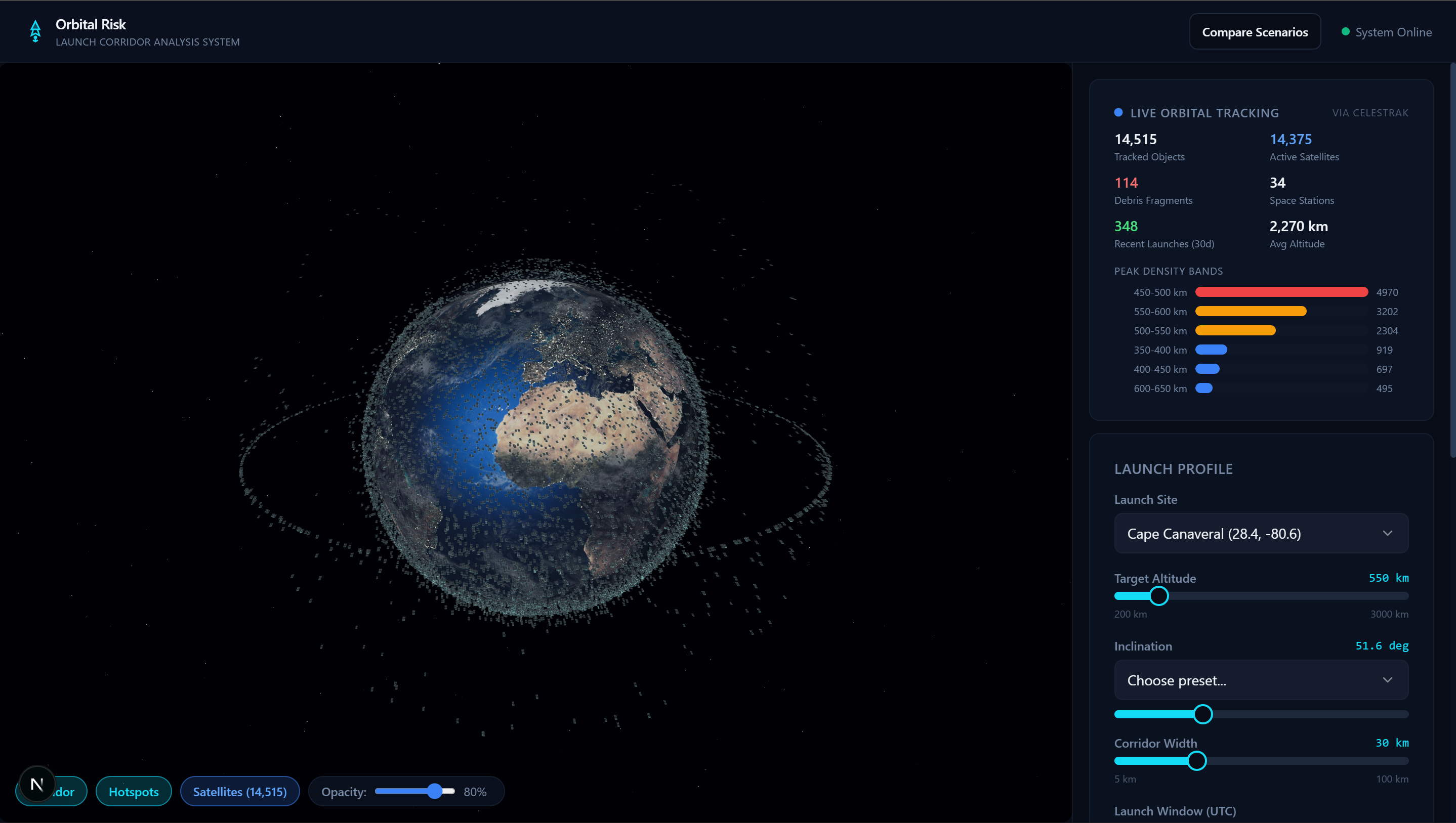
It takes real TLE data about satellites and space debris to then plot them around a model of the earth. It then uses the predicted location of them and the estimated trajectory of the rocket to calculate how risky a rocket launch is at a specific site at a certain time. It also takes data from an XGBoost ML model that we trained to predict whether the weather is suitable enough for launch.
How we built it
Once we got the idea for the project we then used a tool called V0 to generate an initial prototype. Once we had an idea of how it could finally look like we then split up tasks amongst the team. To be able to create this application we utilised AI assistance through tools such as co-pilot and Gemini to be able to quickly iterate and improve upon are prototypes within a short timeframe. We then used git for version control to enable continuous integration which allowed us to work quickly as a team with little interference.
Challenges we ran into
One of the earlier challenges we had faced was trying to make the sphere look like the earth. We to manually add green and blue blobs to make the sphere resemble the earth but it never looked quite right. We then found out about three.js texture loaders which allowed us to wrap a texture resembling the earth around the sphere. This then also allowed us to take it one step further and include moving clouds on the earth model as well. Another challenge of building the Orbital Risk program came when trying to train a model to allow us to predict future weather forecasts. When training the model had a problem when training it on a lot of data. It would end up crashing during the process. To tackle this we reduced the amount of data that got fed into the model which allowed us to successfully train the model whilst also keeping a high accuracy. One of the major challenges we faced was calculating all of the maths involved in predicting the trajectory of the rocket as well as the movement of the space debris and satellites. Since most of the solutions to these predictions are readily available we utilised AI to help identify the maths needed for our solution. This allowed us to be able to work on the rest of the project without having to hassle with some of the meticulous details regarding the maths of the rocket.
Accomplishments that we're proud of
A major aspect of the project which we are proud of is the UI. We were able to generate a realistic 3-D model of the earth with accurate satellite and debris placement. We were able to provide this responsive UI whilst simultaneously processing thousands amount of data. We were also able to create very accurate weather conditions and accurate rocket trajectory with the risk analysis of collision with debris or satellites. Mainly, we are extremely proud of the whole program. We were able to produce a very informative program which could educate people people of some of the factors that influence rocket launches and why they rarely happen due to the amount of precautions needed to take to ensure the risk is at a minimum.
What we learned
This project allowed us to step out of our comfort zone and provided many opportunities for learning. It mainly allowed us to learn about different factors that influence rocket launches. We learned how to generate a 3-D interactive model of the earth which could be very useful in future projects that require running simulations on a planet. Another thing we learned was some of the maths behind rocket trajectory projection. Having to use equations like Kepler's equation and having to incorporate the earth's rotation into our calculations. It was also interesting to see who dominated the satellite orbit. Starlink was one of the major satellite companies which we saw popping up everywhere. It seemed like all of the satellites were owned by Starlink.
What's next for Orbital Risk
To expand on this project we would like to be able to simulate rocket launches on different planets and from planet to planet rather than just leaving the planet's atmosphere. We would also like to be able to use live satellite and space debris data rather than relying on a dataset that is updated every 8 hours.
Built With
- celestrak
- fastapi
- next.js
- numpy
- open-mateo-api
- pandas
- python
- react
- scikit-learn
- three.js
- typescript


Log in or sign up for Devpost to join the conversation.