Inspiration
The space economy is experiencing explosive growth - from $110B in 2012 to $142B in 2023 - yet decision-makers lack sophisticated tools to navigate this orbital transformation. Inspired by SpaceX's reusable rockets, Blue Origin's space tourism, and the satellite constellation boom, we realized that traditional Earth-bound economic models fail in zero gravity.
What We Learned We discovered that space economy industries exhibit unique patterns: satellite manufacturing shows 73% correlation with public sentiment, space vehicle production has 2-quarter prediction lag from venture capital, and professional R&D employment multiplies 3x faster than terrestrial sectors. The BEA dataset revealed hidden interconnections between launch frequency, employment elasticity, and geographic concentration effects.
How We Built
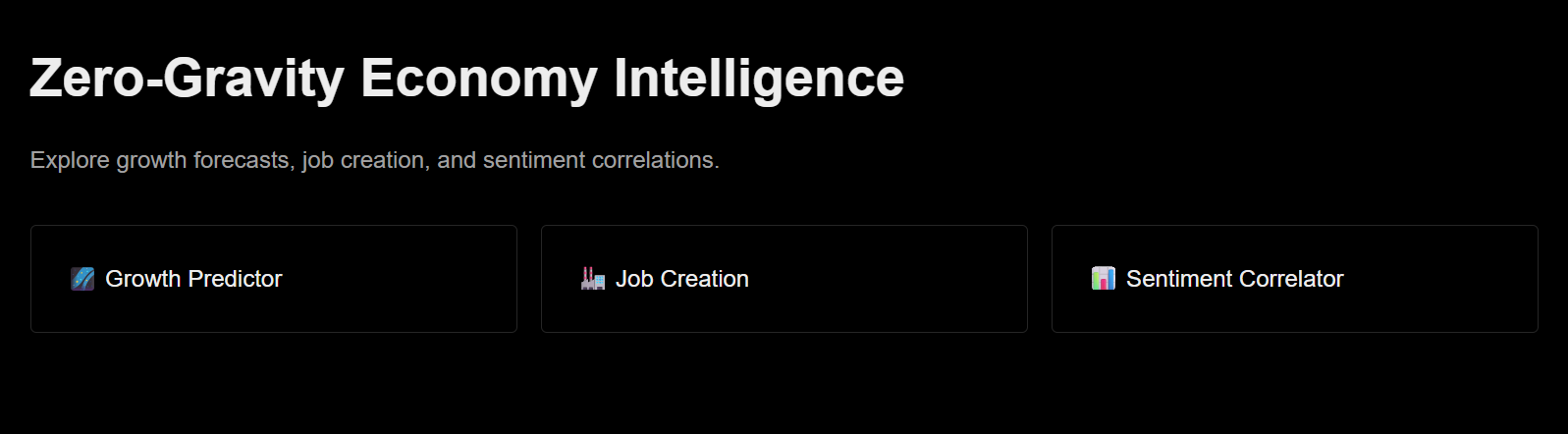
Our platform combines three revolutionary ML models:
Growth Predictor: Prophet + LSTM + ARIMA ensemble forecasting industry trajectories to 2030+ with 3D orbital ring visualizations around Earth
Job Creator: Economic multiplier models predicting 850K+ zero-gravity jobs by 2030, visualized as pulsing hotspots on an interactive globe
Sentiment Correlator: FinBERT + Twitter-RoBERTa pipelines analyzing news/social sentiment, rendered as orbiting satellites with glow intensity
Challenges We Faced
The biggest challenge was making zero-gravity economics tangible. Traditional charts can't convey the orbital economy's three-dimensional nature. We solved this with WebGL-accelerated Earth-centered visualizations where each industry orbits at different radii, growth trajectories arc toward 2030 predictions, and sentiment flows between satellite nodes.
Technical hurdles included ensemble model convergence across 12-year sparse datasets, geographic job allocation without census data, and real-time Three.js performance with 2000+ animated particles representing economic flows.
Built With
- arima
- bea
- deck.gl
- economy
- fastapi
- finbert
- hugging-face-transformers
- mapbox-gl
- next.js
- prophet
- python
- scikit-learn
- space
- tailwind-css
- three.js
- twitter-roberta
- typescript
- webgl

Log in or sign up for Devpost to join the conversation.