Orbital Archipelago
AI agents run a three-planet economy. Change the rules and watch what happens.
Inspiration
We were inspired by Mindcraft, where LLM agents play Minecraft together. Watching agents act in a world is much more fun than reading about them, and we wanted the same thing for economics. Textbooks explain tariffs and interest rates with static charts. We wanted a place where you raise a tariff and watch the freighters reroute.
What it does
Orbital Archipelago turns economics into something you can watch. AI agents run a working economy across three planets, Helion, Verdan and Tethys, and you can change its policies to see what happens.
Each planet has its own currency, its own industries and 35 AI agents, so there are 105 in total:
- Colonists work, eat, and buy and sell iron, grain, water, fuel and tools on their planet's market.
- Traders ship cargo between planets as they orbit, and exchange currencies.
- Governments set tariffs and embargoes. Central banks set interest rates and lend.
No price is fixed. Every price comes from agents bidding against each other.
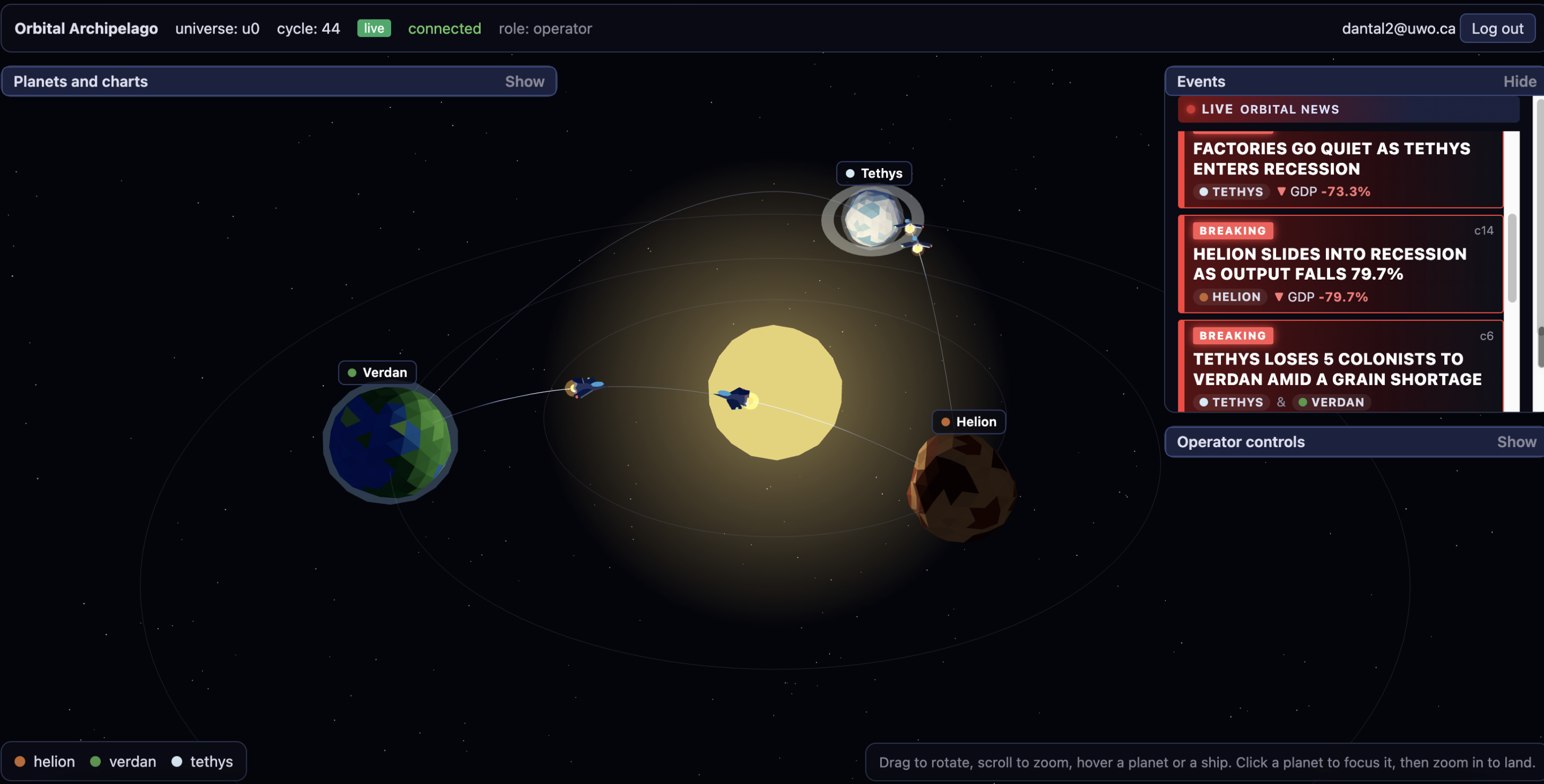
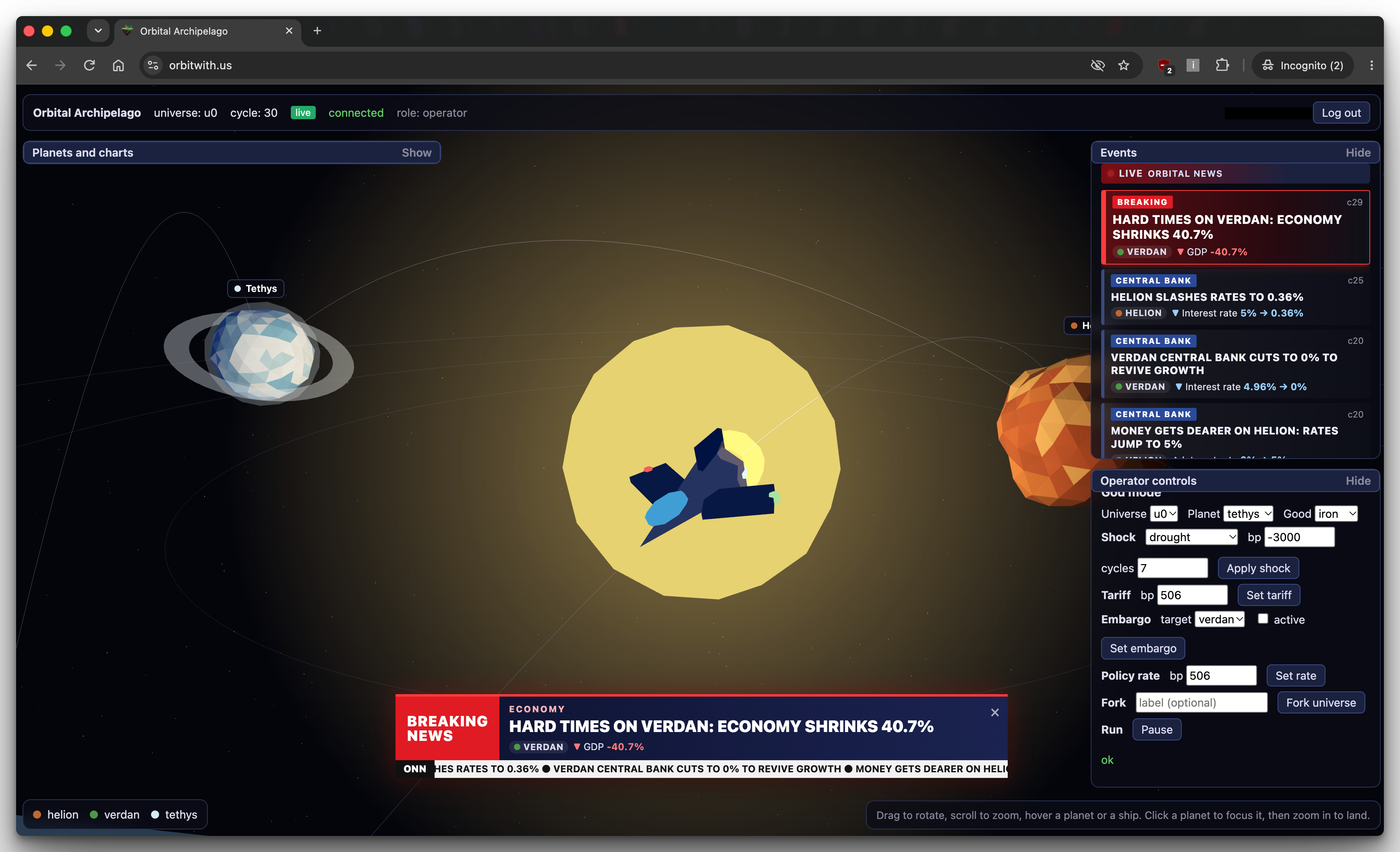
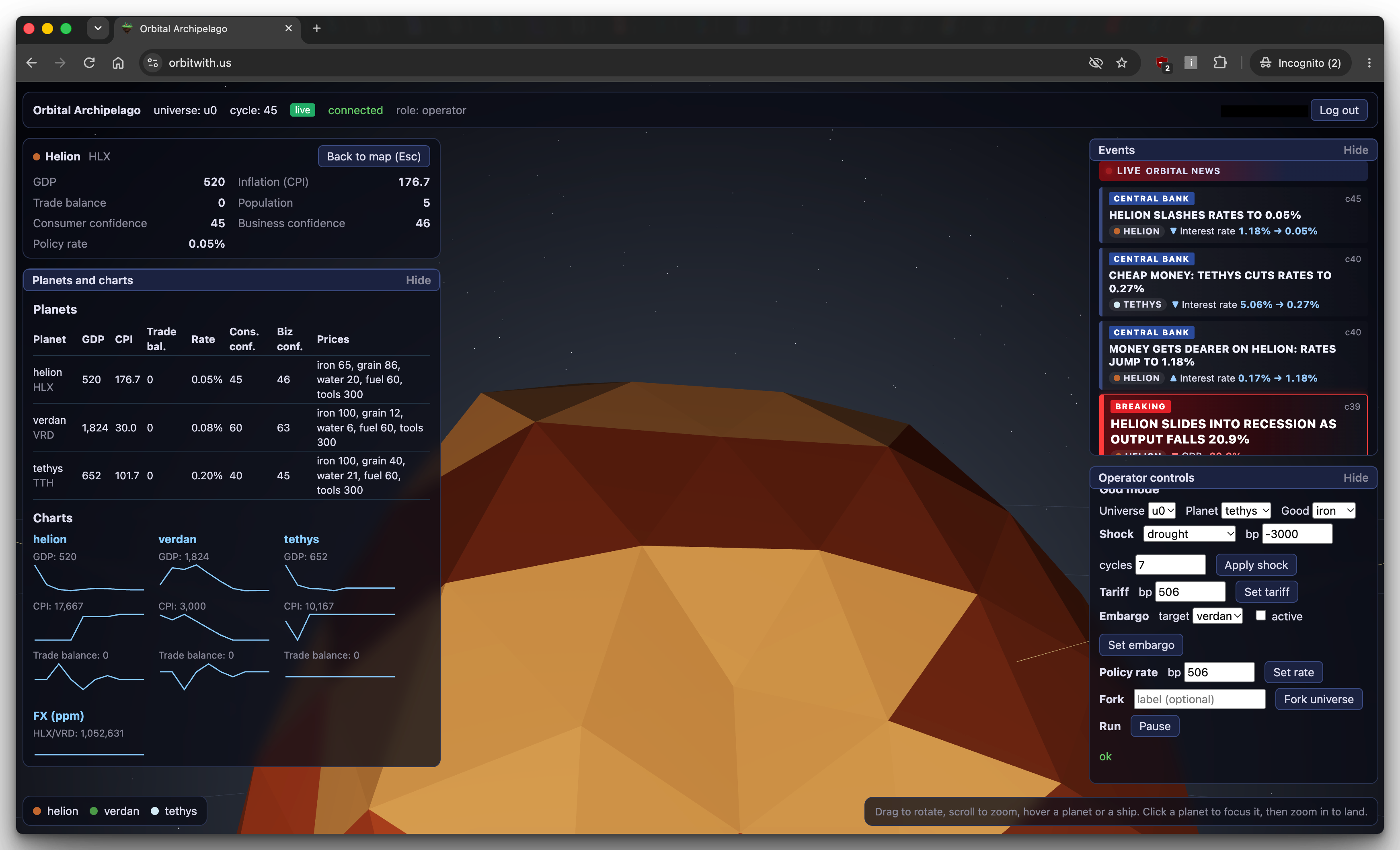
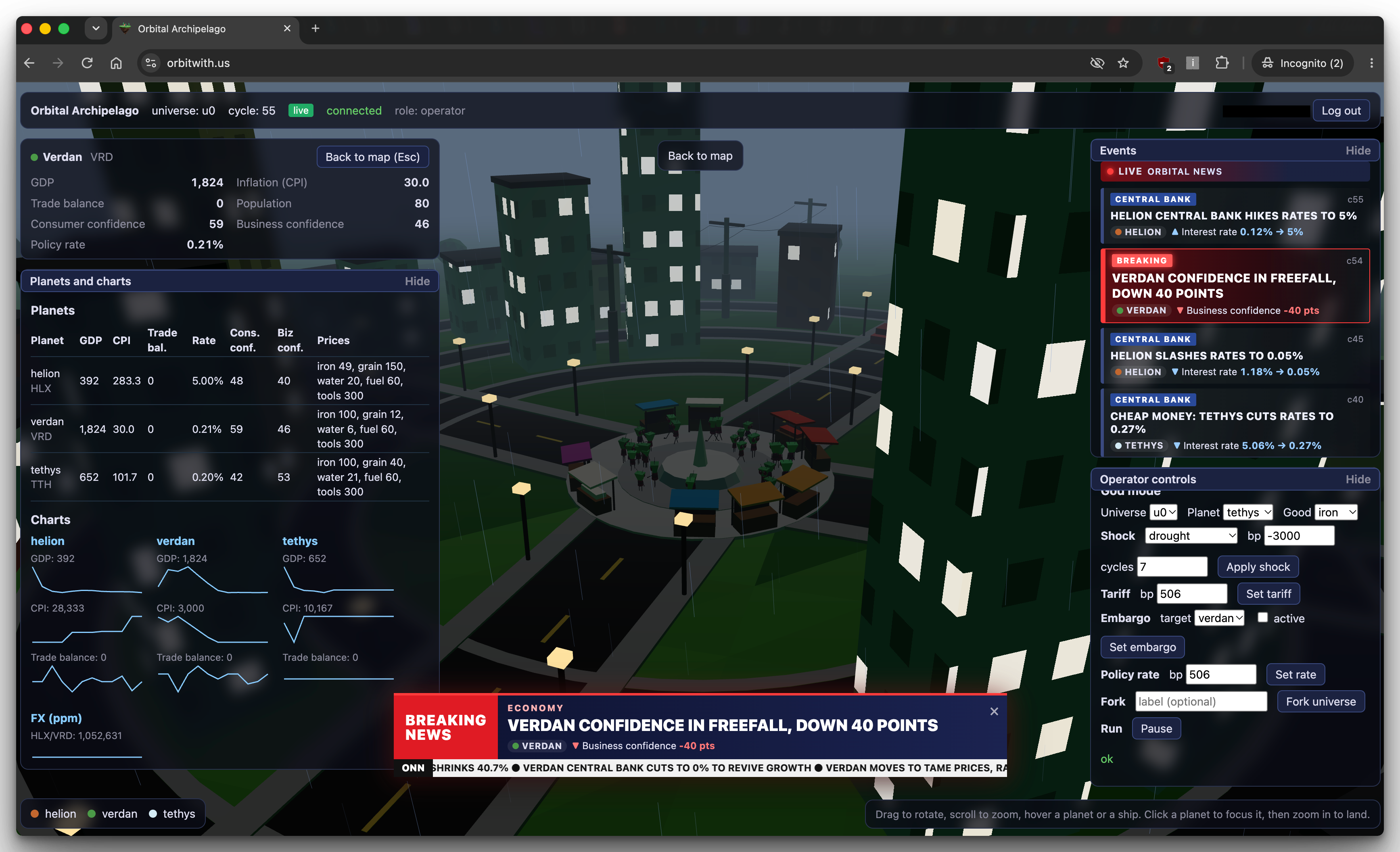
God mode lets you cause a drought, a strike or a windfall, add a tariff, embargo a planet or move interest rates. GDP, inflation, trade and exchange rates respond live. When the sim detects a trade war, a currency crisis or a recession, it shows up as breaking news.
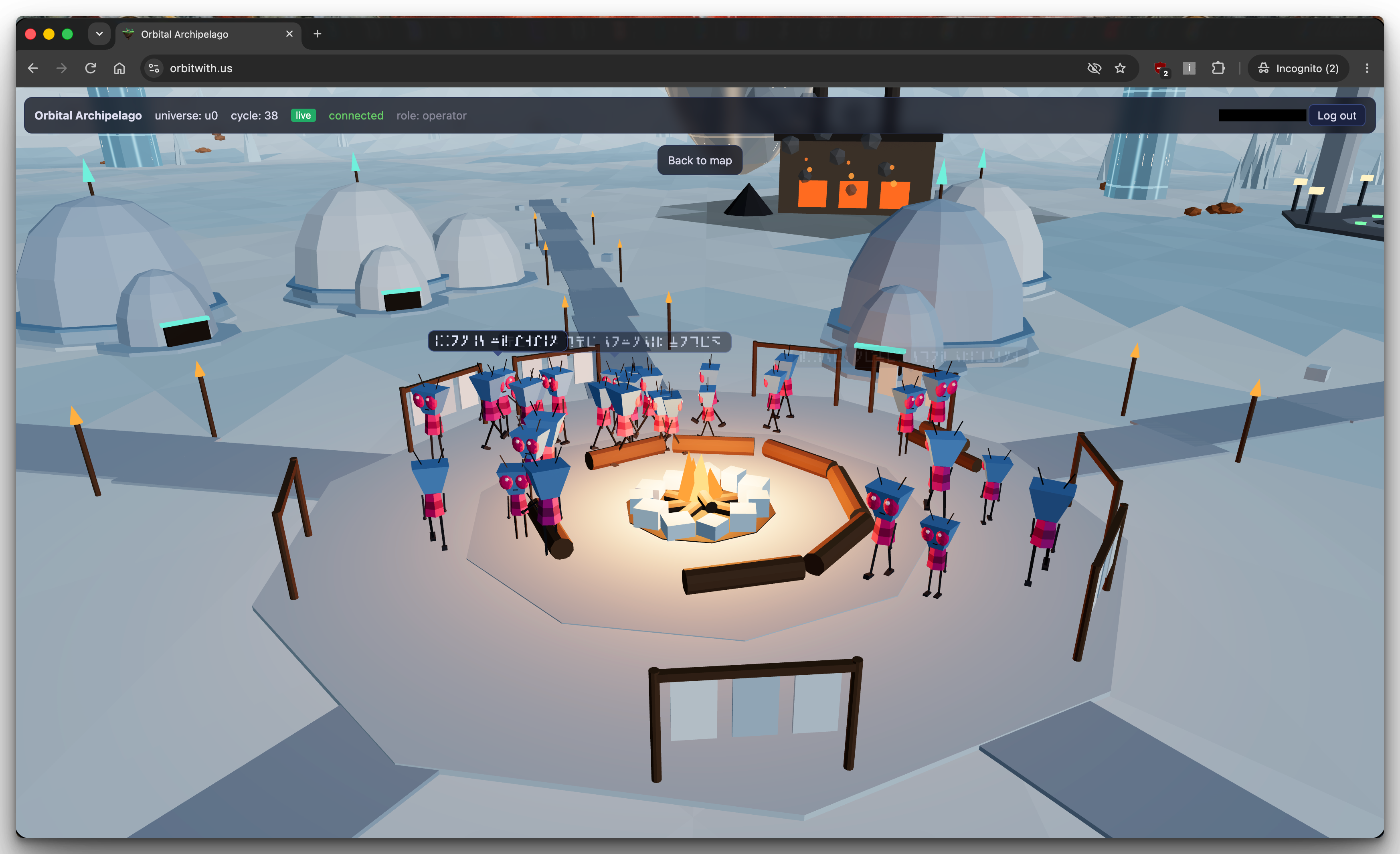
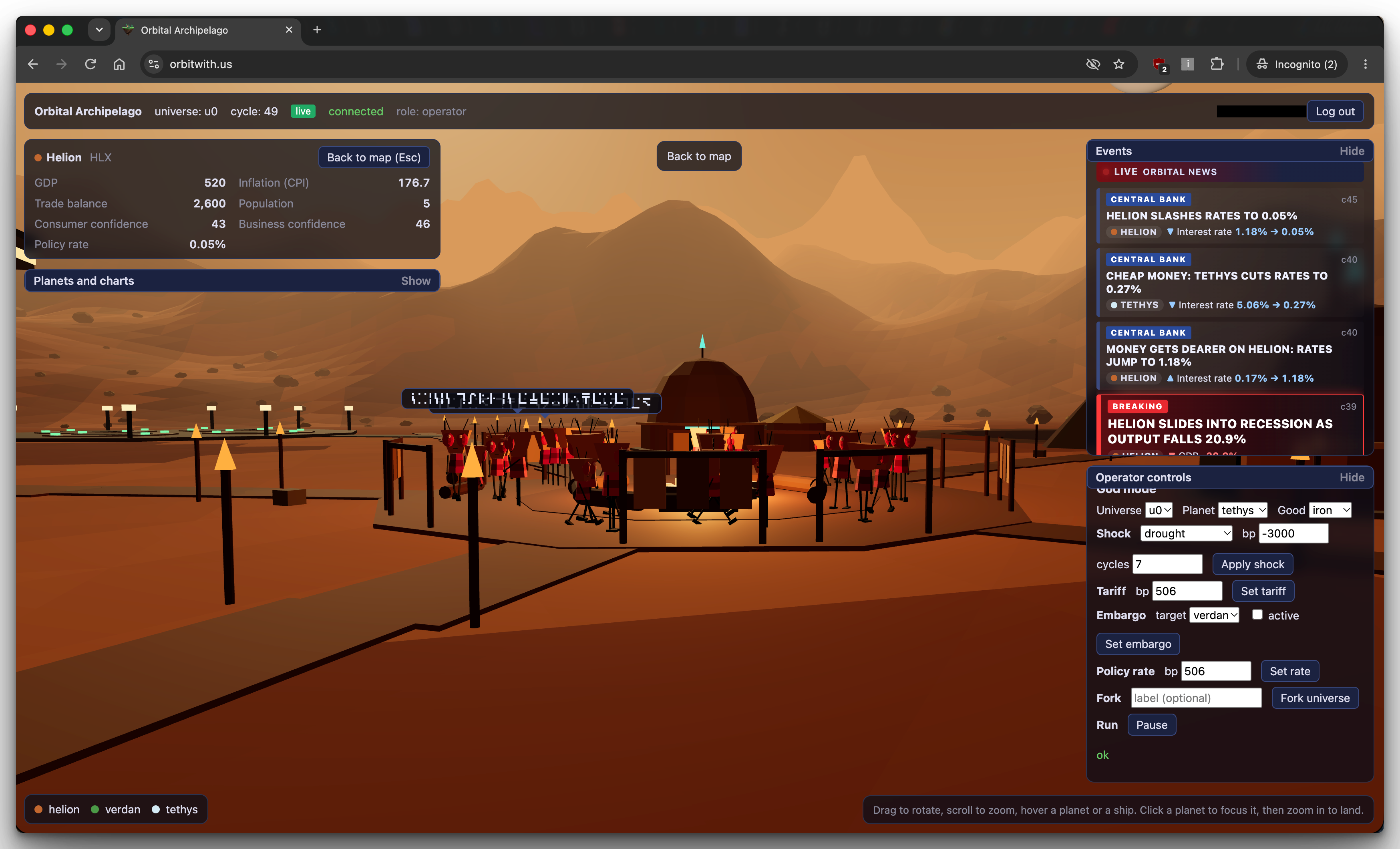
You watch all of it in 3D: planets in orbit, freighters flying trade lanes, and a dive down to any planet's surface to see its cities, farms, spaceport and aliens going about their day.
How we built it
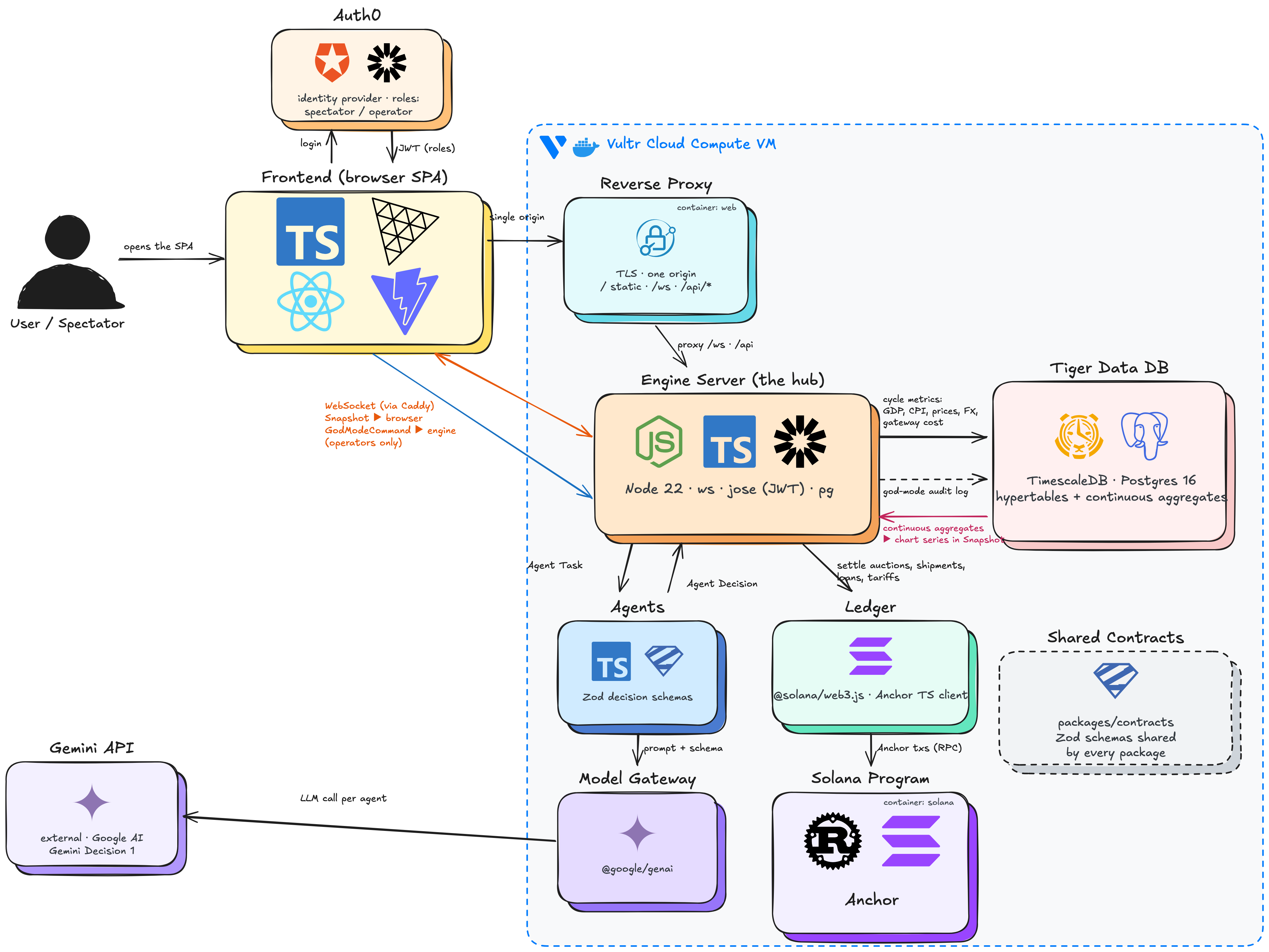
- Agents: Gemini. Each agent gets a short snapshot of its purse, recent prices and the order book, and replies with actions like
place_order,shiporborrow. The engine checks every action before it counts. - Settlement: a Solana program in Rust (Anchor). Auctions, shipments, loans and tariffs settle on-chain. Each currency is a real SPL token, and loans mint and burn it.
- Engine: a TypeScript loop that runs each cycle in order: production, consumption, markets, shipping, currency exchange, credit.
- Data: Tiger Data (TimescaleDB) stores every cycle's metrics and serves the charts.
- Auth: Auth0. Anyone can watch, but only operators can use god mode.
- Front end: React and Three.js.
Challenges we ran into
- Filling orders on-chain. Getting Solana to clear auctions and fill orders exactly the way our simulation did took a lot of work. We sort each order book off-chain and the program checks the sort in one pass, which costs far less than sorting on-chain.
- Deployment. We needed the engine, a Solana validator, a database and the web app running together, with login working end to end. That took far longer than we expected.
- Keeping the database in sync. The sim, the chain and the database each hold a copy of the economy. Keeping the charts in line with what actually happened was harder than it sounds.
Accomplishments that we're proud of
- The 3D world. You can zoom from the whole solar system down to a single planet, with weather, day and night, a working spaceport and aliens chatting in the streets.
- The scale. 105 AI agents, three currencies, an on-chain economy, live charts and a 3D front end, all built and connected during the hackathon. -Quick Decision Turnover. Instead of having an AI write out every decision for every character, the game builds a short menu of sensible options for each colonist, trader and government. Google's Gemini Decision model just picks the best one, which is much faster and cheaper than generating a free-form answer. If it isn't confident about a pick for a trader or government, we hand that decision to a more capable model (Gemini Flash) to think through properly.
What we learned
- Agreeing on shared interfaces on day one let us build the engine, the agents and the Solana program at the same time without blocking each other.
- With 100+ agents, LLM costs add up quickly. Choosing which model handles each decision made a big difference.
- Putting things on-chain makes them trustworthy, but every design choice has to fit inside a transaction.
What's next for Orbital Archipelago
- Run two copies of the same economy side by side with one policy changed, so you can see exactly what that policy did.
- More god-mode events, like credit crunches, snap elections and fake news.
- Colonists who choose their jobs, move between planets and take out loans backed by collateral.
Built With
- anchor
- auth0
- docker
- gemini
- node.js
- postgresql
- react
- rust
- solana
- spl-token
- three.js
- timescaledb
- typescript
- vite


