-
-
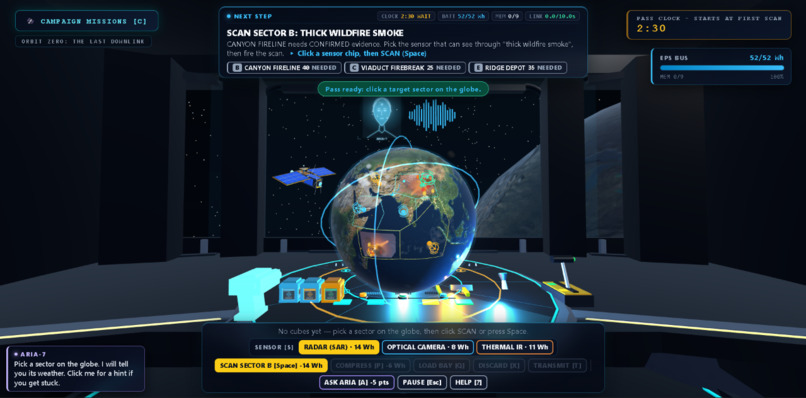
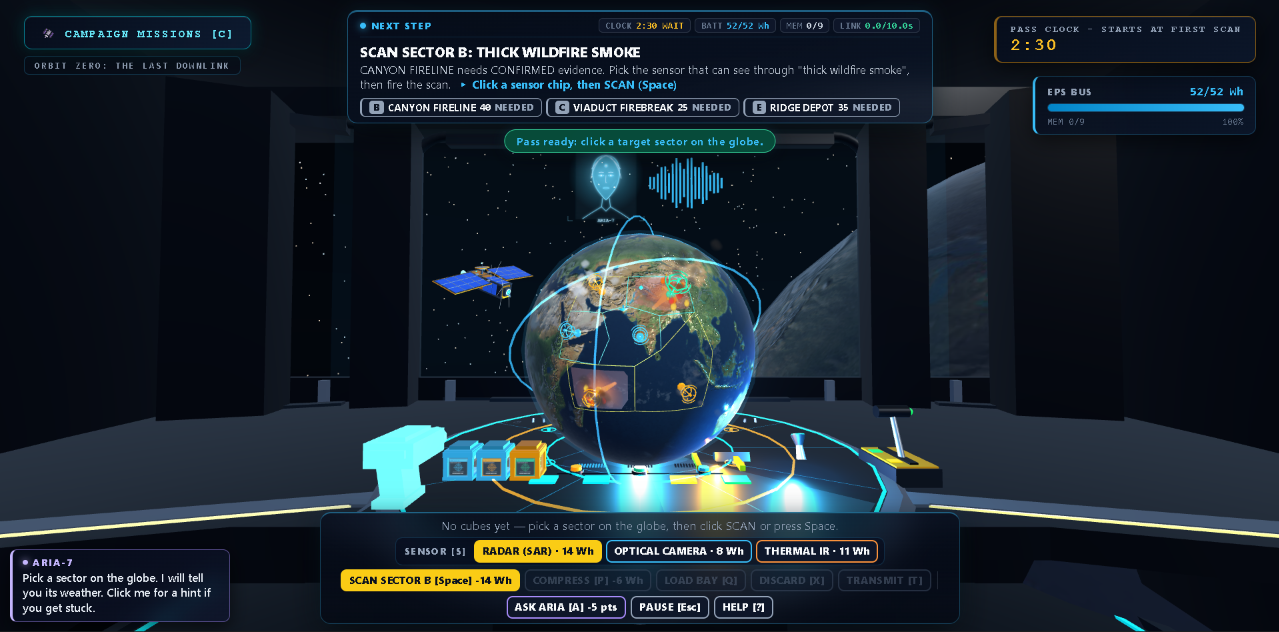
Actual Game Play
-
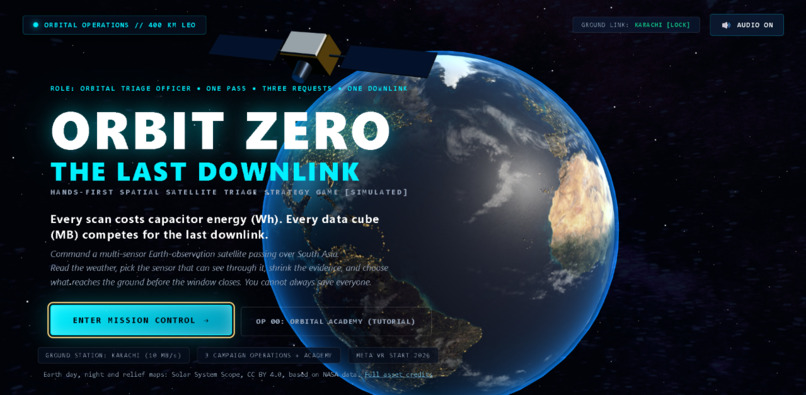
Attractive Landing Page
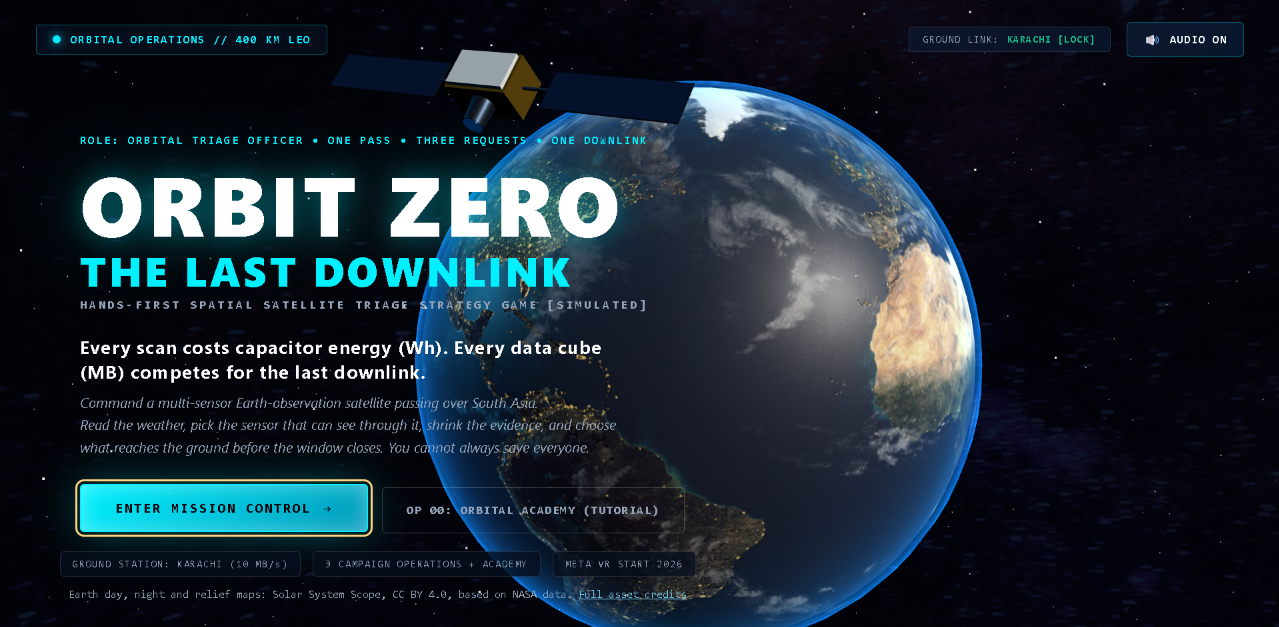
ORBIT ZERO: THE LAST DOWNLINK
The problem
When a natural disaster strikes, timely information can make a real difference. Earth-observation satellites can help identify affected areas, but collecting information is only part of the challenge. Satellites also operate with limited battery power, onboard storage, processing capacity, and communication windows.
What happens when a satellite has collected more information than it can transmit before losing contact with a ground station?
That question became the foundation of ORBIT ZERO: THE LAST DOWNLINK.
What I built
ORBIT ZERO is a seated, hands-first WebXR spatial strategy and satellite-triage game developed for the Meta VR Start Developer Competition 2026 using Meta's Immersive Web SDK.
The player takes the role of a satellite mission operator responding to simulated disaster scenarios. Each mission requires decisions about which areas to scan, which sensing instrument to use, how much battery to spend, and which collected data deserves priority during a limited downlink window.
The objective is simple: collect the most important intelligence, process it efficiently, and transmit it before the satellite passes beyond the ground station's communication horizon.
How it works
The gameplay is built around interconnected engineering constraints:
- Remote sensing: Select between Optical, Thermal IR, and Radar instruments according to the simulated environmental conditions.
- Battery management: Every scan consumes part of the satellite's available energy.
- Onboard storage: Collected evidence competes for limited memory.
- Data processing: Compress selected evidence to reduce transmission requirements.
- Downlink management: Prioritize data and fit it within a limited communication window.
- Mission evaluation: Review the final score and understand the consequences of operational decisions.
Players interact with a 3D Earth, disaster-affected sectors, evidence objects, and mission-control elements. The experience is designed around spatial interaction rather than a conventional menu-driven game.
How I built it
I developed ORBIT ZERO as a browser-based immersive experience using Meta's Immersive Web SDK and a WebXR-compatible development stack.
The project combines a Three.js-based 3D environment, interactive mission systems, resource-management logic, remote-sensing gameplay models, and a mission evaluation system.
A major part of development was building a virtual headset testing workflow using Meta IWER and Playwright. This allowed me to test simulated headset interactions, hand-tracking input scenarios, gameplay controls, and important user flows without relying entirely on physical hardware.
Challenges I faced
One of my biggest challenges was access to a physical Meta Quest headset.
As a student developer in Pakistan, obtaining a headset for development and testing within the competition timeline was difficult. I contacted university resources and explored possible access through other labs, but I could not secure a physical device before the deadline.
Instead of abandoning the project, I built a virtual Quest testing workflow to continue development and validate interaction logic through simulation.
This approach helped me identify and address issues during development, although I recognize that virtual testing is not a replacement for final testing on a physical Meta Quest device.
Another challenge was balancing gameplay and engineering concepts. I wanted the experience to be more than a 3D satellite visualization. Every scan, processing decision, and transmission should have a meaningful consequence within the mission.
What I learned
Building ORBIT ZERO helped me explore the intersection of electrical engineering, satellite operations, remote sensing, and immersive web development.
I learned how to translate engineering constraints into interactive gameplay, design resource-dependent decision systems, develop spatial interfaces, and create automated testing workflows for immersive applications.
Most importantly, I learned that limited resources do not necessarily have to stop development. They can push you to find alternative approaches, provided you remain honest about their limitations.
What's next
The next major step is physical Meta Quest testing, particularly validating hand interactions, comfort, performance, and the complete seated gameplay experience on actual hardware.
I would also like to expand the mission scenarios and make the simulated satellite operations more technically detailed.
ORBIT ZERO started with a simple question: if you only had a few seconds to transmit information that could help people during a disaster, what would you choose?
Now, I invite you to take control of the mission.
Beyond the competition
Whether I win or lose, I know that I have given this project my best effort, learned through every challenge, and grown as an engineer along the way.
I believe that success is not only about the final result, but also about the dedication, lessons, and opportunities God gives us throughout the journey. Whatever the outcome of this competition, I choose to remain thankful to Him in every situation.
I am grateful for the strength, wisdom, and opportunities that made this journey possible.
All glory belongs to my Lord and Saviour Jesus Christ, whether I win or lose.
Built by Artas Yaskar | Pakistan
Built With
- 3d-graphics
- cubesat
- game
- hand-tracking
- javascript
- meta-immersive-web-sdk
- meta-iwer
- playwright
- remote-sensing
- satellite-technology
- simulation
- spatial-computing
- three.js
- virtual-reality
- webxr

