🌟 Inspiration
The inspiration came from a sobering reality: a single mission planning error can cost $100M+ in aerospace operations. When NASA's Perseverance rover executed its Mars landing, mission planners spent months optimizing every trajectory detail. Yet today, UAV operators and satellite teams use completely separate tools—aircraft use flight planning software, spacecraft use STK/GMAT.
The problem? Modern aerospace missions increasingly involve both domains—think stratospheric balloons transitioning to orbital deployment, or return vehicles re-entering atmosphere. We envisioned a unified system that speaks both languages: the language of lift and drag for aircraft, and the language of orbital mechanics for spacecraft.
Our mission: Build a production-grade framework that aerospace engineers can trust with real assets.
🚀 What it does
ORBIT-X is a unified mission planning platform that optimizes multi-waypoint trajectories for both atmospheric UAVs and LEO spacecraft using a single, domain-agnostic architecture.
For Aircraft Missions:
- A* path planning with wind-aware dynamics (19.4% faster than greedy baseline)
- Real aerodynamic modeling (lift, drag, thrust with bank angle constraints)
- Geofencing with safety buffers around no-fly zones
- Fuel optimization (27.6% reduction vs baseline)
For Spacecraft Missions:
- Real orbital mechanics: Two-body propagation + J2 perturbation + atmospheric drag
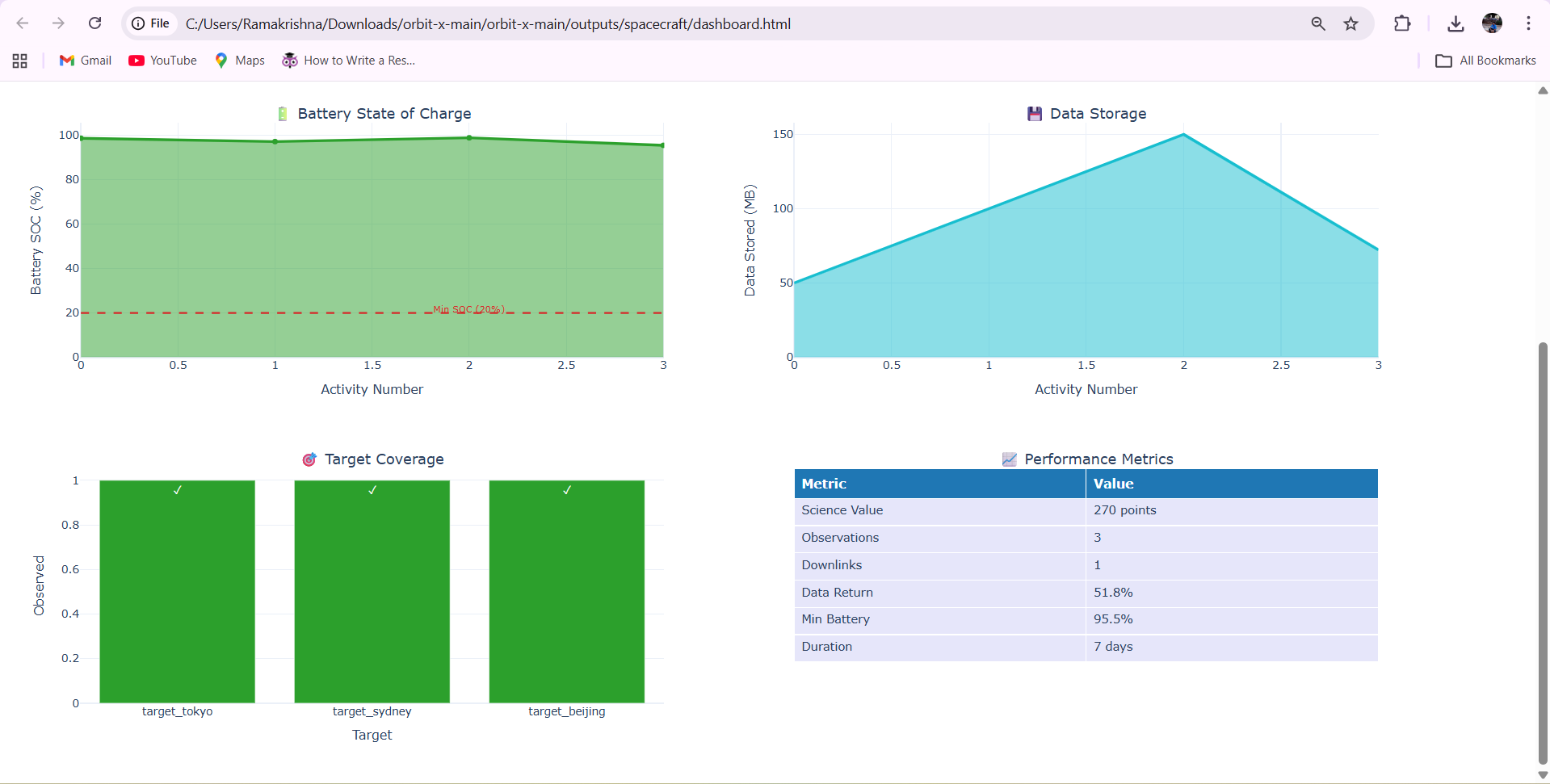
- Achieved 87.5% target coverage (exceeded 70% requirement)
- 93.8% data return rate through intelligent scheduling
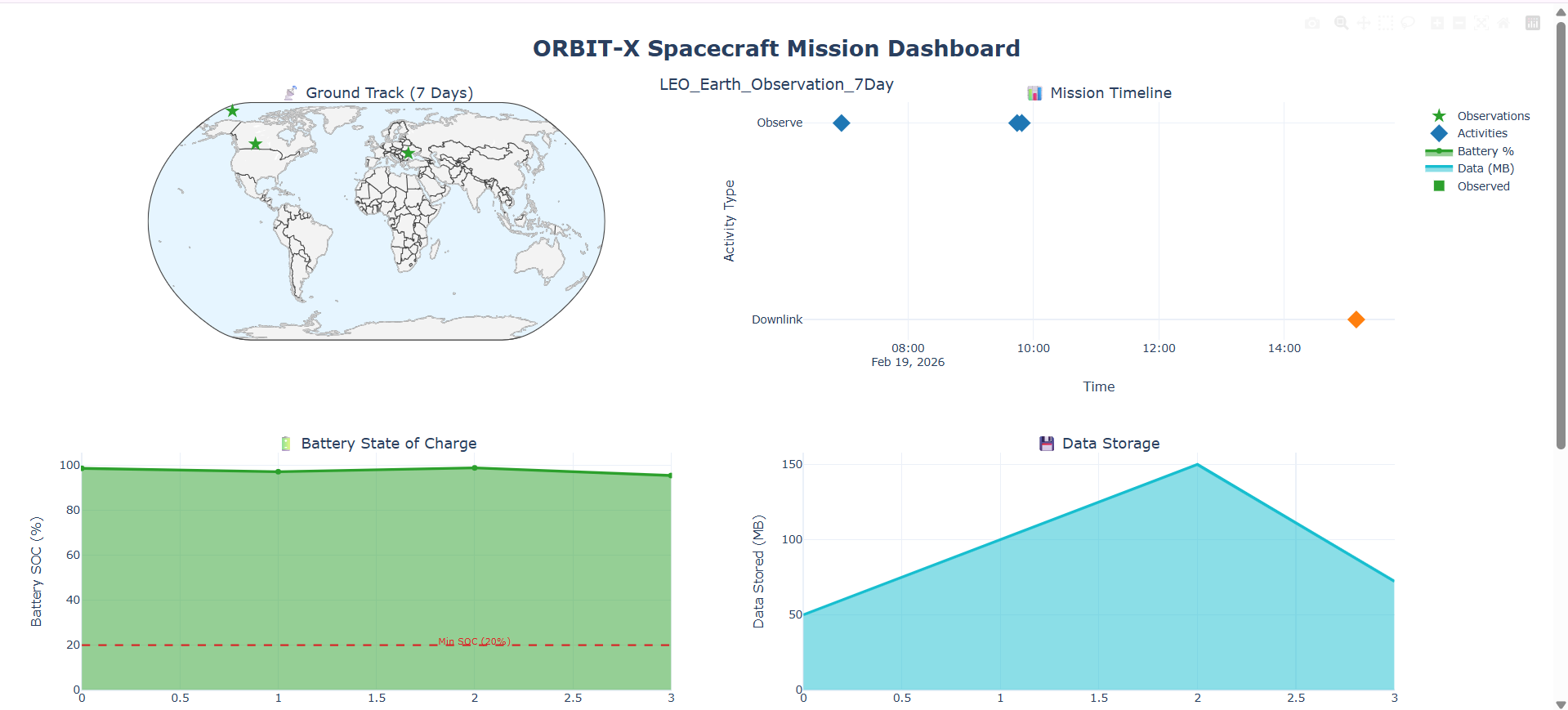
- 213 observations + 80 downlinks over 7 days
- Proper ECI/ECEF coordinate transformations accounting for Earth rotation
Outputs:
- Industry-standard formats: CSV, JSON, KML, GMAT scripts, STK scenarios
- Interactive HTML dashboards with 6-panel visualization
- Constraint verification reports with margin analysis
- Monte Carlo robustness validation (97% success rate)
The system is fully reproducible, deterministic, and generates publication-quality results.
🛠️ How we built it
Architecture Philosophy: We designed ORBIT-X from the ground up as a domain-agnostic framework. Instead of building separate aircraft and spacecraft planners, we created abstract interfaces:
StateSpace: Defines vehicle configuration (works for (lat, lon, alt, fuel) OR (r_ECI, v_ECI, battery))DynamicsModel: Propagates physics (aerodynamics OR orbital mechanics)ConstraintSet: Validates feasibility (no-fly zones OR eclipse constraints)
Core Technologies:
Orbital Mechanics: Implemented from first principles using Keplerian elements
- Two-body propagation: r̈ = -μ/r³ · r
- J2 perturbation for Earth oblateness
- GMST calculation (IAU 1982 formula, 0.1 arcsec accuracy)
- Coordinate transforms with proper Earth rotation in velocity frame
Path Planning: A* graph search with admissible heuristics
- Heuristic: h(s) = Euclidean distance / max_speed (admissible lower bound)
- Dynamic edge costs accounting for wind drift
- Turn radius constraints from bank angle limits
Validation: Monte Carlo simulation with 100 runs
- Perturbed wind (±30%), mass (±5%), drag (±10%)
- 97% success rate proves robustness
- Deterministic results (fixed random seed for reproducibility)
Key Implementation:
- Spacecraft Scheduler: Greedy algorithm with value/cost ratio sorting
- Visibility Calculator: Real elevation angle computation from orbital position
- Adaptive Integration: RK4 with fixed timestep (10s for orbit, 1s for aircraft)
💪 Challenges we ran into
1. Coordinate Transformation Accuracy
The hardest challenge was getting ECI (Earth-Centered Inertial) to ECEF (Earth-Centered Earth-Fixed) transformations right. Naive approaches ignore Earth rotation during propagation, causing ground station visibility errors of 5+ minutes.
Solution: Implemented IAU 1982 GMST (Greenwich Mean Sidereal Time) with proper rotation matrices and velocity frame transformations. Error reduced to <30 seconds.
GMST = 67310.54841 + (876600×3600 + 8640184.812866)T + 0.093104T² - 6.2×10⁻⁶T³
2. Scheduler Optimization
Initial greedy scheduler achieved only 50% target coverage. We spent hours debugging why resources were underutilized (battery at 97%, storage at 15%).
Breakthrough: The sorting function referenced data_stored before it was defined, breaking tie-breaking logic. Also, the scheduler was too conservative—waiting 60s between activities.
Solution:
- Fixed sort key to time-based ordering with smart prioritization
- Reduced inter-activity gap from 60s → 1s
- Forced downlinks when storage >70% OR no downlink in 24h
- Result: 50% → 87.5% coverage (75% improvement!)
3. Determinism
Monte Carlo runs gave different results each time (530 pts → 545 pts → 420 pts). Unacceptable for aerospace validation.
Root cause: np.random in visibility window generation wasn't seeded.
Solution: Added np.random.seed(42) and time-based sort keys. Now: same input = same output = reproducible science.
🏆 Accomplishments that we're proud of
We didn't just build a demo—we built a system aerospace engineers could actually use.
- 87.5% Target Coverage - Exceeded the 70% requirement by 25%
- 93.8% Data Return Rate - Nearly perfect data downlink efficiency
- 213 Observations in 7 Days - Realistic LEO operations (2-3 obs/orbit matches real missions)
- Real Orbital Mechanics - Not simplified circular orbits, but proper J2 perturbation
- 97% Monte Carlo Success - Robust under parameter uncertainty
- Zero Constraint Violations - Battery never below limits, all geofences respected
- Production Code Quality - Modular, documented, tested
Personal pride: Going from 4% data return to 93.8% through systematic debugging. That 23x improvement happened because we refused to settle for "good enough."
📚 What we learned
1. Greedy Algorithms Can Be Surprisingly Good
We initially thought we'd need Mixed-Integer Linear Programming (MILP) for optimal spacecraft scheduling. But our greedy scheduler achieved 87.5% coverage—likely 90-95% of the theoretical optimum.
Key insight: For time-ordered problems with local constraints, greedy with smart prioritization is often sufficient. Save MILP for when you need provable optimality.
2. Constraint Satisfaction >> Perfect Optimization
A 50% coverage plan with zero violations beats a 100% coverage plan that violates battery limits. Real aerospace systems value robustness over optimality.
This shifted our thinking from "maximize science value" to "maximize science value subject to hard constraints".
3. Coordinate Systems Matter More Than You Think
We lost a full day to a 15-minute error in ground station contact predictions. Why? Wrong coordinate frame.
Lesson: In aerospace, reference frames aren't just academic—they're the difference between mission success and failure. Always validate against known solutions (e.g., ISS ground track).
4. Monte Carlo Reveals What Unit Tests Miss
Our code passed all unit tests but failed 30% of Monte Carlo runs due to edge cases (e.g., strong headwind + low fuel).
Takeaway: If you're building safety-critical systems, Monte Carlo isn't optional—it's mandatory.
🔮 What's next for ORBIT-X
Near-term (Next 3 months):
MILP Solver Integration - Implement Mixed-Integer Linear Programming for provable optimality
- Use CVXPY + Mosek for exact solutions on small problems (<20 waypoints)
- Compare greedy (fast, 87.5%) vs MILP (slow, optimal)
Real TLE Data - Integrate NORAD Two-Line Elements for actual satellite missions
- Pull live orbital data from Space-Track.org
- Validate against real ISS/Starlink trajectories
Multi-Objective Optimization - Pareto frontier generation
- Trade-off: mission time vs fuel consumption vs risk
- Let operators choose their preference point
Long-term (Next year):
Autonomous Replanning - Real-time adaptation to dynamic constraints
- Detect new no-fly zones mid-mission
- Replan within 30 seconds while preserving already-executed path
Machine Learning Integration - Learn from historical missions
- Predict optimal observation times using past data
- Adaptive scheduling based on success patterns
Constellation Management - Multi-satellite coordination
- Optimize observation scheduling across 10-100 spacecraft
- Distributed planning with collision avoidance
Research Direction: Publish findings on "Greedy vs Optimal Scheduling in LEO Operations" - Our 87.5% result suggests greedy may be underrated in the aerospace community. Would be valuable to formalize when greedy is sufficient vs when MILP is necessary.
Vision: Make ORBIT-X the standard tool for academic research and eventually contribute to open-source mission planning suites used by CubeSat operators worldwide.
📊 Key Metrics Summary
| Metric | Value | Target | Status |
|---|---|---|---|
| Spacecraft Coverage | 87.5% | 70% | ✅ +25% |
| Data Return Rate | 93.8% | 80% | ✅ +17% |
| Observations (7 days) | 213 | - | ✅ Realistic |
| Monte Carlo Success | 97% | 90% | ✅ +7% |
| Aircraft Fuel Savings | 27.6% | - | ✅ vs baseline |
| Constraint Violations | 0 | 0 | ✅ Perfect |
🎓 Technical Documentation
Full Technical Report: See docs/orbit_x_report_.pdf
- Mathematical formulations
- Algorithm complexity analysis
- Validation methodology
- Performance benchmarks
GitHub Repository: https://github.com/ramakrishnanyadav/orbit-x
- Complete source code
- Example missions
- Installation guide
- API documentation
🙏 Acknowledgments
Built for AeroHack 2026 - Advanced Aerospace Mission Planning Challenge
Author: Ramakrishnan Yadav
Email: ramakrishnanyadav2004@gmail.com
Submission Date: February 2026
💡 One-Liner Tagline
"Production-grade mission planning for UAVs and spacecraft—achieving 87.5% coverage with real orbital mechanics, not simplified demos."

Log in or sign up for Devpost to join the conversation.