Inspiration
Complex projects are often managed through spreadsheets, Gantt charts, and conventional task boards. While these tools display schedules and task lists, understanding how dependencies connect, where bottlenecks emerge, and how one change affects an entire project can become difficult as complexity grows.
I wanted to explore a different approach: what if project planning could happen in the space around us? This led to ORBIT — Spatial Intelligence Workspace, built around the idea of making project relationships visible, explorable, and directly manipulable in 3D.
What it does
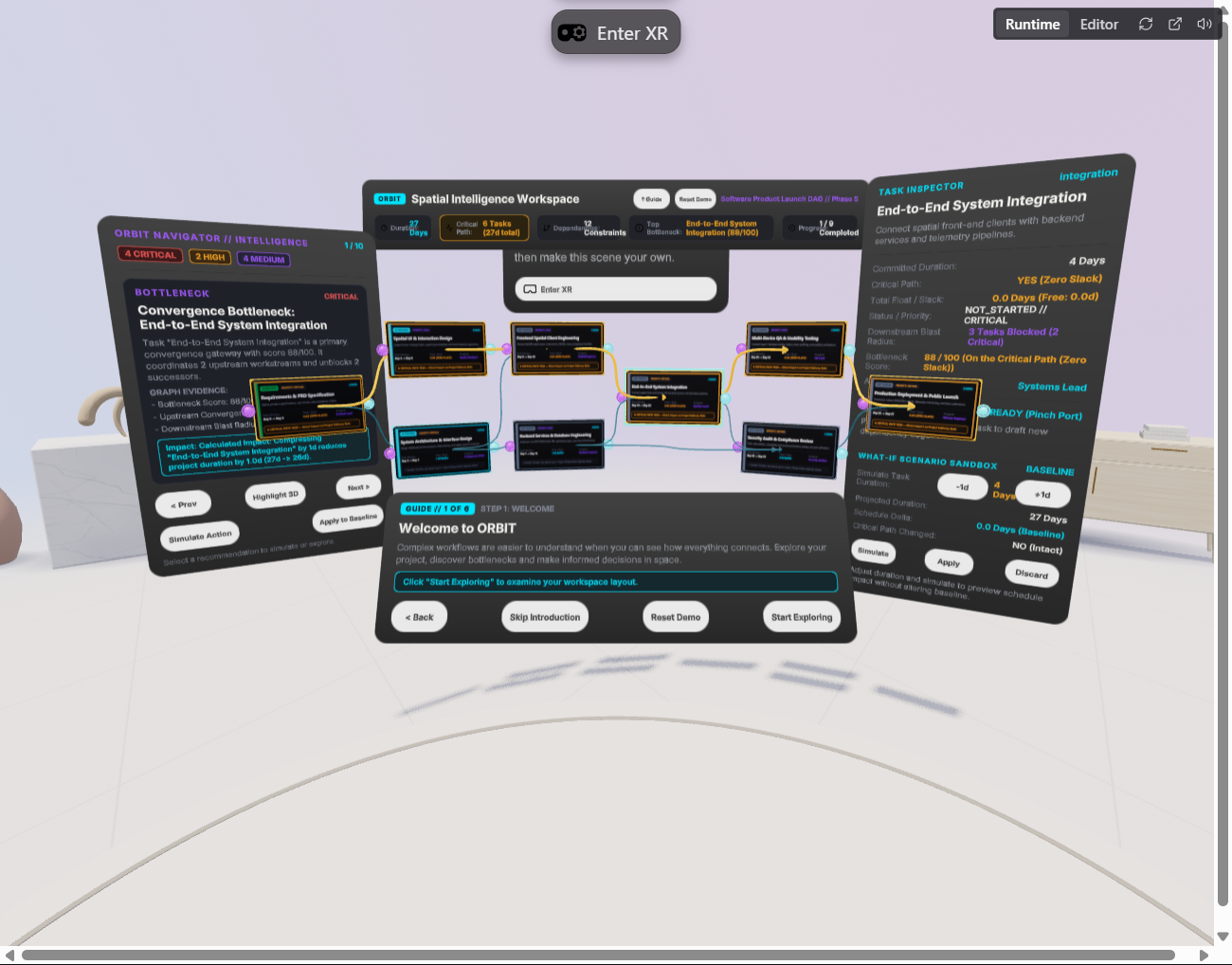
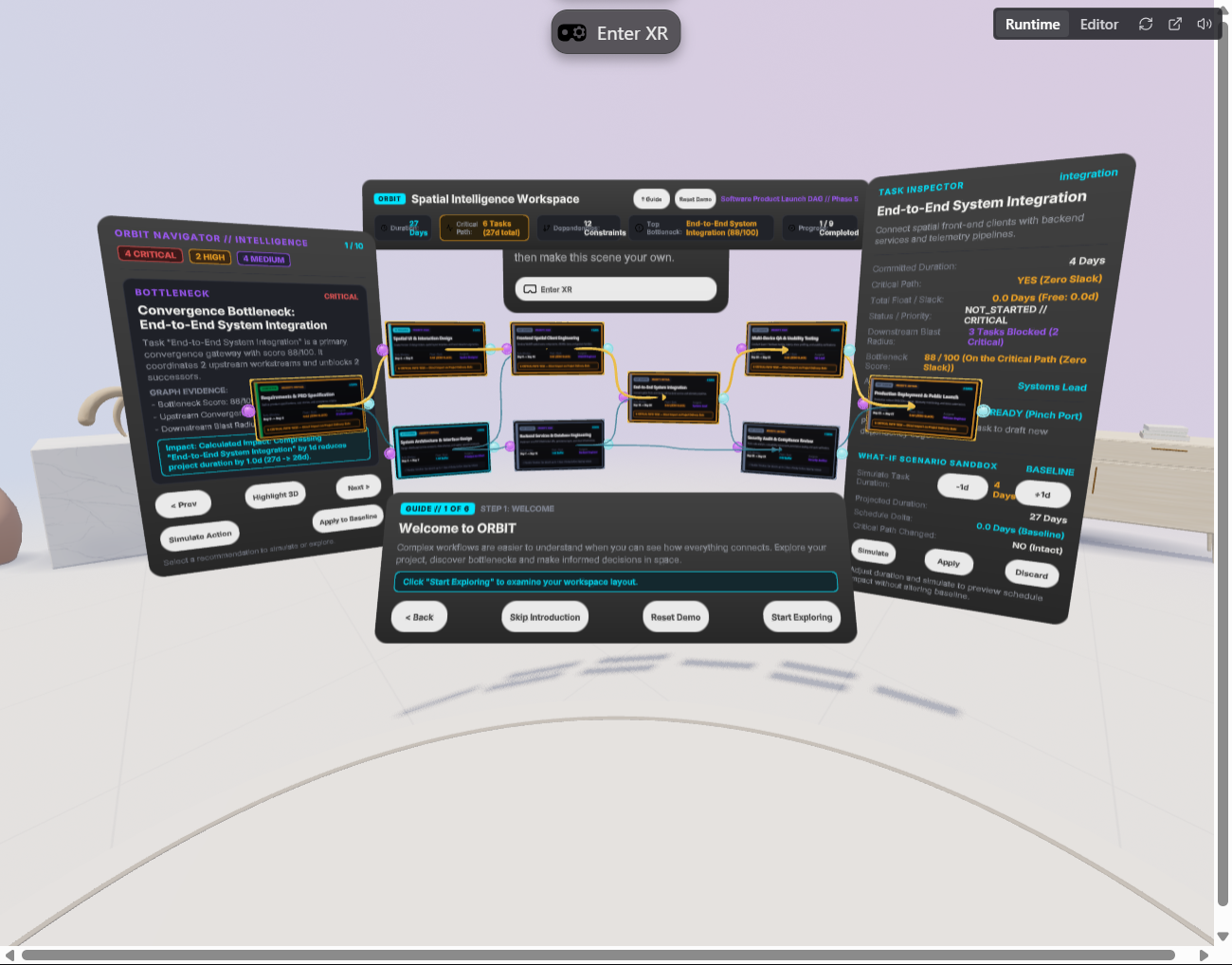
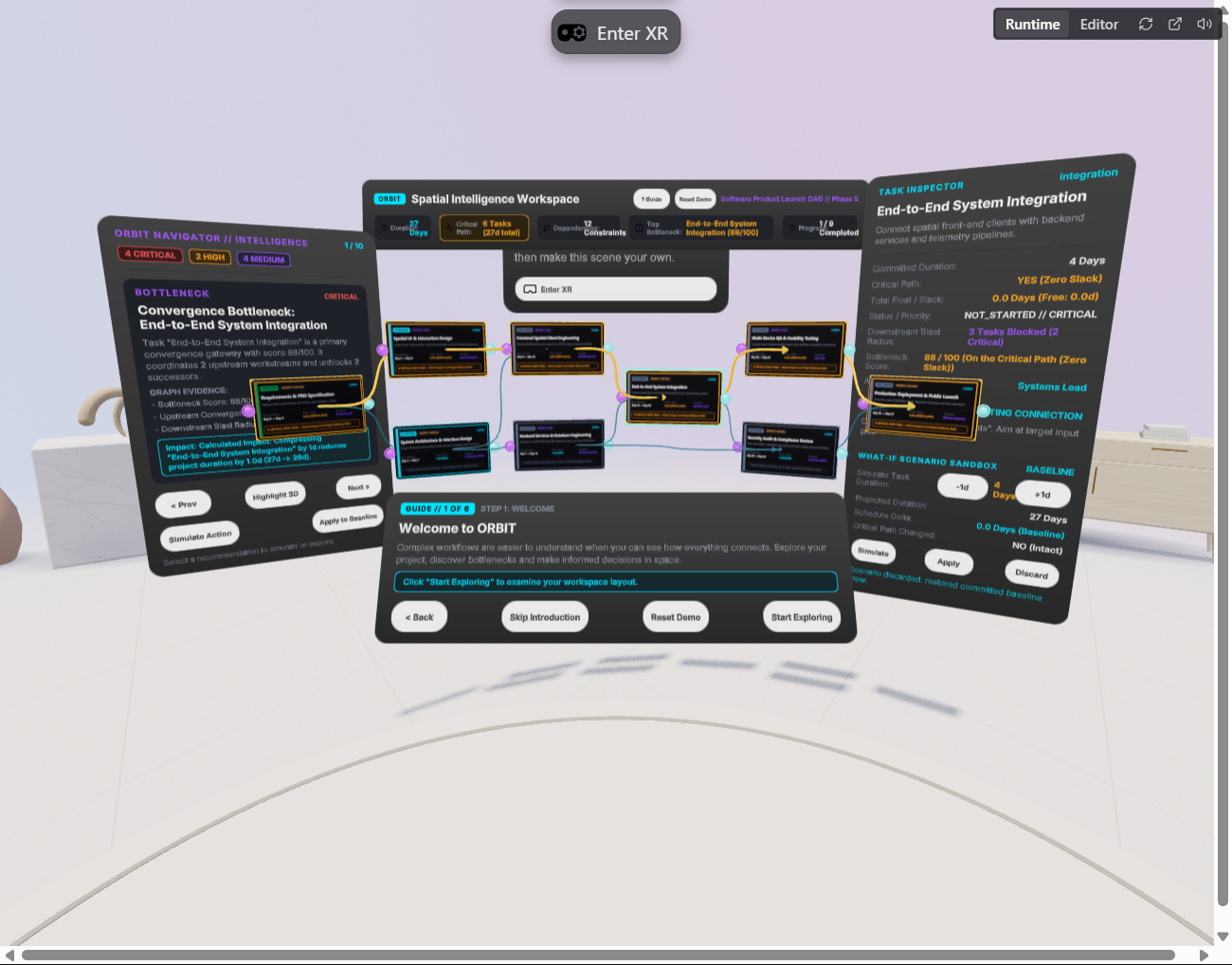
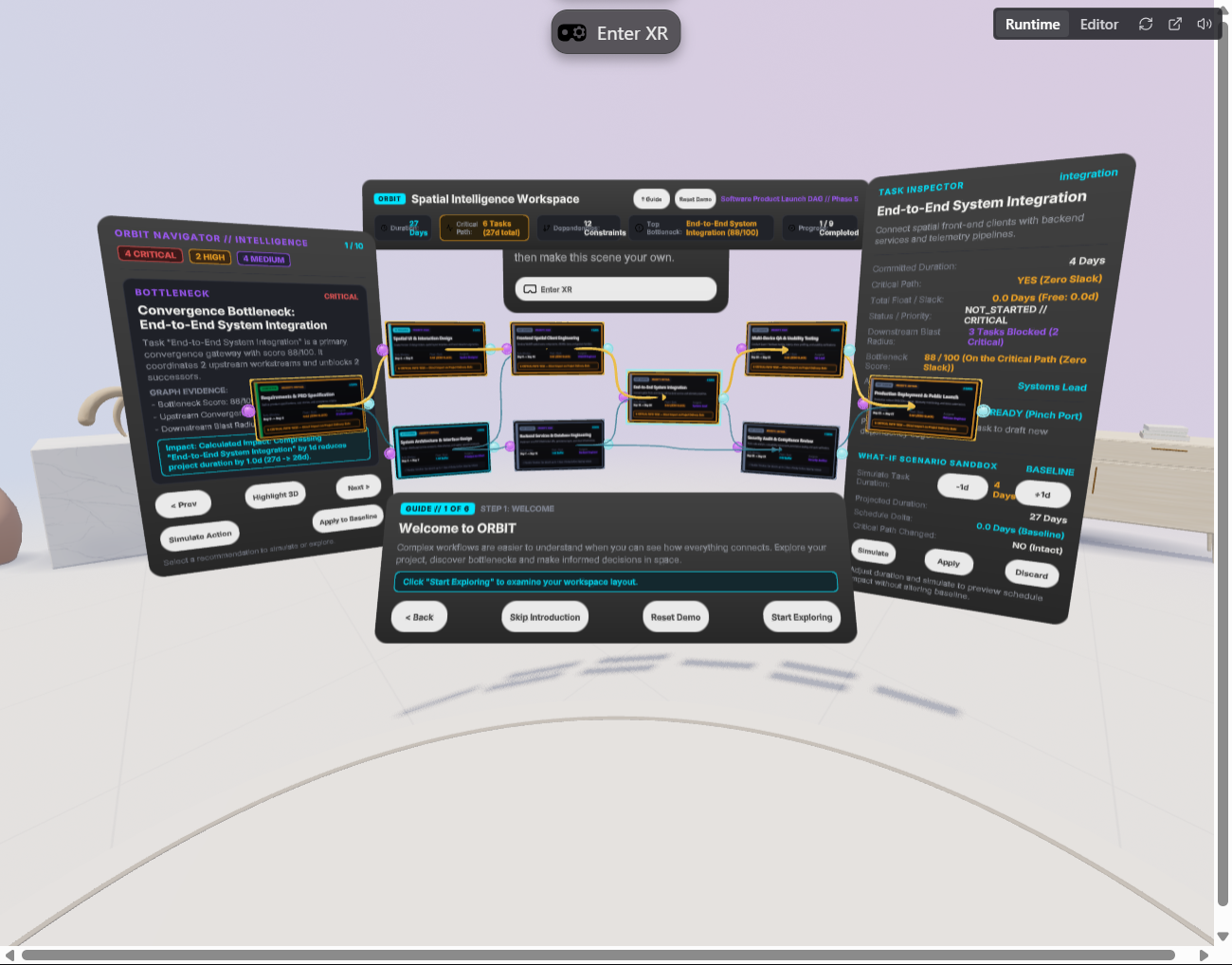
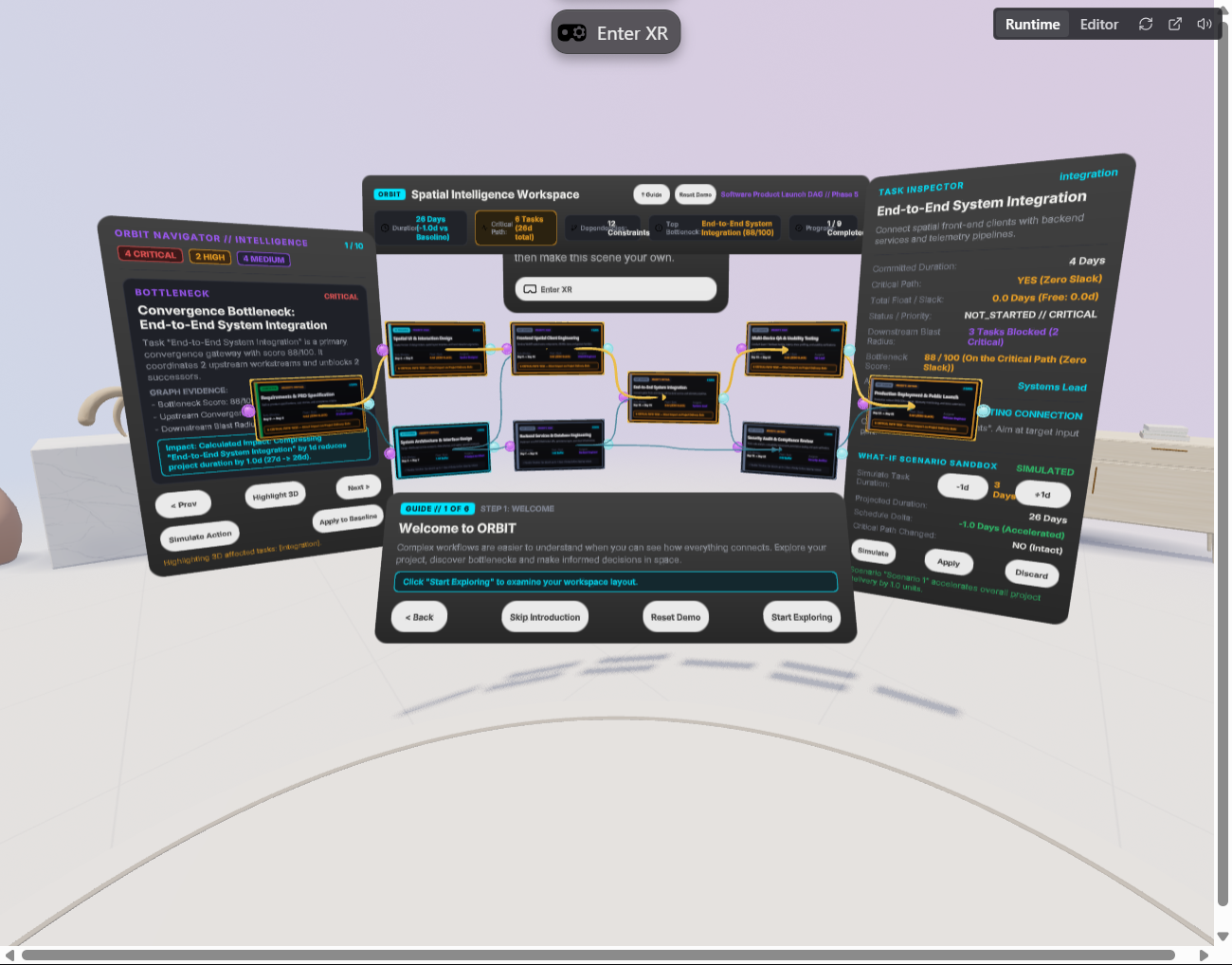
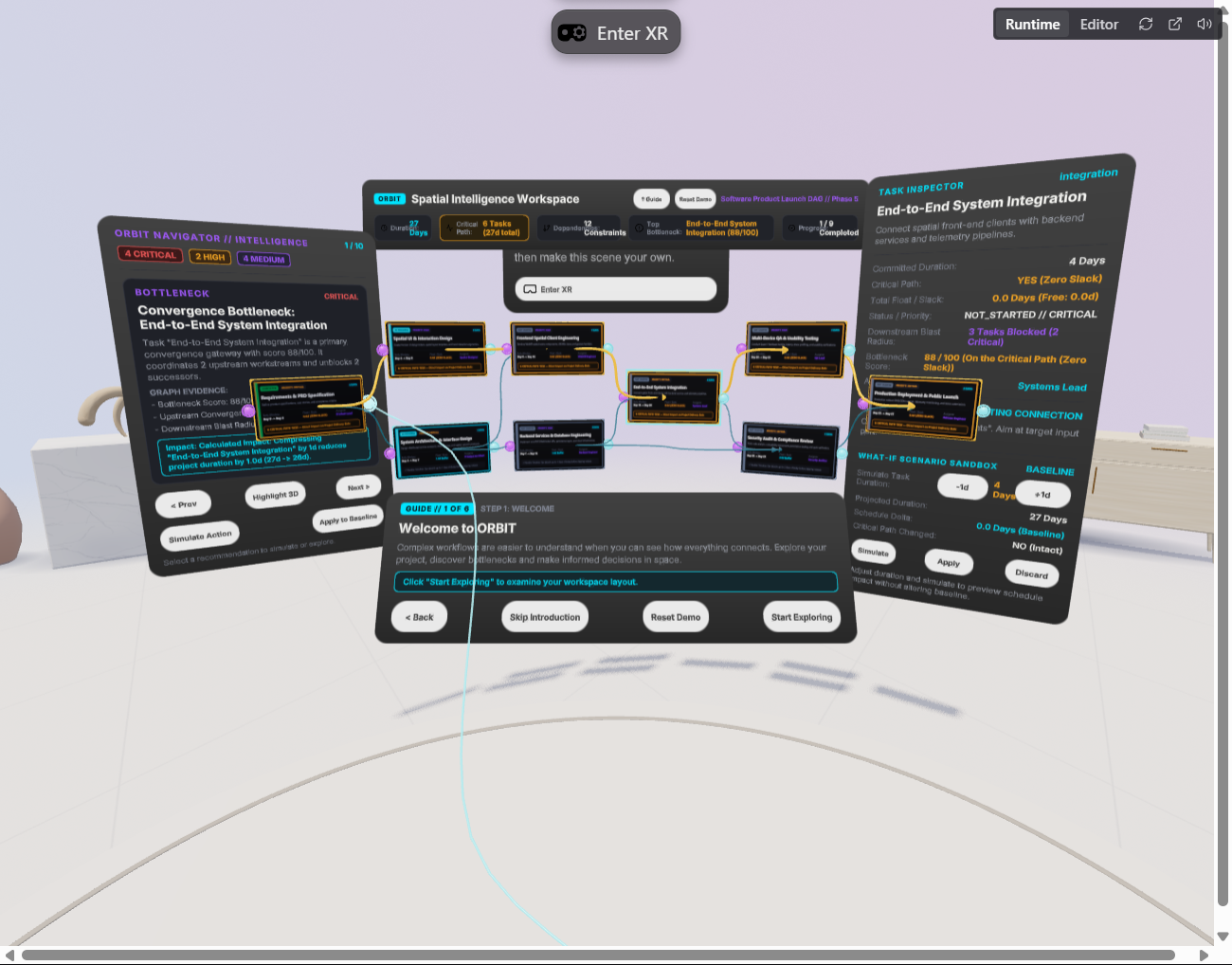
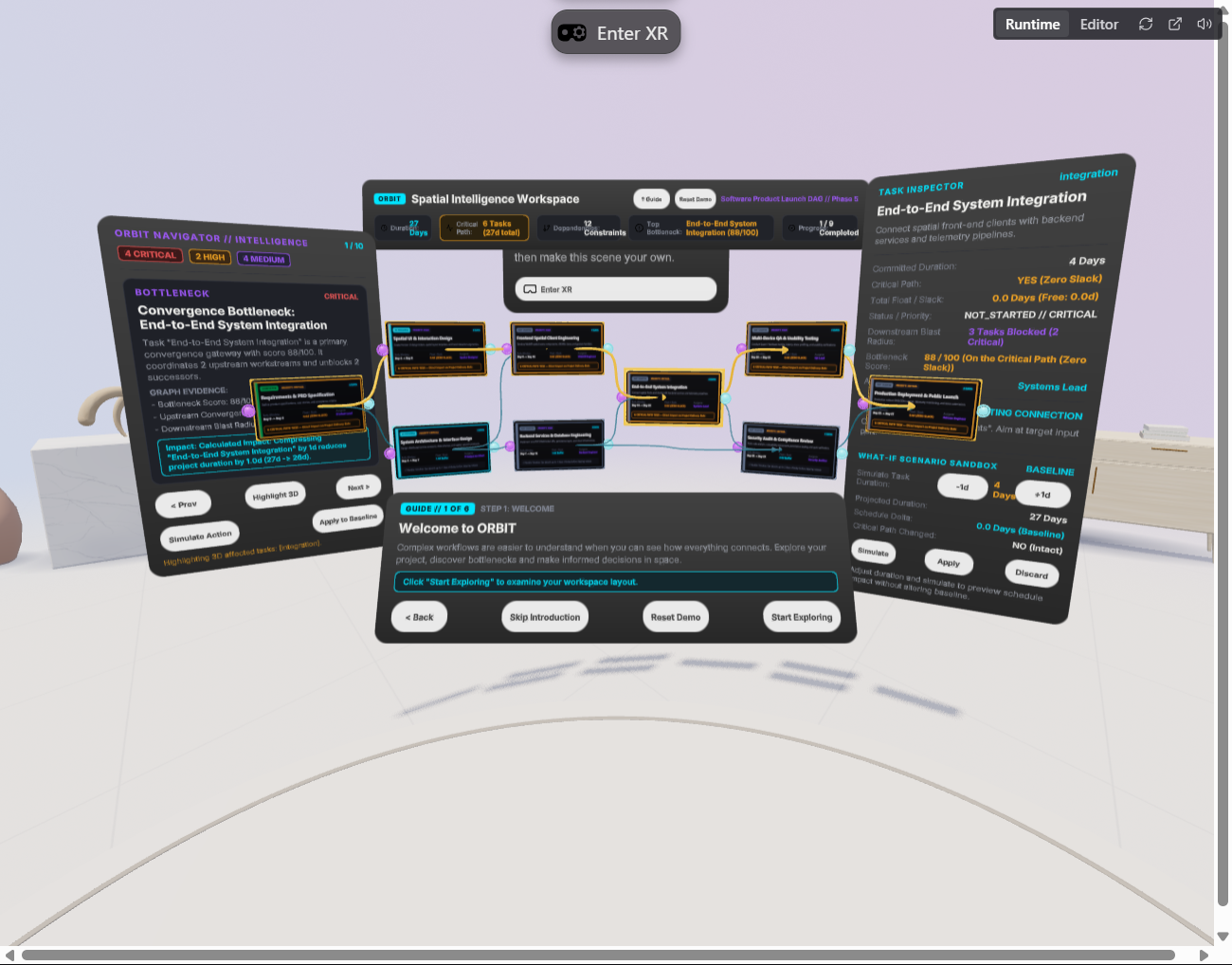
ORBIT transforms a project into a spatial dependency graph where tasks are represented as interactive 3D nodes and relationships as connecting edges. Users can select and reposition tasks, create dependencies with real-time cycle validation, inspect bottlenecks through ORBIT Navigator, and simulate schedule changes before applying them.
Its core workflow is:
Understand → Manipulate → Simulate → Approve → Execute.
For example, ORBIT can identify a critical integration bottleneck and let users explore how reducing its duration affects the overall project timeline before committing the change.
How we built it
ORBIT was developed using TypeScript and the Immersive Web SDK (IWSDK), with WebXR powering the immersive experience. Its underlying workflow engine maintains graph integrity, performs topological analysis, calculates critical paths using the Critical Path Method, and evaluates downstream impact.
A deterministic recommendation engine powers ORBIT Navigator, providing explainable bottleneck analysis and actionable suggestions. A scenario engine maintains separate baseline and proposed states so users can evaluate changes before applying or discarding them.
The spatial interface uses interactive nodes, dependency connections, contextual panels, and visual indicators to communicate project structure and status.
Challenges and learnings
One major challenge was separating the logical dependency graph from its spatial representation. Moving a task in 3D should not accidentally alter the project's actual dependencies. We addressed this by maintaining independent graph relationships and spatial positions.
We also implemented cycle prevention, scenario-state validation, recommendation freshness checks, and resource lifecycle management. Testing through IWER and Quest 3 emulation helped us validate the immersive workflow without physical headset access.
What's next
Future development will focus on validation on physical Meta Quest hardware, improved hand-first interaction, persistent workspaces, collaborative planning, and richer project intelligence. Our goal is to make spatial computing a practical environment for understanding and managing complex systems.
Built With
- immersive
- javascript
- sdk
- typescript
- vite
- web
- webxr
