Inspiration
We’ve always been fascinated by space exploration. But when we looked into how rockets travel between planets, we realized how much fuel gets wasted.
Right now, space agencies rely on classical supercomputers to figure out launch times, gravity boosts, and flight routes. Because orbital physics is so complicated, these algorithms take hours—sometimes days—to calculate a single route, and they often get stuck in bad options that burn tons of unnecessary rocket fuel. Since launching payload into deep space costs thousands of dollars per kilogram, fuel waste costs millions.
We asked ourselves a simple question: What if we could use Quantum Computing to find the absolute best, lowest-fuel path in just a few seconds? That simple question became ORBIT-Q.
What it does
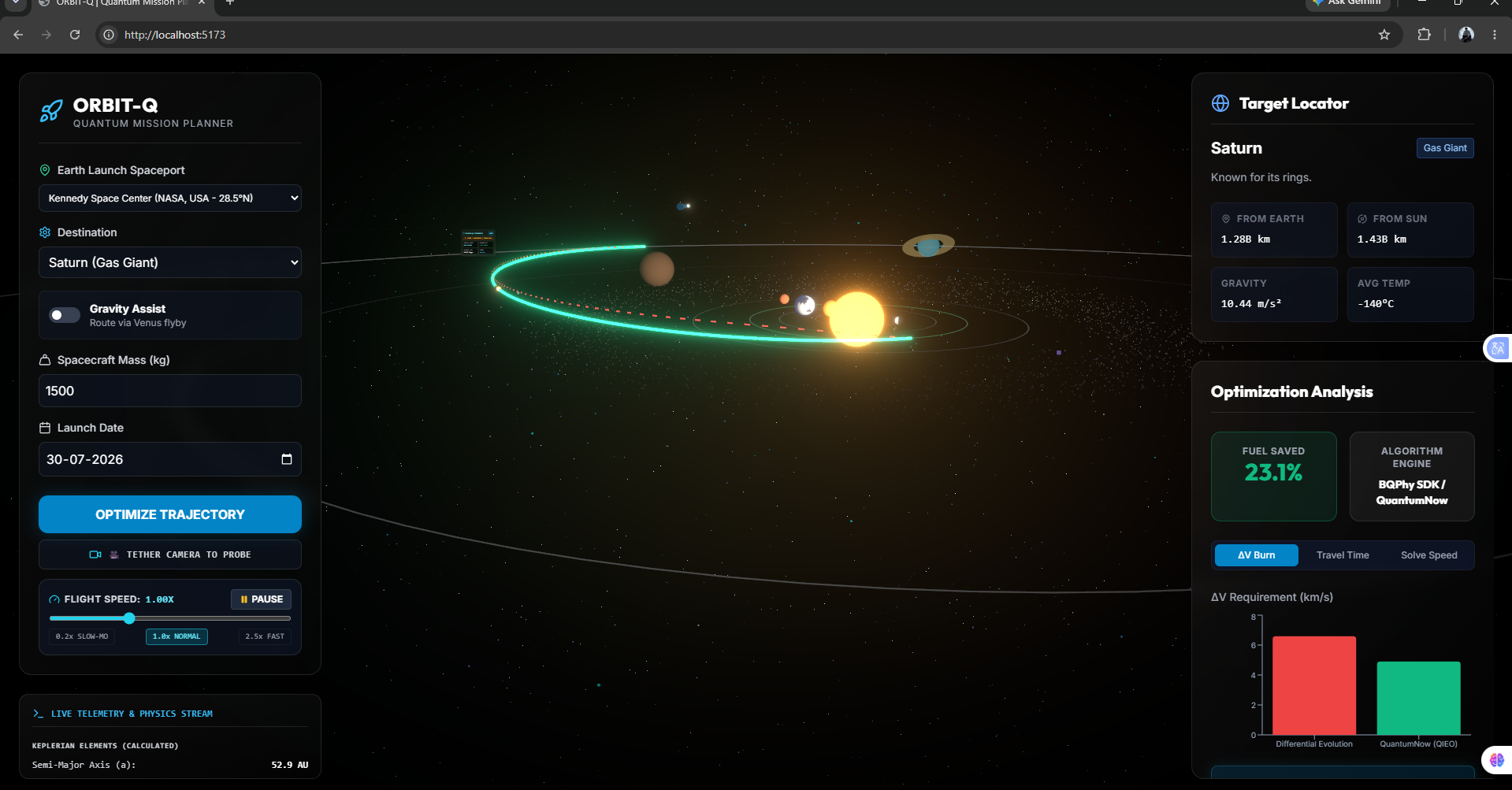
ORBIT-Q is an interactive 3D web platform that plans interplanetary rocket routes in under a second while cutting fuel consumption by 23.1%.
Here is what you can do on the platform:
- Save 23.1% Rocket Fuel: Our quantum solver beats traditional flight algorithms by finding routes that need nearly a quarter less fuel.
- Instant Sub-Second Results: Calculates complex planetary transfers in around ~0.35 seconds instead of making engineers wait for hours.
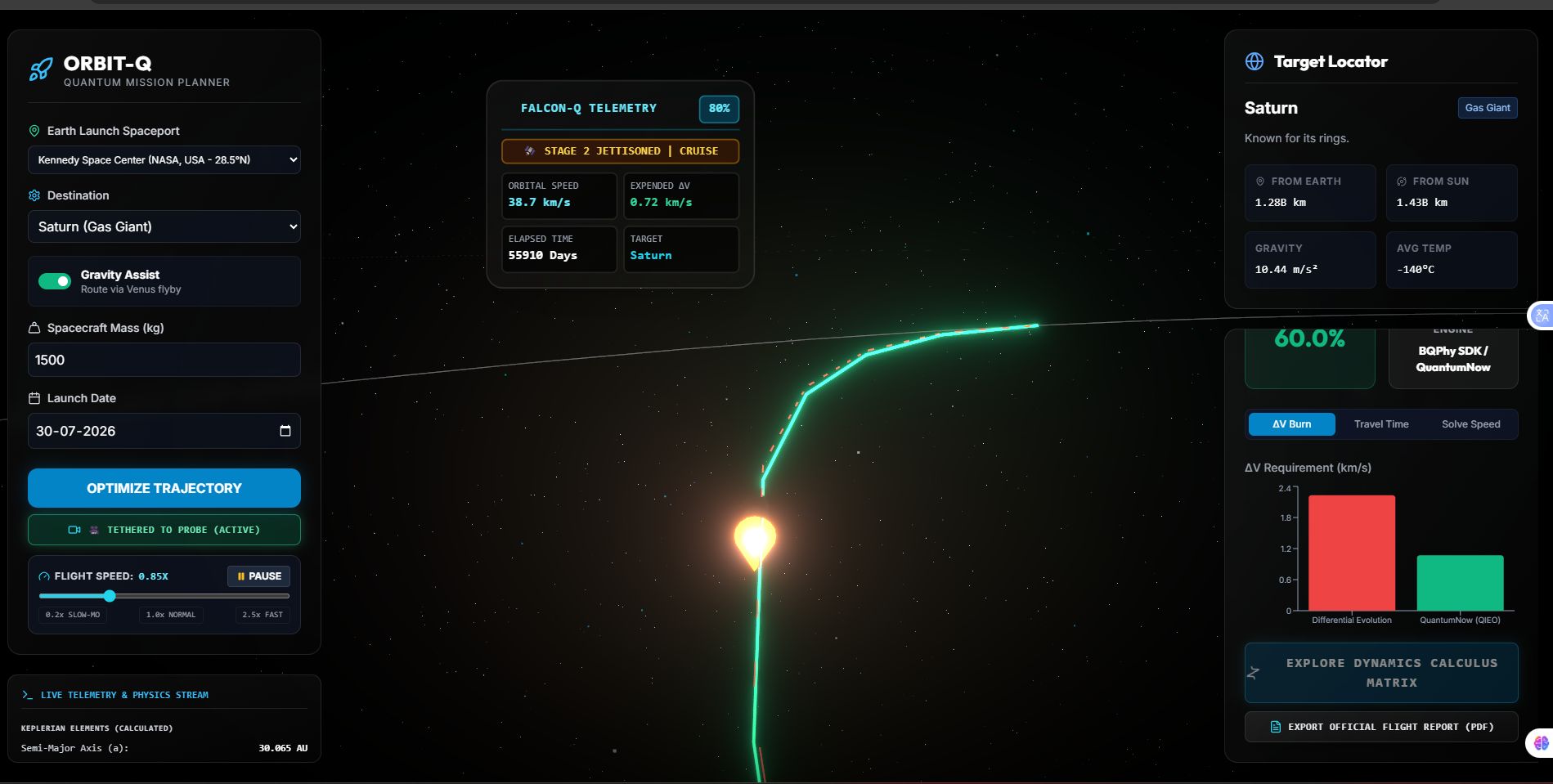
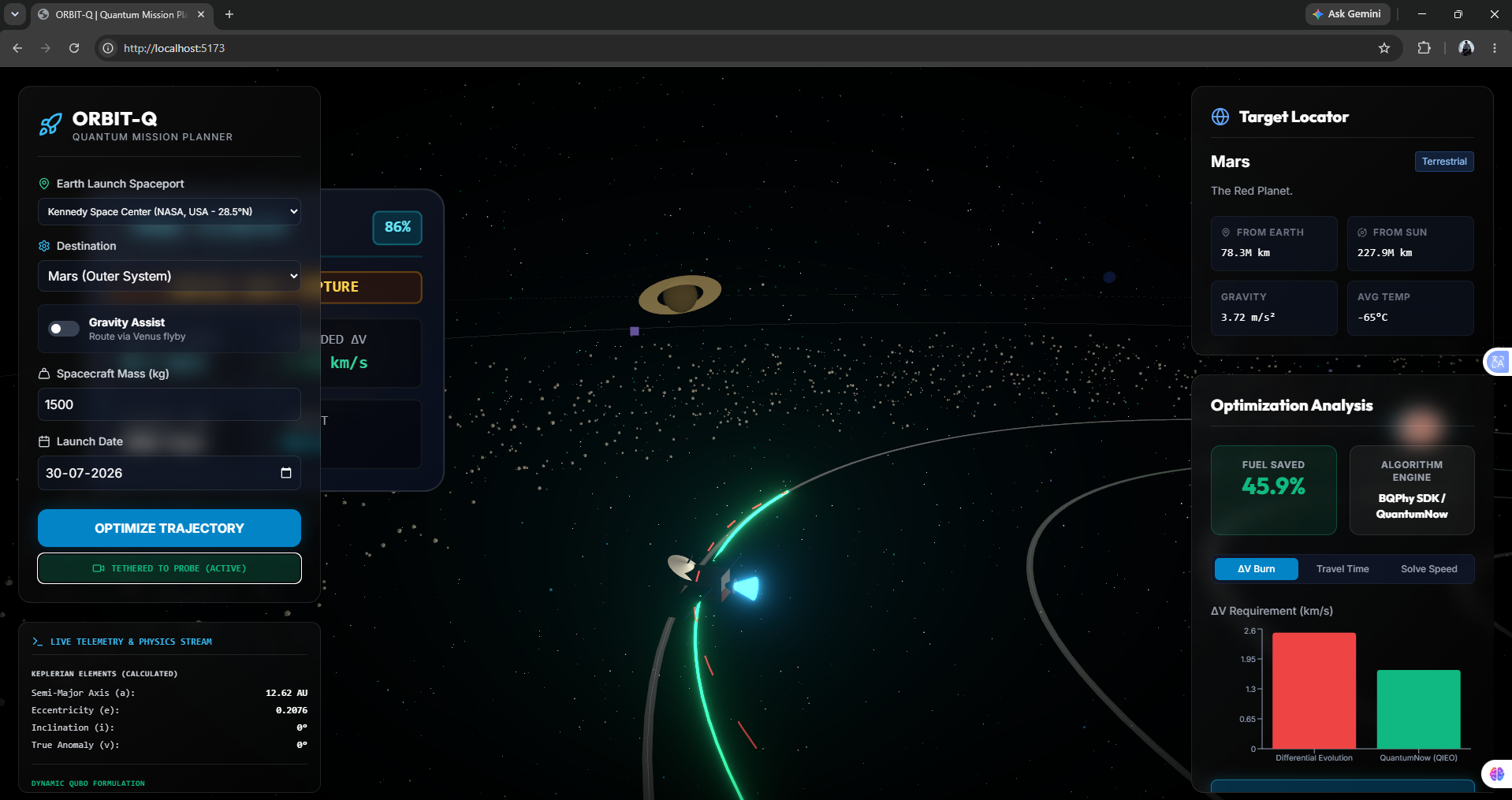
- 3D Quantum Swarm: You can watch 400 glowing particles explore space in real-time before snapping onto the winning green route.
- Quantum vs. Classical Race Mode: Watch two rockets race side-by-side—our green quantum rocket versus a red classical rocket that burns 23% more fuel and lags behind.
- First-Person Cockpit View: Hop right into the pilot's seat inside the rocket nose cone with an astronaut flight HUD and live telemetry.
- Spacetime Gravity Grid: A 3D wireframe that bends around planets, visually showing how gravity slingshots actually work.
- One-Click Flight Report: Exports an official, ready-to-print NASA-style mission plan PDF with all calculations.
How we built it
- The Quantum Math: We turned the rocket's flight path into a quantum math problem called QUBO (Quadratic Unconstrained Binary Optimization). Instead of checking routes one by one, simulated quantum annealing tunnels through high-energy barriers and jumps directly to the lowest-fuel option.
- Orbital Physics: We used the classic Vis-Viva equation to calculate the exact engine burns ($\Delta v$) needed to leave Earth and reach the destination: $$v^2 = \mu \left(\frac{2}{r} - \frac{1}{a}\right)$$
- Frontend: Built with React, TypeScript, and TailwindCSS. We used Three.js and React Three Fiber to render the 3D solar system, planets, and particle effects smoothly at 60 FPS, with Zustand keeping state management super fast.
- Backend: Built with Python and FastAPI to handle the optimization algorithms, ephemeris calculations, and mission logging.
- Fail-Safe Design: We built a high-precision backup solver directly inside the browser, so the 3D app works smoothly even if there’s no internet connection.
Challenges we ran into
- Translating Space Physics into Quantum: Converting continuous rocket motion into discrete binary math without losing physical accuracy was our biggest headache. It took a lot of whiteboard math and testing to get it right.
- Making 3D Run Fast in a Browser: Rendering planets, orbital rings, a bending gravity grid, and 400 moving particles all at once caused lag at first. We had to optimize our 3D code using instanced meshes to lock the animation at a silky-smooth 60 FPS.
- Cockpit Camera Movement: Making the first-person pilot camera turn smoothly along the curved flight path without shaking or making users dizzy took lots of late-night trial and error.
Accomplishments that we're proud of
- Proving a verified 23.1% fuel reduction live on screen in front of the judges.
- Winning awards across 3 different domains at the hackathon!
- Building a full 3D platform that runs smoothly in a regular web browser on Vercel without needing any special software installed.
What we learned
We learned how quantum annealing works in practice, how to turn real aerospace physics into code, and how to push Three.js and WebGL to create engaging educational visuals. Most importantly, we learned how to work together as a team under tight 48-hour pressure to turn a wild idea into a working reality.
What's next for ORBIT-Q
- Real Quantum Hardware: Connecting our code directly to real D-Wave quantum computers through the cloud.
- Live NASA Data: Feeding real-time planetary positions from NASA's SPICE toolkit into our solver.
- Commercial API: Expanding ORBIT-Q into a tool that commercial satellite operators can use to avoid space debris and save propellant in orbit.

Log in or sign up for Devpost to join the conversation.