-
-

Landing Page
-
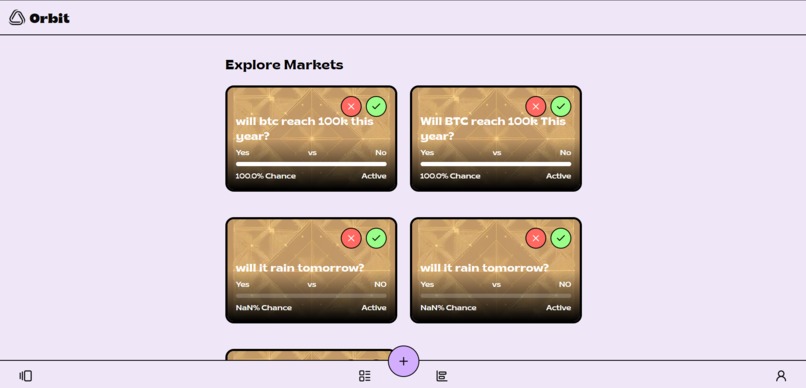
Predictions Markets
-
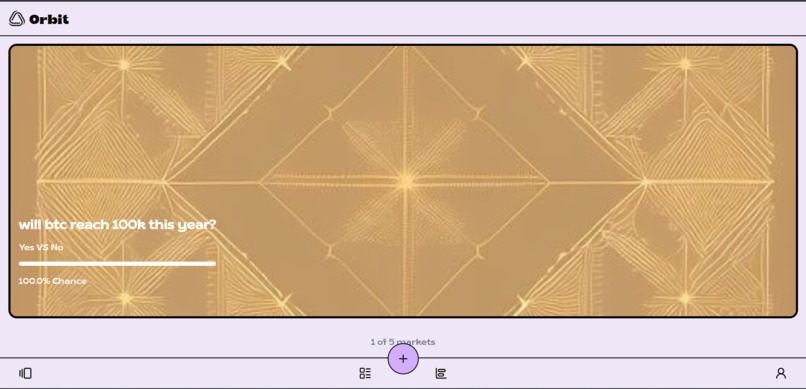
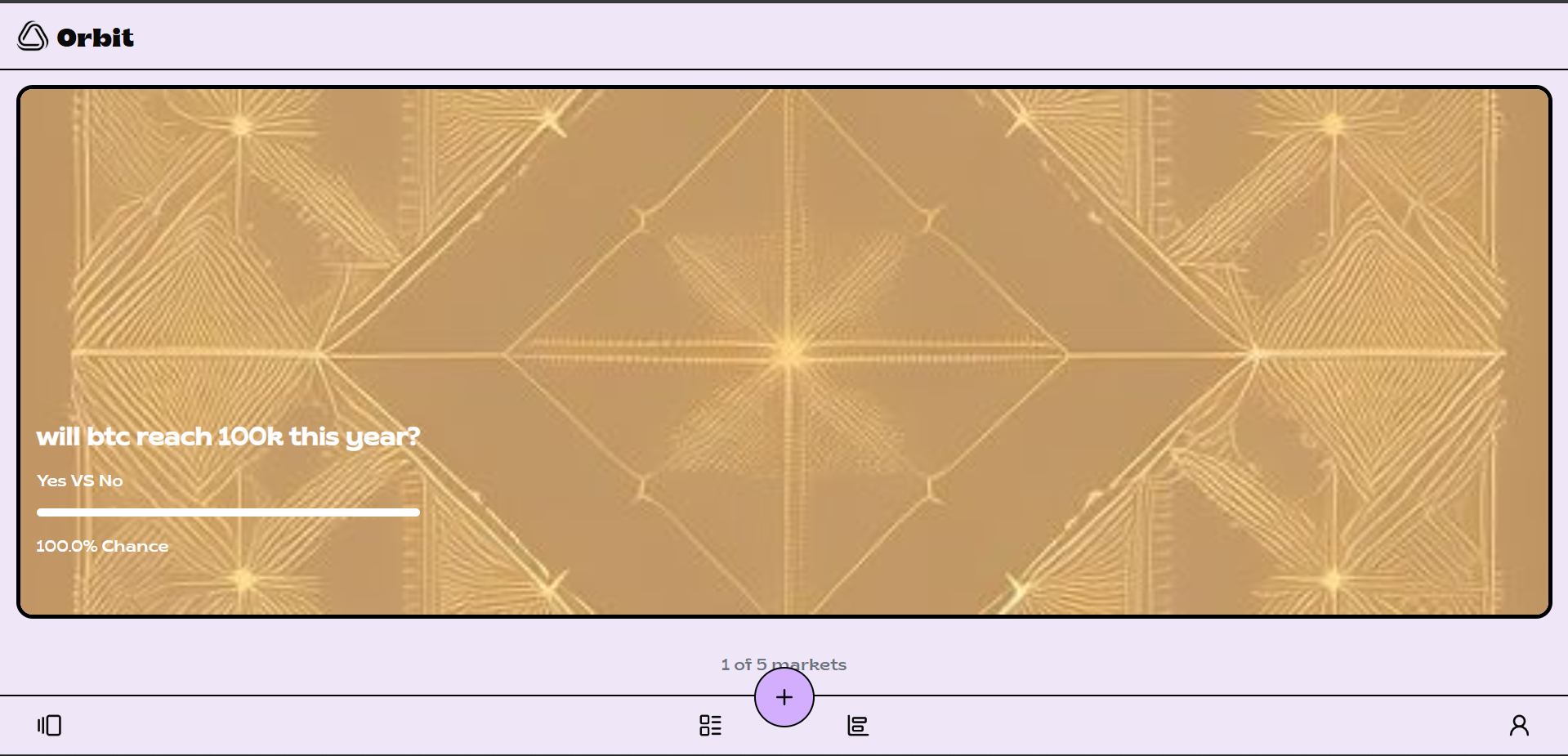
Swipe Card


🎲 ORBIT – About the Project
🚀 Inspiration
The inspiration for ORBIT came from our observation that while prediction markets are one of the most exciting use cases in Web3—combining game theory, crowd wisdom, and financial incentives—they’re still largely unapproachable for mainstream users, especially Gen Z. Most existing platforms require crypto wallets, understanding of gas fees, and interfaces that resemble spreadsheets more than social experiences. Meanwhile, Gen Z lives on swipe-based, mobile-native platforms like Instagram, TikTok, and Tinder.
We asked ourselves: What if prediction markets were fun, mobile-first, and social—like a game, not a dashboard? That’s when ORBIT was born: a Tinder-style, Telegram-native prediction market that users could access instantly and interact with using nothing more than a swipe.
🧠 What We Learned
Building ORBIT pushed us to learn and innovate across several areas. We explored the full stack of Telegram Mini Apps, including UI constraints and authentication flow, and discovered how to design a crypto product that doesn’t feel like one. One of our key learnings was how to abstract complex blockchain mechanics—wallet connections, token swaps, gas fees—so they operate under the hood while keeping the experience clean for users.
We also dove into the design of binary market structures on-chain. By working with exSat, we learned to optimize smart contracts for speed, cost-efficiency, and scalability, and gained experience in syncing real-time frontend state with on-chain predictions and outcomes. Most importantly, we realized that for mass adoption, UX must come before DeFi complexity.
🛠 How We Built It
ORBIT is composed of several key components:
- The frontend is built with React + TypeScript using Tailwind CSS to keep everything lightweight and mobile-friendly.
- We integrated Telegram’s Mini App SDK to launch our platform inside Telegram chats, leveraging Telegram’s ecosystem for instant onboarding and viral growth.
- The core prediction mechanic uses a Tinder-style swipe interface. Users swipe right to vote “Yes” or left to vote “No” on binary questions. This interaction model was designed to be intuitive and addictive—bringing the user experience closer to social media than finance.
- On the backend, we deployed a series of smart contracts on the exSat network, handling prediction market creation, user staking, outcome resolution, and reward distribution. These contracts are built to be gas-efficient and tamper-proof, ensuring users can trust the results.
We also built an internal token swap system to allow users to convert their funds into prediction tokens directly within the interface, hiding the complexity of DeFi mechanics.
⚠️ Challenges We Faced
One of our biggest challenges was making ORBIT feel like a native social app inside Telegram’s constrained Mini App environment. Designing and optimizing a swipe gesture system to work seamlessly on both iOS and Android Telegram clients required careful UI engineering and testing.
On the smart contract side, we had to ensure that market resolutions could happen quickly and securely, with minimal latency between prediction end-time and reward distribution. Managing asynchronous off-chain data (such as event outcomes) while maintaining full transparency and user trust also required careful system design.
Another critical challenge was educating new users without overwhelming them. Since many users may have never touched a crypto product before, we deliberately hid complex Web3 elements like wallets, gas, and transaction hashes. This required abstracting a lot of infrastructure and building fallback logic to handle failed transactions without disrupting user experience.
🌠 Looking Forward
Looking ahead, ORBIT has a clear roadmap. We're working on integrating AI-assisted market resolution, enabling more types of markets beyond binary. We're also building features like community-led prediction channels, NFT-based user streaks, and leaderboards to increase retention and reward power users. Our goal is to make ORBIT not just a product, but a social prediction economy embedded within the apps Gen Z already loves.
By combining fun interactions, blockchain credibility, and frictionless access, ORBIT is poised to onboard the next generation into the world of Web3—without them even realizing it.
Built With
- bitcoin
- blockchain
- react
- tailwindcss

Log in or sign up for Devpost to join the conversation.