Inspiration
AI agents can help with real work, but getting them ready often means repeating the same setup: connecting tools, writing instructions, choosing a model, and deciding what they can access. When someone builds a useful workflow, that expertise often stays in their own configuration.
We built Orbit around a question: what if teams could hire an AI specialist and share its capabilities as easily as they share knowledge?
Inspired by NMC’s emphasis on meaningful, practical problems, we focused on making agent setup reusable, execution visible, and human oversight part of the workflow. Meta’s focus on human connection shaped our collaborative goal: help people share their expertise and build on each other’s work.
What it does
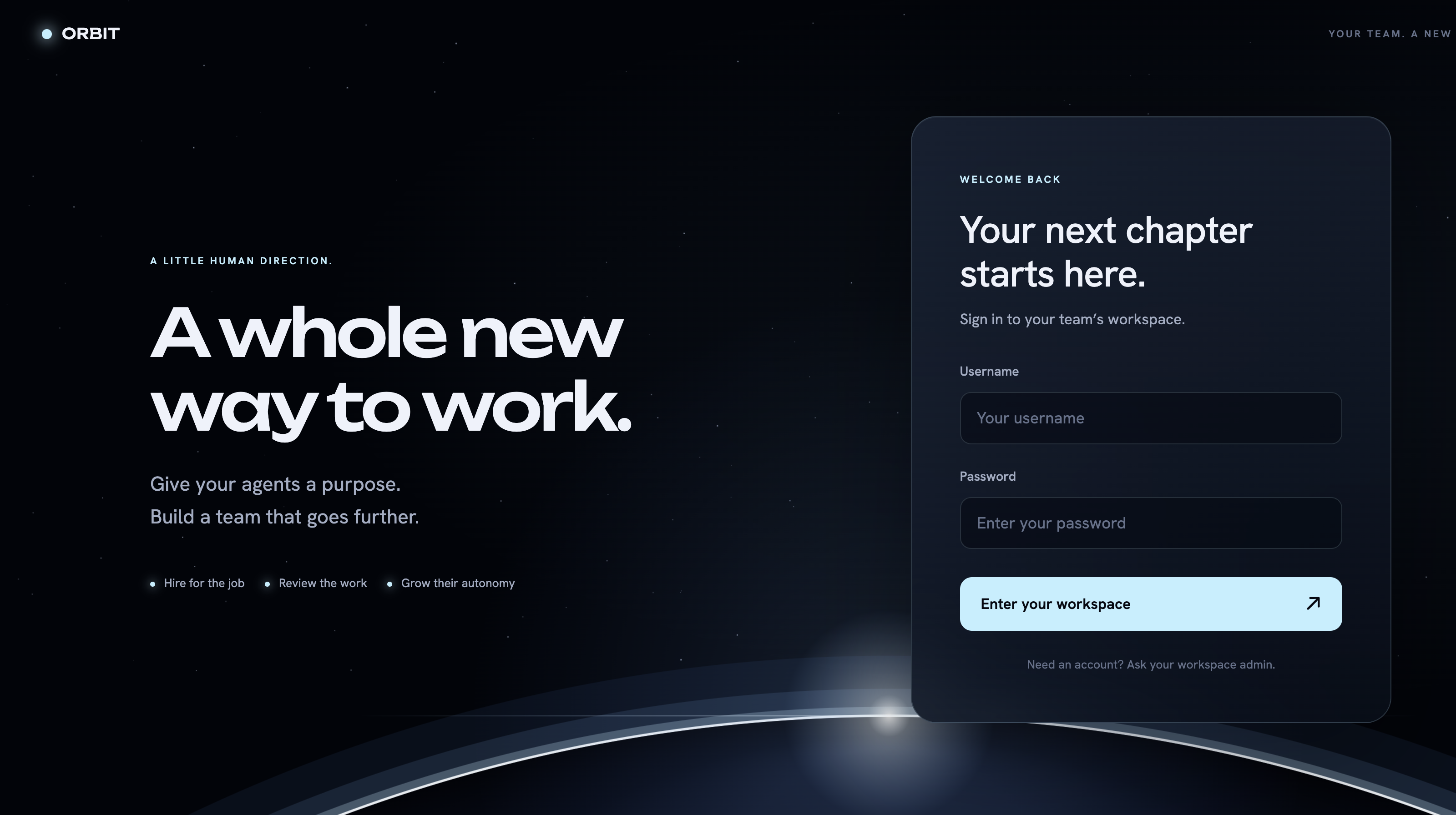
Orbit is a shared workspace where teams create, supervise, and share AI specialists.
Users describe a job and combine capabilities such as research, data analysis, document writing, and presentation creation. Each capability includes a playbook with guidance for using its tools. A manager reviews the agent’s scope before activation, and users can inspect its tool activity and saved results.
The social layer is a company marketplace of reusable agent templates. When someone creates a useful specialist, teammates can build on that contribution instead of starting over. Templates preserve instructions and capability configuration while requiring authorized local connections. Credentials and trust history do not transfer.
Our goal is to make AI a bridge between teammates: helping one person’s knowledge become something others can use, review, and improve.
How we built it
We built Orbit with a Python backend using FastAPI, Pydantic, and SQLite, alongside a JavaScript, HTML, and CSS frontend.
The backend separates agent creation, capability registration, execution, approvals, and monitoring. MCP tools provide supported actions, while model adapters support Meta’s Model API and Gemini. Orbit includes a Meta integration configured for Muse Spark, allowing a configured deployment to use Meta’s model for agent setup and tool-driven execution.
We built versioned agent configurations, persistent execution history, department permissions, manager approvals, and template publishing and installation. A separate, clearly labeled deterministic demo mode lets us test workflows without calling a live model.
Challenges we ran into
One challenge was separating what a model proposes from what an agent is authorized to do. We enforced permissions and approval rules in the backend rather than relying on instructions alone.
Another was making completion verifiable. A response saying “I created your presentation” is not enough—we need an actual saved artifact and an execution trail that a reviewer can inspect.
We also encountered tool-budget limits: an agent can spend too many calls exploring source material before producing its deliverable. This taught us to narrow tasks, expose failures clearly, and treat recovery as an important part of the experience.
Sharing introduced another design challenge. We wanted useful expertise to travel between teammates without accidentally transferring credentials, access, or earned trust.
Accomplishments that we're proud of
We built a connected workflow from describing a job to creating an agent, executing tools, reviewing results, and sharing a reusable template.
We’re proud that sharing is more than copying a prompt. Templates combine instructions, capability references, and model configuration while preserving local access boundaries.
We also made human contributions visible through creator attribution and reuse counts. This gives teams a way to recognize the people behind useful workflows and discover expertise beyond their own setup.
Most importantly, Orbit brings practical execution and team collaboration into the same workspace.
What we learned
We learned that useful AI products depend on much more than model quality. Clear permissions, reliable tools, durable state, and understandable results are essential.
We also learned that execution success and output quality are different. A completed task still needs review, and activity counts alone do not prove that an agent does good work.
Building the sharing workflow reinforced another lesson: collaboration works best when people can understand what they are reusing and who contributed it. AI can support human connection by making expertise easier to share while keeping people involved in decisions.
What's next for Orbit
Our first priority is execution reliability: better recovery from failed tasks, more effective tool-budget handling, and stronger checks that requested deliverables were actually saved.
Next, we want to simplify connection setup, expand supported integrations, and improve live Meta-powered workflows.
We also want to deepen collaboration through discussions around shared templates, feedback for their creators, and clearer ways to discover specialists built by teammates. These additions would help Orbit become a place where people exchange knowledge and improve workflows together.
Our long-term vision is a shared library of team expertise: practical AI specialists built by people, reviewed by people, and improved through collaboration.

Log in or sign up for Devpost to join the conversation.