-
-
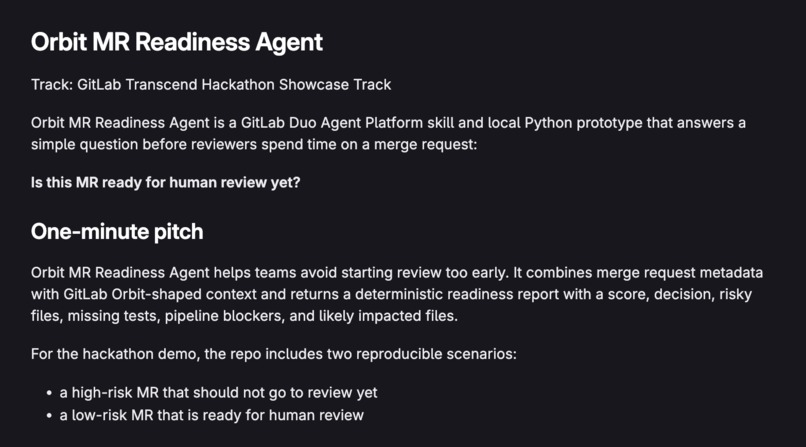
Project Overview: “Orbit MR Readiness Agent” and the one-minute pitch.
-

High-Risk MR Decision
-
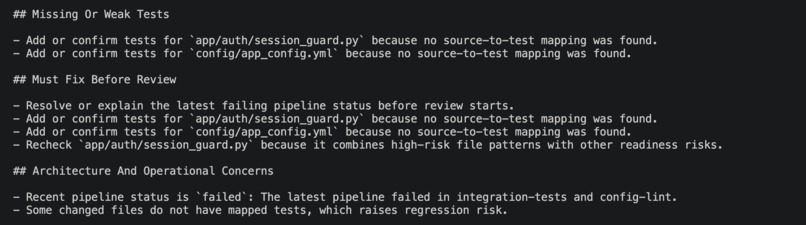
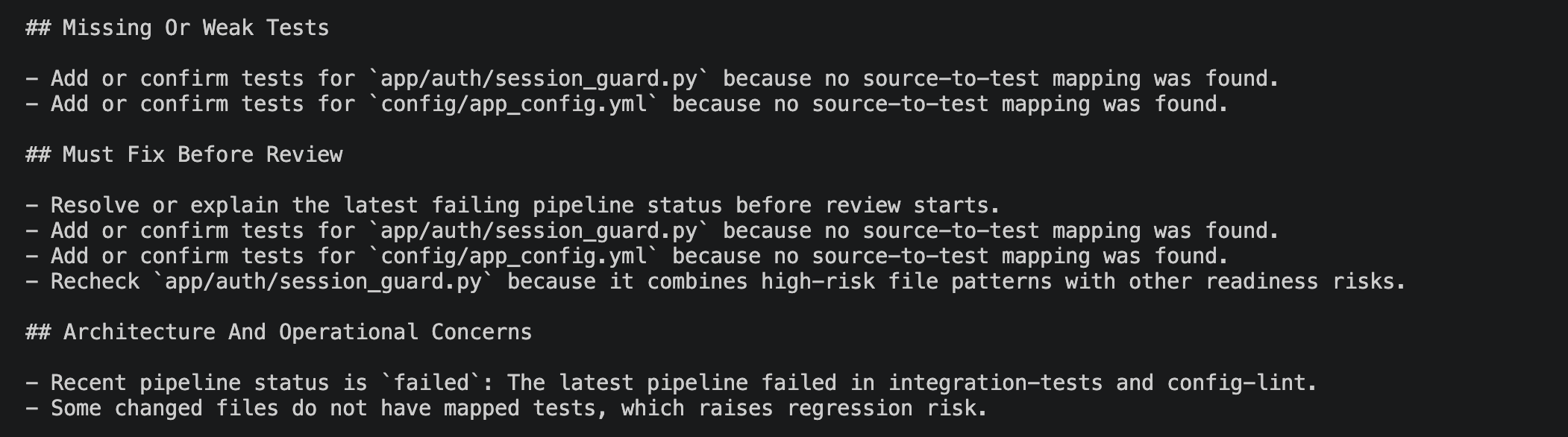
Must-Fix Review Blockers: missing tests, must-fix items, and pipeline concerns
-

Ready-for-Review Decision


Inspiration
Code review often starts before a merge request is actually ready. Reviewers spend valuable time discovering problems the author could have found earlier: failing pipelines, missing tests, risky auth or payment changes, hidden dependencies, and affected files outside the obvious diff.
For the GitLab Transcend Hackathon, I wanted to build something that uses GitLab Orbit’s codebase context to help developers answer a practical question before asking for review:
Is this MR ready for human review yet?
What it does
Orbit MR Readiness Agent generates a readiness report for a merge request. It analyzes merge request metadata together with Orbit-shaped context and produces:
- a readiness score from 0 to 100
- a final decision: Ready for review, Needs work before review, or High risk
- highest-risk files
- likely impacted files
- missing or weak tests
- must-fix items before review
- estimated reviewer time saved
- a reviewer checklist
The project includes two reproducible demo scenarios:
- A high-risk MR touching payment, auth, and config files with missing tests and a failing pipeline.
- A ready-for-review MR with a low-risk UI text change, mapped tests, and a passing pipeline.
The goal is not to replace human reviewers. The goal is to help authors prepare better MRs so reviewers can start later, faster, and with better context.
How we built it
The project is built as a Python CLI prototype with a GitLab Duo Agent Platform skill definition.
The main components are:
- skills/code-review-prep/SKILL.md: the agent skill definition
- src/main.py: CLI entrypoint
- src/review_prep/orbit_client.py: the Orbit context loading seam
- src/review_prep/analyzer.py: deterministic MR readiness heuristics
- src/review_prep/report.py: markdown report generation
- examples/: high-risk and ready-for-review demo contexts
- .gitlab/duo/: GitLab Duo Agent Platform metadata
The local CLI demo uses sample Orbit-shaped JSON so judges can reproduce the workflow without private credentials. The official GitLab Showcase Track project has also been pushed to GitLab and validated with GitLab Orbit indexing.
Live Orbit validation:
- Official GitLab project: https://gitlab.com/gitlab-ai-hackathon/transcend/37331744
- glab orbit setup succeeds
- GitLab Orbit indexed the project
- glab orbit remote graph-status reported:
- Projects indexed: 1
- Source files: 24
- Definitions: 34
- Imported symbols: 23
- Directories: 11
- Indexing state: indexed
Challenges we ran into
The biggest challenge was balancing a reproducible demo with the live GitLab Orbit setup. I wanted the project to be honest and runnable even if a judge does not have my exact Orbit environment, so the CLI uses deterministic sample Orbit-shaped JSON.
Another challenge was GitLab access and project provisioning. I had to register for the Showcase Track, authenticate with glab, wait for GitLab project access, push the project to the provisioned GitLab repository, and verify that Orbit indexing worked.
I also had to resolve Git remote issues while keeping both a GitHub backup and the official GitLab hackathon project in sync.
Accomplishments that we’re proud of
I’m proud that the project is not just a chatbot idea. It produces a concrete artifact that a developer or reviewer can act on immediately: an MR readiness report.
The project now has:
- a working CLI prototype
- two clear demo scenarios
- deterministic scoring and decisions
- a GitLab Duo Agent Platform skill file
- GitLab Duo metadata
- passing tests
- official GitLab project deployment
- live GitLab Orbit indexing validation
The high-risk and ready-for-review examples make the value easy to understand in a short demo.
What we learned
I learned how GitLab Orbit fits into AI-native developer workflows by giving agents structured context about a project. I also learned how important it is to separate a clean local prototype from the future live integration path.
The project reinforced that useful developer agents should not only summarize information. They should make workflow decisions, surface risks, and produce actionable outputs.
I also learned more about GitLab CLI, Orbit setup, GitLab project provisioning, and how the Duo Agent Platform can use skills and future Orbit API/CLI/MCP integration.
What’s next for Orbit MR Readiness Agent
Next, I would connect OrbitClient directly to live GitLab Orbit data through the Orbit API, CLI, or MCP path. That would allow the agent to analyze real merge requests instead of sample JSON.
Future improvements include:
- live merge request ingestion
- real source-to-test mapping from Orbit
- dependency blast-radius analysis
- pipeline-aware review gates
- MR comments generated automatically
- reviewer assignment suggestions
- AI Catalog publishing as a reusable GitLab Duo Agent Platform skill or flow
The long-term vision is a pre-review gate that helps teams reduce review back-and-forth and protect reviewer time.

Log in or sign up for Devpost to join the conversation.