-
-
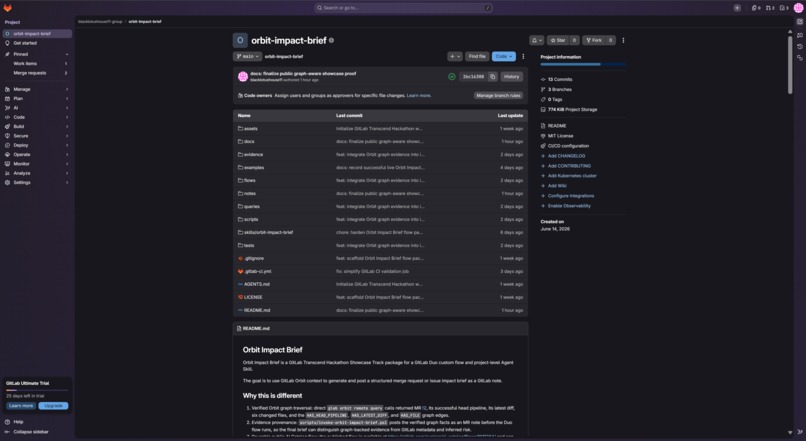
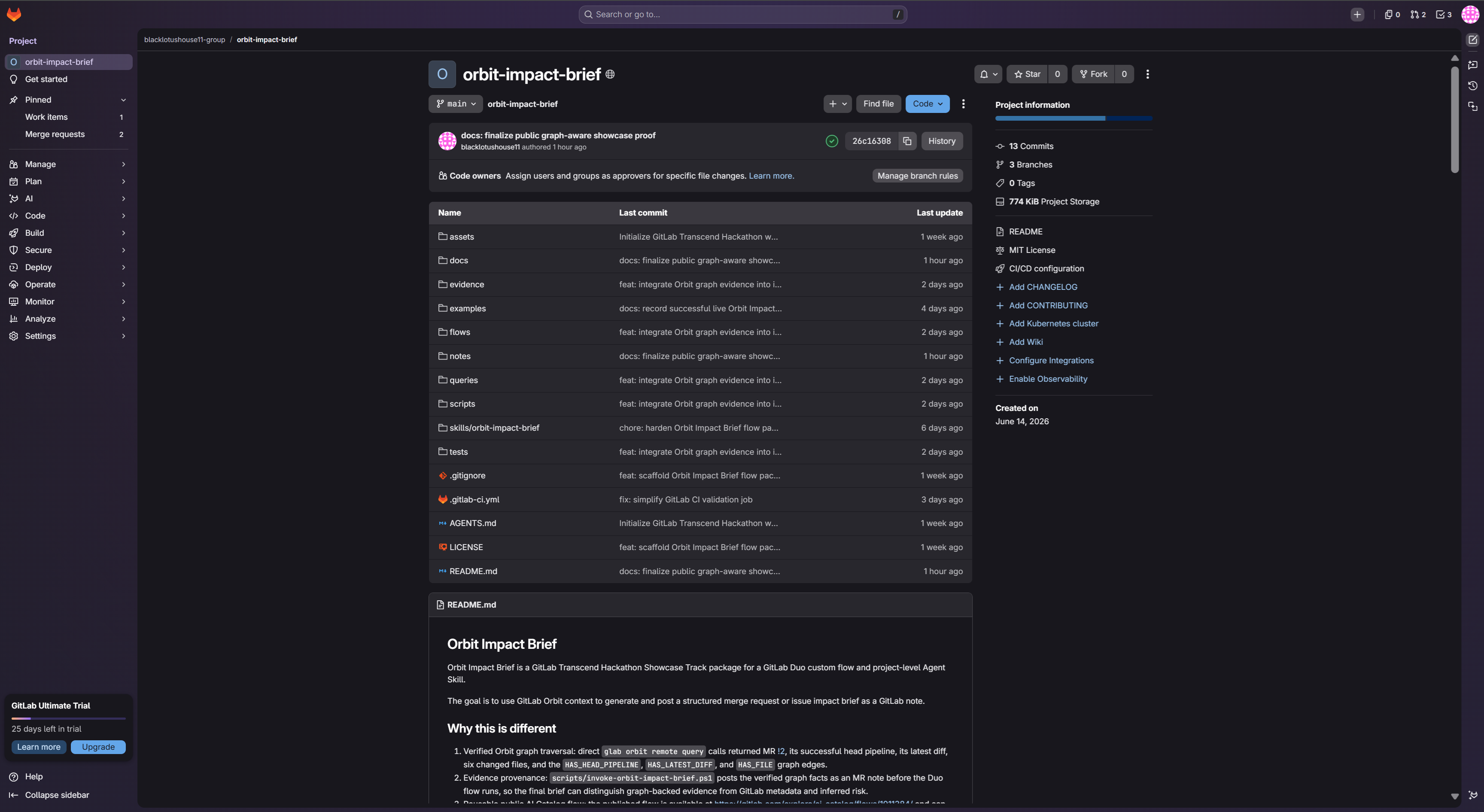
Public GitLab repo with the flow, Agent Skill, Orbit bridge, tests, evidence, documentation, and MIT license.
-
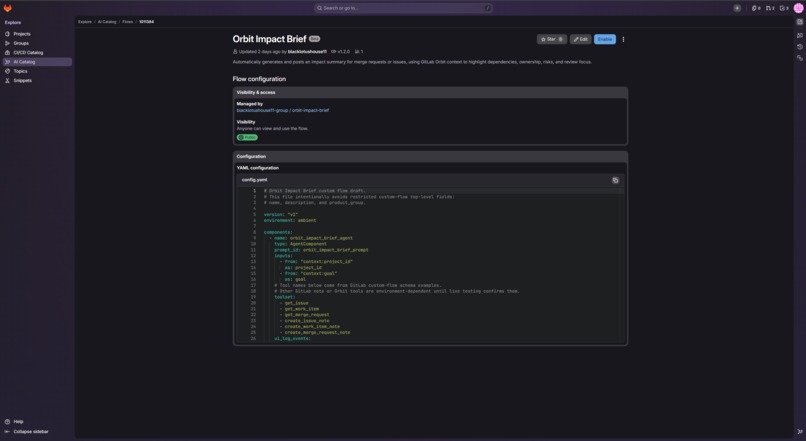
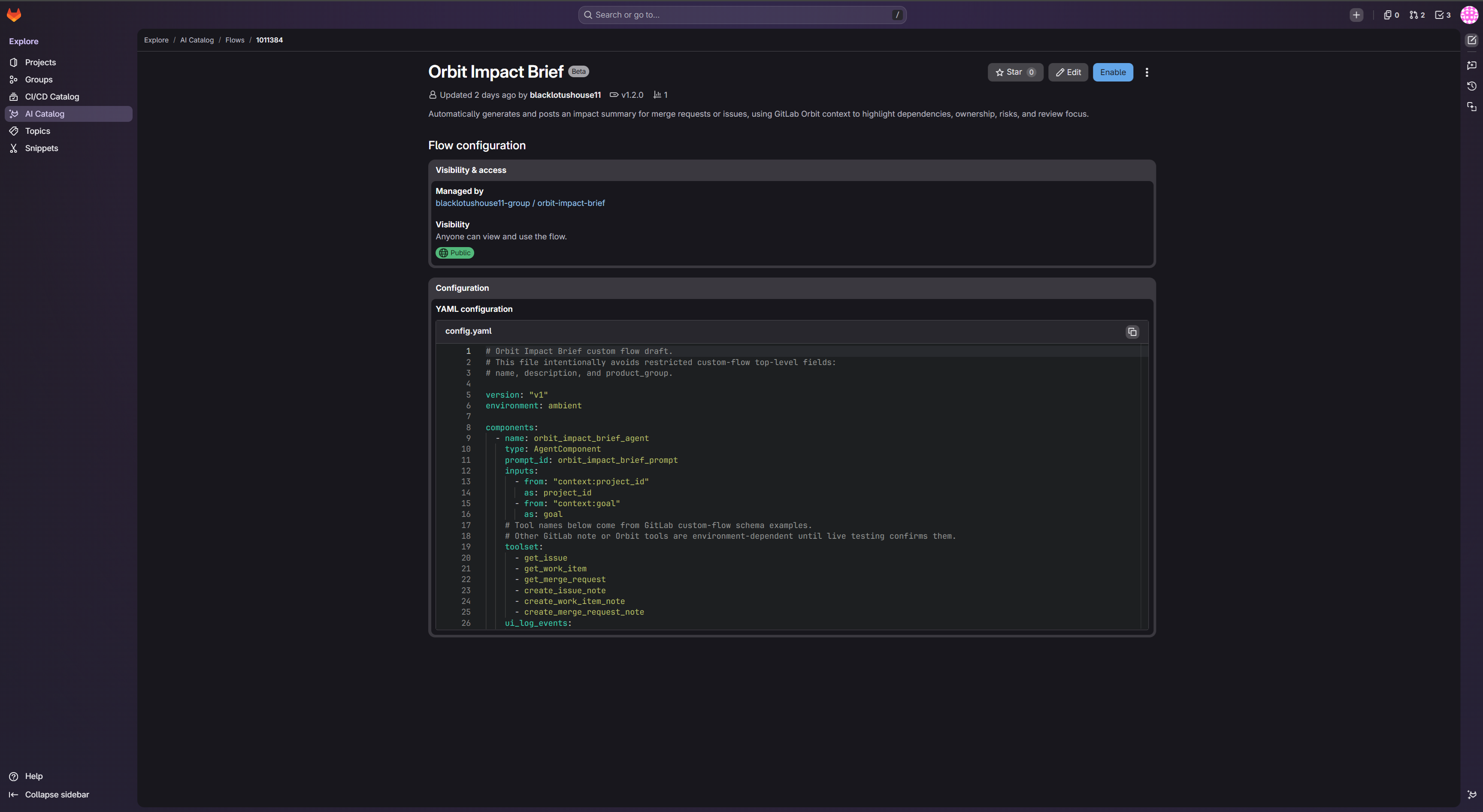
Public AI Catalog listing for the reusable Orbit Impact Brief GitLab Duo custom flow.
-
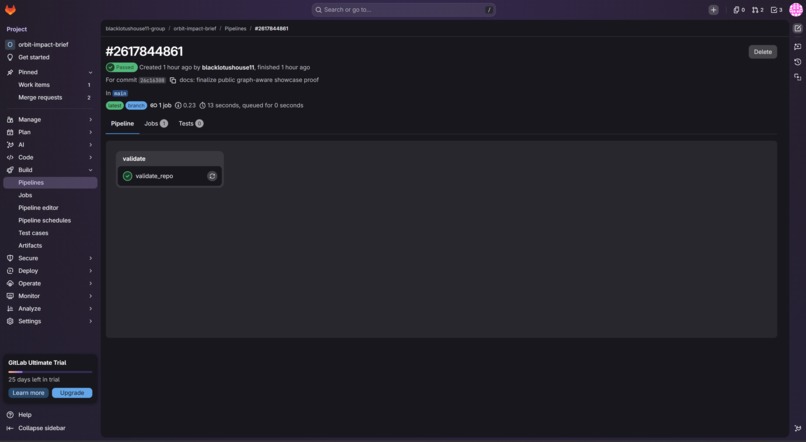
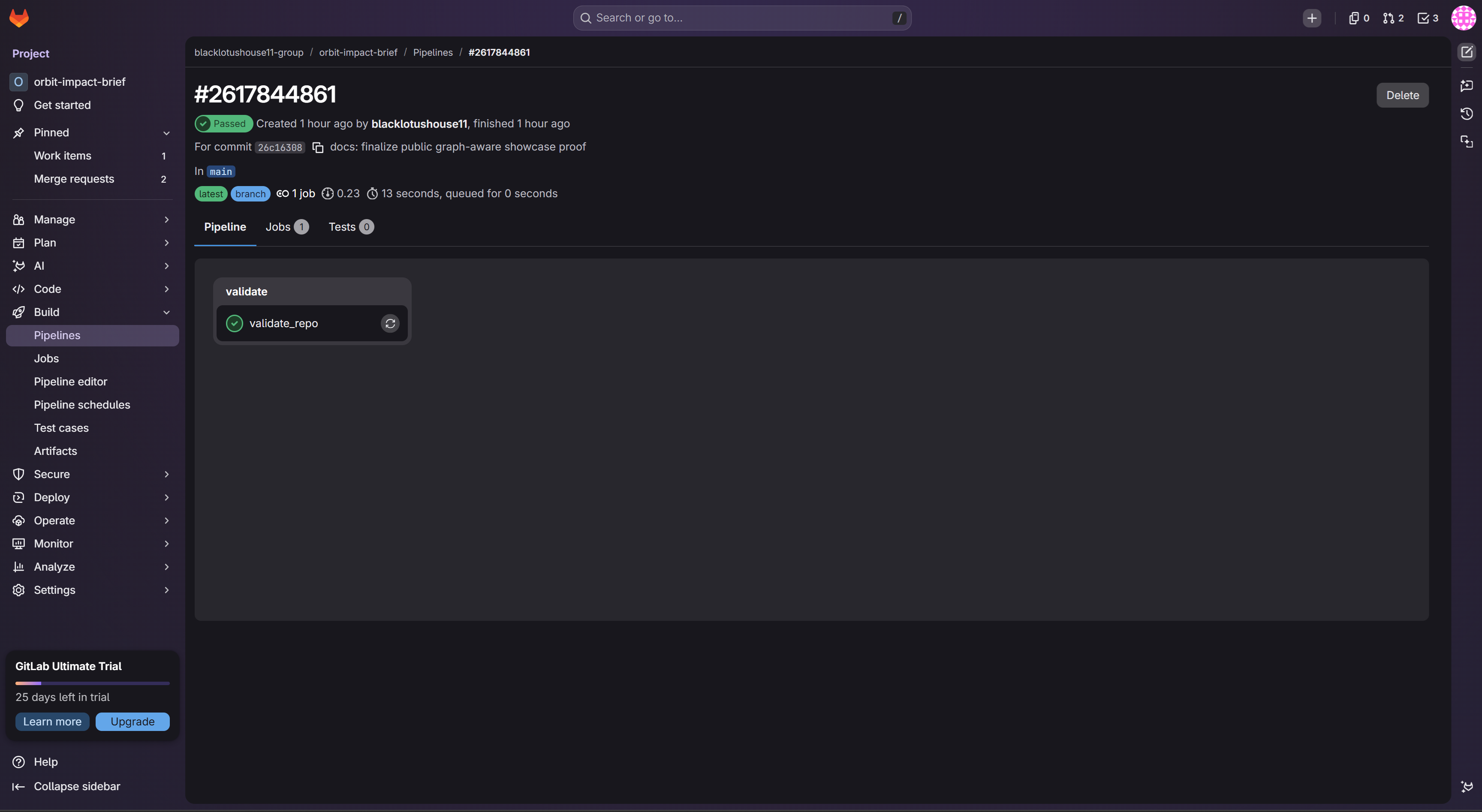
Passing GitLab CI pipeline validating the flow schema, graph bridge, documentation, and contract tests.
-
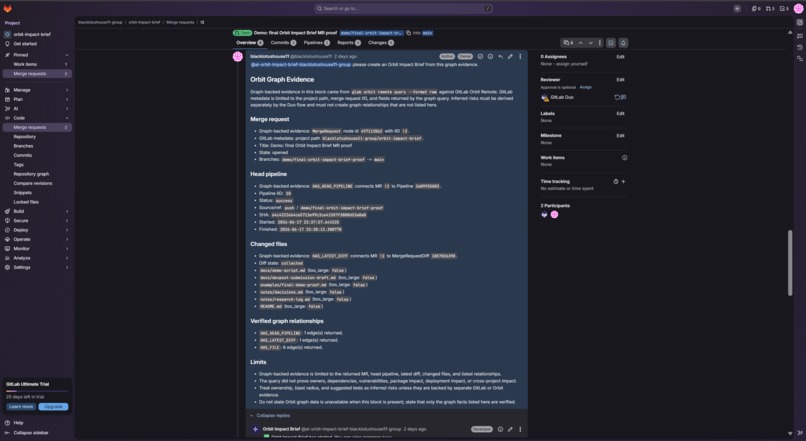
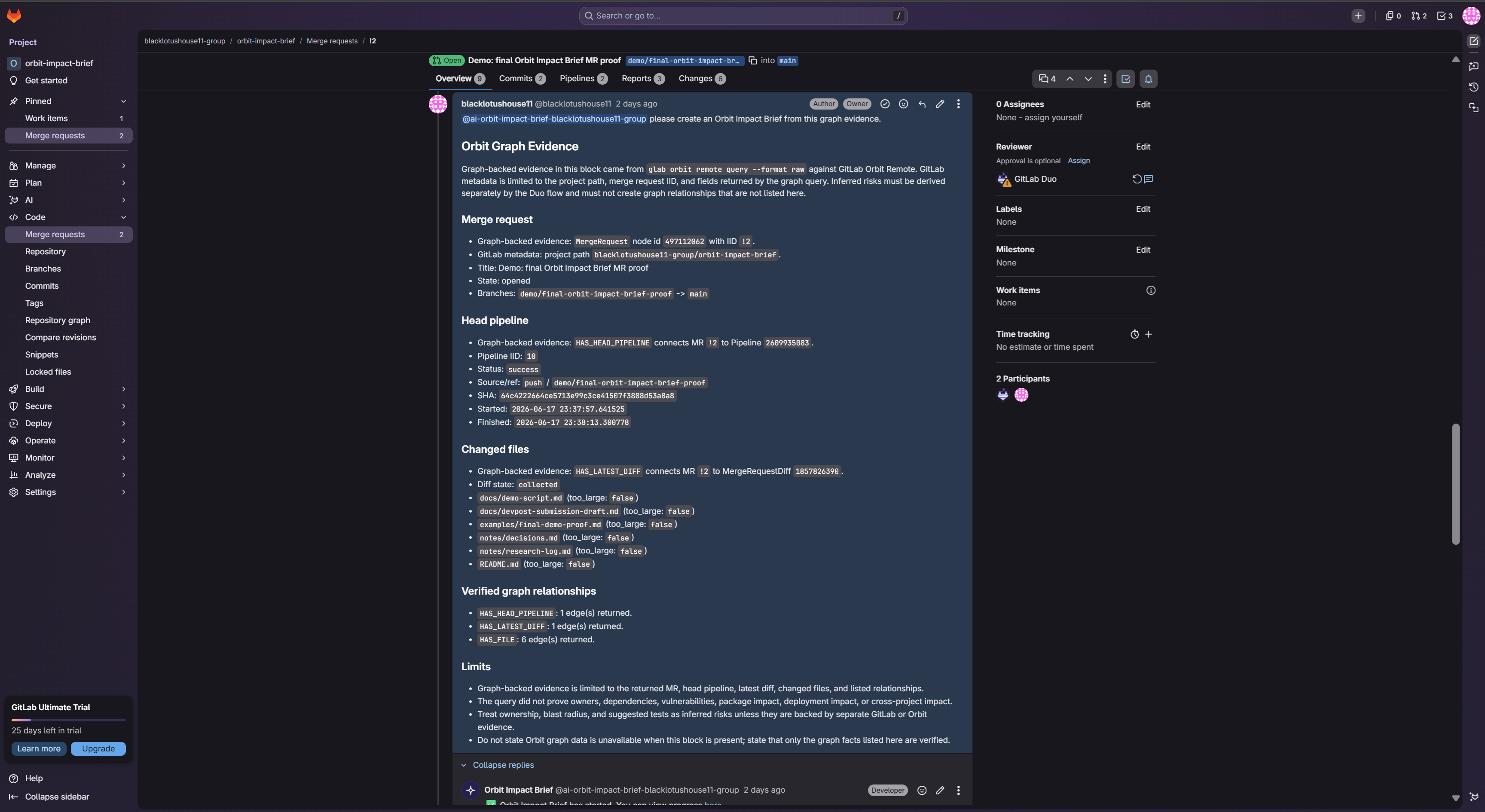
Orbit graph evidence linking MR !2 to its successful pipeline, latest diff, and six changed files.
-
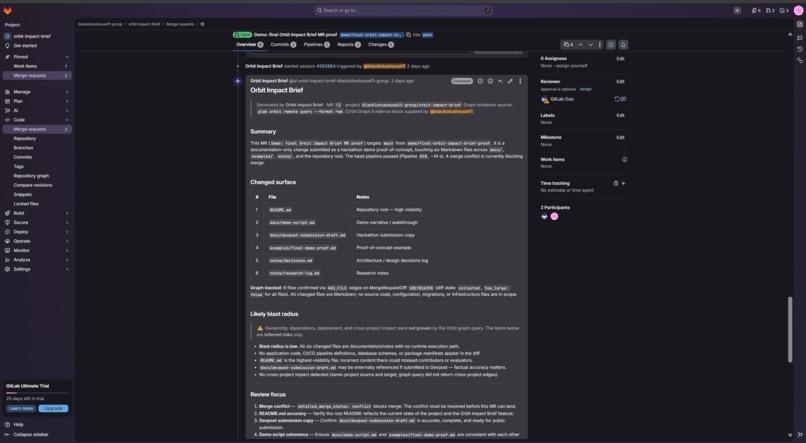
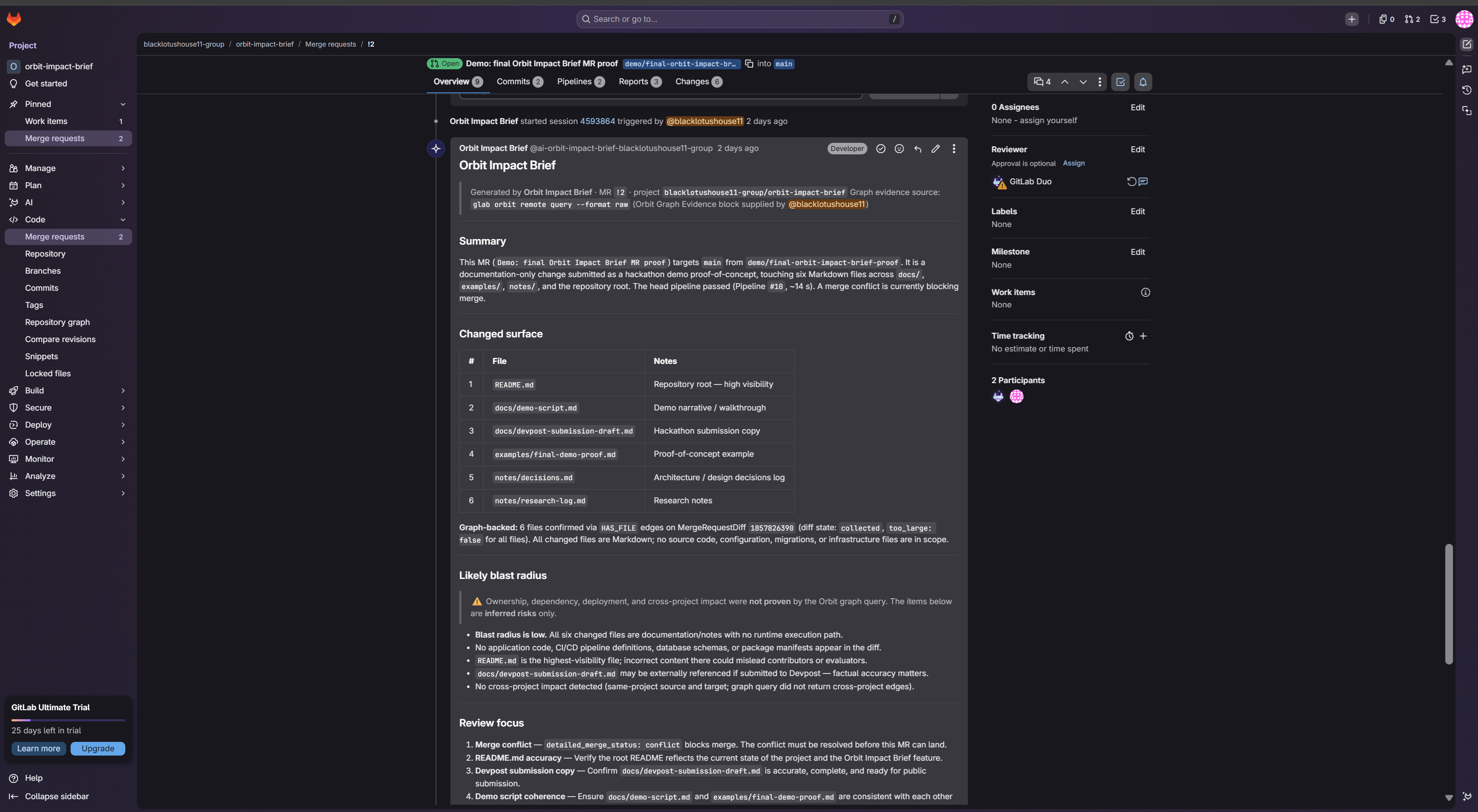
Graph-aware MR review packet separating verified Orbit evidence, GitLab metadata, and inferred risk.
Inspiration
Merge request reviewers often have to reconstruct context manually: what changed, which pipeline ran, which files are affected, what should be tested, and which conclusions are facts versus assumptions.
Orbit Impact Brief turns that scattered context into an evidence-first review packet directly inside GitLab.
What it does
Orbit Impact Brief combines GitLab Orbit and GitLab Duo in a reproducible workflow:
glab orbit remote querytraverses the GitLab Orbit knowledge graph.- The query retrieves the merge request, its head pipeline, latest diff, and changed files.
- A PowerShell bridge formats those verified graph relationships and posts them to the merge request.
- The comment mentions the public Orbit Impact Brief custom flow.
- GitLab Duo converts the evidence into a structured impact brief directly on the merge request.
Each brief includes:
- Summary
- Changed surface
- Likely blast radius
- Review focus
- Suggested tests
- Owners or context holders
- Follow-up checklist
The output separates:
- Graph-backed evidence returned by GitLab Orbit
- GitLab metadata
- Inferred risks
This prevents assumptions from being presented as verified graph facts.
How we built it
The project uses:
- GitLab Orbit Remote
- GitLab Duo Agent Platform
- A public GitLab AI Catalog custom flow
- GitLab CLI (
glab) - PowerShell automation
- Python repository validation and contract tests
- GitLab CI/CD
The verified Orbit traversal for the final demo merge request returned:
- The merge request node
- Its successful head pipeline
- Its latest diff snapshot
- Six changed files
HAS_HEAD_PIPELINEHAS_LATEST_DIFFHAS_FILE
The custom flow does not pretend it directly queried Orbit. Instead, the automation bridge supplies verified CLI graph evidence to the flow, which then produces the human-readable review packet.
Challenges
The first custom-flow YAML draft was rejected by GitLab, so we repaired it against the live GitLab flow schema.
We also had to route issue, work-item, and merge-request notes through the correct tools. Finally, we separated standard GitLab metadata from actual Orbit graph evidence so the system would not overstate what had been verified.
Accomplishments
- Published a public GitLab Duo custom flow to the AI Catalog
- Enabled and triggered the flow on issues and merge requests
- Queried the real GitLab Orbit graph through
glab - Posted verified graph evidence to a live merge request
- Automatically triggered a graph-aware Orbit Impact Brief
- Added reusable query templates and a one-command PowerShell bridge
- Added repository validation, contract tests, and passing GitLab CI
- Published the complete project under the MIT License
What we learned
Graph context becomes significantly more useful when provenance is explicit.
A reviewer should be able to distinguish what Orbit proved, what GitLab metadata reported, and what the AI inferred. That evidence boundary is central to Orbit Impact Brief.
What's next
Future versions can add:
- Automatic execution when a merge request becomes ready
- Updating an existing brief instead of posting duplicates
- Deeper code-level traversal through imports, definitions, and calls
- CODEOWNERS and reviewer-routing context
- Cross-project blast-radius analysis
- Configurable risk and graph-depth settings
Orbit Impact Brief demonstrates a reusable pattern for turning verified GitLab Orbit relationships into actionable developer workflows with GitLab Duo.
Built With
- ci/cd
- gitlab
- gitlab-ai-catalog
- gitlab-cli-(glab)
- gitlab-duo-agent-platform
- gitlab-orbit-remote
- powershell-7
- python-3.11
- yaml


Log in or sign up for Devpost to join the conversation.