Orbit Guardian
Inspiration
Software projects often lose their most valuable asset: knowledge.
Every development team eventually faces situations where key contributors leave, documentation becomes outdated, or architectural decisions are forgotten. While modern AI coding assistants can generate and explain code, they rarely preserve the reasoning and context behind it.
We were inspired by a simple question:
What happens if the person who understands this critical module leaves tomorrow?
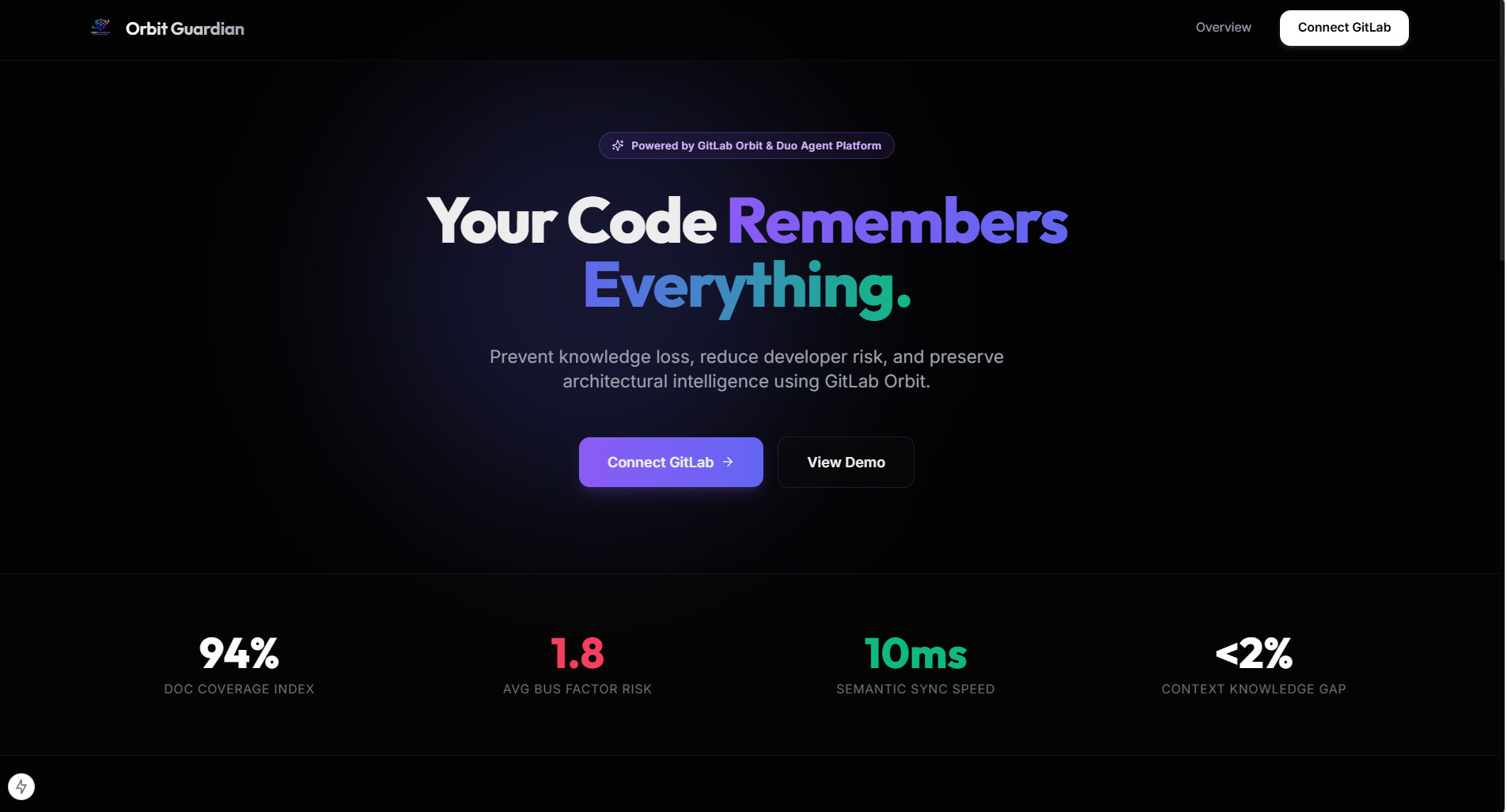
This led us to build Orbit Guardian, an AI-powered knowledge preservation platform that transforms repository history into a living organizational memory system. Instead of focusing on writing code, Orbit Guardian focuses on preserving the knowledge behind the code.
What It Does
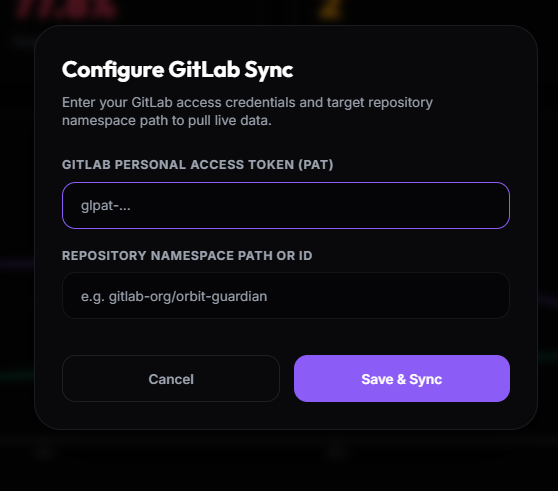
Orbit Guardian helps engineering teams understand, preserve, and manage project knowledge using GitLab Orbit and GitLab Duo.
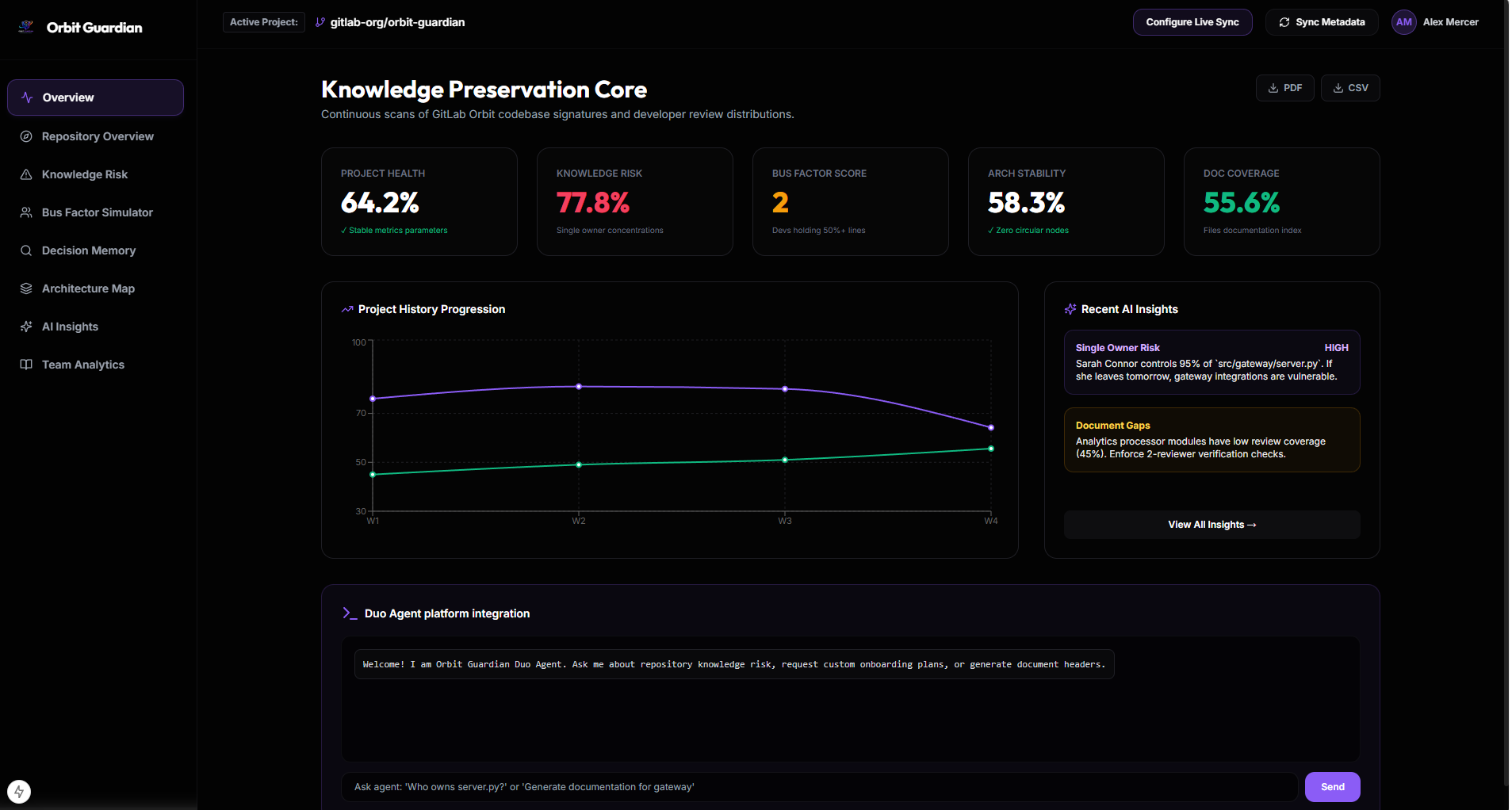
The platform continuously analyzes repositories and provides:
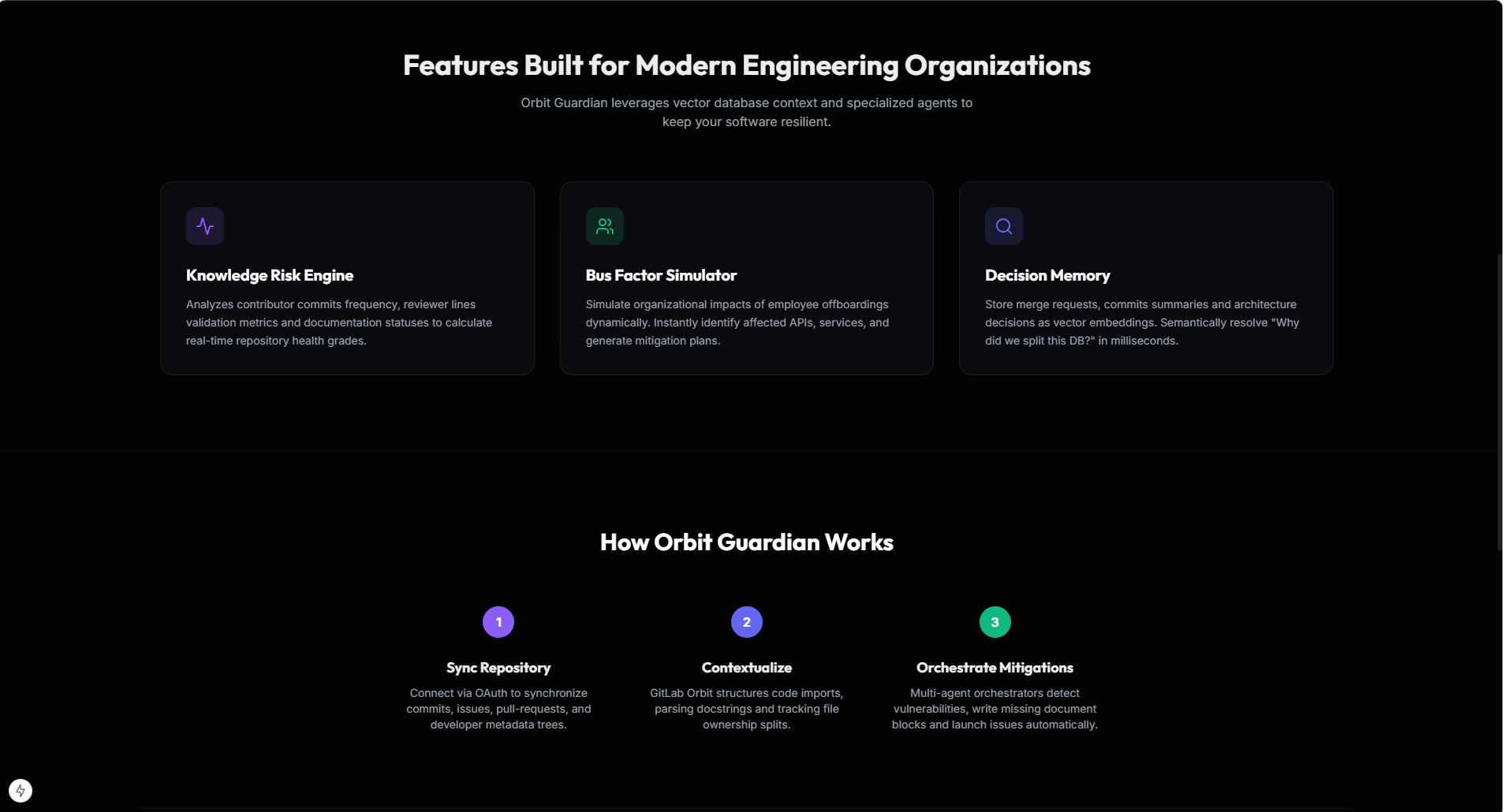
- Knowledge Risk Analysis
- Bus Factor Prediction
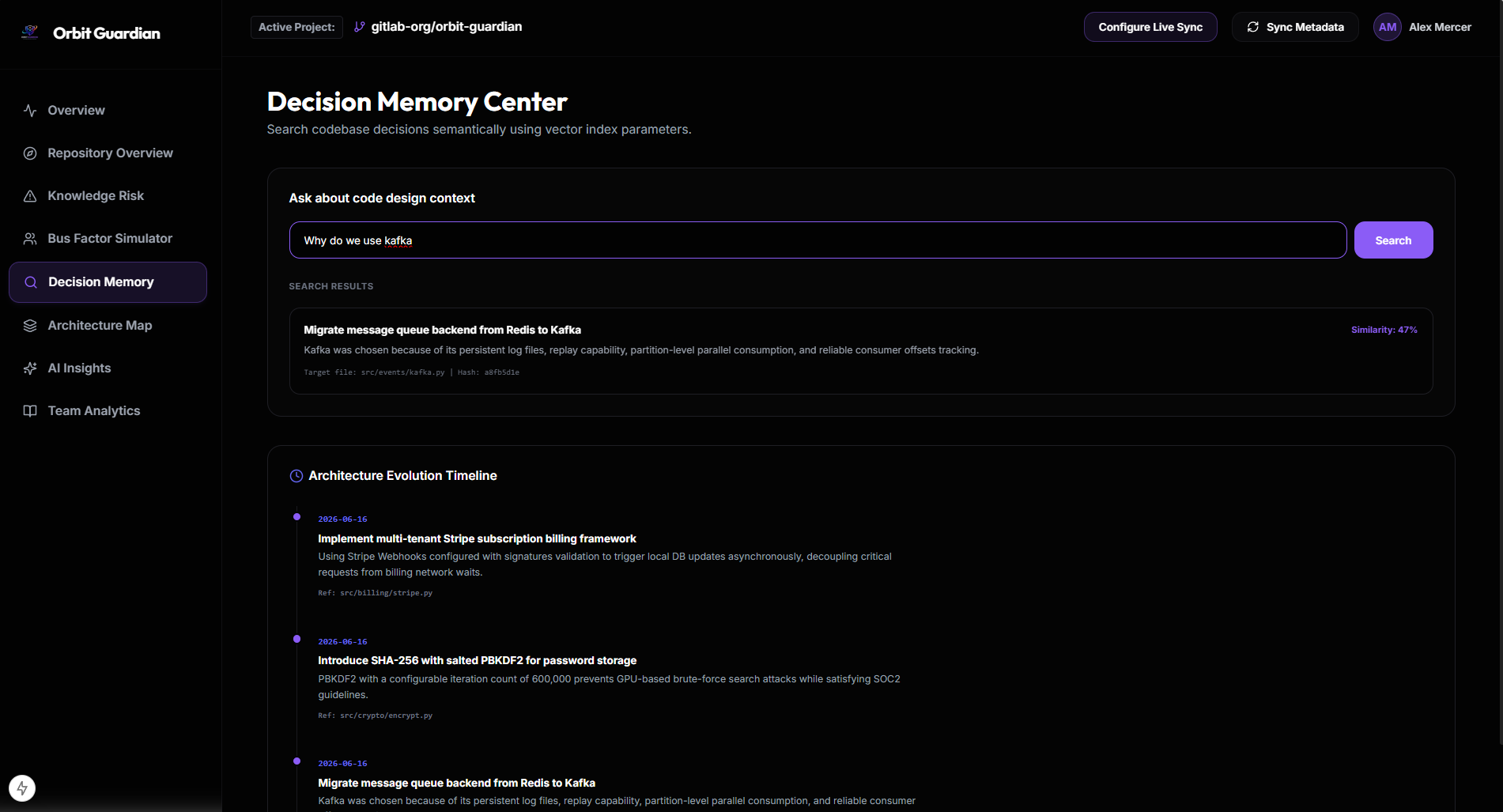
- Decision Memory Search
- Architecture Intelligence
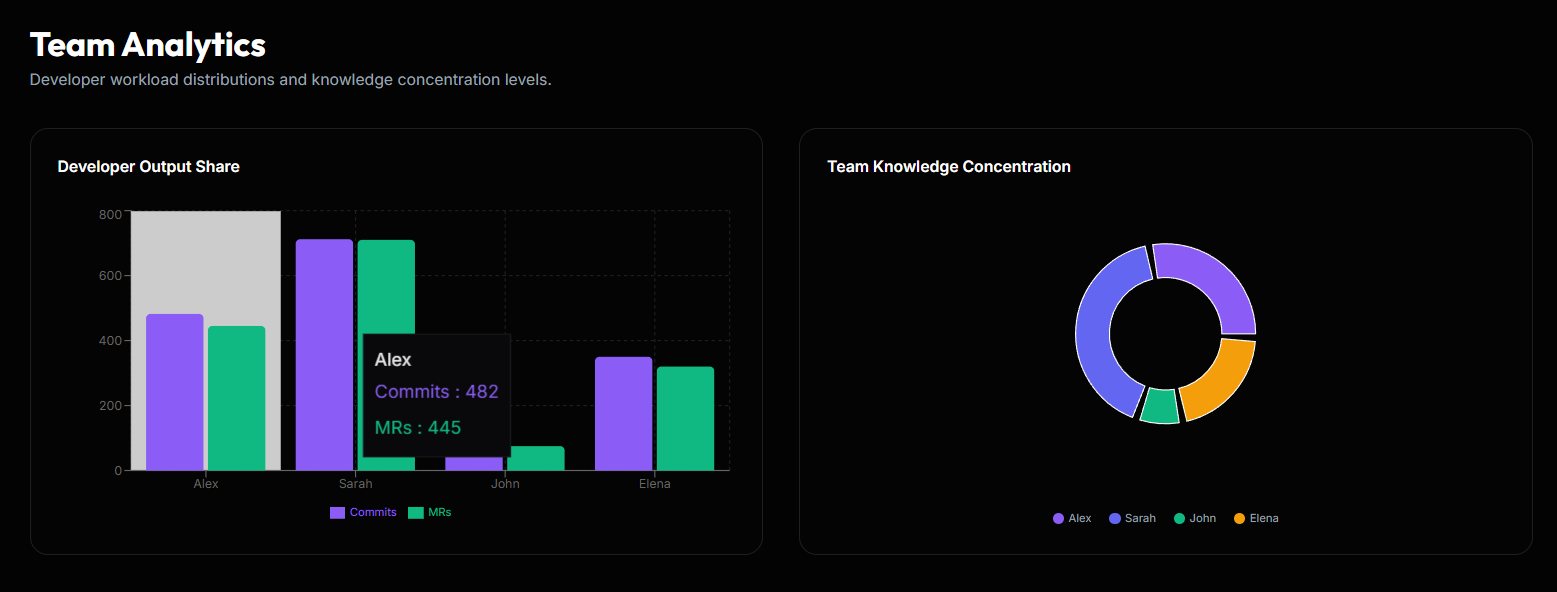
- Contributor Dependency Insights
- Automated Documentation Suggestions
- Knowledge Transfer Recommendations
With Orbit Guardian, teams can:
- Detect critical knowledge bottlenecks
- Identify modules owned by a single developer
- Understand why architectural decisions were made
- Reduce onboarding time for new developers
- Preserve project knowledge as teams grow
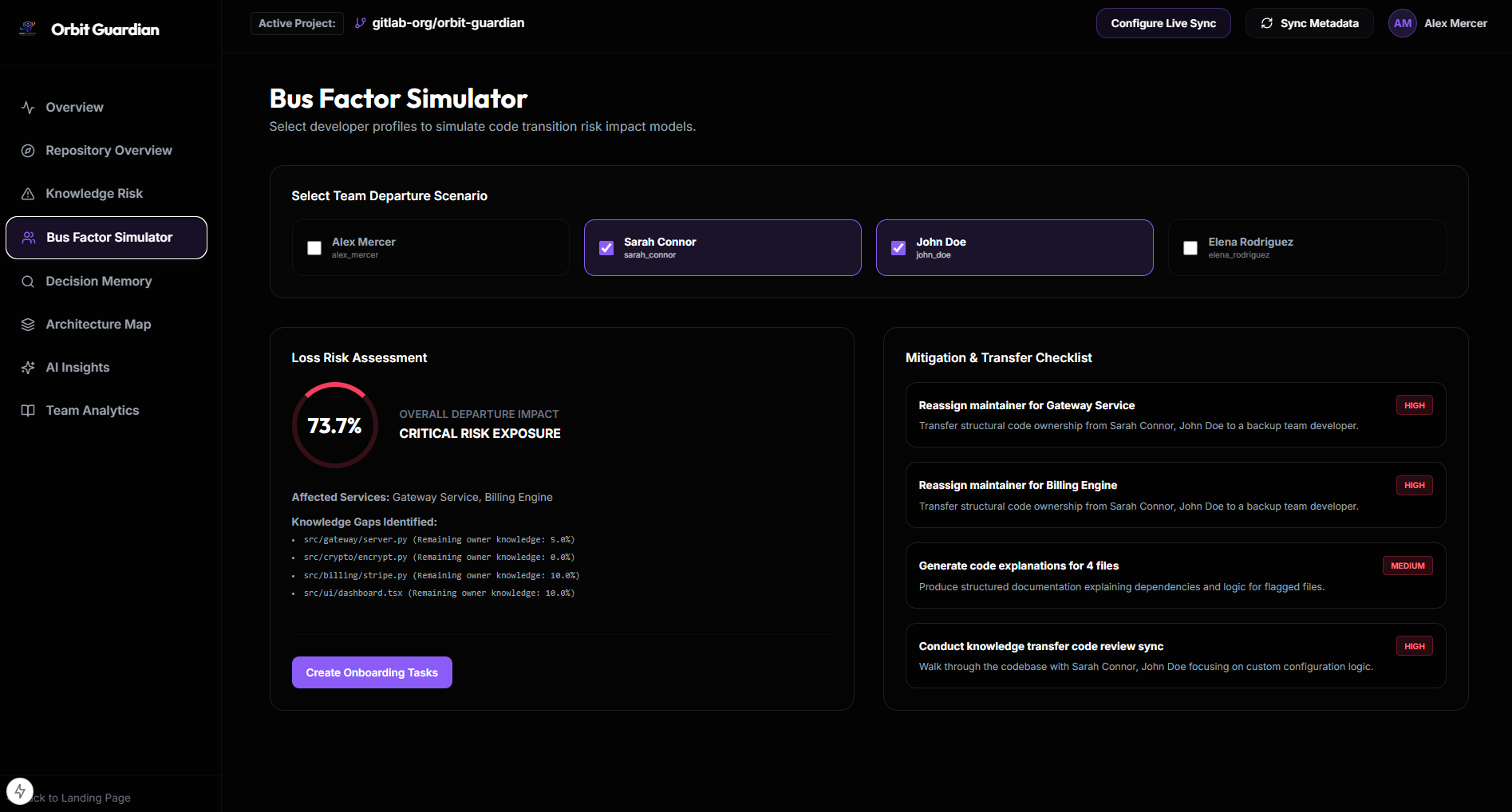
One of our most powerful features is the Bus Factor Simulator, which answers:
"What would happen if a specific developer left the project today?"
The system instantly identifies affected modules, ownership risks, missing documentation, and mitigation strategies.
How We Built It
Frontend
- Next.js
- TypeScript
- Tailwind CSS
- shadcn/ui
- React Flow
- Recharts
The frontend provides interactive dashboards, architecture visualizations, risk reports, and semantic search capabilities.
Backend
- FastAPI
- Python
- PostgreSQL
- pgvector
The backend handles repository analysis, risk calculations, decision indexing, and AI workflows.
GitLab Orbit
GitLab Orbit serves as the contextual intelligence layer.
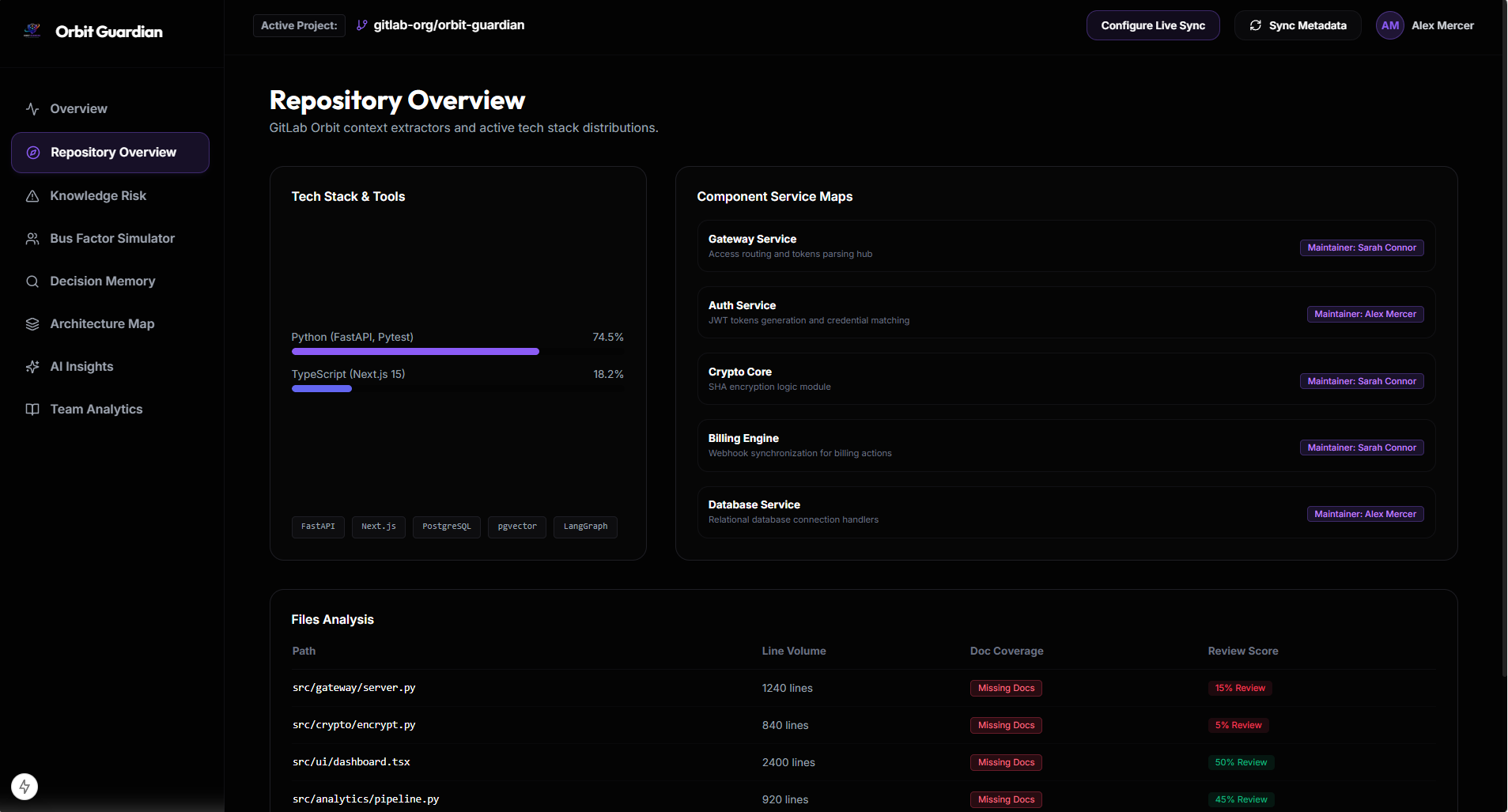
We use Orbit to understand:
- Repository structure
- File relationships
- Dependency graphs
- Symbol relationships
- Contributor ownership
- Project architecture
This allows the system to move beyond simple code analysis and understand the broader context of the project.
GitLab Duo Agent Platform
GitLab Duo powers the Orbit Guardian Agent.
The agent can:
- Analyze repository risks
- Generate documentation recommendations
- Create onboarding plans
- Explain architectural decisions
- Suggest knowledge transfer actions
Unlike traditional chat assistants, the agent performs actionable workflows and automations.
AI Memory Layer
To preserve decision history, we created a Decision Memory Engine.
Merge requests, commit summaries, discussions, and architecture explanations are converted into embeddings and stored in a vector database.
This enables semantic queries such as:
- Why was Redis introduced?
- Why was this service separated?
- What problem was this API designed to solve?
Challenges We Faced
One of the biggest challenges was shifting the focus from code generation to knowledge preservation.
Most AI developer tools already help developers write code. We wanted to solve a different problem: helping teams retain understanding over time.
Another challenge was determining how to measure knowledge risk in a meaningful way. We experimented with multiple factors, including contributor concentration, documentation coverage, review history, and dependency complexity before developing a scoring model that produces actionable insights.
Designing a system that combines repository intelligence, contributor analytics, architectural context, and AI-powered recommendations into a single workflow was also technically challenging. We needed a way to transform large amounts of repository data into insights that developers could immediately understand and act upon.
What We Learned
Through this project, we learned that preserving software knowledge is just as important as generating software.
We explored how contextual code intelligence can be used for much more than code completion and discovered how repository history, contributor activity, and architectural evolution can be combined to create a living memory system for software teams.
We also gained hands-on experience working with:
- AI Agents
- GitLab Orbit
- GitLab Duo
- Vector Search
- LangGraph Workflows
- Repository Intelligence Systems
- Developer Experience Design
What's Next
Our vision is to make Orbit Guardian the memory layer for software engineering teams.
Future plans include:
- Real-time repository monitoring
- Predictive knowledge loss alerts
- Architecture evolution tracking
- Team onboarding copilots
- Cross-repository intelligence
- Enterprise-wide engineering knowledge graphs
We believe the future of software development is not just AI that writes code, but AI that understands, preserves, and protects the knowledge behind it.
Orbit Guardian is our step toward that future.
Tech Stack
Frontend:
- Next.js
- TypeScript
- Tailwind CSS
- Shadcn UI

Backend:
- FastAPI
- Python

Database:
- PostgreSQL
- pgvector

AI:
- GitLab Orbit
- GitLab Duo Agent Platform
- LangGraph

Deployment:
- Docker
- GitLab CI/CD
Core Innovation
Traditional AI Coding Assistants:
→ Help developers write code

Orbit Guardian:
→ Helps teams preserve knowledge, understand decisions,
   reduce bus-factor risk, and maintain project intelligence
   throughout the software lifecycle.

Log in or sign up for Devpost to join the conversation.