-
-
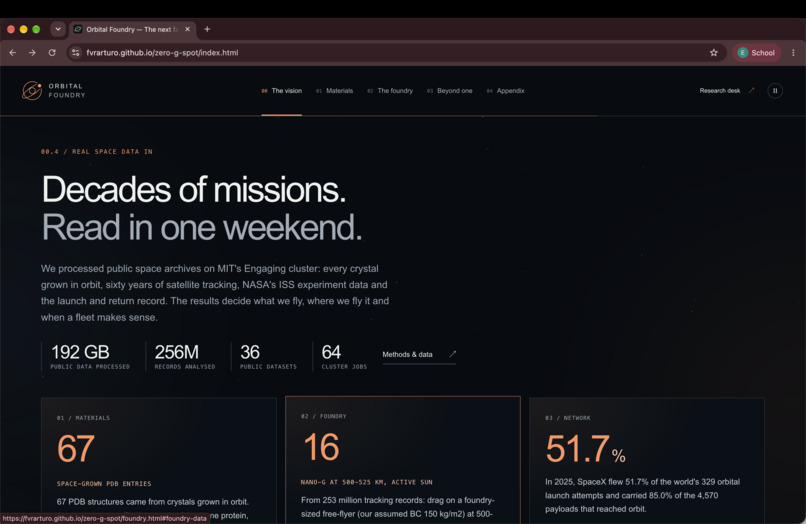
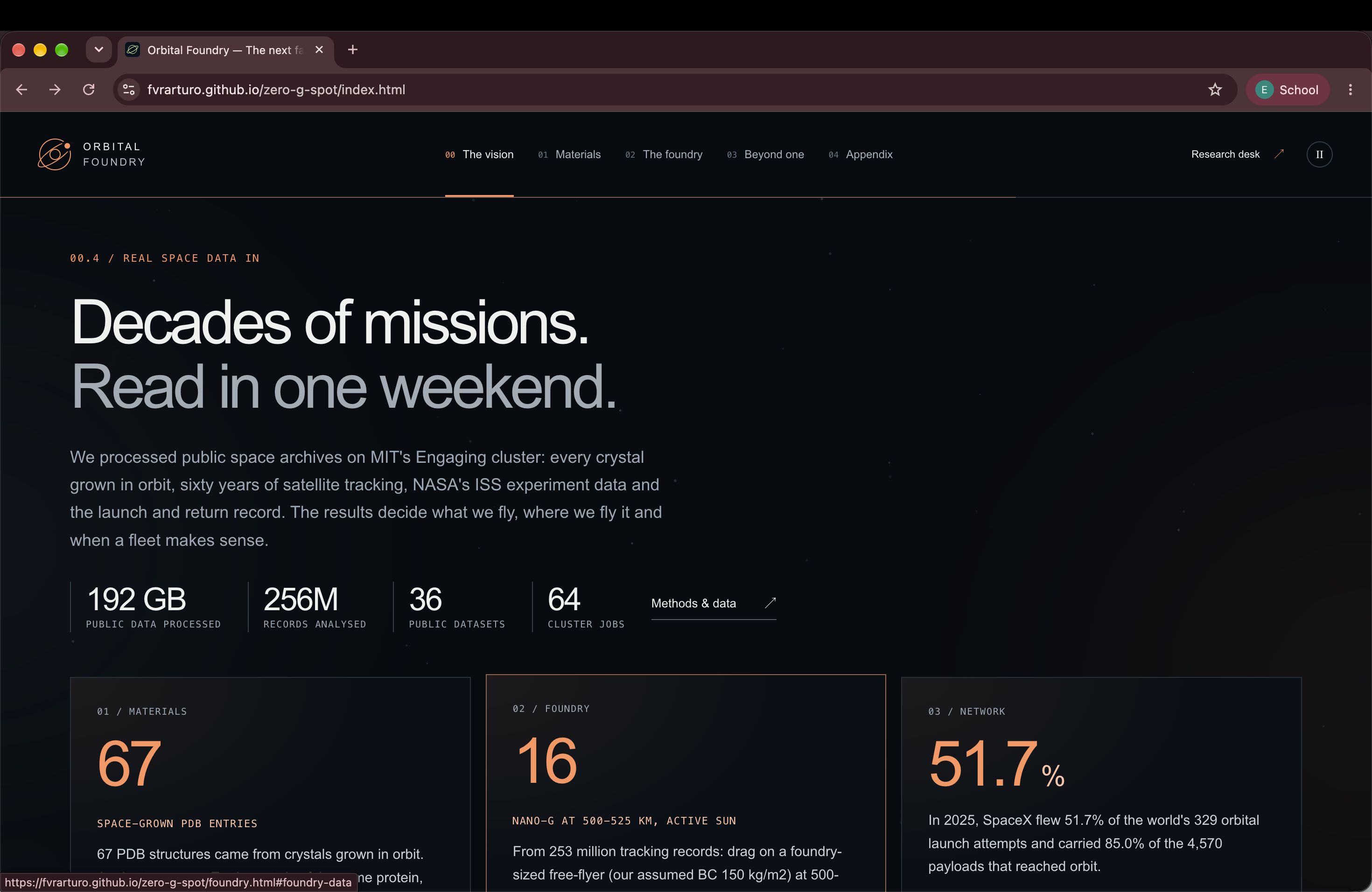
Preview of demo, with the scale of the datasets used
-
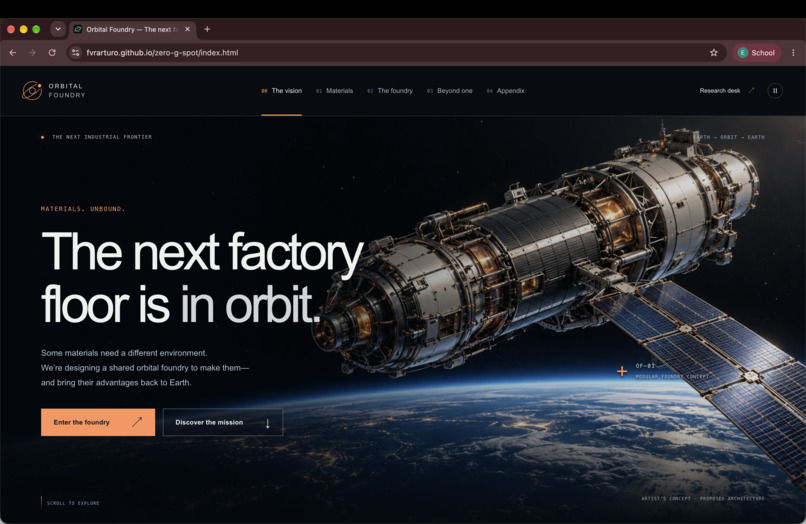
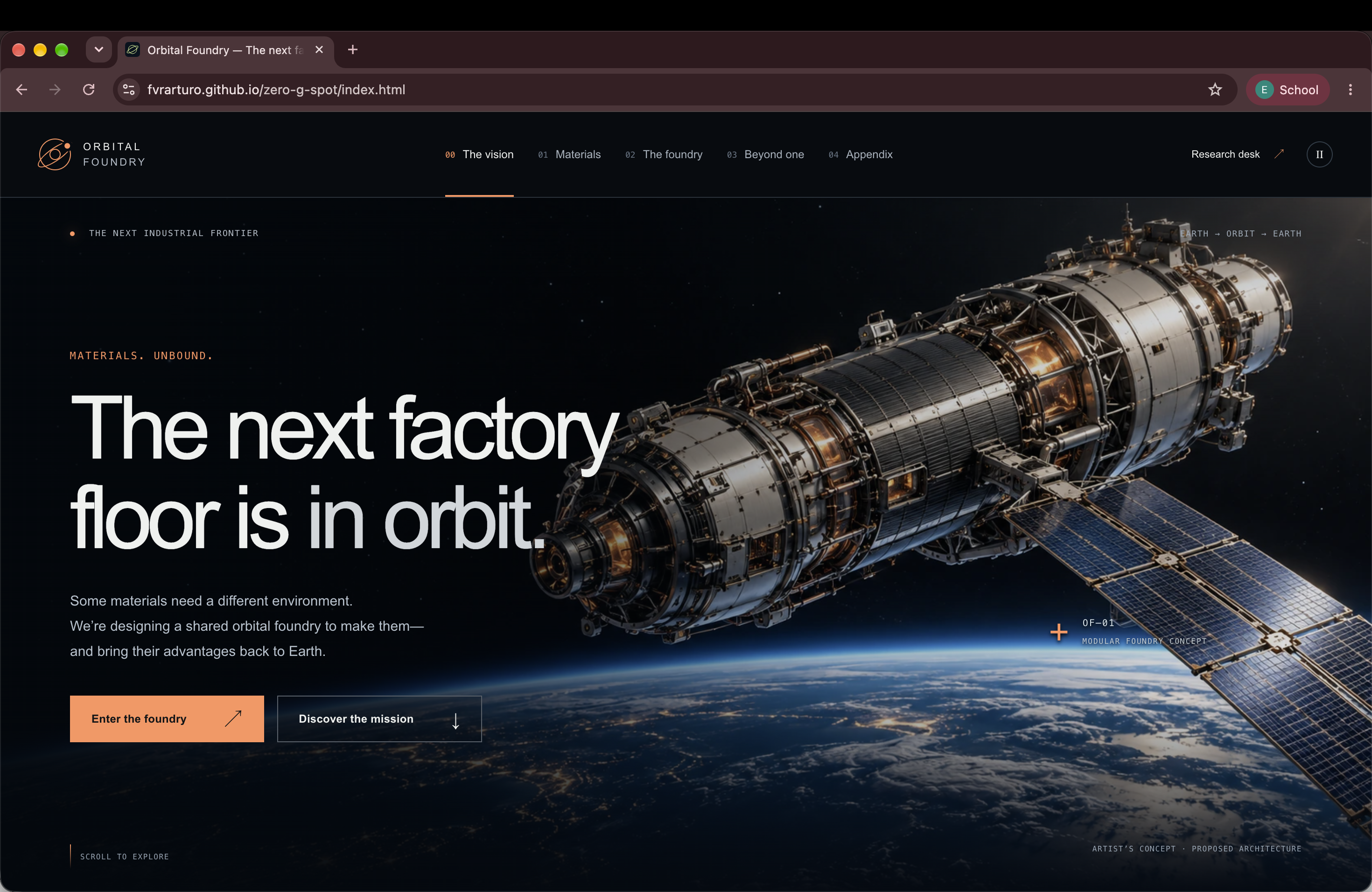
Landing page of the demo
-
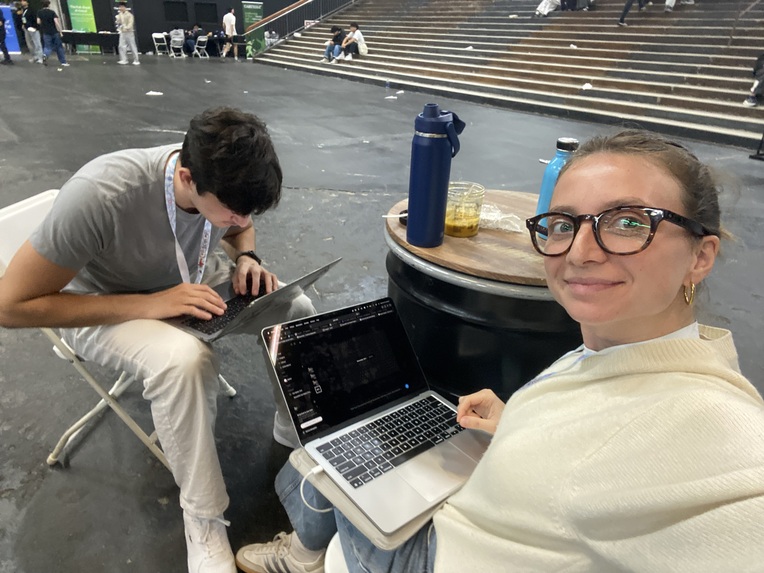
Grinding on cursor and waiting for Grok to generate an awsome video
Inspiration
For forty years, crystals grown on the Space Shuttle and the ISS have come back to Earth looking different. Merck grew pembrolizumab (Keytruda) crystal suspensions in orbit. Varda recovered ritonavir crystals after an autonomous re-entry. ISS colloid experiments returned photonic crystals too large to grow on the ground. But each result needed its own flight, its own hardware and its own ride home, and then it stopped. What's missing isn't another experiment. It's a factory floor they can all run on.
Chips went through the same shift: designers stopped building their own fabs once foundries like TSMC turned production into a shared service. We want to be that foundry for orbit. The SpaceXAI challenge gave us a way to test the idea: enormous public datasets, decades of missions, and a literature no human can read all of. We wanted to find out whether real space data would back a shared orbital foundry, or kill it.
What it does
Orbital Foundry is a shared factory floor in orbit: a free-flying platform that pharma, energy and optics companies run their processes on, instead of each flying its own mission. A customer brings a sealed process cartridge holding its own chemistry. We provide everything around it: a quiet orbit, power, thermal control, cameras, data, and a return capsule that brings the finished product home.
The five materials below aren't a product line. They're the first processes that could run on the platform, and we tested each against public data to see whether orbit is worth it:
- Protein crystals. Across all 261,139 Protein Data Bank entries, we found 67 structures from crystals grown in orbit. Against same-era Earth crystals of the same protein, the space crystal was sharpest for 54% of 28 proteins, where shuffling the labels predicts 21% ($p < 0.001$).
- Drug crystals. 58% of FDA drugs crystallised at least twice in the open Crystallography Open Database show two or more solid forms, versus 34% of organic compounds in general. Which form you get decides how a drug dissolves and how long it keeps.
- Solidification. We measured cell spacing in 53,895 ISS images from NASA's DECLIC-DSI experiment.
- MOF membranes. 84% of 12,863 MOFs have pore windows between a water molecule and a hydrated Mg²⁺ ion, so geometry isn't the bottleneck for lithium separation. Orientation and defects are, and orbit might change those.
- Photonic colloids. Gravity beats Brownian motion once the sedimentation Péclet number passes 1:
$$\mathrm{Pe} \sim \frac{\Delta\rho\, g\, a^4}{k_B T}, \qquad d^* \propto g^{-1/4}$$
For silica, that crossover sits at about 1.1 µm on the ground and moves to about 36 µm at ISS gravity levels.
All five ask orbit for the same few things: quiet microgravity, stable temperature, imaging while they grow, and a ride home. That shared layer is what we build, so we used the data to size it too. From 253 million satellite-tracking records, drag on a foundry-sized free-flyer at 500–525 km works out to roughly 60–670× below the ISS 1 µg microgravity requirement. Since 2021, a capsule a US commercial payload could ride has landed only every 45 days at the median, so return, not launch, is the bottleneck, and the platform has to own it. And since 2020 the FDA has licensed under-the-skin versions of 16 antibodies first given by IV, which tells us where the first customers are.
Everything lives on our site, zerogspot.us, in chapters for Vision, Materials, Foundry, Network and a Methods appendix.
How we built it
- Compute: 12 analyses run on MIT's Engaging cluster: 192 GB of public data processed, about 256 million records, 36 datasets and 64 Slurm jobs. We also catalogued 30.3 TB of NASA's Physical Sciences Informatics archive object by object.
- Data: PDB, COD, CoRE MOF, NASA PSI, CelesTrak/Space-Track TLE history, GCAT launch records, ClinicalTrials.gov, FDA, USGS and OpenAlex.
- Analysis: reproducible Python modules (
analysis/), one compact JSON result per analysis, and unit tests that check the simulation invariants. - Fleet model: a seeded simulation of 24 scenarios × 100 paired seeds that tests the platform idea head-on: a shared foundry network against dedicated single-purpose missions.
- Site: a static site with no dependencies, using native SVG and canvas. Every chart is drawn straight from the result files, and no number is typed in by hand.
- Video: AI-generated scenes following a full mission, from the literature to orbit to splashdown to the patient.
- Tools: Cursor helped us write most of the project's code. Grok was our research partner: we used it to brainstorm, test our assumptions and check how novel the idea is. Grok Imagine generated the scenes in our video.
Challenges we ran into
- Our own model said no. A platform only makes sense if sharing beats going alone. Under our initial assumptions it didn't: the shared fleet lost to dedicated missions by about 20 percentage points of on-time delivery, because changeovers are expensive. We kept that result and searched for the conditions where sharing wins: with no changeover cost and fast return, it comes out +6.4 points ahead. That's the platform's job description: fast swaps between processes and frequent trips home.
- Correlation isn't an advantage. Against the all-time best Earth crystal, a later Earth crystal usually wins. We had to write carefully about what the PDB result does and doesn't show.
- Messy archives. Crystal names don't merge cleanly, open databases miss most pharmaceutical polymorph data, and one ISS experiment can record a median 702 GB of video per science day. We could only catalogue most of NASA's archive, not process it.
- Fragile fits. A leave-one-out check flipped the sign of the spacing–velocity exponent in the DSI images, so we dropped the claim.
Accomplishments that we're proud of
- A census of every orbit-grown crystal structure in the PDB.
- A platform case tested against its own alternative: a shared foundry against dedicated missions, including the conditions under which sharing wins.
- Twelve reproducible analyses on real cluster hardware, each with an appendix covering its data, jobs, methods and limits.
- An honest evidence boundary: every claim we make on the site and in the video is tied to a result file, and every claim the data doesn't support is listed next to it.
What we learned
- Very different materials need the same few things from orbit. That overlap is what makes a shared foundry possible.
- Space manufacturing has a logistics problem as much as a physics problem: return cadence matters more than launch.
- The research frontier is wide open. Of 4,532 works pairing microgravity with a foundry process, only 11 are about drug crystals, 10 of them since 2024, and only 2 grow MOFs.
- A negative result, reported clearly, makes a pitch more credible.
What's next for Orbital Foundry
- Choose an anchor process and customer, and define the performance bar it must beat against the best Earth comparator.
- Define a standard cartridge interface, so a second and third process can plug in without redesigning the foundry.
- Test batching and selective sharing in the scheduler on fresh, held-out seeds.
- Process more of the 30.3 TB NASA archive and find matched Earth control runs.
- Talk to the partners the data points to: pharma companies running subcutaneous antibody programs, MOF membrane groups, and rideshare and return providers.
Built With
- atlassian
- claude
- convex
- crystallography-open-database
- cursor
- foundry
- grok
- grok-image
- nasa-declic-dsi
- rcsb-protein-data-bank
- space
- space-physics-interactive-data-resource


Log in or sign up for Devpost to join the conversation.