Inspiration
Our project stemmed from our need for connection with our friends and family, and our want for a unique way to go about this. To do this, we capitalized on scrapbooking, a hobby that revolves around containing memories in a unique format, where you and your loved ones can document pictures and adventures.
What it does
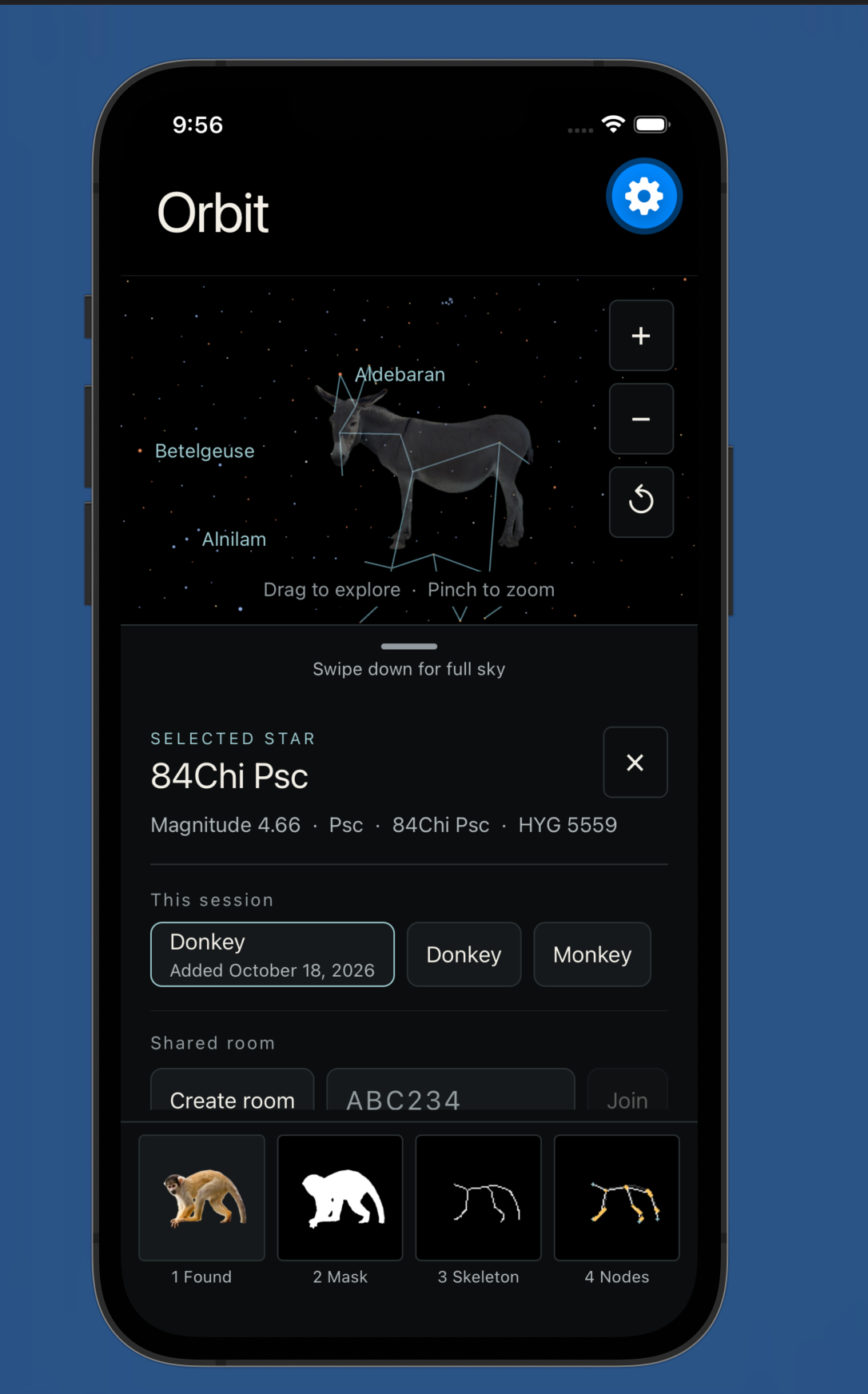
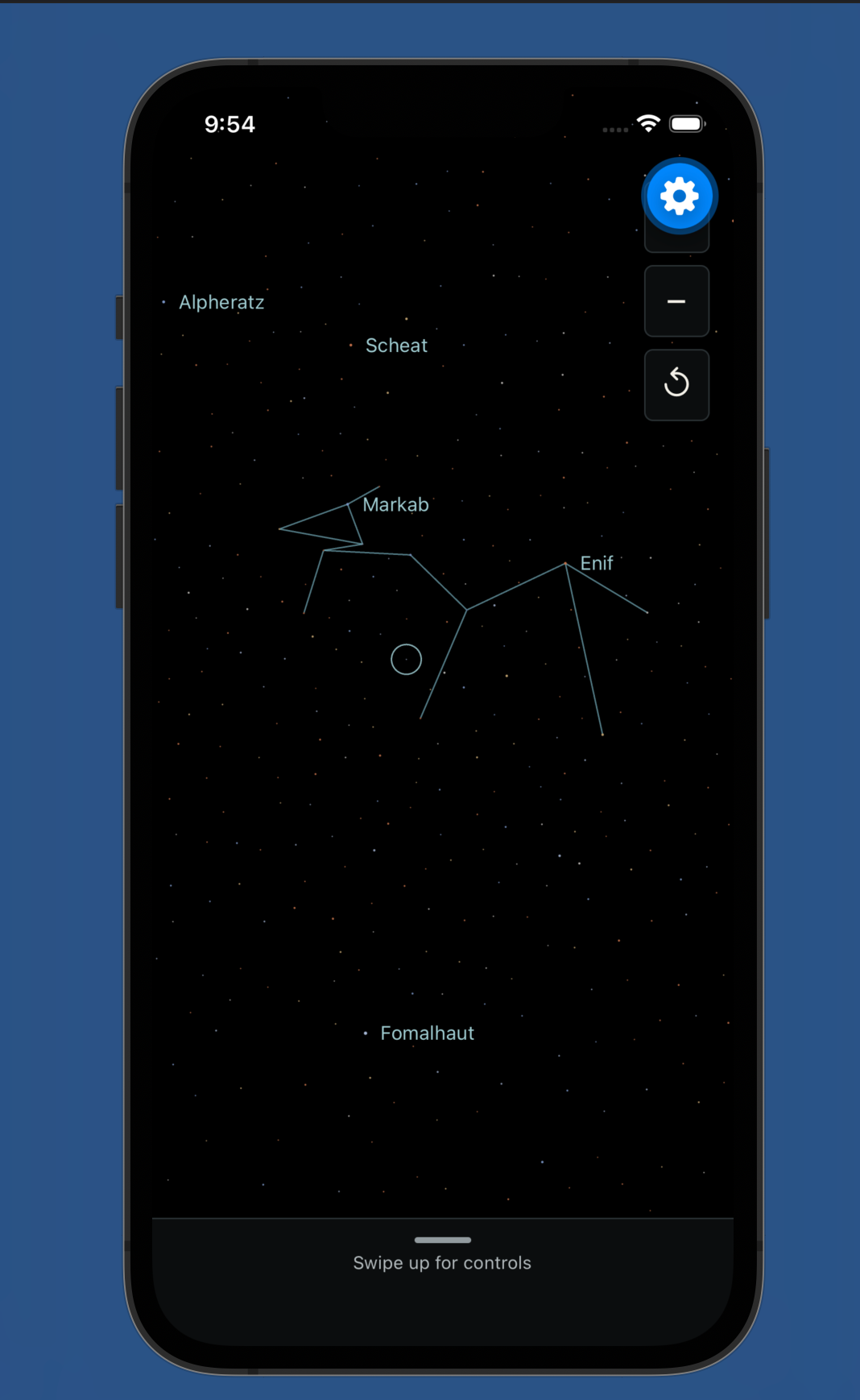
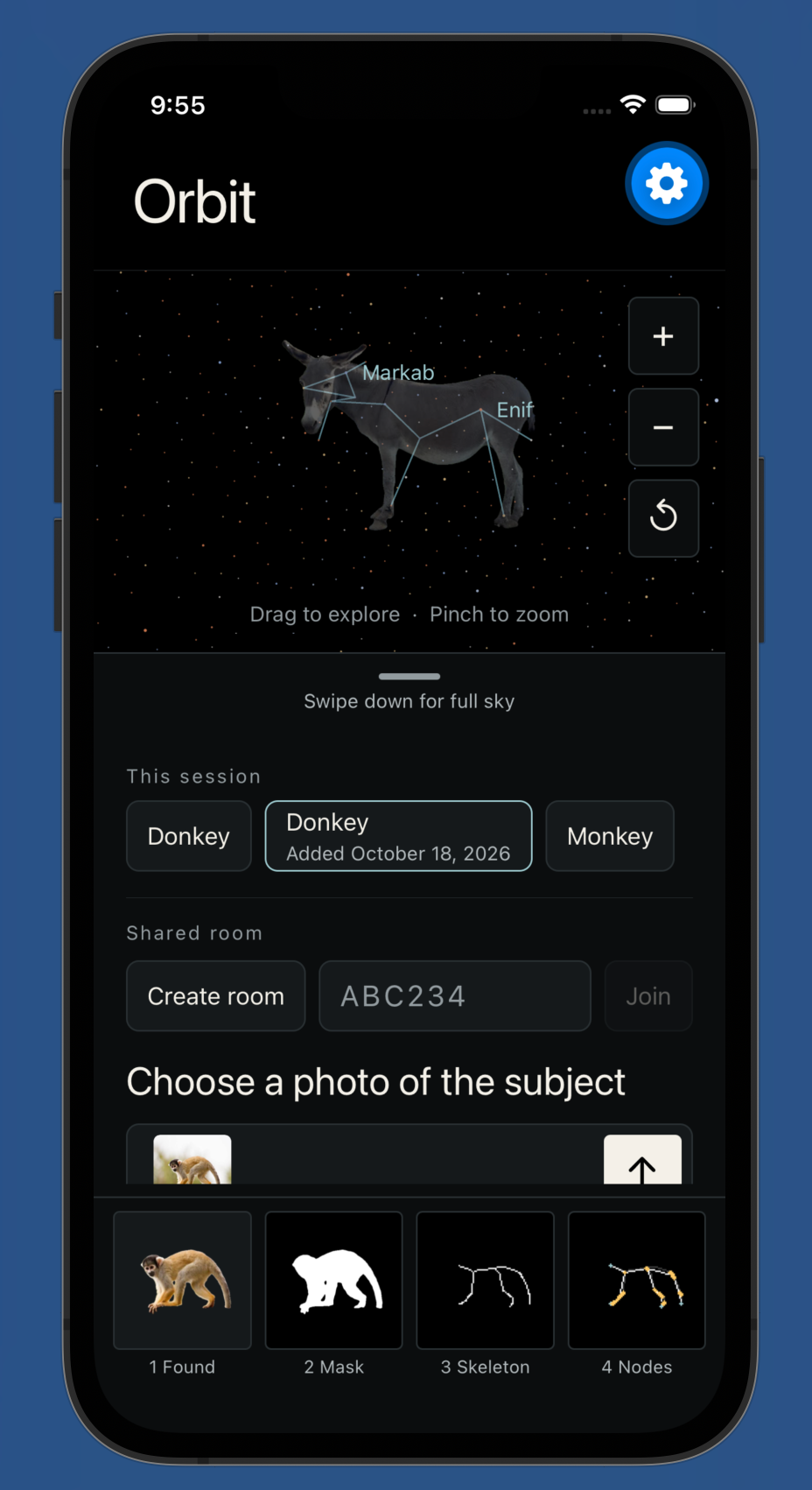
Orbit is a virtual star map of the visible stars in our night sky. With the click of a button, a user can join a group with their friends and upload pictures of memories or objects. Orbit creates a constellation of the main feature of the uploaded picture, and superimposes it over existing stars in the night sky. These constellations can be viewed by anyone in the group, who can in turn, add their own. In this way, a virtual scrapbook can be created for group members.
How we built it
When an image is uploaded, SAM 3, an opensource image processor model, removes the background of the image and masks the remaining pixels. The program then executes skeletonization, a process where successive passes are made on a binary objects borders, reducing a masked image down to a 1 pixel wide representation of the objects topology, resembling a skeleton of the image. Nodes are then placed on joints and endpoints, and lines are placed between already connected nodes with the original skeleton being removed. The program then snaps the nodes to stars on a starmap of the night sky, with a translucent image overlayed over. Users can join groups through a locally deployed mobile app, and see their friends constellations and memories in one sky space.
Challenges we ran into
One major challenge that took most of the hackathon to overcome was implementing the constellation generator. As we are locally hosting our model, we did not use credits for an AI model, which greatly increased the speed and effectiveness of our generator, but required every step in our process to function as intended. Additionally, porting the project over to mobile devices that could coexist in groups was a very time-consuming process.
Another challenge was the ideation of our project. Understanding how to best connect with our core audience was extremely important for us, but also proved to be a hard problem to tackle.
Accomplishments that we're proud of
We are very proud of how well we were able to get through challenges as a team, specifically the challenges of constellation generation and our ideation process.
What we learned
We learned a lot about evaluating the scope of a project, and making sure the core functionality of a project is working as intended. Additionally, we learned a lot about implementing complex features, mobile development, and working as a team.
What's next for Orbit
We hope to continue with this project by first adding a field of vision in the app that represents the visible sky from your geographical position. As constellations are only visible for one part of a year, Orbit would act as a genuine scrapbook, revealing constellations and memories from previous years as the seasons change. Additionally, we would like to implement a feature that allows us the view the sky in Augmented Reality, projecting our own constellations onto the actual night sky.


Log in or sign up for Devpost to join the conversation.