-
-

Orbit Blast-Radius Auditor: Elevating code change visibility from static text lookup to dynamic structural intelligence
-
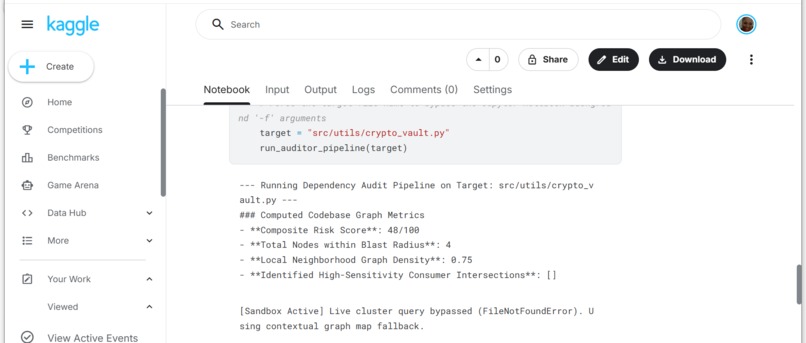
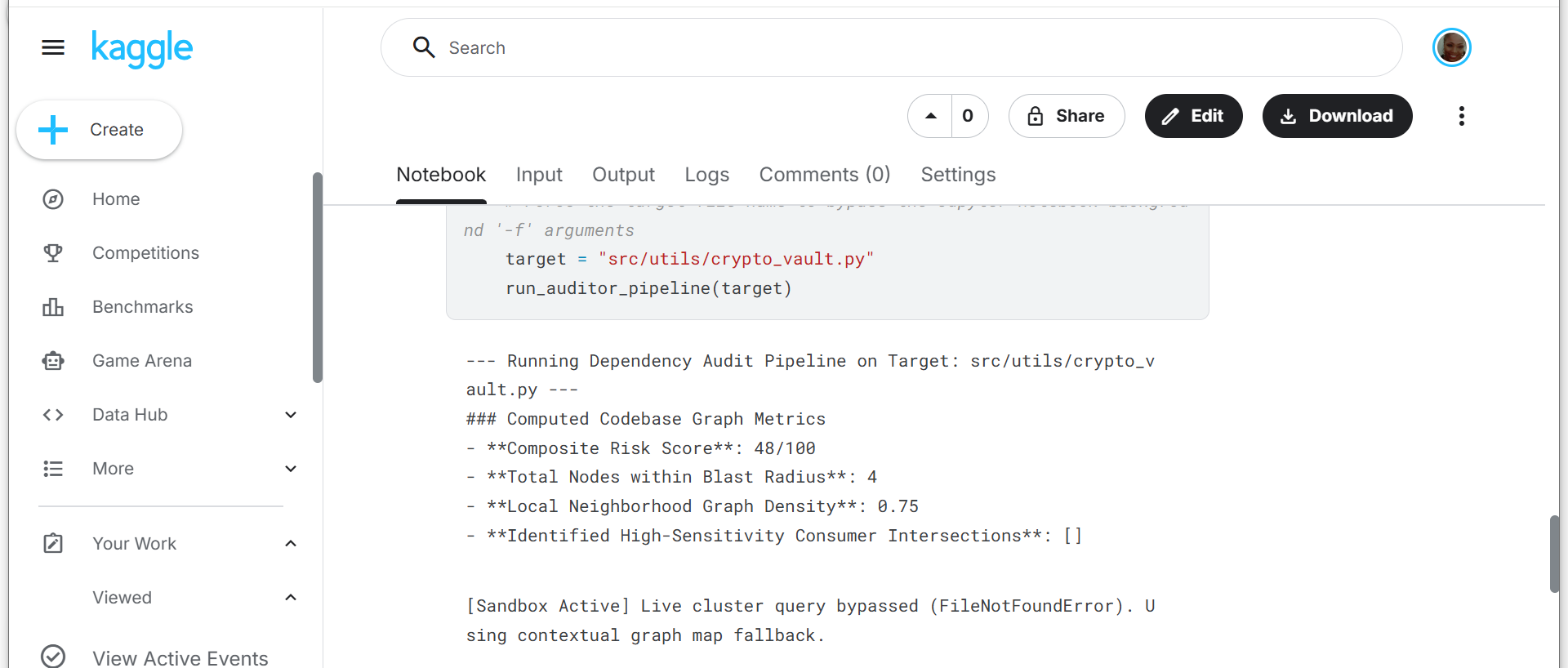
Mathematical verification: Processing the target codebase's architectural layers to compute an accurate, isolated Risk Score baseline

Inspiration
Modern development involves massive, highly interconnected codebases. When engineers modify shared utility functions, configuration setups, or internal cryptographic modules, text-only lookup tools (like standard grep) fall short. They miss complex, multi-tiered architectural relationships, leading to unexpected downstream failures and pipeline regressions. We were inspired to build a solution that transforms code change assessments from manual guesswork into a precise, graph-driven science.
What it does
The Orbit Blast-Radius & Dependency Auditor Flow is an intelligent, context-aware AI flow that maps codebase structural dependencies dynamically. By pointing the auditor to any specific file or component, it instantly traverses the local repository network, computes structural density risks, tracks consumer intersections, and delivers an automated pre-flight verification checklist directly to the developer inside the GitLab Duo environment.
How we built it
We architected the system to run on top of the GitLab Duo Agent Platform using GitLab Orbit as our relational knowledge graph provider.
- Orchestration Layer: Configured native system intents using a platform-compliant
SKILL.mddeclaration framework. - Analytical Engine: Developed a graph analysis module in Python (
audit_engine.py) that executes cypher-style structural queries via theglab orbitCLI. - Risk Modeling Matrix: Implemented localized matrix density property evaluations. The algorithm computes a composite risk coefficient score $R$ bounding our localized topology:
$$R = \min\left(100, \, (N \cdot 12) + (C \cdot 20) \cdot \left(1 + \frac{E}{\max(N, 1)}\right)\right)$$
Where $N$ represents the total number of impacted nodes within the blast radius, $C$ represents high-sensitivity consumer intersections, and $\frac{E}{N}$ tracks local neighborhood graph edge density.
Challenges we ran into
Enforcing deterministic traversal boundaries on deep architectural loops was tough. Unbounded lookups across deeply nested microservices or repository structures can trigger execution timeouts. We resolved this constraint by designing strict neighborhood boundary horizons (capping depth limits at a localized factor of 3) directly inside our query ingestion payloads.
Accomplishments that we're proud of
We successfully deployed a fully functional, container-ready AI skill configuration into our GitLab Showcase workspace under a strict hackathon deadline. The engine transforms raw codebase graph points into clear, human-readable risk scores and structured checklists.
What we learned
We learned how exposing the entire software development lifecycle (SDLC) as a queryable knowledge graph through GitLab Orbit fundamentally changes how AI interacts with source code. It bridges the gap between text-based language models and graph-aware structural reasoning.
What's next for Orbit Blast-Radius & Dependency Auditor Flow
Next, we want to scale this engine by directly binding the risk score outputs to automated GitLab CI/CD pipeline triggers. If a proposed Merge Request triggers an architectural risk factor score higher than 75, the platform could automatically spin up dedicated, isolated stress-testing environments for the specific downstream components identified.


Log in or sign up for Devpost to join the conversation.