-
-
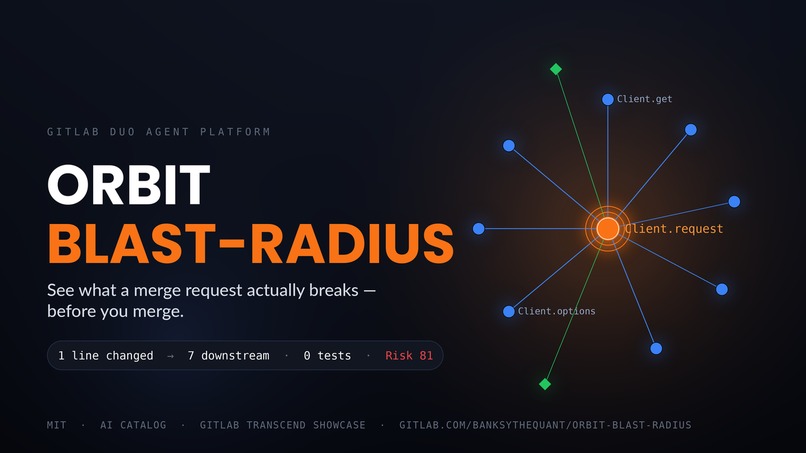
Know the potential damage before hitting merge.
-
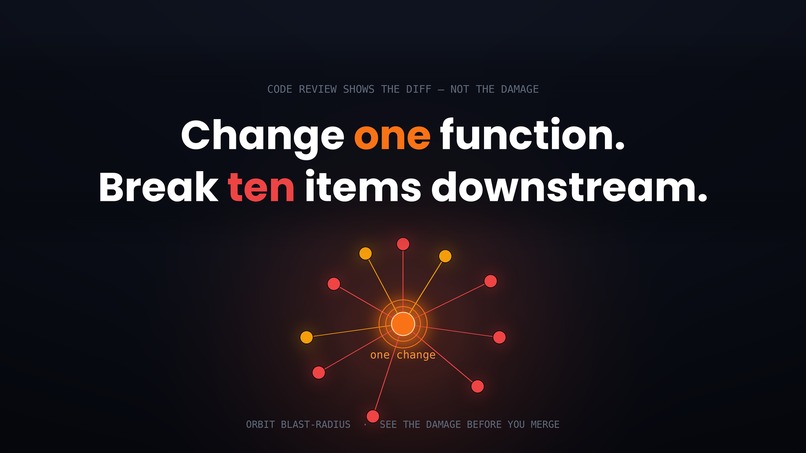
Check downstreem
-
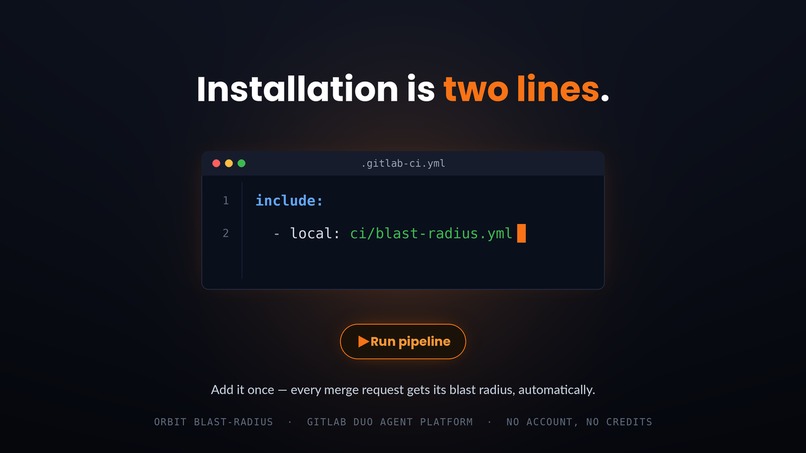
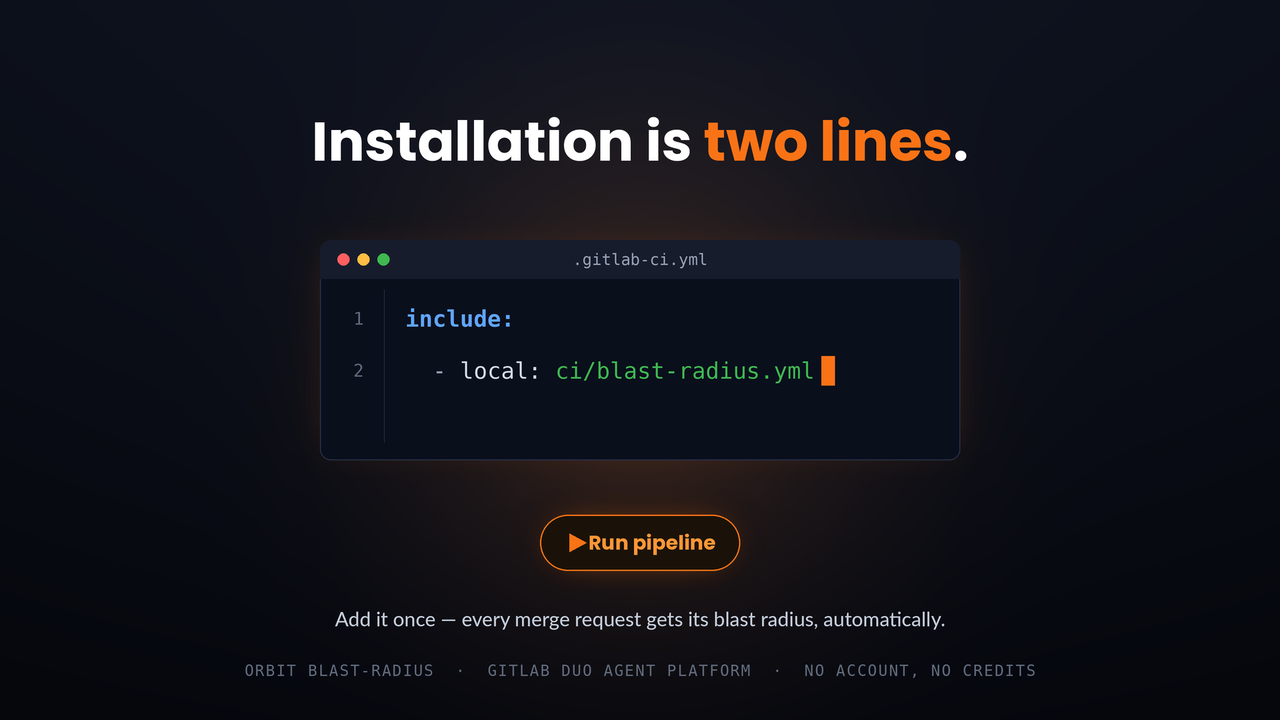
2 lines to install
-
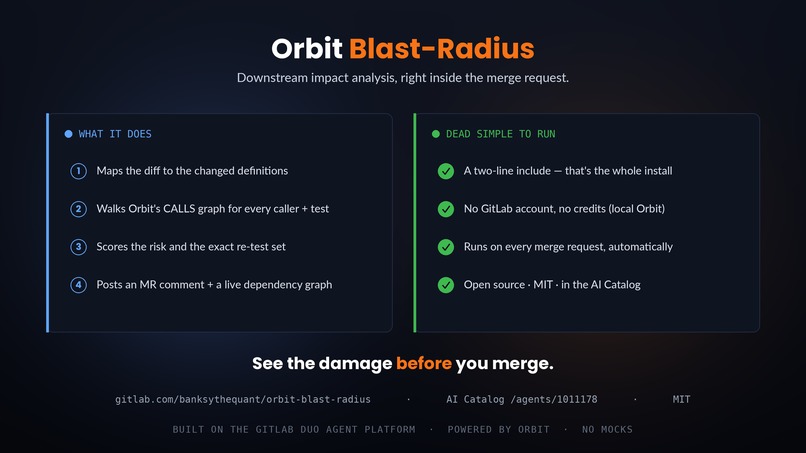
Benefits
Orbit Blast-Radius — Devpost submission
See the real downstream impact of a merge request — before you click Merge. Proven on real codebases (httpx, requests, peewee, tqdm) via GitLab Orbit.
Inspiration
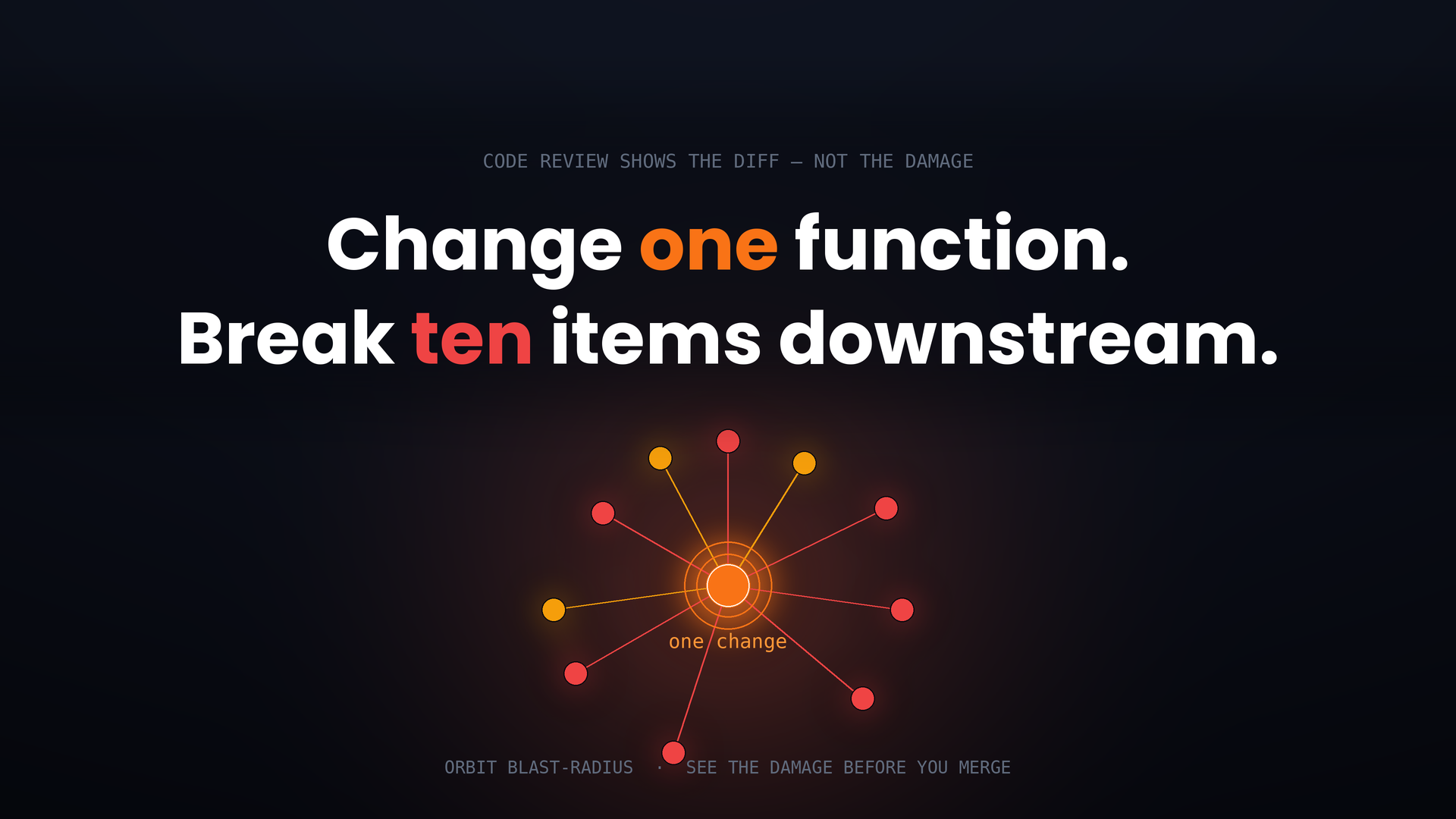
Every reviewer has approved a "one-line change" that quietly broke something three files away. Code review shows the diff, not the blast radius — the callers, the tests, the work items downstream of what you touched. GitLab Orbit finally makes that knowable: it's a queryable graph of the whole codebase. We built the agent that turns that graph into a go/no-go signal right inside the merge request.
What it does
On a merge request, Orbit Blast-Radius:
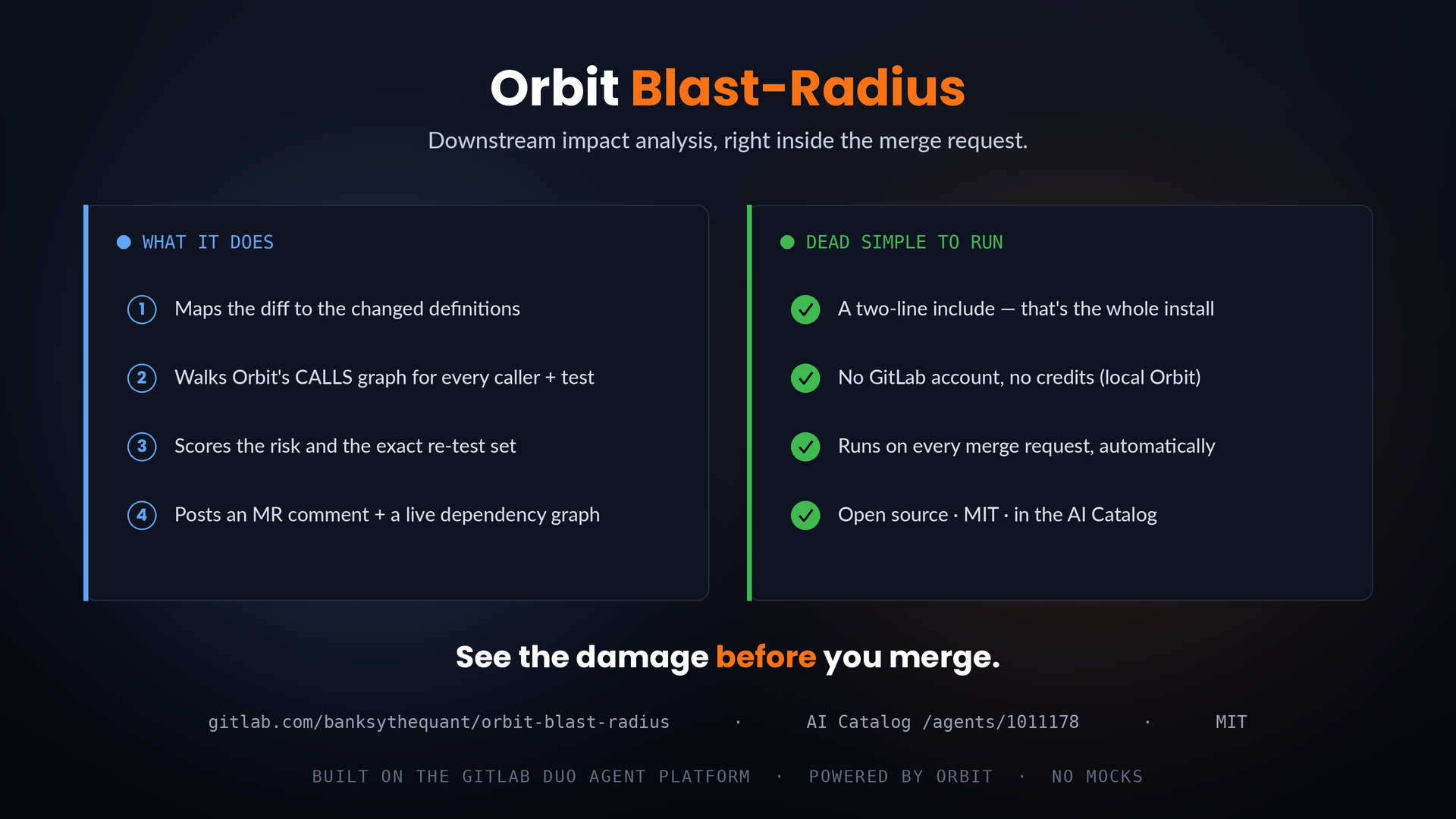
- Reads the diff and maps each changed line to the tightest enclosing definition.
- Queries Orbit's graph for everything downstream — callers (transitive) and the tests that exercise them — using the CALLS relationship edges.
- Computes a ranked risk score and a suggested re-test set.
- Posts an MR comment + an interactive, animated dependency graph.
The developer sees, before merging: what this change can break, and exactly what to re-test.
Proven on real code (not mocks)
We dumped GitLab Orbit graphs for six real repos and ran the agent against them. From the live httpx graph:
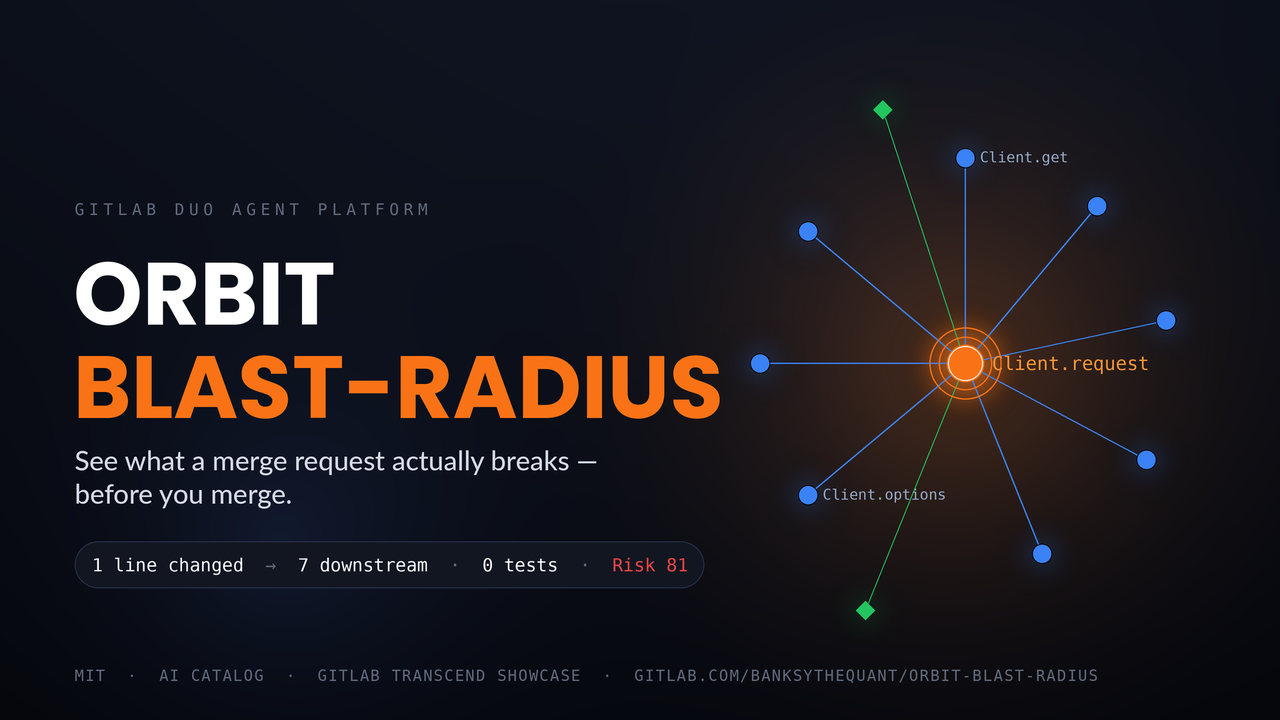
- Risky: changing
Client.request(httpx/_client.py) ripples to 7 downstream methods (the HTTP verbs) — risk 81/100 — and the agent flags that nothing directly tests the core method; the suite only reaches it through the public verbs. - Well-covered: changing
streaming_bodysurfaces the 8 tests that exercise it — risk 0 — i.e. a precise re-test set.
Both results come straight from Orbit's graph with zero authentication and zero credits.
How we built it
- Engine (Python):
parse_diff→changed_definitions(tightest-enclosing, with inferredend_lineso mid-body edits still map) →graph_backend.references_blast_radius(reverse the CALLS edges to find callers, transitively, depth-limited) → risk + re-test set. - Orbit integration — the no-auth path: instead of the Duo-gated MCP
get_referencestool, we read the local Knowledge Graph'sGET /api/graph/initialREST endpoint and compute the blast radius from its CALLS relationship edges. Free, local, no GitLab account, no credits. - GitLab layer: reads the MR diff and posts the comment (gated — never automatic).
- Visual: a self-contained D3 force graph — changed symbol at center, dependents rippling outward, colored by risk — fed directly by the engine's JSON.
- Delivery: a GitLab Duo Agent Platform flow, published to the AI Catalog.
The engine is locked by 7 offline test suites, including a test_graph_real_shape built
from real gkg output, so the parser matches reality (synthetic node ids, the double-quoted
relationship_type, node_type keys, Windows %5C path encoding).
Challenges
- gkg's Python call-graph resolves direct/named calls but not instance-method calls
(
client.get()→Client.get), so the re-test set is richest for symbols tests call by name. We surface this honestly rather than hide it — "nothing directly tests this" is a real, useful signal. - The graph endpoint 404s on any query parameter and needs
%5C-encoded Windows paths — found and pinned by probing the live server.
What's next
- Cross-repo blast radius via Orbit Remote.
- Resolve instance-method call edges to enrich the re-test set.
- A VS Code surface so you see the radius before opening the MR.
Try it
# against a saved Orbit graph dump (no server needed)
python demo_live.py --graph samples/graph_httpx.json --auto
# or live: gkg index <repo>; gkg server start;  python cli.py --mr <project>!<iid> --backend graph
License: MIT.
Built With
- claude
- css
- d3.js
- gitlab
- gitlab-ai-catalog
- gitlab-api
- gitlab-ci
- gitlab-duo-agent-platform
- gitlab-knowledge-graph
- gitlab-orbit
- gitlab-pages
- gkg
- html
- javascript
- mcp
- python
- rest-api

Log in or sign up for Devpost to join the conversation.