
Inspiration
I build from Lagos and work with Web3 teams spread across time zones, often with almost no shared working hours. The failure is not that we missed a standup recap. It is that almost-finished work goes cold, a decision from yesterday gets reopened this morning, and a blocker ages quietly overnight — hours that nobody can point to, because Jira does not bill the time a ticket spent waiting for someone who was asleep in the other city.
A lot of tools in this space will summarise the day. I did not want another digest. I wanted a meter for that wait, and a brief that tells the incoming city what to finish, what not to reopen, who can actually unblock a ticket, and whether the handover held up.
What it does
Orbit is a Jira project page (plus an issue panel) that compiles a follow-the-sun brief for a two-city team. Out of the box the cities are Lagos (09:00–18:00 WAT) and San Francisco (09:00–18:00 PT).
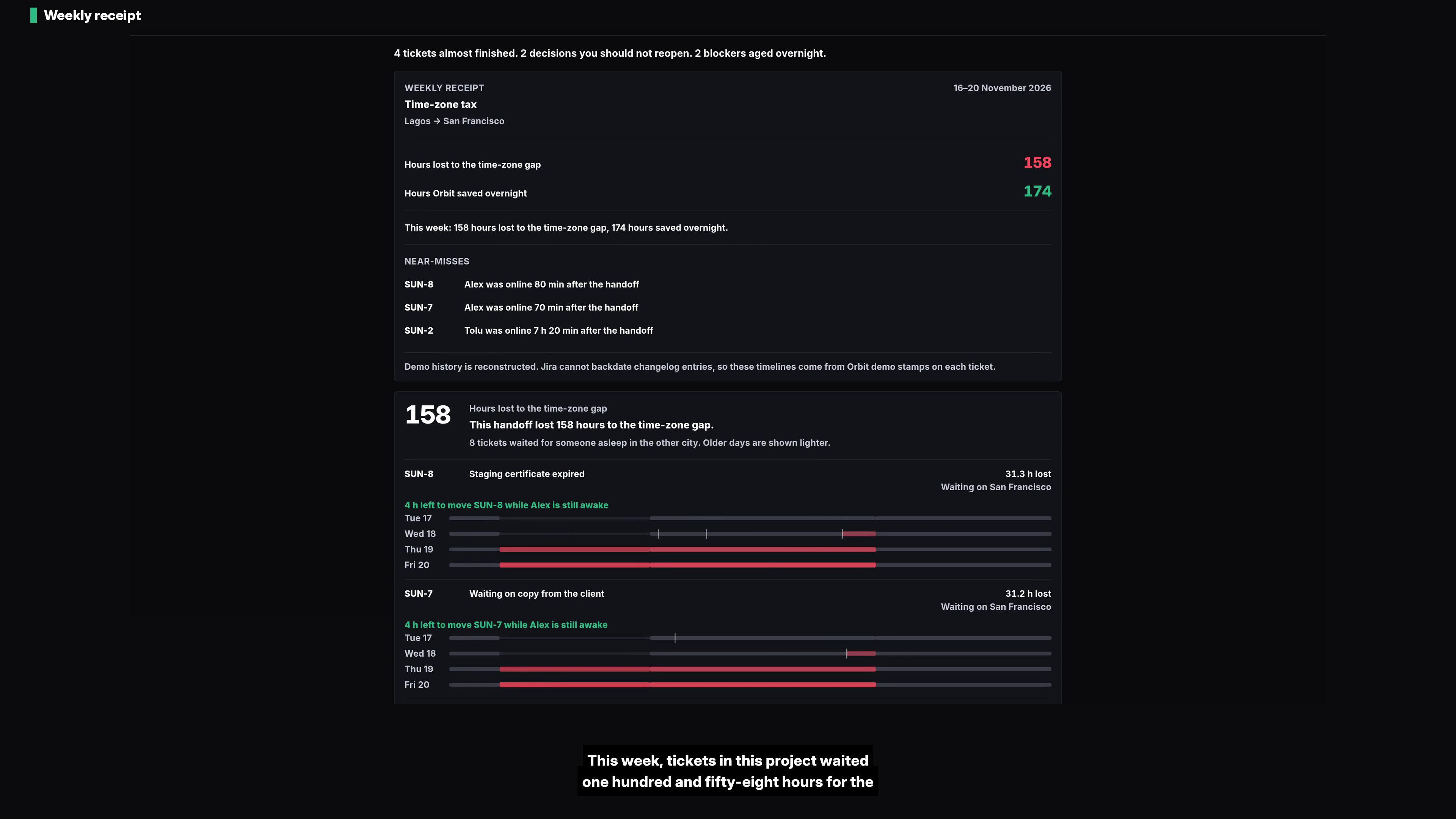
- Time-zone tax. For each ticket, Orbit rebuilds when the work was waiting on the other city and counts only weekday, off-shift hours. Weekends and a city’s own overnight are not tax. The page shows a weekly receipt (hours lost vs hours saved by answering questions overnight), per-ticket bars, and either a live overlap countdown (“time left to move this ticket while Alex is still awake”) or a near-miss after the window closes.
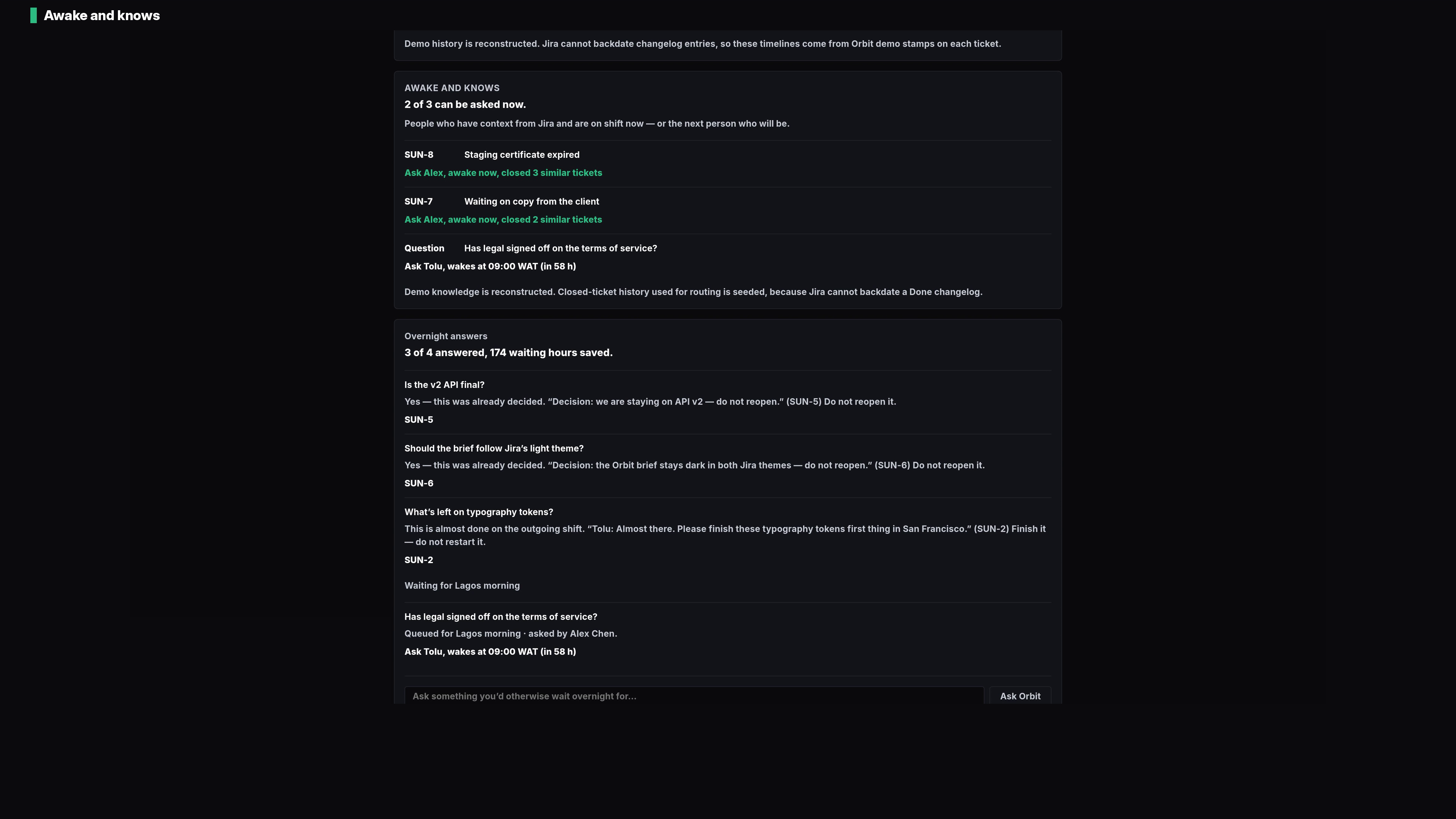
- Awake and knows. Routing is not “anyone in that city.” A ticket waiting on San Francisco is offered only to people on that side, ranked by knowledge from assignees, commenters, component leads, and similar closed tickets. If no one awake has evidence, the brief says who to ask and when they wake.
- Overnight answers. Ask a question that would otherwise wait for the other morning. If the brief already contains a locked decision or almost-done work that answers it, Orbit answers now, with issue keys as citations, and credits the waiting hours saved. If it cannot, the question is queued for the other city’s morning.
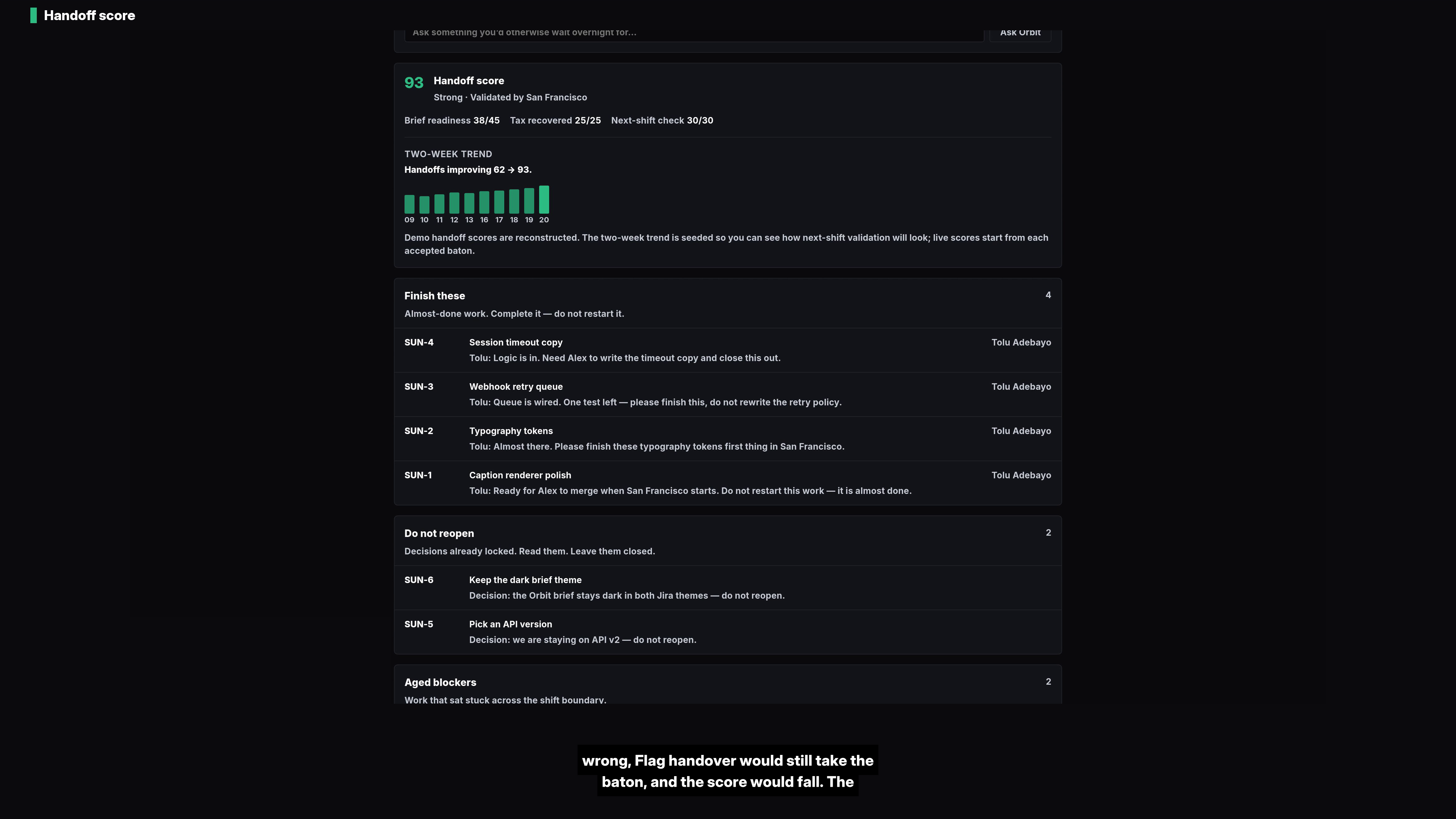
- Do not reopen, finish these, aged blockers, first 15 minutes. The operational brief under the meters: almost-done work to finish rather than restart, locked decisions with the supporting quote, blockers that aged across a shift, and a short start plan.
- Handoff score. Three legs: brief readiness, tax recovered, and next-shift validation. Until the incoming city accepts, the score is provisional. Accept the baton marks the handover confirmed; Flag handover still takes the baton but records a flagged verdict.
- Issue panel. On a taxed ticket, the same tax and brief placement for that issue.
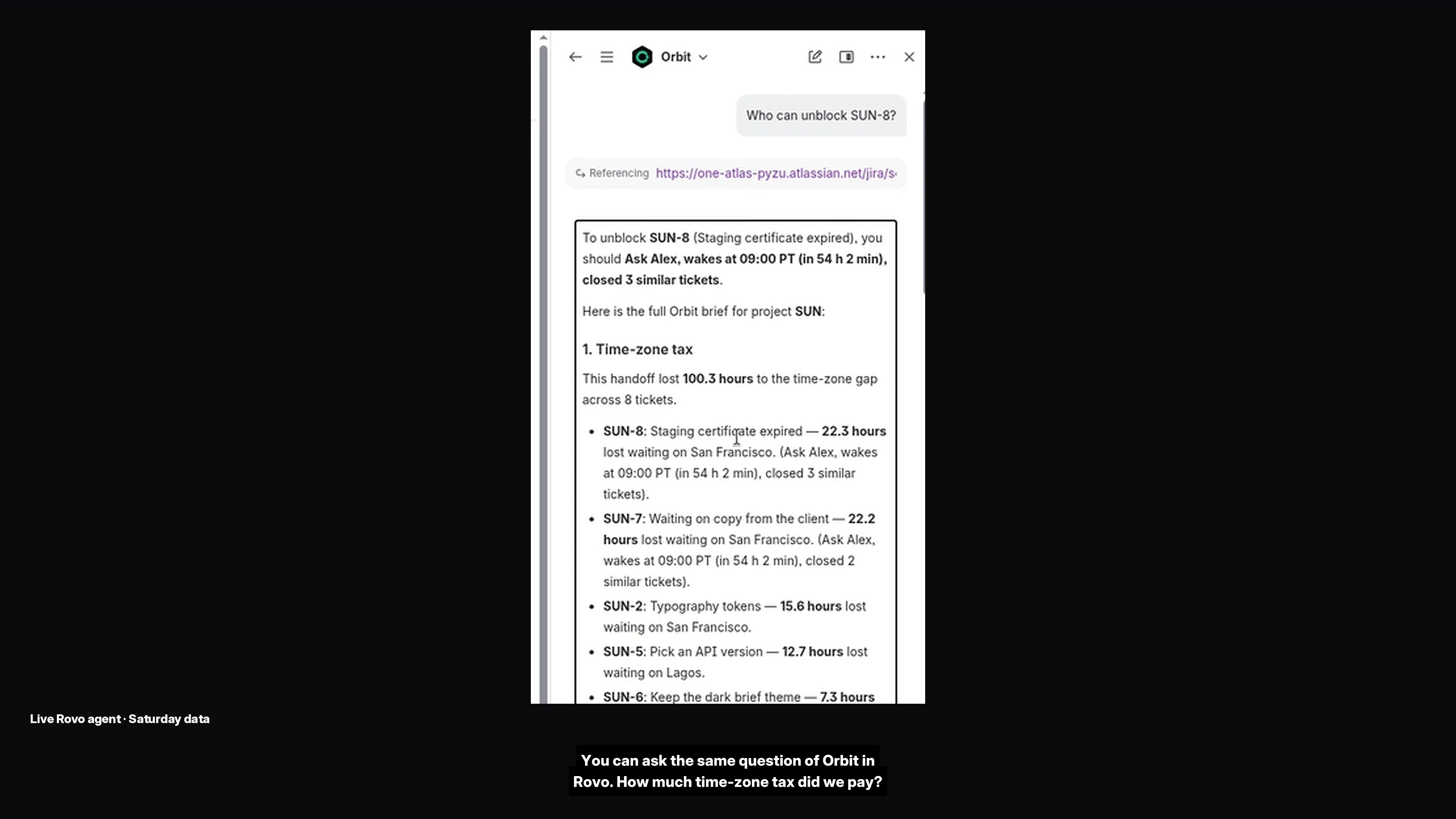
- Orbit in Rovo. A Rovo agent, also named Orbit, with actions that load the same compiled brief (tax, who to ask, locked decisions, overnight answers). It quotes issue keys from the brief. It does not invent a generic daily summary.
How we built it
Orbit is a Forge app (runtime nodejs24.x) with a Custom UI project page and issue panel (React + Vite) and a Rovo agent declared in the manifest.
The brief is compiled in the Forge resolver from Jira issues and comments (read:jira-work), then stored in app KVS (storage:app) so the page and the Rovo actions read the same snapshot. Compiling happens when someone opens the page, clicks Close my shift, or loads the Lagos–SF demo; Rovo’s get-latest-brief action force-compiles so the agent cannot quote a stale cache. Who to ask is one waiting-side function used for the routing card, tax “unblocker” lines, and the Rovo payload, so the page and the agent cannot disagree.
Write scope (write:jira-work) is used only to seed the demo tickets and tax-history stamps, and to write the baton-pass comment and property when someone accepts or flags the handover. There is no external egress. The production version is eligible for Runs on Atlassian. The app asks for those three scopes and no others.
Challenges we ran into
Jira cannot backdate changelog entries, so a realistic tax history for a seed demo cannot be inferred from “created yesterday.” Demo tax timelines are stored as Orbit stamps on each ticket, and every card that uses reconstructed history says so on the page.
Jira issue search also returns a truncated comment list. An early seed left a locked-decision comment still saying “Relay” on the ticket because the sync trusted the short search payload; the fix is to fetch the full comment thread before rewriting copy, and to brand quotes in memory when the brief is assembled.
A later production bug was sharper: after a hard refresh the page routed SUN-8 and SUN-7 to Alex, but a new Rovo chat still said “Ask Tolu.” The agent was not supposed to invent a name — it was reading a different suggestion than routing.items (stale action/cache and a second unblocker picker). Unifying every person suggestion on the waiting-side rule, and making the Rovo action return a freshly compiled brief, is what made the recaptured production chat match the page.
The demo video is a Friday 14:00 PT / 23:00 WAT handoff story, which is the moment the product is designed around. Live installs use the real clock, so a Saturday morning looks different (both cities asleep; wake times land on Monday) even though the seeded tax, receipt, and knowledge are the same. The testing notes spell that out so a judge is not surprised.
Accomplishments that we're proud of
A judge can install the app, open one project, load a Lagos–San Francisco demo, and see the tax, the receipt, the routing, overnight answers, and a provisional score without writing any handoff doc. On the builder’s site the production install is live at major version 2. The Rovo agent, in a new production chat, names the same people the page does and quotes the current locked-decision text. The demo video is a 4K, under-five-minute walkthrough of that same Friday handoff, with the real production Rovo stills in the agent slot.
What we learned
A brief that two surfaces share has to be one object. If the page and Rovo compute “who to ask” even slightly differently, or if one of them can serve a cached compile, a judge will catch it in a single question. I also learned to be literal about reconstructed demo history: hiding the seed makes a prettier screenshot and a worse submission. And “follow the sun” is only interesting if the product does something a digest cannot — count the wait, name the person who knows the work, and let the next city accept or flag the baton.
What's next
Live tax should eventually come from real changelog and comment times on the judge’s own project, with the demo stamps remaining a seed, not the only path. The two-week score trend should fill from accepted handovers rather than a seeded shape. I would also like a quieter mid-week mode, so a team that is not in the middle of a Lagos close / San Francisco open still gets a truthful receipt without the Friday story being the only way the clocks look “right.”
Built With
- atlassian-forge
- javascript
- jira
- react
- rovo
- vite
