Inspiration
Imagine spending months studying for an exam.
You sit in a classroom every day. The teacher writes words on a board. You copy pages of notes. You memorize definitions. You read textbooks until midnight. Yet when you enter the exam hall, your mind goes blank.
This happens to millions of students every single day—not because they are lazy or not intelligent, but because they were never taught in a way their brain could truly understand.
One of the biggest reasons students fail is the lack of great teachers. Across the world, classrooms are overcrowded, teachers have limited time, and many students are left behind because lessons are taught in one fixed style. Every student learns differently. Some learn by reading, some by listening, some by doing, but a huge number of students learn best by seeing.
The second problem is even bigger: students struggle to picture what they're learning.
A biology teacher explains how blood flows through the heart using words and diagrams. A chemistry teacher explains molecules with formulas on a whiteboard. A physics teacher talks about gravity and motion through equations. Students are expected to imagine everything in their minds, even though they have never actually seen those concepts happen.
Learning becomes memorization instead of understanding.
Then we noticed something interesting.
Students forget slides, but they remember movies.
Think about your favorite movie from years ago. You probably still remember scenes, characters, emotions, and even conversations. But many students forget a classroom PowerPoint presentation just a few days after seeing it. The human brain remembers stories, movement, color, sound, and experiences much better than static text on slides.
That became our biggest inspiration.
We asked ourselves:
What if studying felt like watching a movie instead of reading endless slides?
What if every PDF, textbook, lecture note, PowerPoint, audio recording, or YouTube lesson could instantly become an interactive AI teacher that explains concepts visually?
That question became Orbit.
Orbit exists to give every student the teacher they deserve—not just someone who explains information, but someone who helps them see it, experience it, and remember it.
What it does
Orbit is an AI-powered learning platform that transforms any learning material into a complete personalized learning experience.
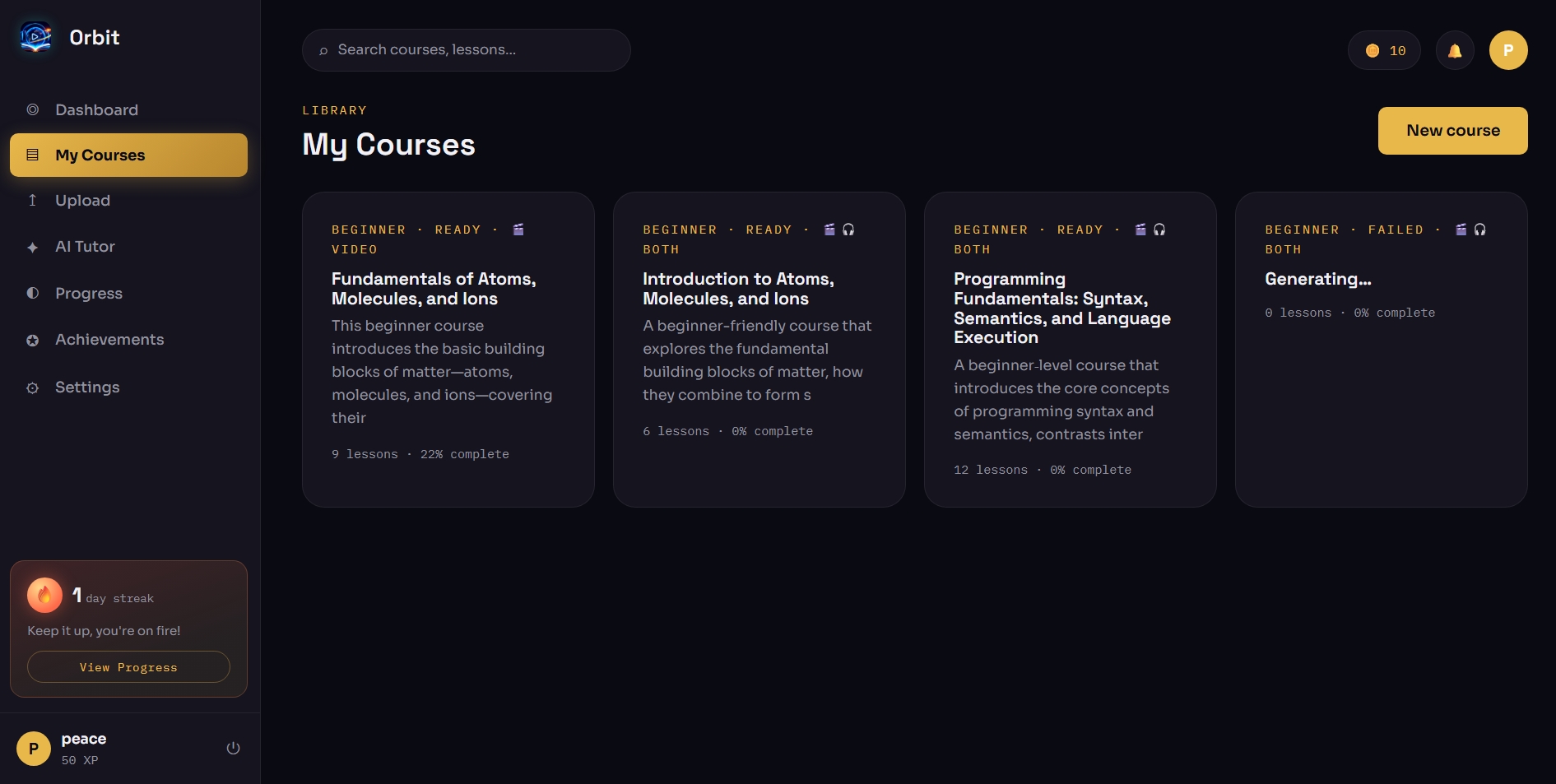
A student uploads a PDF, Word document, PowerPoint, text notes, audio recording, or a YouTube link. Orbit analyzes the content with AI and automatically converts it into a structured course.
Orbit creates:
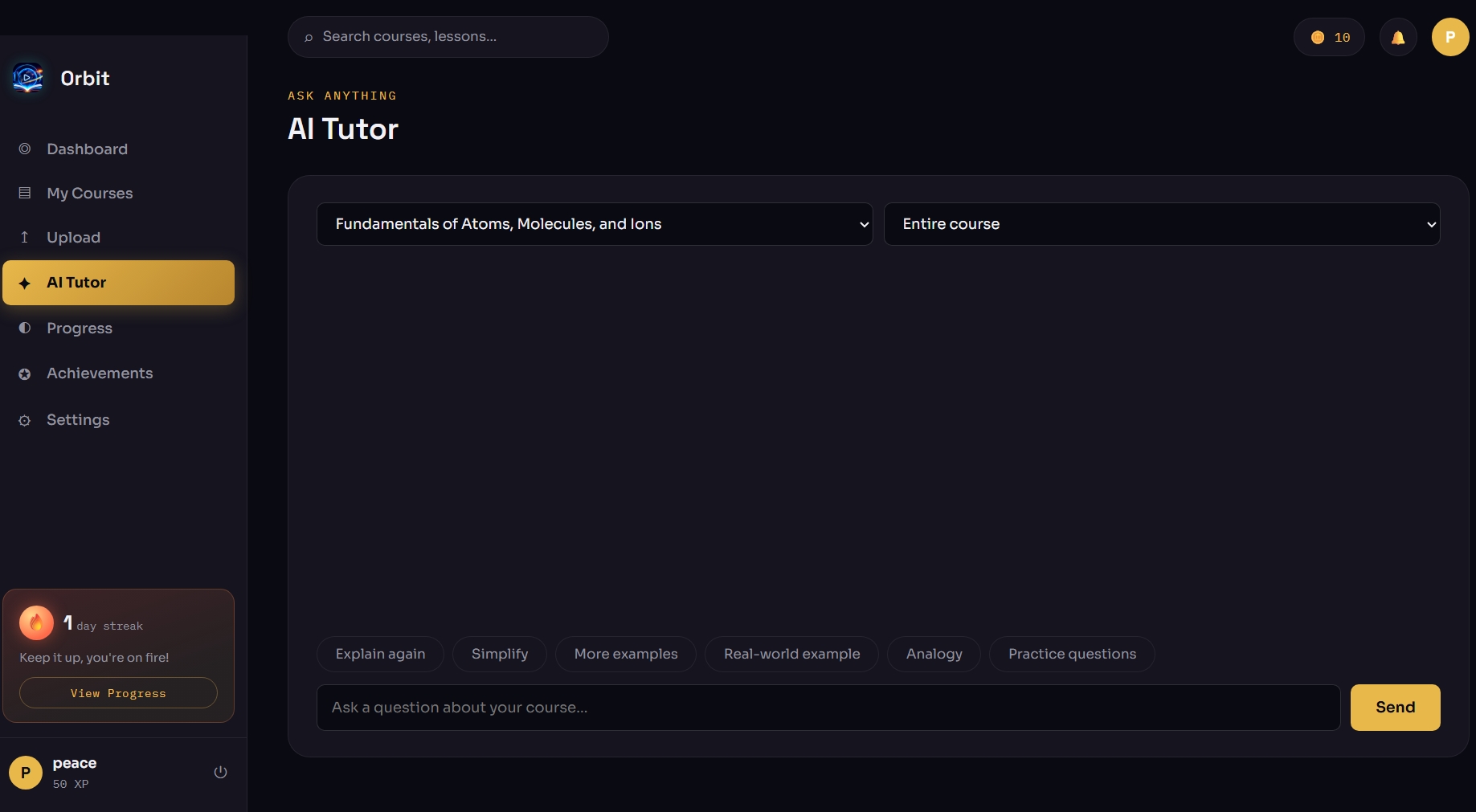
Complete course modules and lessons. AI-generated summaries. Key concepts and explanations. Interactive quizzes. A personalized final exam. Smart study notes. Rhythmic cram tracks for revision. A live AI tutor that answers questions about the uploaded material.
But Orbit's biggest feature is visual learning.
Every lesson is converted into an interactive 3D educational scene using Three.js. Instead of reading about the human heart, students watch blood flow through it. Instead of imagining DNA replication or planetary motion, they watch the process unfold visually inside the lesson.
The current Three.js 3D scenes are a proof of concept—they successfully turn lessons into interactive visual experiences—but they are not yet at the quality we ultimately envision. Right now the visuals are functional, but they are not cinematic or highly realistic.
Our vision is much bigger.
We designed Orbit's rendering system so it can evolve into AI-generated educational videos with dramatically higher quality. By integrating advanced video-generation APIs, such as Google Gemini's video generation capabilities, Orbit could transform lesson scenes into smooth, realistic educational videos with cinematic camera movements, lifelike lighting, richer environments, voice narration, physics simulations, and professional-quality animations.
In other words, Orbit could generate educational videos that feel less like animations and more like high-quality AI-produced documentaries.
The technology foundation is already there through Three.js—we simply need the computing resources and funding to integrate next-generation AI video generation into the platform.
Orbit doesn't just summarize information.
It teaches students through visuals, interaction, conversation, quizzes, revision, and memory-based learning.
How we built it
We built Orbit as a full-stack AI learning platform from scratch.
The backend is built with Python and Flask, while SQLAlchemy manages the database for users, courses, lessons, quizzes, achievements, progress tracking, tutor history, and certificates.
Authentication is handled securely using Flask-Login and BCrypt so every student's learning journey is saved and personalized.
The AI engine is powered by Groq, which analyzes uploaded content and generates:
Course outlines. Lesson summaries. Notes. Quizzes. Final exams. Tutor responses. Study tracks.
We created an extraction pipeline capable of reading PDFs, DOCX files, PowerPoint presentations, text files, audio recordings, pasted notes, and YouTube links before converting them into AI-readable educational material.
For visualization, Orbit uses Three.js to render interactive 3D scenes generated dynamically from AI-created scene JSON. Rather than manually designing every lesson animation, Orbit generates scene instructions automatically, allowing educational visuals to scale across different subjects.
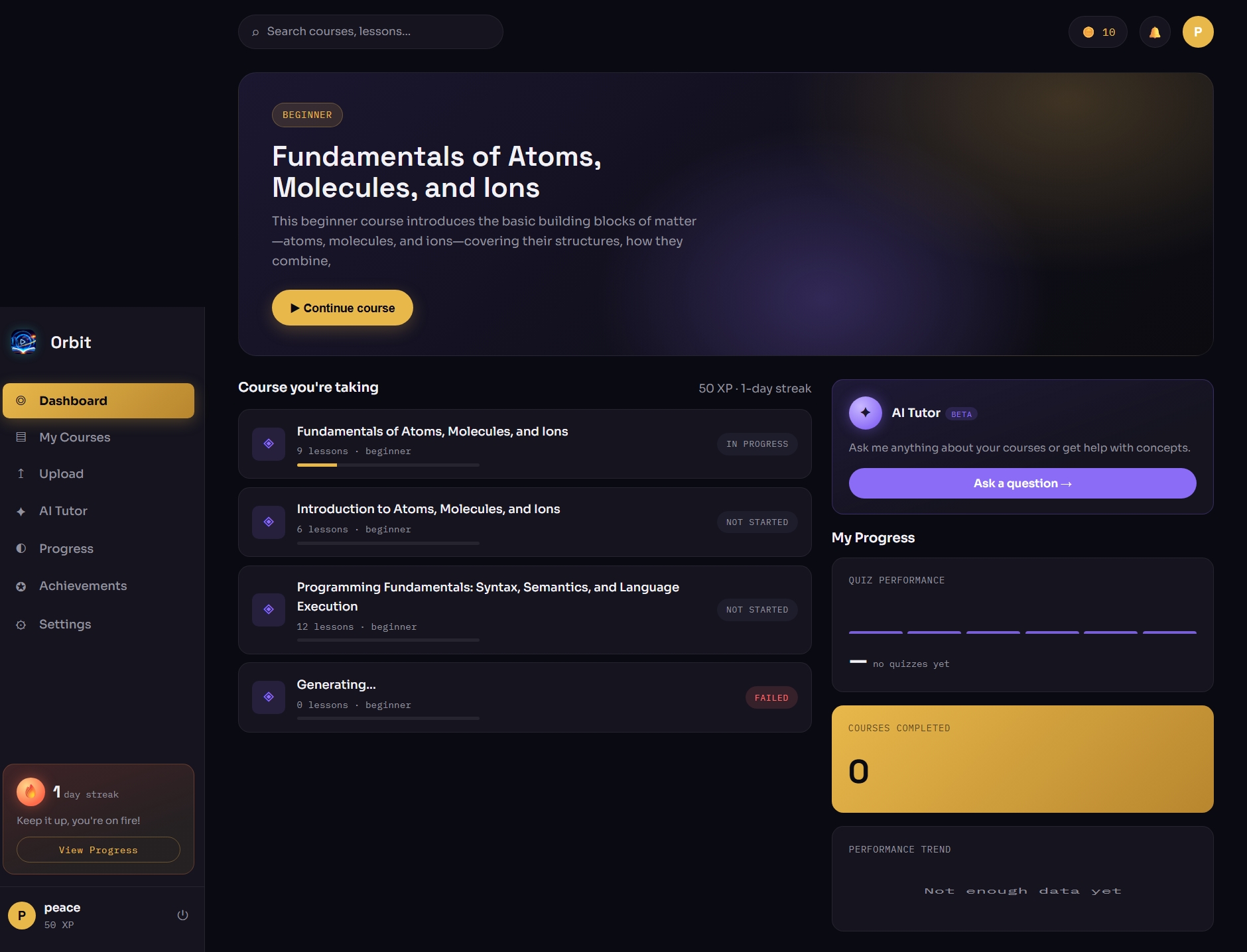
The frontend combines HTML, CSS, JavaScript, and modern glassmorphism-inspired design to create a futuristic learning dashboard where students can upload materials, learn visually, chat with AI, complete quizzes, earn achievements, and monitor their progress.
Everything was built around one goal:
Make learning immersive instead of overwhelming.
Challenges we ran into
Building Orbit was much more difficult than building a chatbot or a document summarizer.
Our first challenge was understanding educational content in many different formats. Every uploaded document has different formatting, layouts, images, and structures, so we needed a reliable extraction system before AI could teach from it.
The second challenge was balancing AI quality with performance. Generating summaries, notes, quizzes, exams, tutor responses, and visual lessons can require many AI requests. To solve this, we designed Orbit to generate advanced lesson content only when students actually open a lesson, reducing unnecessary processing and improving speed.
The biggest technical challenge was visualization.
Teaching AI to explain a topic is one thing.
Teaching AI to describe a visual scene that a 3D engine can understand is something completely different. We had to design a structured scene format that Three.js could interpret into educational experiences.
Another challenge is graphics quality.
Our current Three.js scenes demonstrate the concept successfully, but they are still far from the immersive cinematic quality we imagine. Creating realistic educational animations requires significantly more computing power, AI video generation, rendering resources, and infrastructure than we currently have.
Finally, connecting authentication, uploads, AI generation, streaming tutor responses, quizzes, progress tracking, achievements, and certificates into one seamless platform required building an entire educational ecosystem rather than a single AI feature.
Accomplishments that we're proud of
We're proud that Orbit is much more than another AI study tool.
We created a platform that automatically converts ordinary learning materials into complete personalized courses without requiring teachers to manually build lessons.
We're proud of building an AI tutor that answers questions using the student's own uploaded material instead of generic information.
We're proud of creating adaptive quizzes that identify weak topics and help students improve over time.
We're proud of building achievements, XP, streaks, coins, certificates, and progress tracking that motivate students to keep learning consistently.
But our biggest accomplishment is changing how students remember information.
Instead of relying on text and slides, Orbit introduces visual memory into education.
Students often forget PowerPoint slides and lecture notes because they're static and disconnected. But people remember movies years later because stories, visuals, movement, and emotion create stronger memories.
Orbit applies that same principle to education.
We are building a system where lessons become memorable experiences instead of pages students struggle to memorize.
We're also proud that Orbit's 3D engine is designed to grow. The current scenes prove the idea works, and we've built the architecture so future AI-generated cinematic lessons can plug directly into the platform.
Orbit demonstrates that AI can become a teacher, visualizer, tutor, study coach, and learning companion inside one application.
What we learned
Building Orbit taught us that education isn't just about giving students information.
Information already exists everywhere.
The real problem is helping students understand and remember it.
We learned that visualization makes complex concepts much easier to understand.
We learned that personalized explanations matter more than one-size-fits-all teaching.
We learned that students stay motivated when learning feels interactive and rewarding instead of repetitive.
Most importantly, we learned that AI is most powerful when it teaches with context—using the student's own learning material—and presents that knowledge in ways that match how humans naturally remember information.
Education becomes more effective when students experience concepts instead of imagining them.
What's next for Orbit
Orbit is only getting started.
Our vision is to build the world's most immersive AI learning platform.
The next evolution of Orbit is a cinematic AI education engine capable of generating lessons that feel like professionally produced educational movies.
We plan to significantly improve the visual quality of every lesson. Because Orbit is built on Three.js, the rendering system is flexible enough to support richer environments, smoother animations, realistic lighting, interactive simulations, voice narration, camera transitions, and much higher-quality educational visuals.
One of our biggest future goals is integrating Google Gemini's video generation API into Orbit.
This would allow AI-generated lesson scenes to become high-quality educational videos generated directly from uploaded study materials. Instead of simple animated scenes, students could watch AI-produced cinematic explanations that feel similar to next-generation AI educational content while still interacting with the lesson in real time.
This is one area where funding becomes important.
Video generation requires significantly more computing resources, API usage, rendering infrastructure, and cloud processing than our current prototype can support. With funding, we can integrate these capabilities and dramatically improve the educational experience for every student.
Beyond visuals, we're building:
Orbit AI Avatar — a holographic AI teacher that speaks, listens, and teaches lessons in real time. Orbit Practice Classroom — collaborative AI-powered study rooms where students learn together. Orbit Community — friends, study groups, discussions, and collaborative learning. Orbit Memory Engine — an AI system that remembers every student's strengths, weaknesses, revision history, confidence levels, and learning habits to create personalized study plans.
Our long-term vision is simple but ambitious.
We want Orbit to become the operating system for learning—a platform where anyone, anywhere in the world, can upload knowledge and instantly receive a teacher that explains, visualizes, tests, revises, and adapts to them personally.
We believe the future of education isn't reading more slides.
It's watching, interacting, asking questions, and remembering lessons the same way people remember unforgettable movies.
Because education shouldn't depend on finding the perfect teacher.
Everyone deserves one.

Log in or sign up for Devpost to join the conversation.