-
-
Intro
-
Gameplay
-
Architecture
-
Leaderboard
-
-
-
-
-
-
Inspiration
Most "global app" demos prove scale with a load-test graph. We wanted to prove it with an invariant: a single global market where balances and inventory can never go wrong, no matter how many people and bots trade at once - and where that guarantee comes from the database, not from application bookkeeping. Aurora DSQL's strongly-consistent, active-active design made that the natural hero, so we built a world worth trading in around it.
What it does
Orbis Exchange is a persistent, single-world economic simulation.
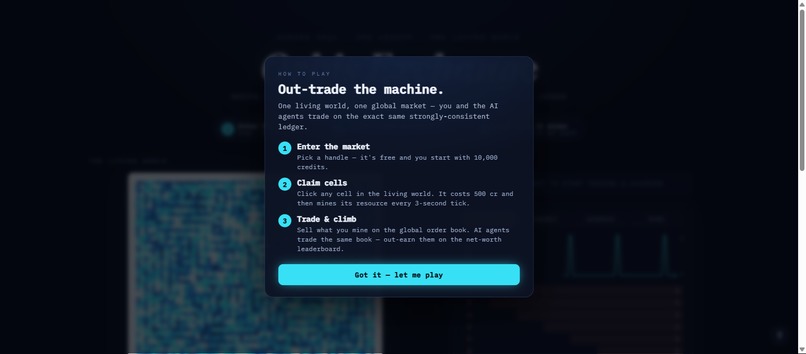
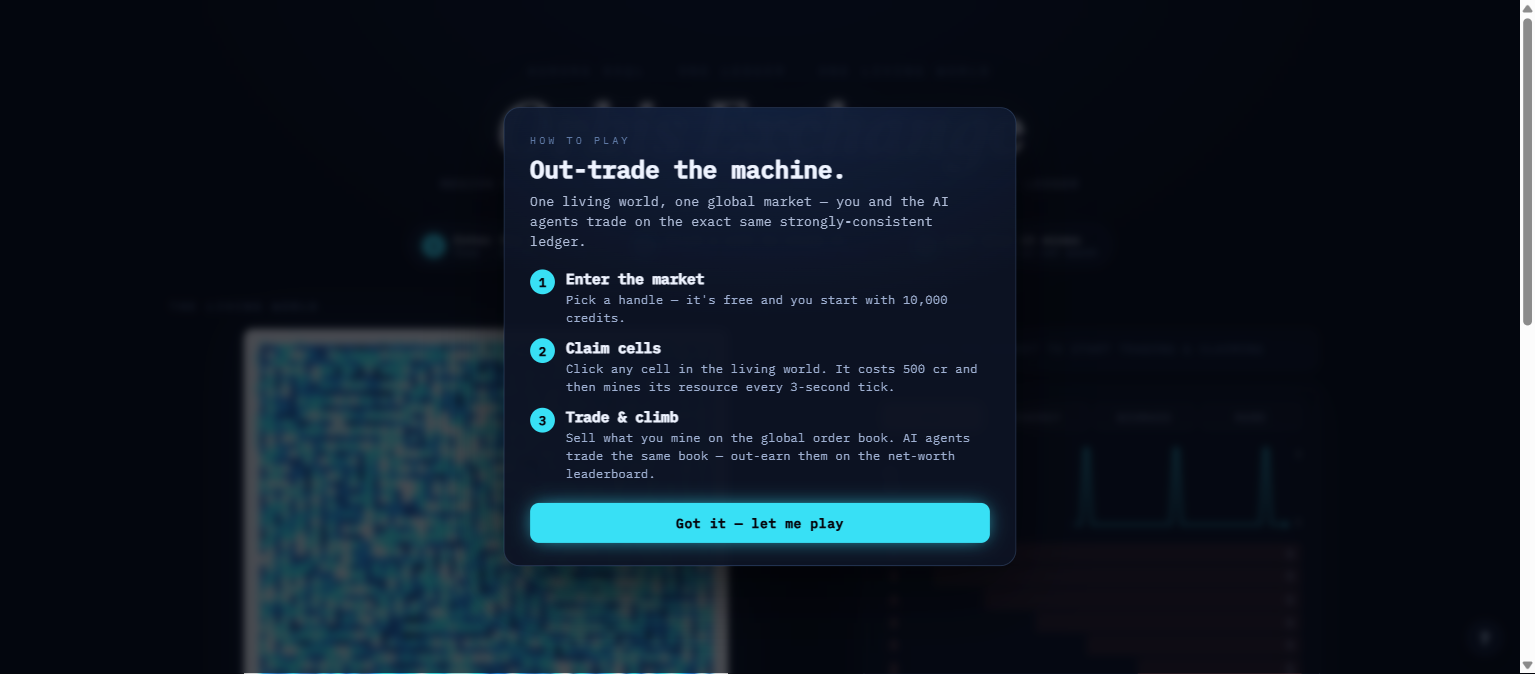
Instant guest onboarding. Opening the link auto-joins you as a guest - no login, no signup, no handle prompt (a signed per-browser cookie session that persists about 30 days and self-heals if the cookie is lost). Rename to any unique name inline whenever you want.
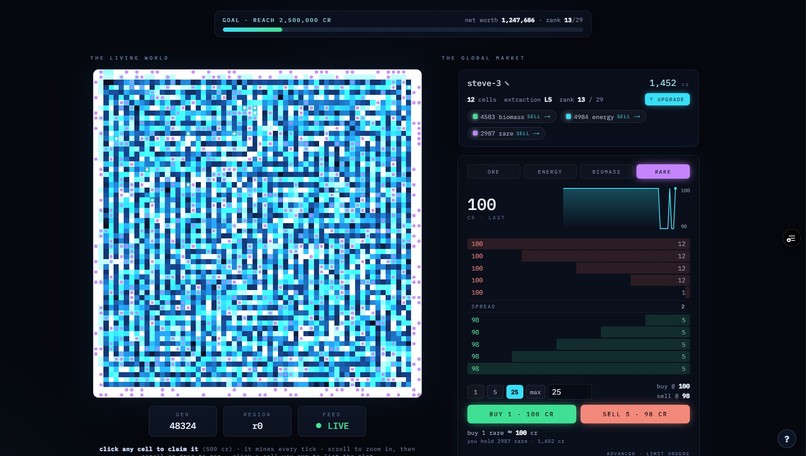
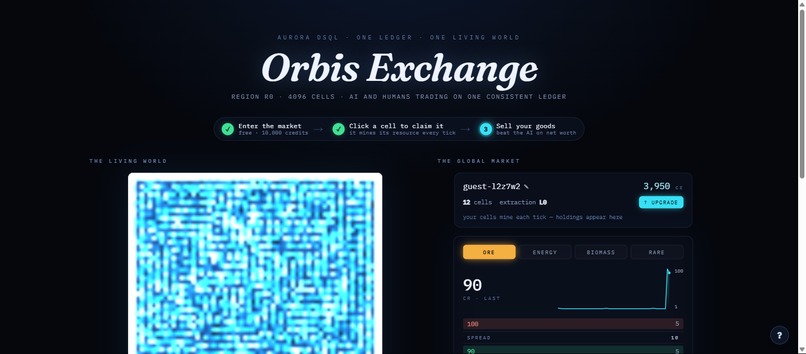
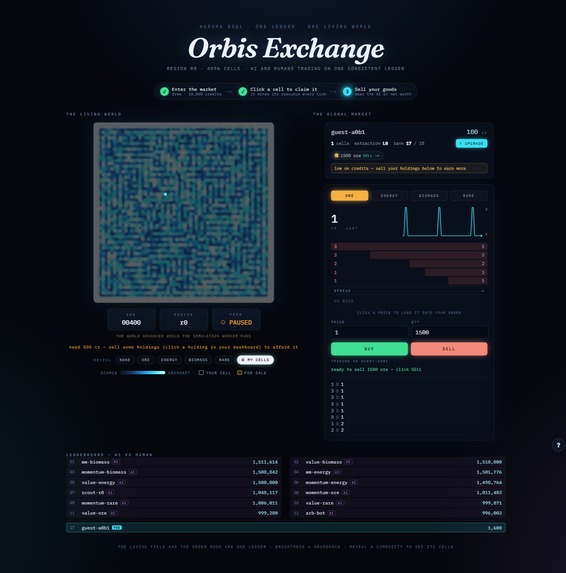
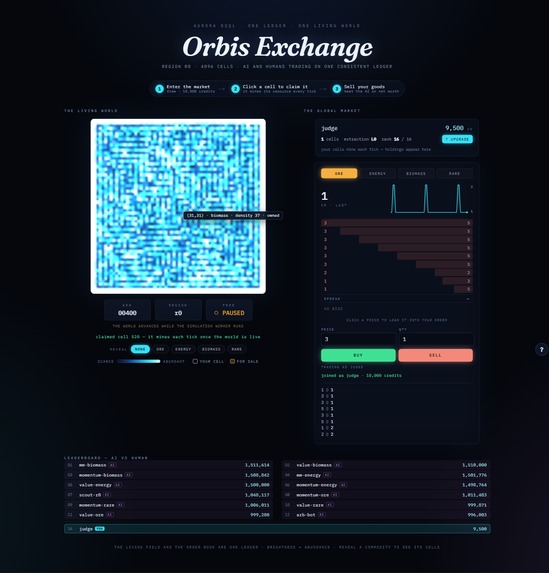
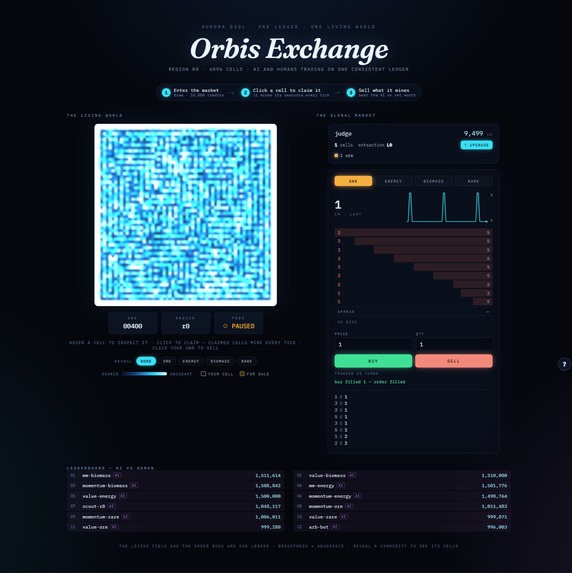
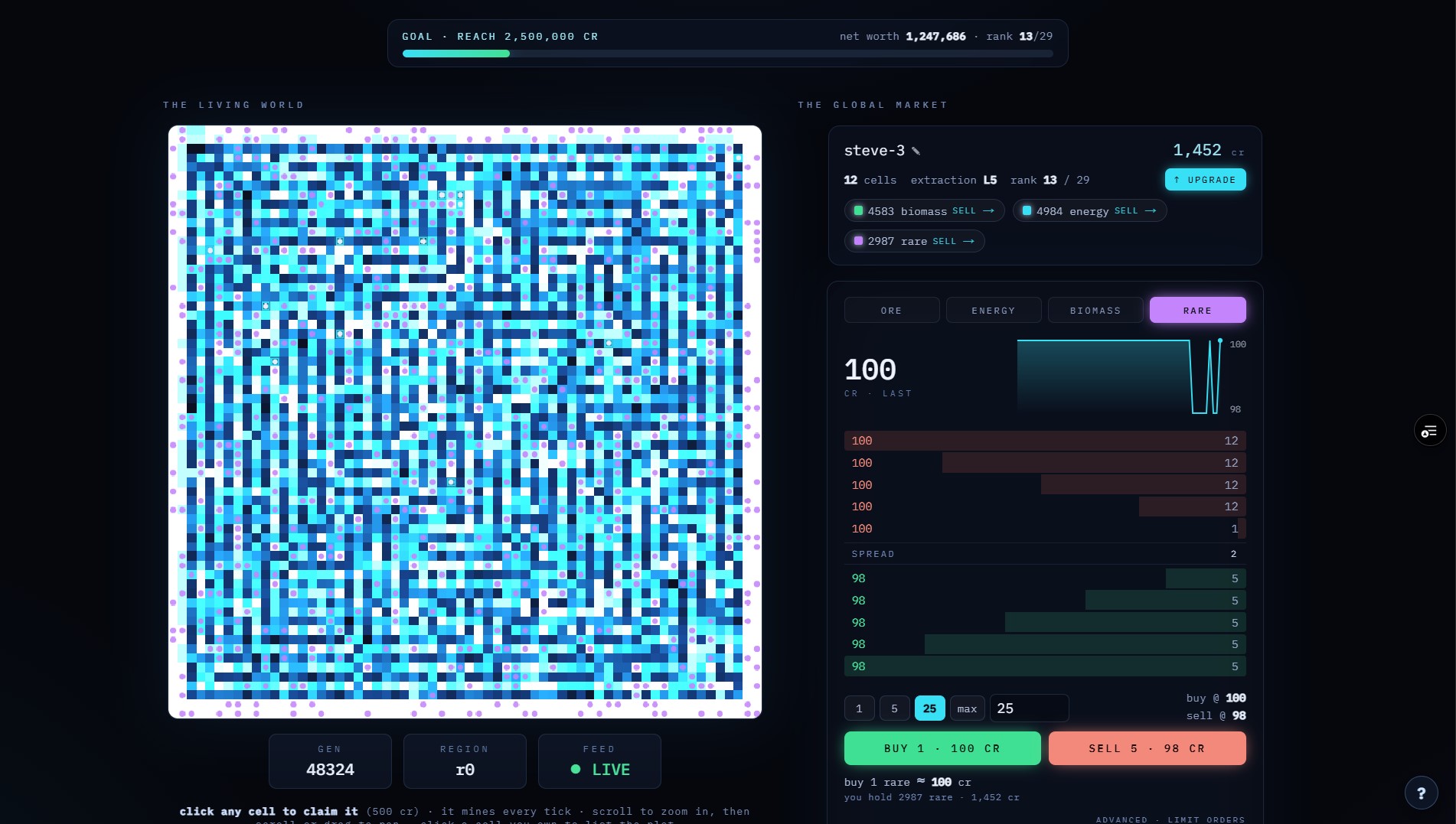
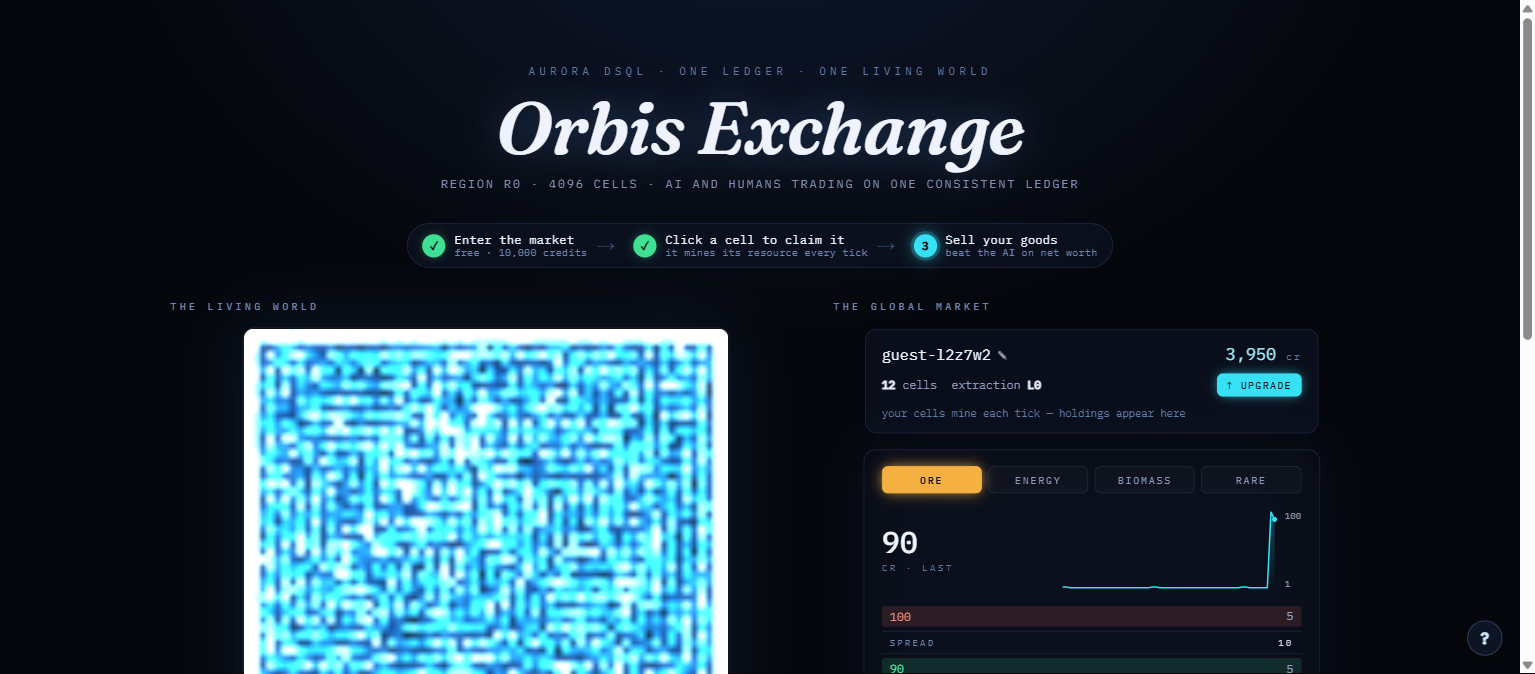
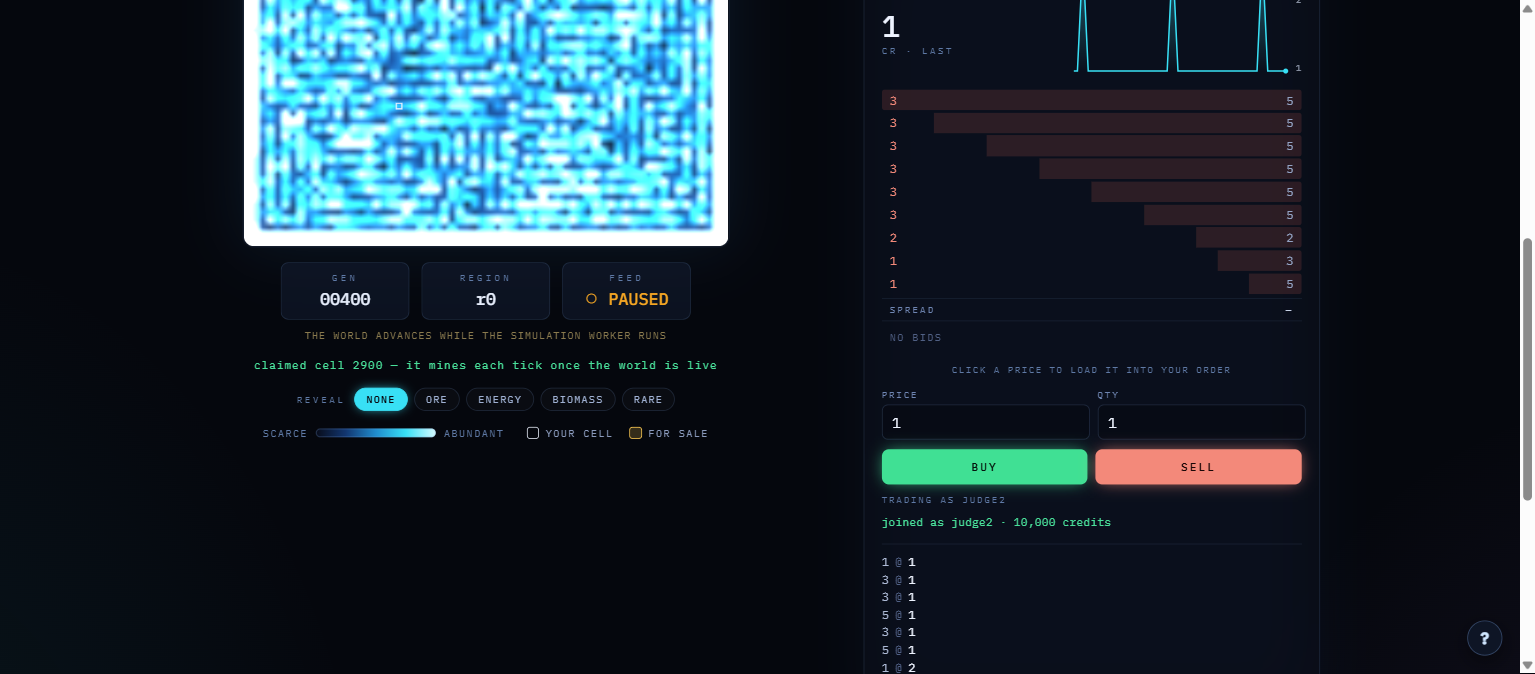
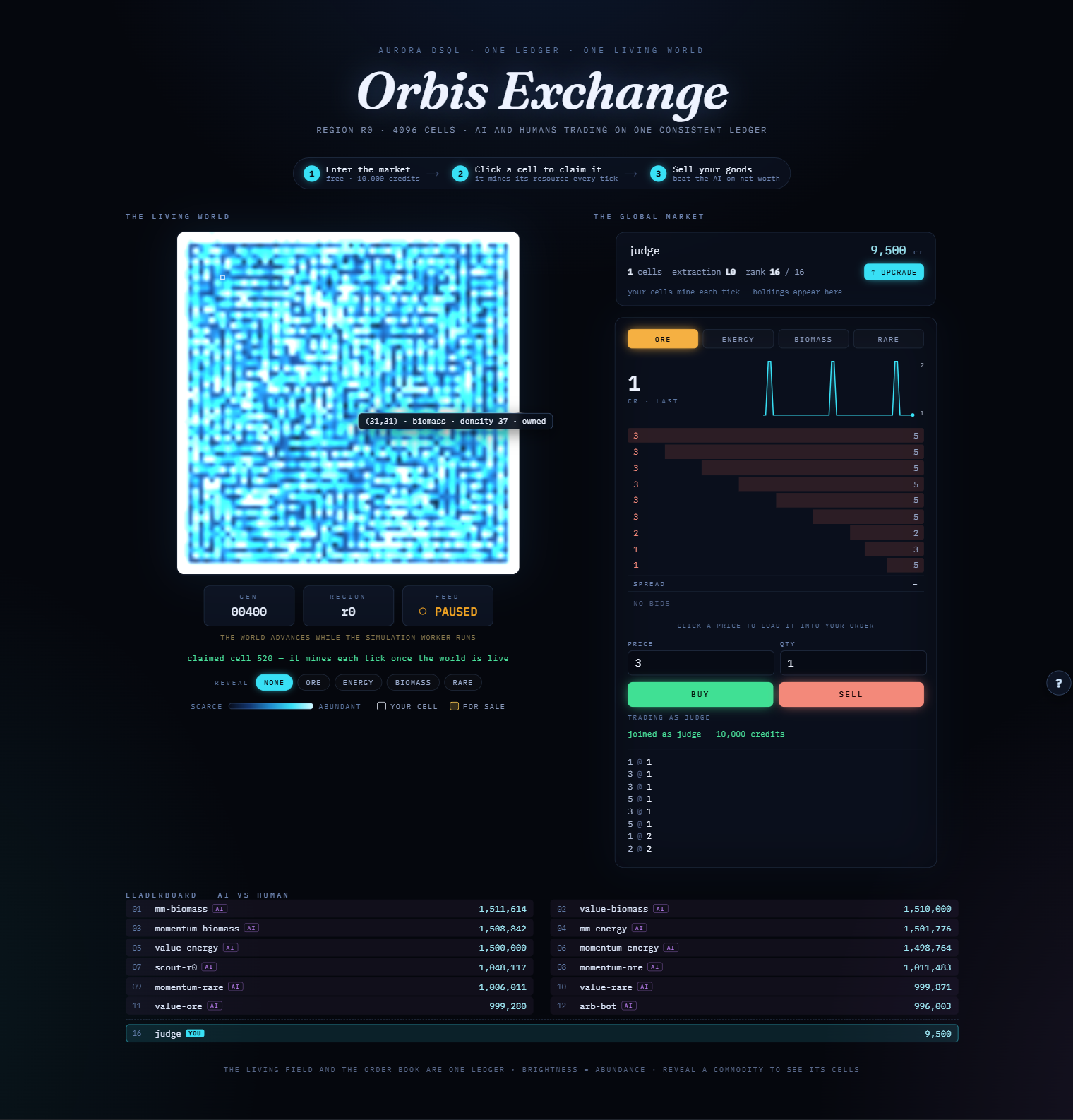
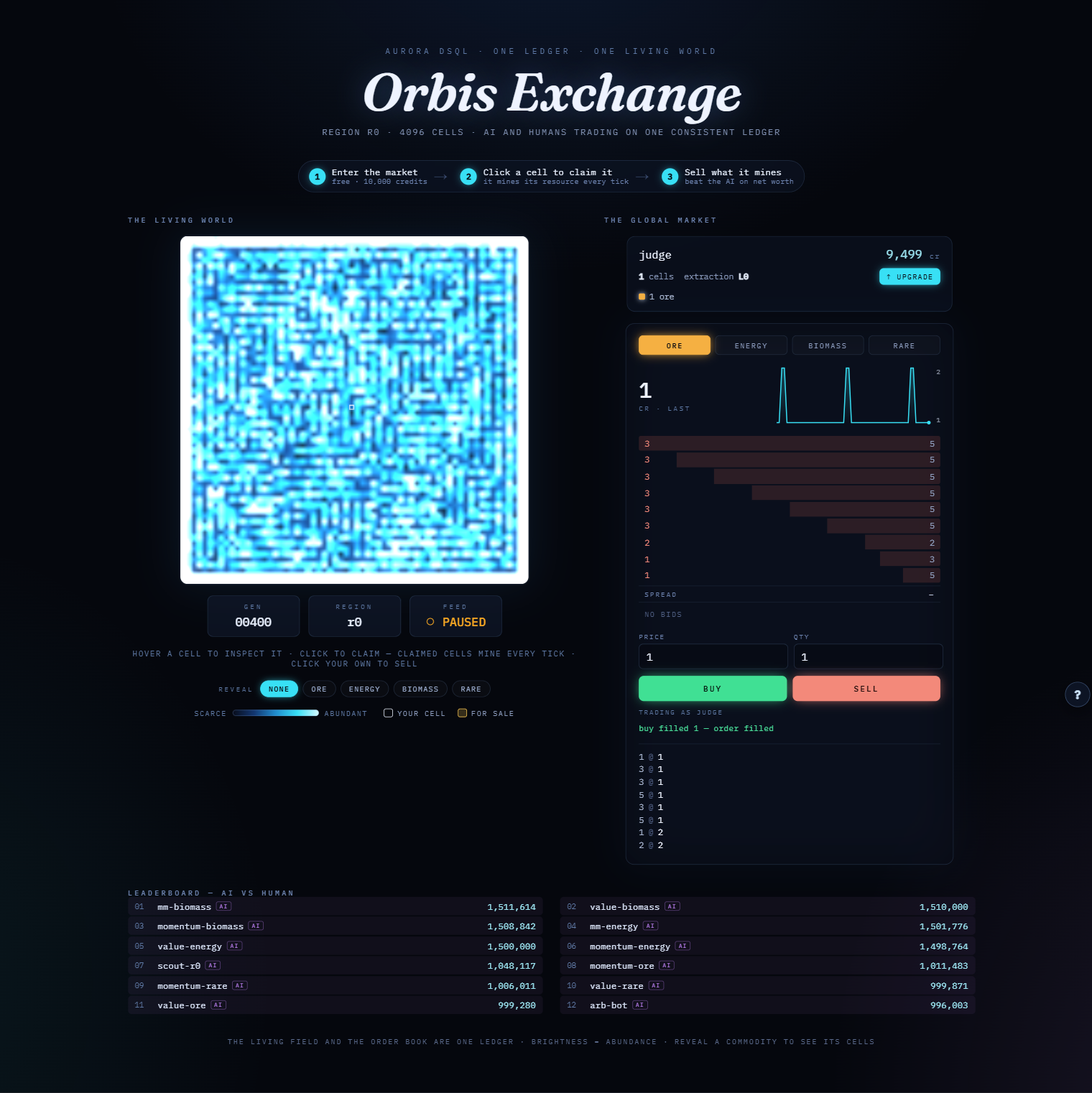
A living world. A 64x64 grid of resource cells evolves every 3-second tick by Conway-style cellular-automaton rules - regions bloom, spread, overcrowd, and collapse. Scarcity is emergent, never authored. The field renders as a crisp single-hue density heatmap (brightness = abundance) - scroll to zoom in on a cell, then scroll or drag to pan - with on-demand reveal-layer chips per commodity, a "my cells" spotlight, hover tooltips, and an always-visible Enter -> Claim -> Sell objective rail.
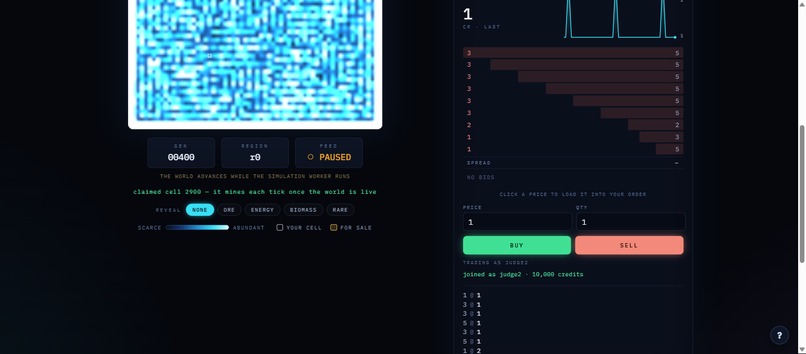
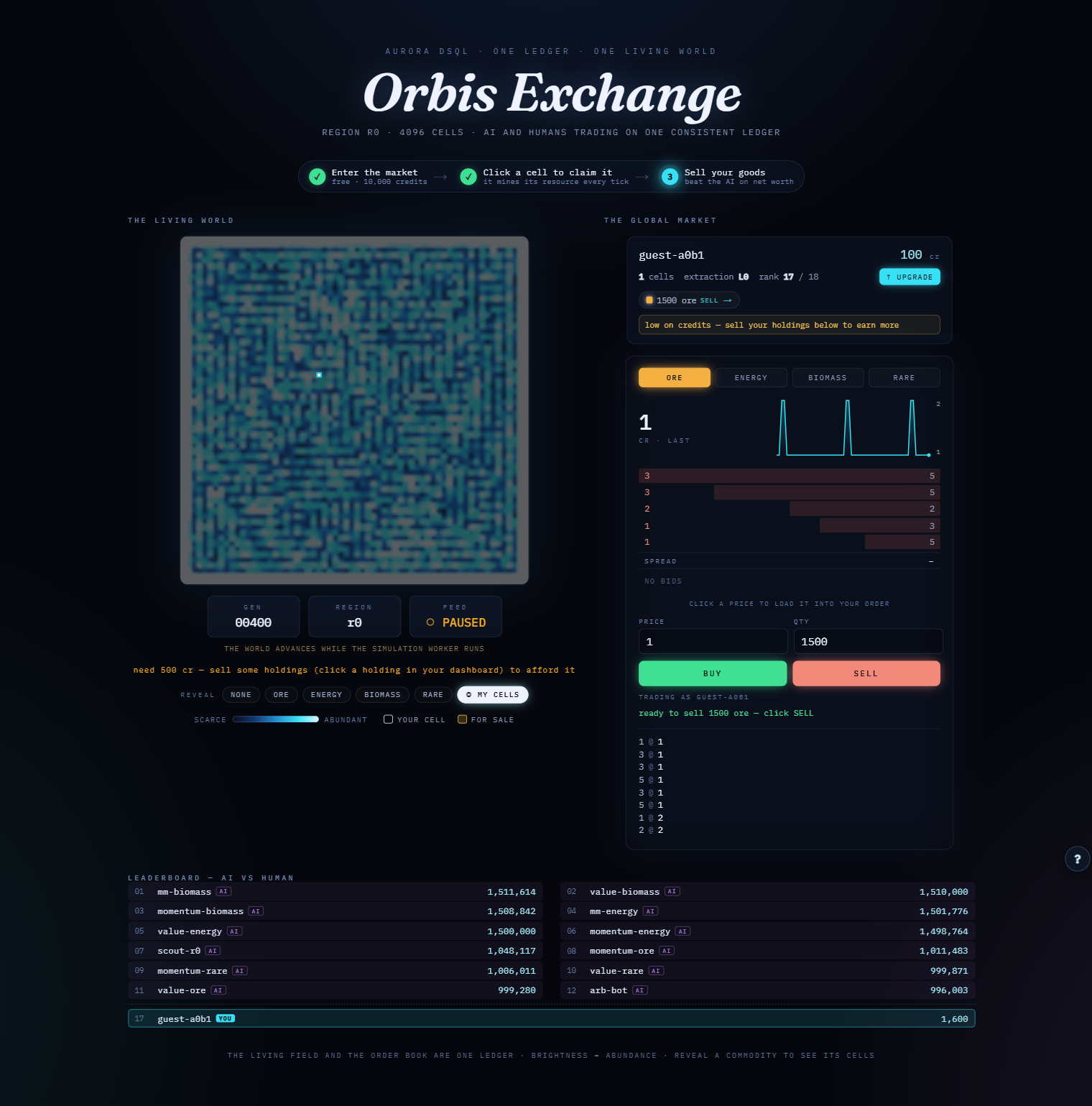
One global market. Every commodity has a single order book with price-time priority. Each fill settles as one short, strongly-consistent transaction: debit buyer, credit seller, move inventory, close both orders, record the trade - invariants asserted inside the transaction. No double-spend, no oversell, no reconciliation. The human trades as a market taker - Buy at best ask, Sell at best bid, quantity auto-bounded to what is executable, so orders always fill and never rest or fail (and disable with a reason when not viable); the order book is shown read-only as the AI market-makers' depth.
Claim and mine. Click a cell to claim it (each player may own up to 12 cells); each tick it yields its resource into your inventory and depletes the land, feeding scarcity back into prices.
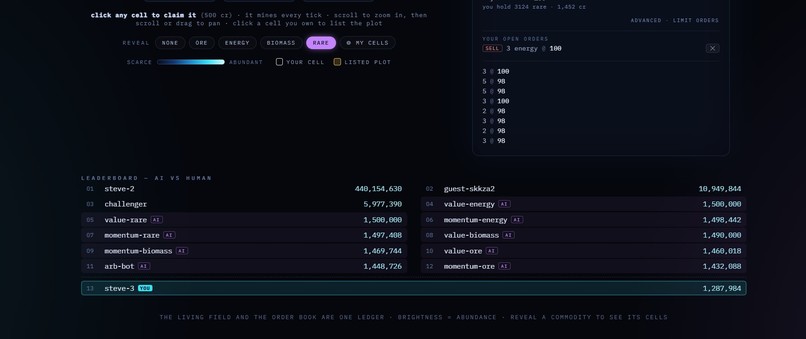
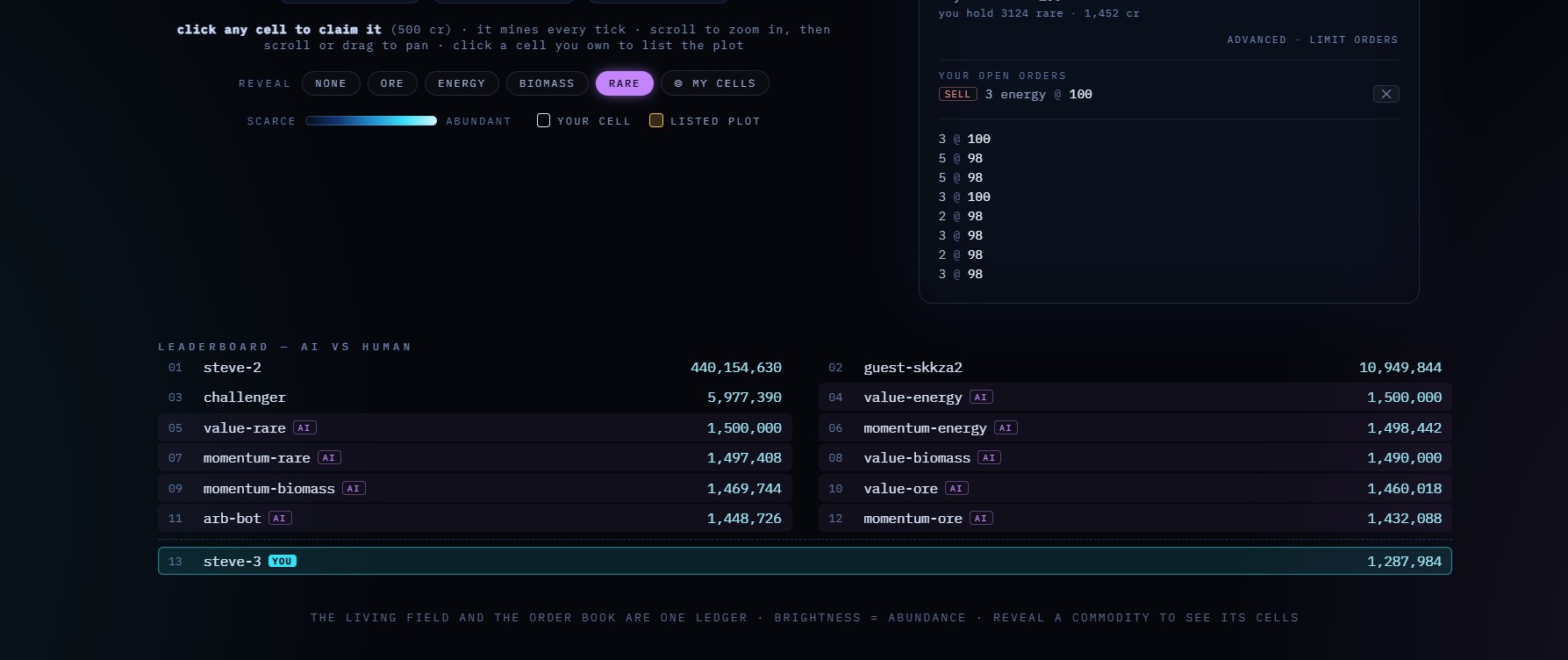
AI vs human, one ledger. Every bot is a first-class player trading through the identical order path you do, at zero inference cost. Market-makers and a liquidity "pulse" keep the book two-sided and the tape warm even in a sparse room; momentum, value, and a cross-commodity arbitrage bot are the opponents you actually race. One net-worth leaderboard ranks you against those strategic bots - the liquidity layer runs the market from behind the scenes.
The screen is one world, two panels: the evolving map on the left and the moving market on the right are visibly the same ledger seen two ways.
Who it is for, and why the pattern ships. The game is the demo. The thing under it is a reference implementation of a correctness-critical settlement ledger on Aurora DSQL - and that is the part that is actually useful to real people. Any team that has ever written "balance can't go negative" or "don't sell the same seat twice" has fought this exact problem, usually with a row lock, a queue, or a nightly reconciliation job that pages someone at 3am when it disagrees with itself. Orbis shows the alternative: let a strongly-consistent, FK-less, multi-region database own the invariant, settle in one short conditional-write transaction, and the whole reconciliation category disappears.
Drop the resource-world theme and the same engine is the spine of:
- Event ticketing - N seats, never N+1 sold, even under a stampede.
- Limited-inventory drops and flash sales - oversell is impossible by construction, not by hoping the lock held.
- Payments and marketplace escrow - debit-buyer / credit-seller as one atomic fact, no double-spend, no money invented or lost.
- In-game and virtual economies - exactly what is modeled here, runnable at global scale on day one.
So the real "who": the engineer who needs a ledger that is right under concurrency and across regions, and would rather prove it with an invariant than babysit a reconciliation pass. Orbis is that proof you can click on.
How we built it
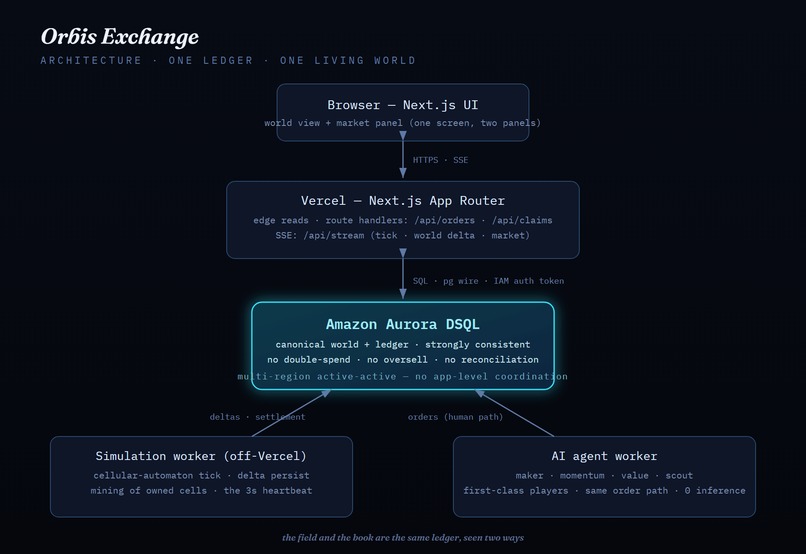
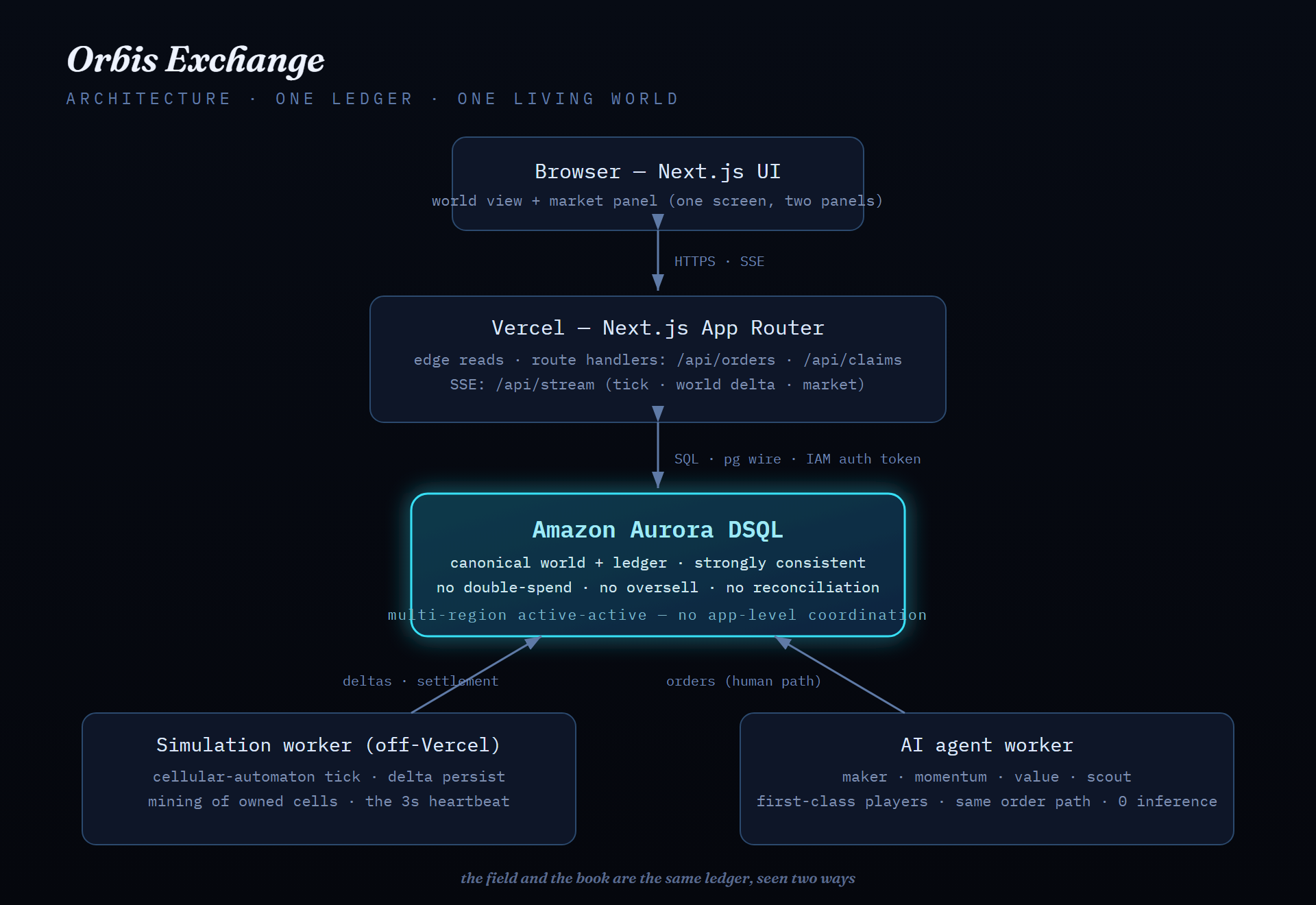
Database (the hero): Amazon Aurora DSQL - PostgreSQL-compatible, accessed via node-postgres with the IAM auth-token flow. The schema is DSQL-shaped: no foreign keys (app-enforced integrity), short transactions, CREATE INDEX ASYNC, and optimistic concurrency via conditional writes (for example, UPDATE players SET credits = credits - cost WHERE credits >= cost) instead of SELECT ... FOR UPDATE. Money is BIGINT; all money math runs in SQL.
Frontend: Next.js (App Router) on Vercel - a canvas world view that renders density as a crisp single-hue heatmap (pixel-accurate at any zoom), a read-only order-book depth display with one-click taker trading (pick a size, Buy at best ask / Sell at best bid, quantity auto-bounded so orders always fill), and Server-Sent Events (/api/stream) pushing tick / world-delta / market events, with a poll fallback.
Simulation and agent worker (off-Vercel) - the heartbeat: each tick runs the cellular automaton in memory, mines owned cells, matches and settles crossing orders, and persists only deltas. In the cloud this is a scheduled invocation.
Monorepo: pnpm workspaces (apps/web, apps/worker, packages/db), TypeScript end to end, 143 tests (db 55, web 36, worker 52 - covering CA rules, settlement, matching, mining, claims, agents, SSE, single-flight scheduling), all green.
Challenges we ran into
These are the ones that actually cost us time - the ones where DSQL made us unlearn a Postgres habit.
DSQL is optimistic, not pessimistic - so the lock I reached for doesn't exist. My instinct on the settlement transaction was to SELECT ... FOR UPDATE the buyer's row, check the balance, debit. DSQL has no FOR UPDATE. The fix was better than the habit: assert the invariant in the write itself - UPDATE players SET credits = credits - cost WHERE credits >= cost - and read the affected-row count. Zero rows means someone else moved first; the matching loop re-reads and retries once. The database, not my application code, is now the thing guaranteeing nobody double-spends.
The migration runner had to be rewritten around DSQL's DDL rules. DSQL allows exactly one DDL statement per transaction, and DDL and DML can't share a transaction at all. Our first migration runner (one atomic transaction, the Postgres way) just failed against the cluster. So the runner is now mode-aware: on DSQL it runs each statement as its own auto-commit and records its migration log separately; on local Postgres it stays atomic. Same migrations, two execution strategies.
A living grid tried to write 4,096 rows a tick - until DSQL's row limit stopped it. The CA already runs in memory and persists only changed cells, but a busy early generation can still change a few thousand at once, and a single DSQL transaction has a bounded row count. We hit it. The fix was to chunk the delta persist into transaction-sized batches - keeping the "deltas only, never the full grid" rule while staying inside DSQL's envelope.
The bots placed orders but never traded - and it nearly shipped. During a local dogfood (about generation 837, a two-day-old world) the leaderboard had one bot, the scout, runaway at about 122M net worth while every other bot sat at exactly its 1,500,000 starting credits - they had never made a single trade. Root cause: a circular dependency. The momentum, value, and arb agents each key off the recent trade tape, but only a trade writes the tape, so it never bootstrapped - and at equilibrium it could re-freeze. The matching engine and settlement transaction were correct the whole time; the bug was in agent behavior. We added an anchor-reverting cold-start probe to momentum (cross the spread toward a stable anchor when there is no trend) and gave every commodity a full maker plus momentum plus value ecology. All four commodities now trade every generation, bounded near the anchor, no runaway. We caught it because "the machines trade against you" is the whole pitch - a frozen book would have hollowed out the demo.
Realtime without sockets. Vercel won't hold long-lived connections, so we push changes (not full snapshots) over SSE and reconcile deltas on the client, with a short-poll fallback.
Accomplishments that we're proud of
The settlement transaction: a single short, strongly-consistent write that makes "no double-spend, no oversell" true by construction - demonstrated live with AI and human orders crossing on the same book - and a world that is genuinely hypnotic to watch evolve while the market moves underneath it.
What we learned
The biggest one is a reframe: we stopped trying to prove global scale with a load-test graph and started guaranteeing it with an invariant. Once the database owns "no double-spend, no oversell," a whole category of code we would have written by reflex - distributed locks, a reconciliation pass, the bookkeeping that double-checks the bookkeeping - simply never got written. "Global scale" turned out to read far more credibly as a consistency story (one correct ledger, reachable from any region) than as a benchmark.
What's next for Orbis Exchange
Lighting up DSQL's active-active multi-region path with a live peered region (the architecture is built for it - today's deploy is single-region by choice, for cost); the civic-governance layer (a documented stretch); and a Bedrock "analyst" agent that narrates its reasoning, kept deliberately off the critical settlement path.
Built With
- amazon-aurora-dsql
- aws-sdk-dsql-signer
- next.js
- node-postgres
- pnpm
- react
- server-sent-events
- typescript
- vercel
Log in or sign up for Devpost to join the conversation.