-
-
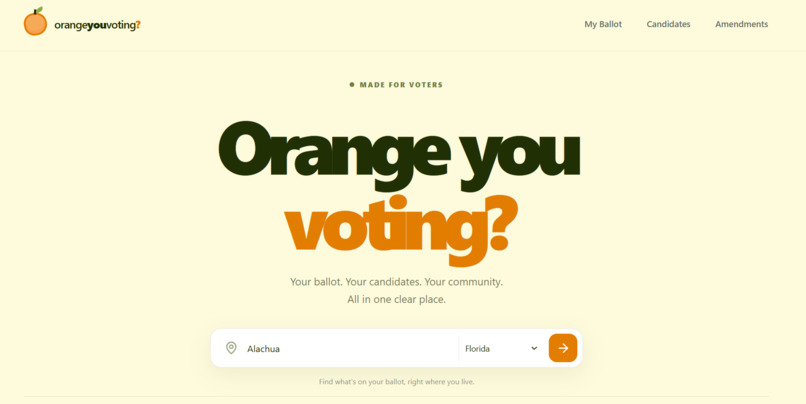
Landingpage
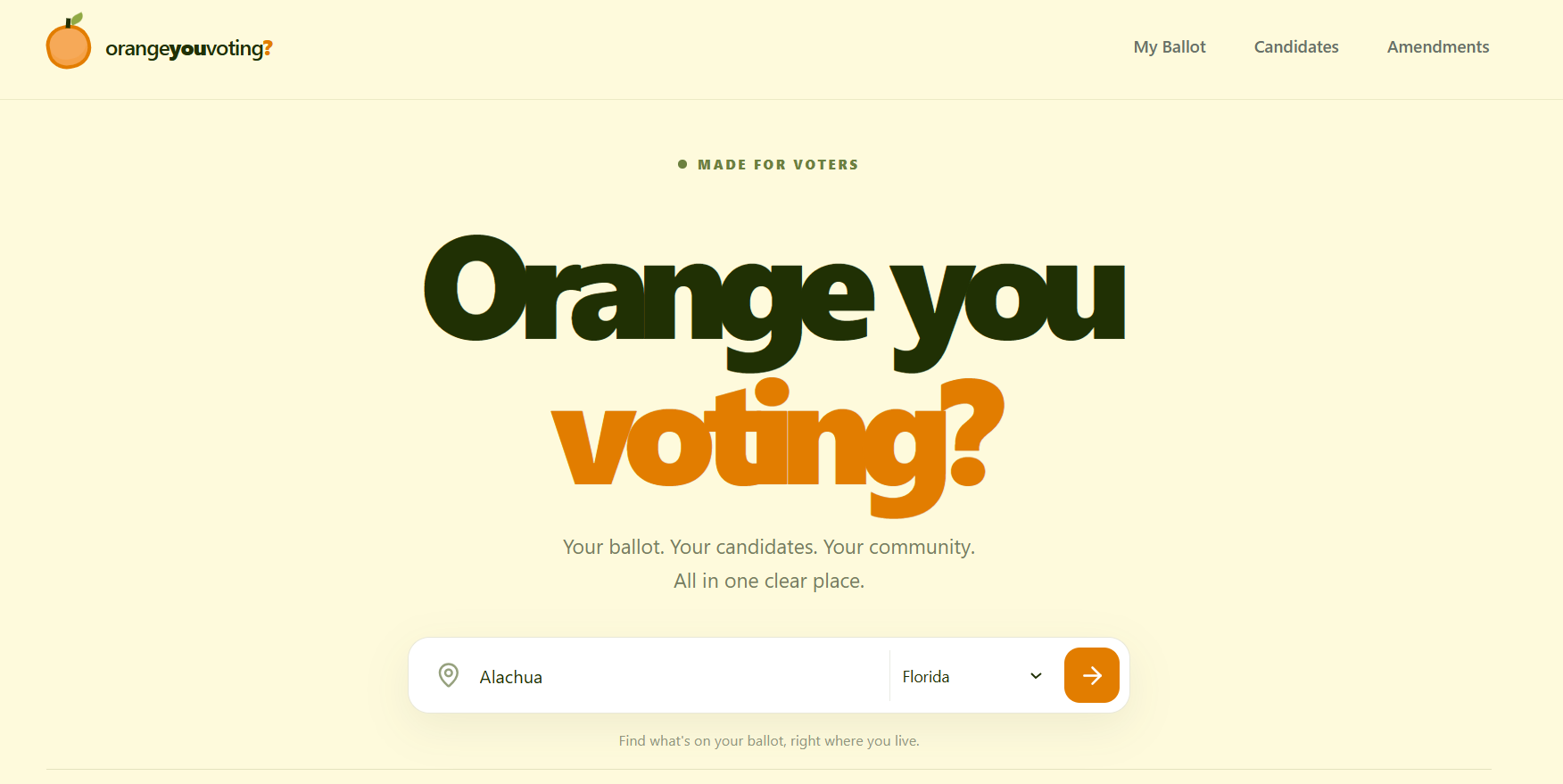
Inspiration
Voting is one of the most important ways we can make our voices heard, yet researching who to vote for can feel overwhelming. Candidate information is often scattered across campaign websites, news articles, and election resources, making it difficult to understand who is running and what they stand for.
We wanted to answer one simple question: Why is it so hard to learn about the people who want to represent us?
As students and young voters, we recognized the need for a platform that makes political information more accessible, digestible, and easier to compare. That's how Orange You Voting? was born: a centralized, AI-powered platform designed to help voters feel more informed and confident heading into an election.
What it does
Orange You Voting? makes researching candidates as simple as entering your county.
Once users select their Florida county, our platform identifies relevant candidates and organizes their information in one place. Instead of searching through dozens of websites, voters can explore candidate profiles, read AI-generated summaries, and compare information about their backgrounds and political positions.
Our platform focuses on three key features:
- Location-based candidate discovery: Find candidates running in elections relevant to your county, including statewide and congressional races.
- AI-powered candidate summaries: Turn lengthy, scattered information into concise, understandable overviews of candidates' backgrounds and documented policy positions.
- Side-by-side comparisons: Help voters explore candidates within the same race and understand their differences on important issues.
Our goal isn't to tell people who to vote for. It's to give them the information they need to make that decision themselves.
How we built it
We designed Orange You Voting? around an automated data pipeline that connects election information, web research, and AI.
Our workflow begins with the user entering a county. From there:
- Election API integration: We use an election API to retrieve relevant races and candidates based on the user's selected county.
- Supabase database: Candidate names, political affiliations, offices, and election details are organized and stored in Supabase.
- Automated web scraping: Candidate names trigger our web scraper to collect publicly available information from campaign websites and other online sources.
- AI-powered summarization: We use AI to transform collected information into structured, easy-to-understand summaries of candidates' backgrounds and policy positions.
- User-friendly interface: We present the results through candidate profiles and comparison features designed to make election research more intuitive.
By connecting these components, we're building a system that can collect and organize candidate information without requiring every profile to be researched manually.
Challenges we ran into
One of our biggest challenges was connecting geographic information to the correct elections and candidates. Elections don't always follow county boundaries, and a single county can contain multiple congressional districts. We had to account for the differences between statewide, district-level, and local races.
Another challenge was collecting reliable candidate information. Not every candidate has a detailed campaign website, and public information varies significantly between candidates. This made it important to distinguish verified information from missing or unclear policy positions.
We also had to think carefully about using AI in a political context. AI-generated summaries need to be neutral, fact-based, and supported by sources rather than making assumptions about a candidate's beliefs.
Finally, coordinating our Election API, Supabase database, and web scraper introduced challenges around data consistency, duplicate candidates, and the order in which information should be processed.
Accomplishments that we're proud of
We're proud of turning an idea centered on civic accessibility into a concrete platform and data architecture.
Some of our biggest accomplishments include:
- Developing a county-based candidate discovery experience that simplifies how users begin researching elections.
- Building structured candidate datasets for Florida counties, including Alachua, Leon, and Orange.
- Designing an automated research pipeline connecting election data, Supabase, web scraping, and AI-generated summaries.
- Creating a consistent candidate profile structure that supports political backgrounds, key issues, source references, and comparison features.
- Prioritizing political neutrality and transparency, ensuring our platform is designed to inform voters rather than influence their decisions.
Most importantly, we're proud that our project addresses a real-world problem with technology that has the potential to make civic information more accessible.
What we learned
Building Orange You Voting? taught us that making information accessible is about more than simply collecting data. It's about organizing that information in a way that people can understand and trust.
On the technical side, we gained experience designing workflows that connect external APIs, databases, automated web scraping, and AI. We also learned the importance of structuring data properly so it can be reused across different counties and elections.
We explored the challenges of AI-generated content, particularly when accuracy and neutrality are essential. Our biggest takeaway was that AI can be a powerful tool for simplifying complex information, but responsible implementation requires transparency, source attribution, and careful handling of uncertainty.
We also learned to approach development from the user's perspective. A technically sophisticated platform isn't useful unless people can navigate it easily and understand the information it presents.
What's next for Orange You Voting?
We're starting with Florida, but our vision extends much further.
Our next priority is to fully automate the pipeline from county selection to completed candidate profiles, allowing new information to populate our platform with minimal manual intervention.
Looking ahead, we want to:
- Expand nationwide: Support counties and elections across all 50 states.
- Improve AI summaries: Add stronger source verification, more detailed policy breakdowns, and regularly updated candidate information.
- Build interactive comparisons: Allow voters to select candidates and compare their documented positions on issues they care about.
- Personalize election discovery: Use more precise district information so users can find the races relevant to their actual ballots.
- Improve accessibility: Make candidate information easier to navigate and understand for users with different needs and levels of political knowledge.
- Keep information current: Automatically refresh candidate profiles as new information becomes available.
Ultimately, we envision Orange You Voting? becoming a trusted starting point for election research—where voters can spend less time searching for information and more time understanding the choices in front of them.
Because making an informed vote shouldn't be the hardest part of voting.
Built With
- brave
- election
- gemma
- json
- python
- supabase
- typescript
- vite


Log in or sign up for Devpost to join the conversation.