-
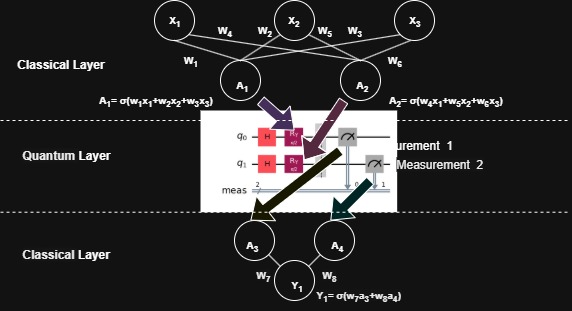
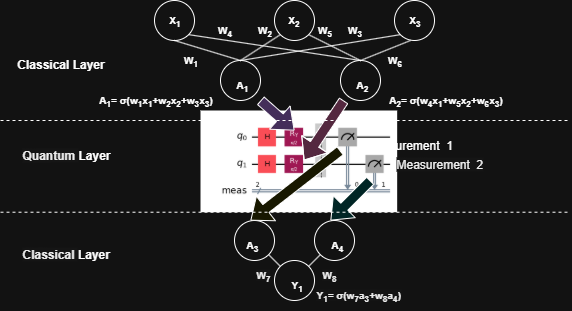
Figure 1: Two Qubit HQCNN model
Disclaimer
📌 📌 The underlying code is not proprietary to any individual but originates from IBM’s open-source Qiskit ecosystem. 📌 📌 This project builds upon the Quantum Convolutional Neural Network (QCNN) framework by Isaac Cong et al., with implementations adapted from IBM’s Qiskit. Parts of the code are modified from original Qiskit resources and retain required Apache License 2.0 notices and attributions. This work is part of a Qiskit-based project and complies with IBM licensing policies. The extended codebase is released under the MIT License, allowing free use, modification, and distribution.
Inspiration
Over 97% of the people around the world suffer from health problem, but early diagnosis is still expensive, slow, and often wrong.
What it does
Hybrid quantum-classical neural network (HQCNN) & Quantum Convolutional Neural Network (QCNN) to look at medical images and determine what kind of diseases the patient has.
How we built it
We used Qiskit, PyTorch, and Google Colab to make HQCNN and QCNN models that can tell the difference between different kinds of oral diseases based on medical images.
Challenges we ran into
We had trouble getting to quantum hardware, scaling qubits, and training for a long time on a free-tier cloud to test those models on a Real IBM Brisbane (QPU)
Accomplishments that we're proud of
Using a hybrid quantum-classical model on real medical datasets, we could correctly classify 88.73% of the time.
What we learned
We learned that hybrid quantum models can be more accurate, stable, and efficient at training than pure quantum models.
What's next for Medical image recognition Using Quantum Machine Learning Models
Use real quantum hardware and improve real-time clinical diagnosis.
Built With
- matplotlib
- numpy
- pandas
- pytorch
- qiskit
- scikit-learn
- tensorflow


Log in or sign up for Devpost to join the conversation.