Inspiration
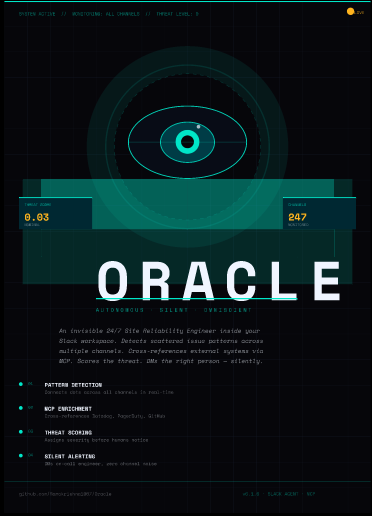
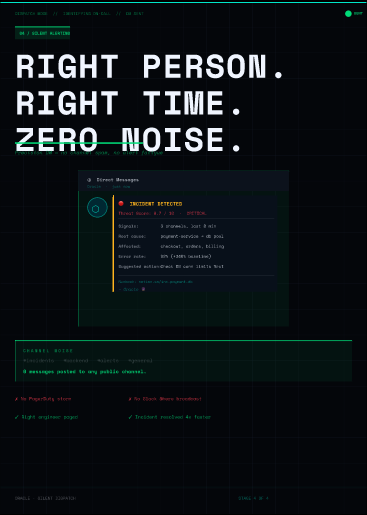
Conventional Slack bots are completely reactive—waiting for rigid slash-commands or explicit mentions. We built Oracle to redefine this paradigm. Oracle acts as a proactive, autonomous backend observer that monitors conversations and intelligently resolves workflow blockers before they escalate.
What it does
Oracle transforms raw chat interactions into actionable project intelligence through a three-step pipeline:
- Listens & Normalizes: The
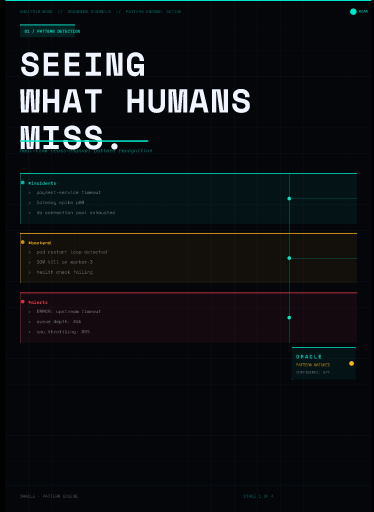
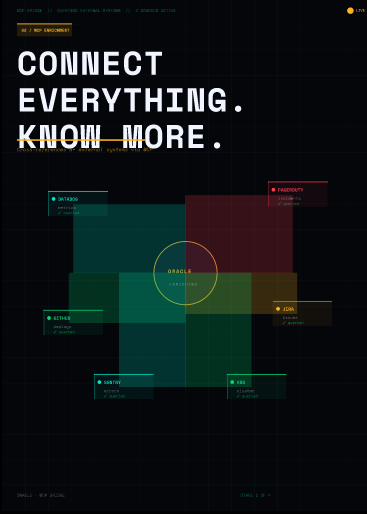
signal-watcherhooks into Slack's Event API to monitor text streams, member updates, and reaction trends in real-time, instantly normalizing the data[cite: 1]. - Enriches Context: Using a native Model Context Protocol (MCP) client, Oracle cross-references detected chat patterns with live repository states from GitHub and issue lifecycles from Jira[cite: 1].
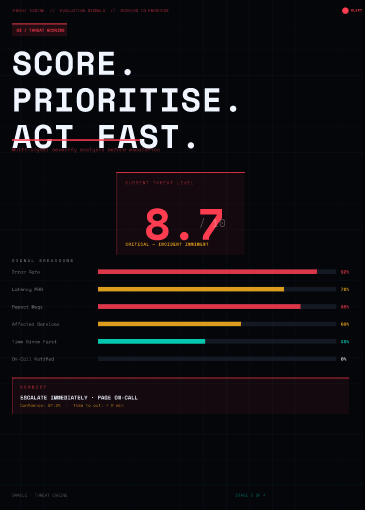
- Scores & Acts: A Confidence Scorer evaluates the enriched data[cite: 1]. If the action threshold is met, the
action-layersafely executes personalized interventions (like sending targeted DMs) while strictly adhering to built-in rate limiters and maintaining an audit trail[cite: 1].
How we built it
Oracle is a heavily decoupled, enterprise-ready microservice architecture:
- Language: 100% TypeScript for strict type safety across fast-moving data pipelines[cite: 1].
- Infrastructure: We used a Redis-backed distributed task queue to separate high-throughput Slack ingestion from resource-heavy LLM scoring tasks[cite: 1].
- Testing & Deployment: The system is thoroughly tested using Jest and containerized with Docker (
docker-compose.yml) for instant production deployment[cite: 1].
Challenges we ran into
Solving the "Noise vs. Signal" problem in high-volume enterprise Slack workspaces. Listening to streaming messages threatened to exhaust our APIs and trigger Slack rate limits. We solved this by building an asynchronous Hold Queue directly into our Confidence Scorer[cite: 1]. Instead of firing an action on every keyword, incoming signals are statefully staged in Redis to aggregate and settle before triggering an execution[cite: 1].
Accomplishments that we're proud of
- Decoupled Architecture: If our Jira integration goes down, the Slack
signal-watchercontinues capturing stream data flawlessly without dropping system events[cite: 1]. - Seamless MCP Integration: Successfully deploying the Model Context Protocol to tie ephemeral chat behavior directly to structured workspace platforms like GitHub and Jira[cite: 1].
What we learned
Building Oracle taught us that an agent's value isn't just determined by the raw intelligence of its core model, but by the robustness of its context engineering and environmental safety boundaries. Designing deterministic rate limiters and audit trails proved just as critical as the AI itself[cite: 1].
What's next for Oracle
- Bi-Directional Write Actions: Allowing the
action-layerto automatically open GitHub pull requests or transition Jira issues directly from chat context[cite: 1]. - Expanded Tooling: Adding MCP adapter support for Linear, Notion, and Datadog.
- Vectorized Memory: Migrating to semantic vector searches so Oracle can recognize long-term project trends over months instead of hours

Log in or sign up for Devpost to join the conversation.