Inspiration
We noticed that large language models can work effectively with massive and diverse data sources, especially when they are used to continuously analyze information in the background. This inspired us to build a system that turns fragmented business data into structured, actionable insights.
What It Does
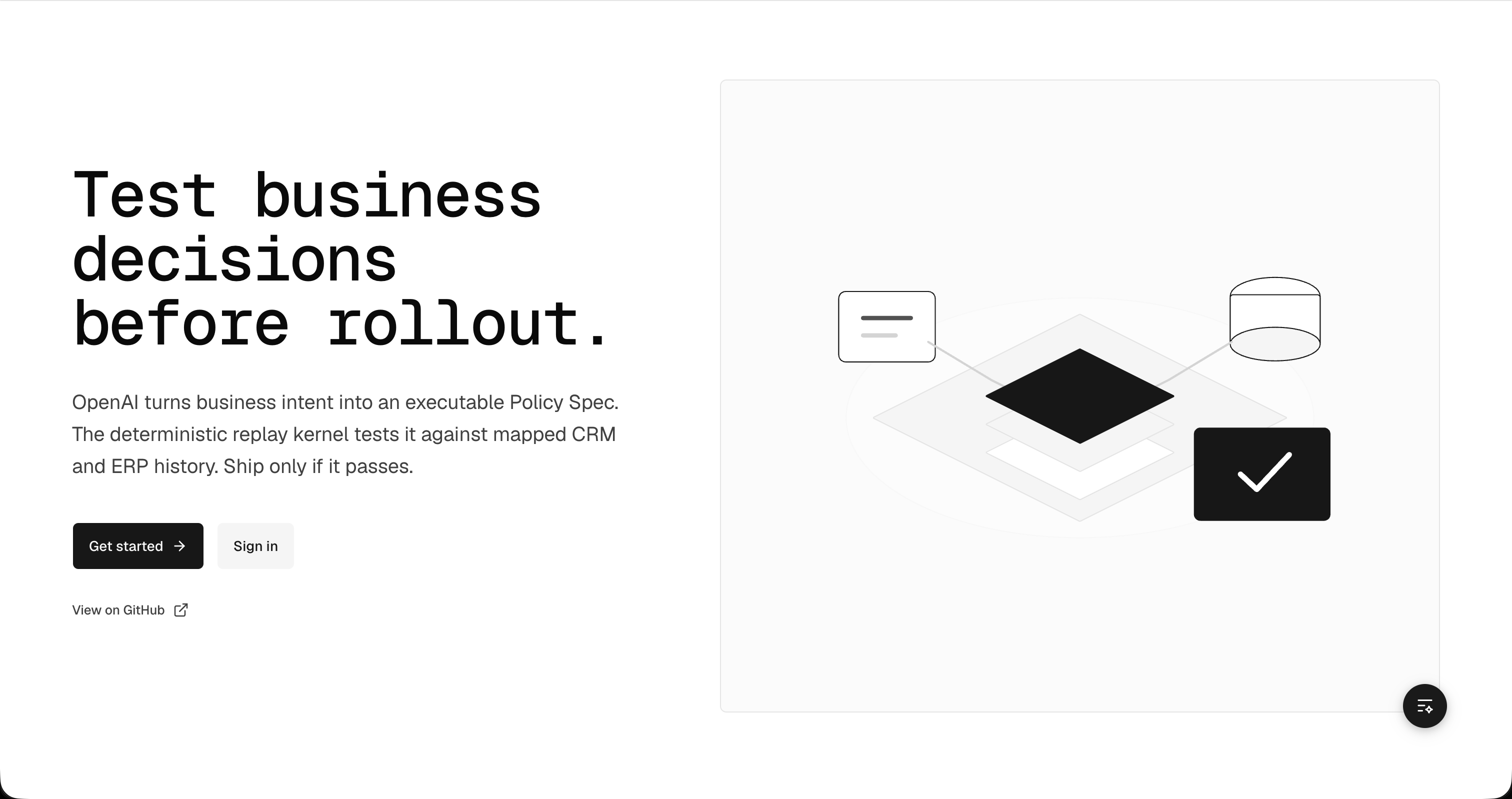
Our system combines data from multiple sources into a single logical layer. This layer enables AI agents to consistently and accurately evaluate how changes in business-product parameters may affect performance.
Instead of relying on generic AI responses, the system provides agents with structured context, clear relationships between metrics, and deterministic analytical rules. This makes the resulting recommendations more reliable, explainable, and useful for business decision-making.
How We Built It
We used GPT-5.6-sol throughout the development of both the technical and visual parts of the project.
During the event, we created a complete design system, reusable UI/UX components, and the architecture of the project’s analytical layer. We transformed abstract ideas into practical implementations that could be applied to real-world business scenarios.
After a large number of iterations, we assembled a complete system for testing business decisions without requiring companies to run risky experiments in their actual operations.
Challenges We Ran Into
We spent a significant amount of time analyzing and discussing the project’s most important architectural decisions with GPT.
The main challenges involved working with raw data, including its extraction, export, transformation, normalization, and further use by AI agents. We also had to determine how to simplify the user experience while keeping the system’s complex analytical logic hidden behind an accessible interface.
Another major challenge was ensuring that the AI interpreted information consistently across multiple sources instead of producing conclusions based on incomplete or conflicting data.
Accomplishments That We’re Proud Of
We built an ETL/ELT system that collects and transforms data from multiple sources into a consistent structure.
The system provides an LLM with precise instructions on how different data points, metrics, and business entities should be interpreted. This allows the model to analyze information from numerous sources with greater accuracy, consistency, and explainability.
Most importantly, we created a practical environment in which businesses can test potential decisions and evaluate their expected impact before implementing them in the real world.
What We Learned
We learned that combining strong planning with an iterative, LLM-assisted development process can significantly accelerate product development without necessarily reducing product quality.
This approach is especially effective when building complete products within a limited timeframe. However, the expertise of the person working with the model remains essential. AI cannot replace a clear understanding of the system being developed, its constraints, and its technical details.
The best results come from treating an LLM as a development partner rather than as a replacement for engineering and product expertise.
What’s Next for orabbit
Our next goal is to launch orabbit in Kazakhstan as an effective decision-support tool for small and medium-sized businesses.
We plan to further develop our approach to building data-consistency systems powered by AI agents. This includes expanding the number of supported data sources, improving analytical accuracy, and making advanced business analysis accessible to companies that do not have dedicated data or business-intelligence teams.
Built With
- codex
- gpt-5.6
- next.js
- openai-responses-api
- prisma
- react
- sqlite
- typescript


Log in or sign up for Devpost to join the conversation.