-
-
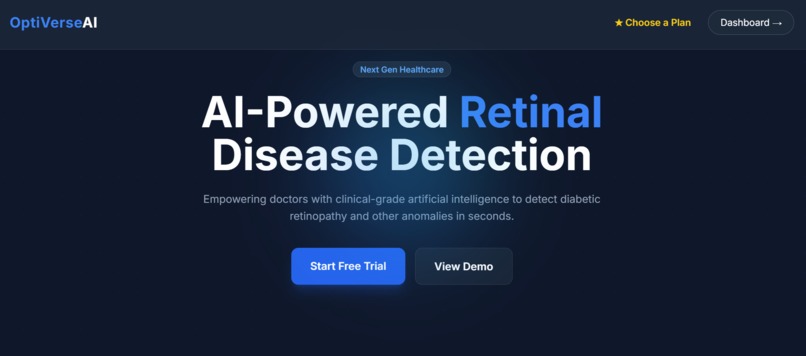
Landing Page
OptiVerse AI – Project Story
OptiVerse AI started with a simple but critical realization: vision loss is often preventable, yet thousands lose their sight every year due to late or inaccurate diagnosis.
In Egypt alone, millions suffer from retinal diseases, and nearly 50,000 people lose their vision annually. What stood out to us was not just the scale of the problem, but the gap in early detection, especially in mild stages where diagnosis is most challenging and often overlooked.
Our journey began by deeply exploring how ophthalmologists diagnose retinal diseases. We learned that the process is time-consuming, highly dependent on expertise, and lacks consistent tools for visual explanation. This insight pushed us to ask a key question: what if diagnosis could be faster, more accurate, and more explainable at the same time?
To answer this, we built OptiVerse AI, an intelligent system that analyzes retinal fundus images using deep learning models. We developed a pipeline that processes images, predicts diseases and their stages, and generates visual explanations using heatmaps. But we didn’t stop there. We introduced a 3D retinal reconstruction module, transforming flat images into depth-aware representations, giving doctors a new way to see and understand retinal structures.
Throughout development, we faced multiple challenges. One of the biggest was data limitation. High-quality medical datasets were limited, and ensuring model accuracy required careful preprocessing, augmentation, and continuous optimization. Another challenge was building trust. In healthcare, it is not enough to provide predictions; the system must explain why. This led us to integrate explainable AI as a core component, not an optional feature.
We also learned that technology alone is not enough. Through feedback from doctors and early testing, we realized the importance of usability, speed, and real-world workflow integration. This shaped our system into not just a model, but a practical tool that reduces diagnosis time from 30–50 minutes to nearly 10 minutes while maintaining accuracy exceeding 96%.
Today, OptiVerse AI stands as more than a prototype. It is a step toward a future where early detection is accessible, diagnosis is augmented by intelligent systems, and preventable blindness becomes significantly reduced.
Our vision is clear: to bridge the gap between advanced AI and real-world healthcare, and to ensure that no patient loses their sight simply because detection came too late.

