
Inspiration
In today’s digital age, screen time is unavoidable. An average U.S. adult will spend approximately 44 years of their life in front of screens, and 65% of Americans report symptoms of digital eye strain. What’s even more concerning is that 30-40% of children and young adults already show early signs of eye strain.
As computer science students, we spend over 10 hours per day on screens, and we’ve personally experienced dry eyes, fatigue, and discomfort. However, simply telling people to reduce screen time isn’t a practical solution. That’s why we built Optiq—to ensure that screen time is healthier, not just reduced.
What it does
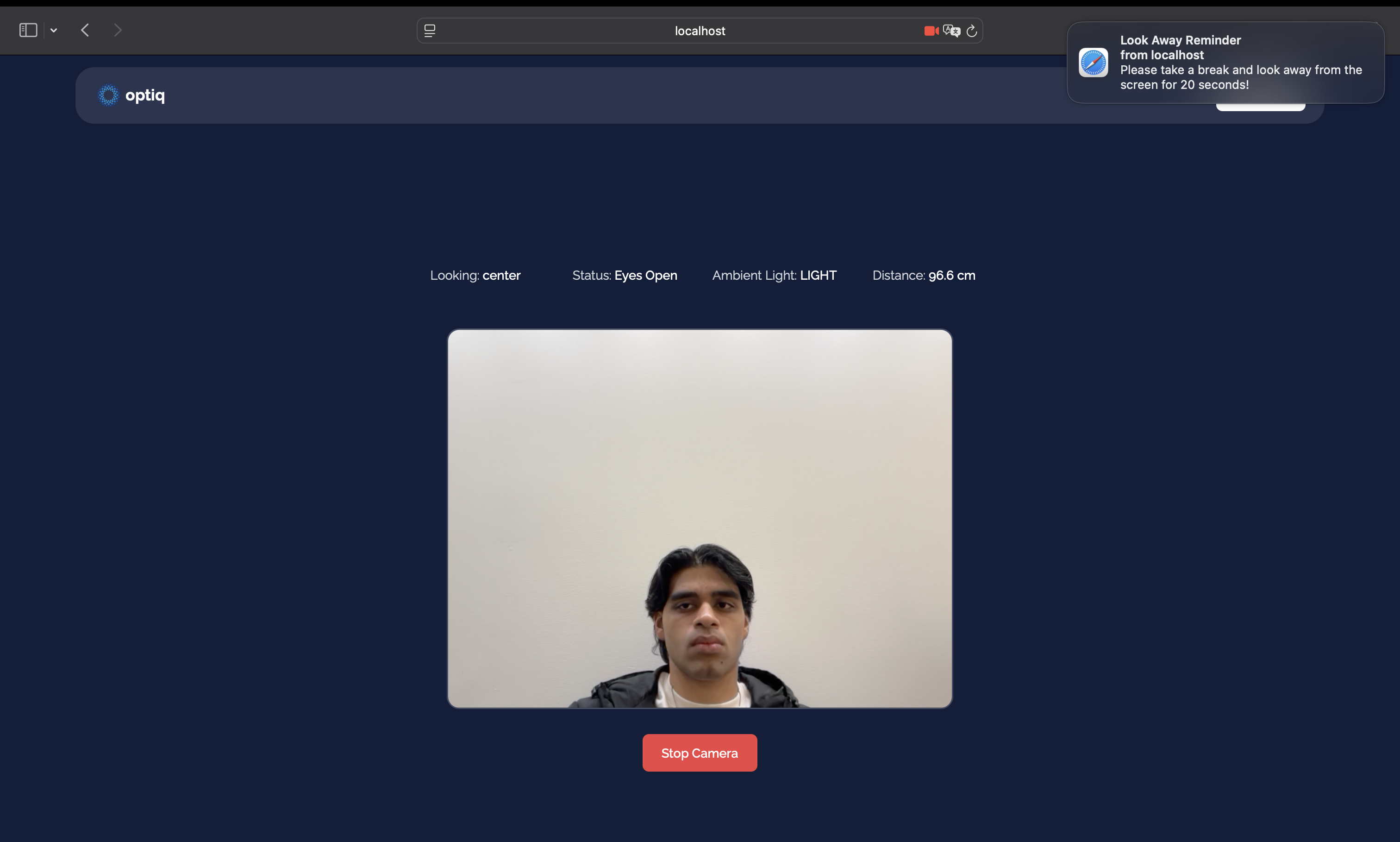
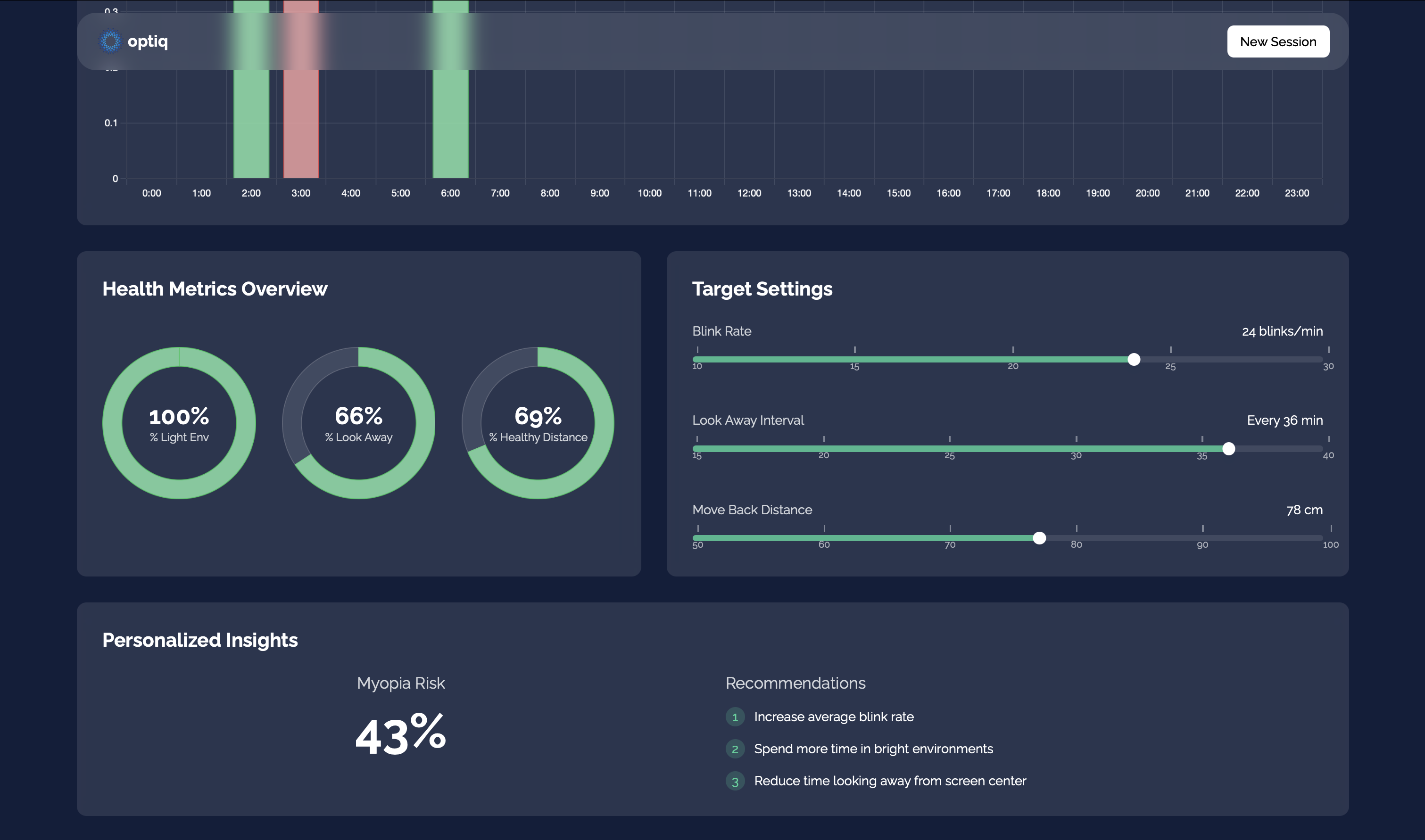
Optiq is an AI-powered tool that actively monitors and enhances your screen usage habits to prevent digital eye strain. Using a suite of computer vision technologies, Optiq tracks critical cues such as blink rate, gaze direction, environmental lighting, and screen distance.
Optiq operates in four key stages:
- Detection: Captures and tracks 20+ facial features to assess strain indicators.
- Analyzation: Uses a multimodal algorithm personalized to each user’s habits.
- Suggestion: Provides real-time automated feedback based on the user’s screen behavior. This is done through live push-notifications that are triggered on-device (no matter what app you are on!).
- Actionable Insights: Offers customizable settings to help users correct unhealthy habits in real-time.
With Optiq, users receive data-driven, personalized recommendations to minimize digital eye strain while maintaining productivity.
How we built it
We leveraged open source CV models (openCV, mediaPipe, etc) to track facial landmarks and assess eye health indicators in real-time. Our multimodal AI algorithm processes data from multiple input sources, including the user’s blinking frequency, posture, and ambient light levels. We then developed a custom feedback system that provides actionable insights, offering subtle yet effective guidance to improve screen habits. This is powered by our proprietary health score formula, which is used to assess the user's screen use. The entire system was built with a user-first approach, ensuring minimal disruption while maximizing benefits.
Challenges we ran into
One of the biggest challenges we faced was creating a reliable measurement score and tracking all of the user's features in real-time through a JavaScript frontend and a Python backend. We also hit roadblocks when it came to using the tools that the open source CV models had and fine-tuning them to our specific purpose. However, we were able to overcome these challenges through the past 36 hours!
Accomplishments that we're proud of
We’re incredibly proud of creating a working prototype that can analyze multiple facial and environmental factors in real-time. The seamless integration of AI-based feedback without disrupting the user experience was a key milestone. Additionally, the personalized nature of Optiq makes it adaptable to each user’s unique screen usage patterns, something we found to be both technically and practically impactful.
What we learned
Throughout this project, we gained deeper insights into computer vision, multimodal AI processing, and user behavior analytics. We also learned the importance of balancing automation with user control—providing suggestions without being overbearing. Lastly, we discovered that small behavioral adjustments, such as optimizing blink rate and screen distance, can significantly reduce digital eye strain, reinforcing the need for technology like Optiq.
What's next for Optiq
Moving forward, we plan to refine Optiq’s AI models to improve accuracy and expand its features. Potential next steps include:
- Increasing Model Accuracy to validate and refine Optiq’s recommendations.
- We'd like to expand broader from solely eye strain and use other CV models to analyze other parts of the face that can also provide valuable insight.
Our ultimate vision is to build a world where screen time is not just necessary, but healthy. With Optiq, we aim to empower users with the tools they need to maintain better sight while staying productive in the digital world.
Built With
- fastapi
- mongodb
- next
- node.js
- python
- tailwind
- typescript


Log in or sign up for Devpost to join the conversation.