-
-
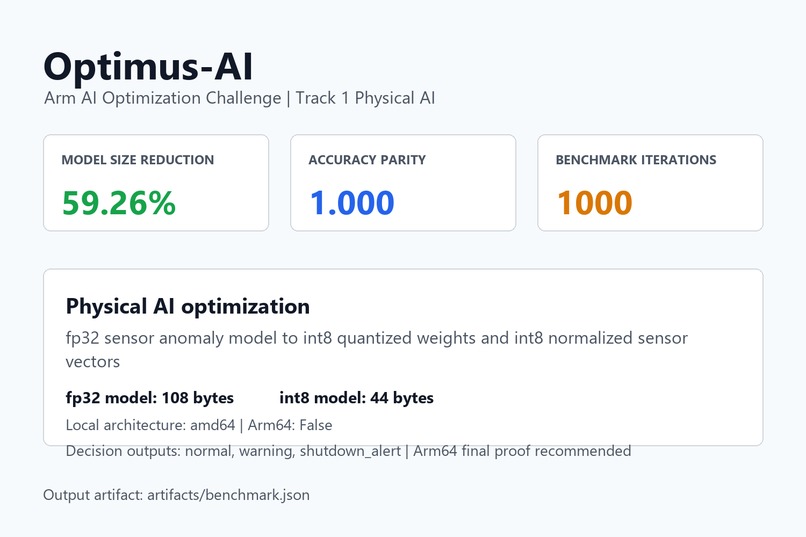
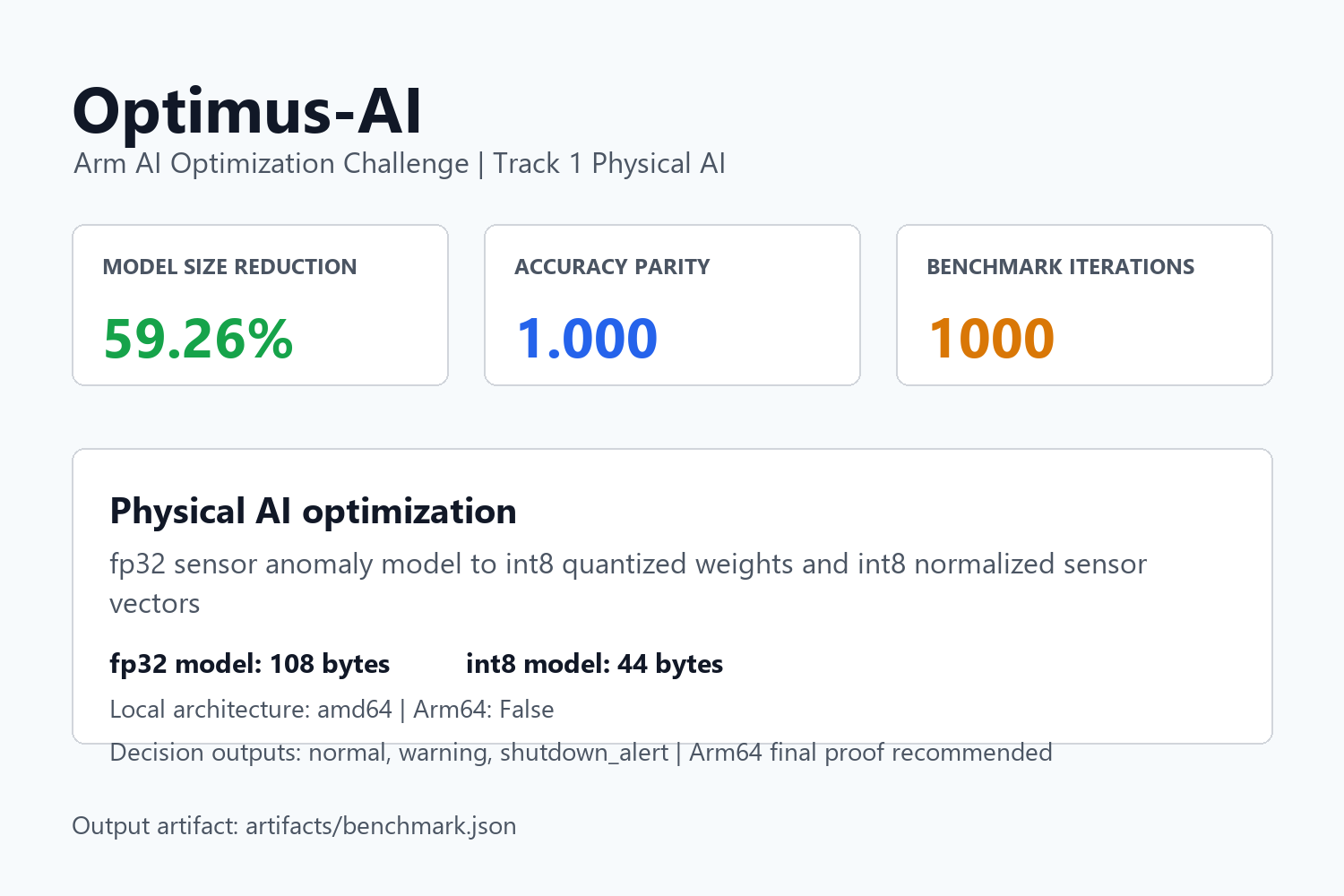
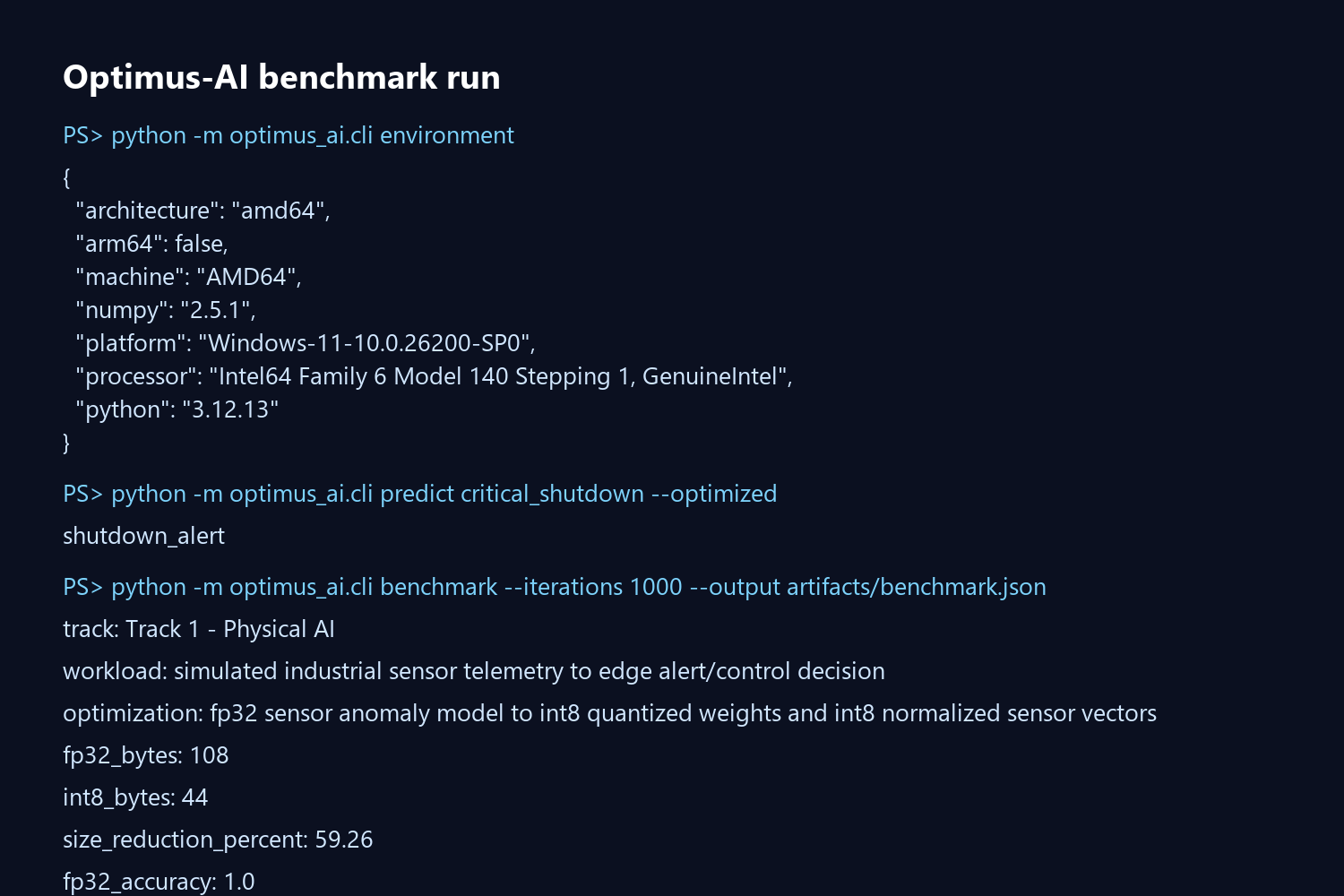
Track 1 Physical AI benchmark showing fp32 to int8 optimization, 59.26% model size reduction, and accuracy parity.
-
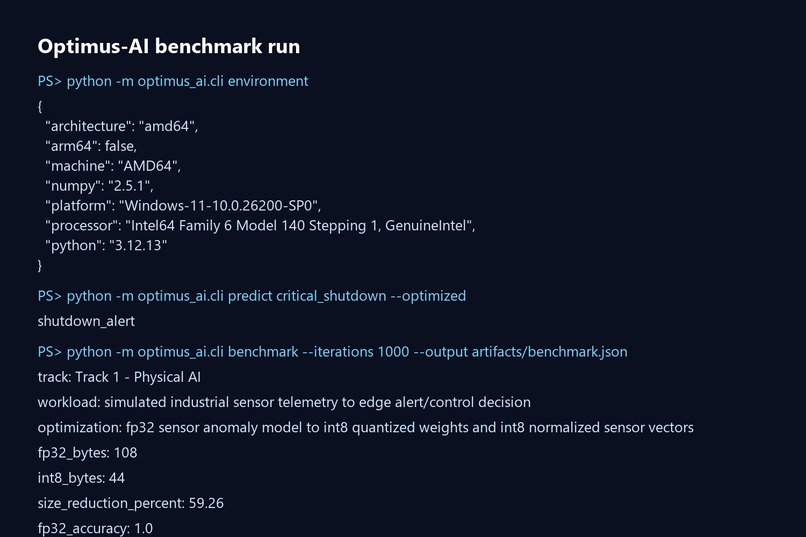
CLI proof showing simulated sensor telemetry, shutdown_alert decision output, and benchmark artifact generation.
-
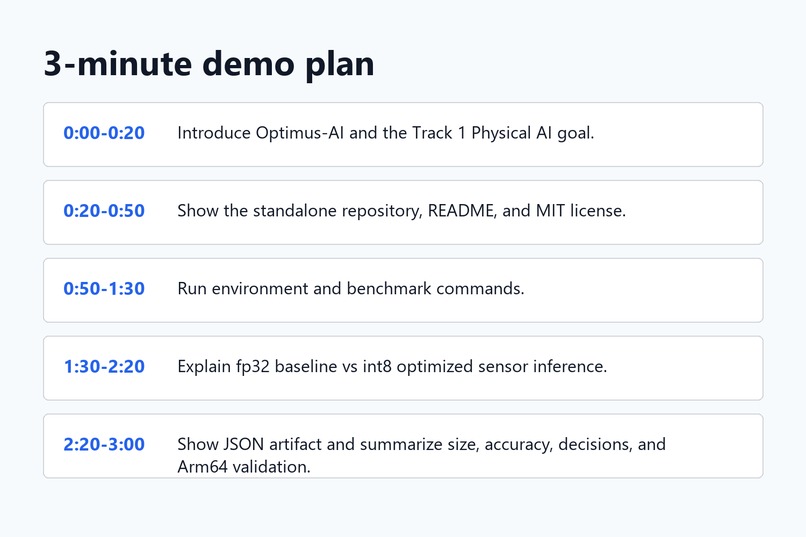
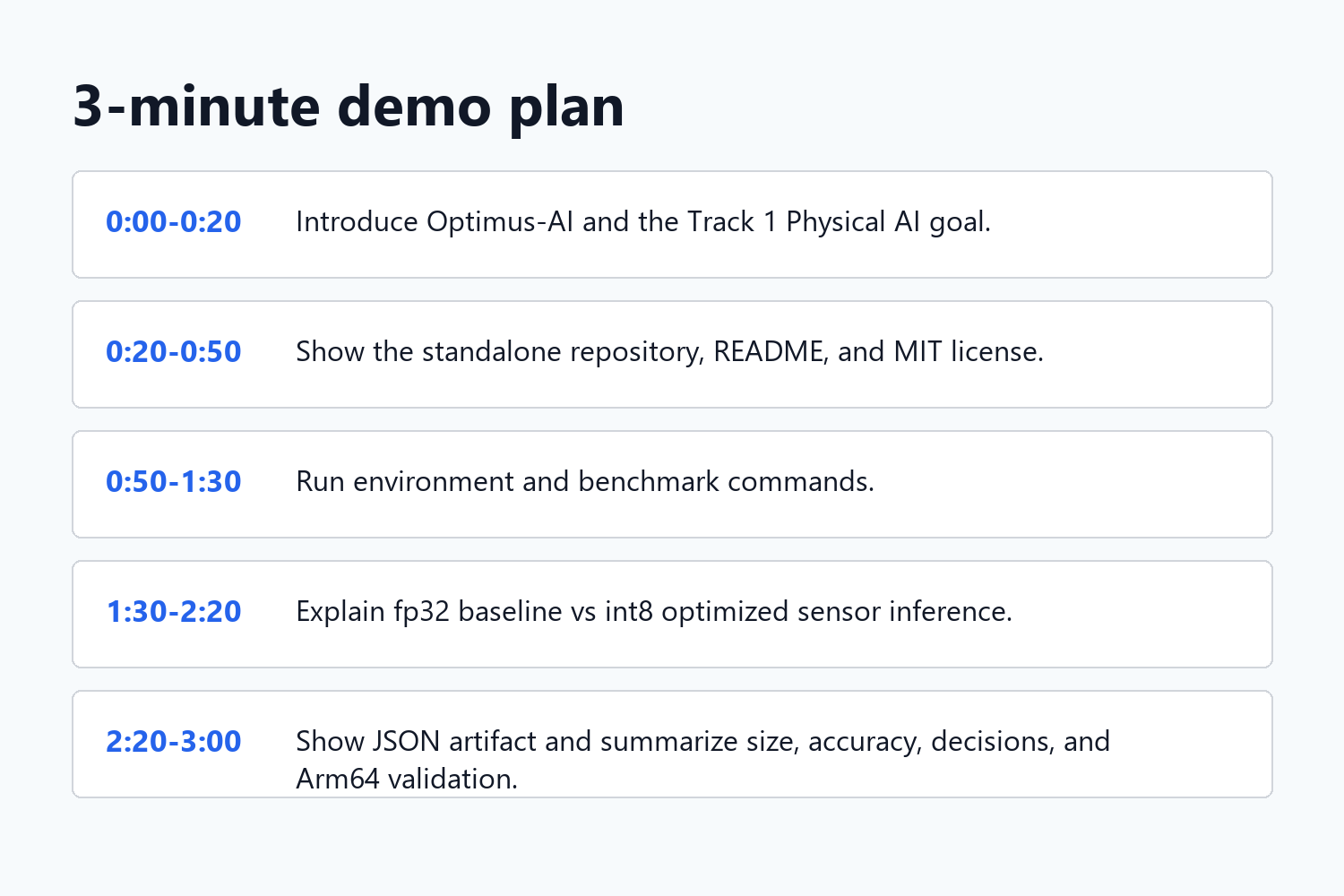
Demo flow for Optimus-AI: sensor input, edge decision, int8 optimization, and Arm64 validation plan.
Inspiration
Physical AI systems need fast local decisions. A robot, industrial controller, smart camera, drone, or edge device cannot always wait for a cloud round trip before deciding whether to keep running, alert an operator, or stop a machine. Optimus-AI was inspired by the Arm Create: AI Optimization Challenge goal of making AI workloads smaller, faster, and easier to validate on Arm-powered platforms.
What it does
Optimus-AI is a Track 1 Physical AI project that optimizes edge sensor anomaly detection. It simulates industrial sensor telemetry such as vibration, temperature, motor current, acoustic level, pressure, RPM, humidity, and IMU jitter.
The model classifies each sensor window into a local physical-world decision: normal, warning, or shutdown_alert. It compares a baseline fp32 inference path with an optimized int8 quantized path and reports model size, latency, throughput, accuracy, architecture, Python version, and NumPy version.
How we built it
We built Optimus-AI as a standalone Python project using NumPy. The project includes a deterministic simulated sensor dataset, a compact fp32 anomaly model, an int8 quantized inference path, a CLI, benchmark exporter, tests, and Devpost-ready proof artifacts.
The optimization path quantizes fp32 model weights into int8, quantizes normalized sensor vectors, performs integer dot-product inference, and dequantizes only the final decision scores.
Challenges we ran into
The main challenge was making the project clearly fit Physical AI while keeping it simple enough for judges to run quickly. We needed the workload to include realistic sensor inputs and physical-world decisions without requiring special hardware.
Another challenge was preserving decision quality after quantization. The optimized int8 model needed to reduce model size while still matching the fp32 baseline on the sample evaluation set.
Accomplishments that we're proud of
We are proud that Optimus-AI now has a clear Physical AI loop: sensor input, edge inference, local decision output, optimization, and measurable proof artifact.
The current benchmark shows a 59.26% model size reduction while maintaining accuracy parity between fp32 and int8 inference. We are also proud that the project is simple to run, open source, and completely standalone.
What we learned
We learned that Physical AI optimization is strongest when it connects model improvements to real edge decisions. It is not enough to say a model is smaller or faster; the project should show what sensor data comes in, what decision comes out, and how the optimization affects size, latency, throughput, and accuracy.
We also learned that int8 quantization is a practical starting point for Arm-powered edge AI because it reduces memory use and maps naturally to efficient integer operations.
What's next for optimus-AI
Next, we want to run the benchmark on real Arm64 edge hardware and attach Arm-specific results to the submission. We also plan to add Arm Performix benchmark artifacts, compare additional sensor scenarios, and test inference backends such as ONNX Runtime.
Future versions could include NEON-aware kernels, Raspberry Pi validation, ROS 2 integration, live sensor streaming, and a small dashboard for comparing benchmark runs across Arm-powered devices.
Built With
- ai
- anomaly-detection
- arm64
- benchmarking
- edge-ai
- int8
- machine-learning
- model-optimization
- numpy
- physical-ai
- python
- quantization
- sensor-data

Log in or sign up for Devpost to join the conversation.