-
-
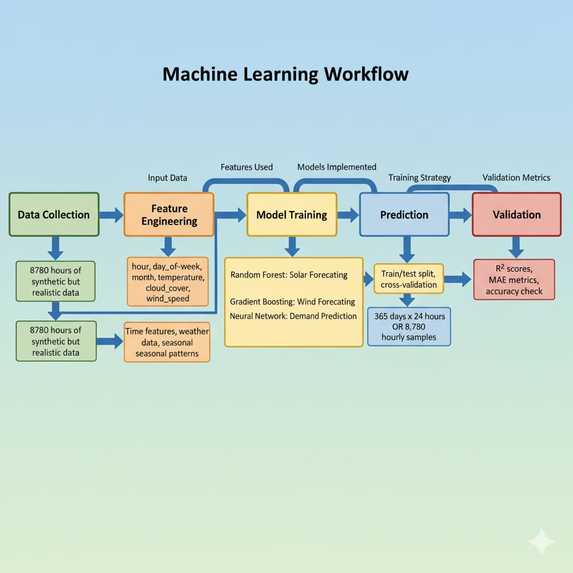
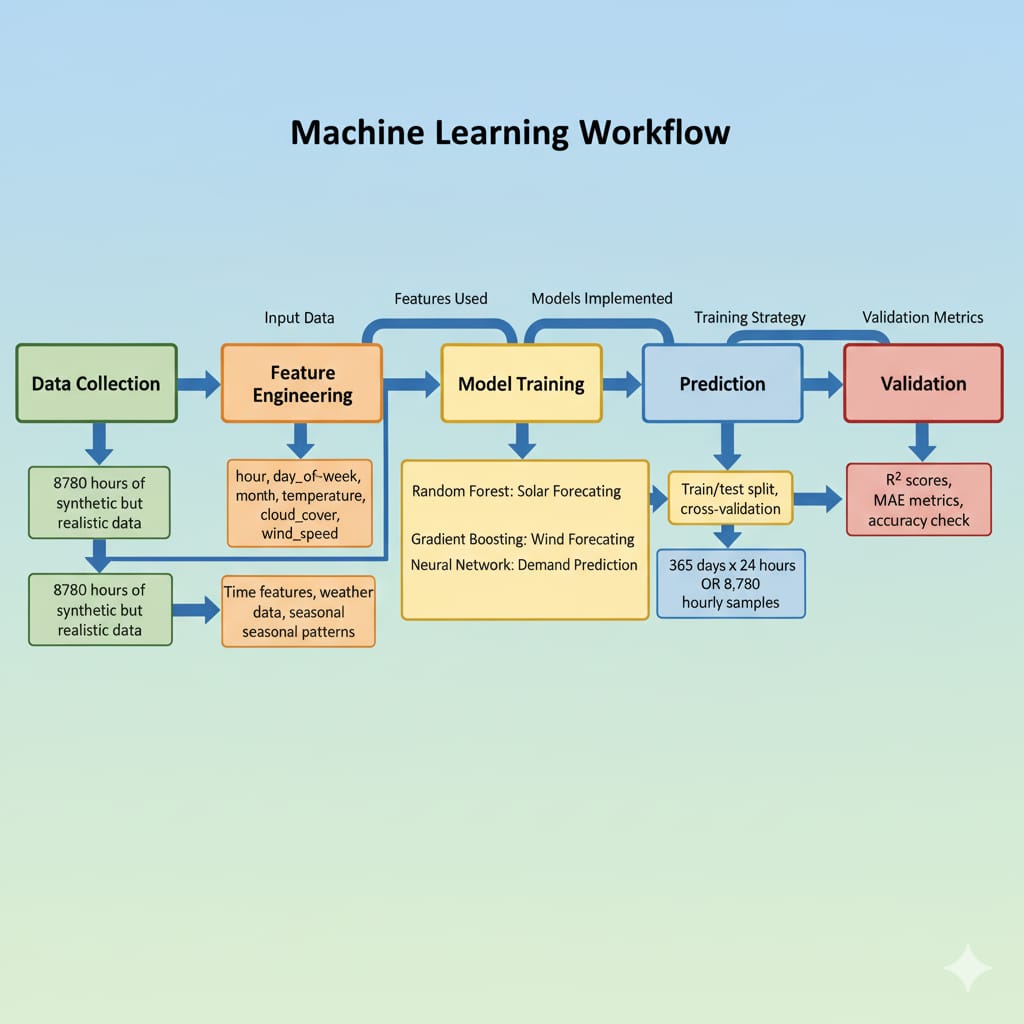
FlowChart
-
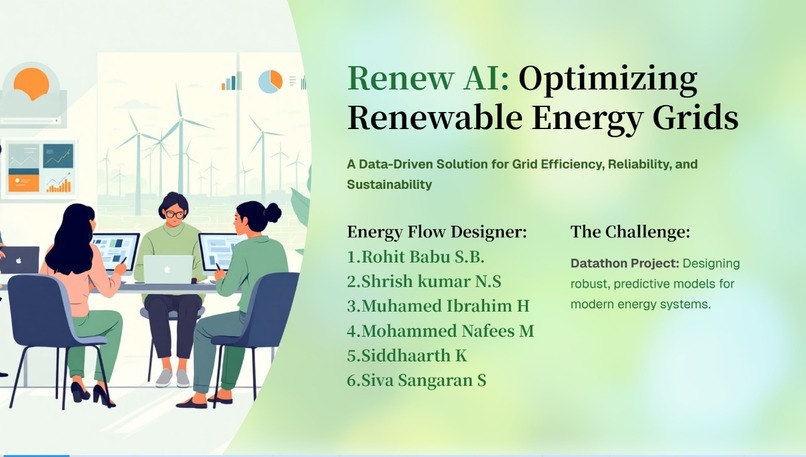
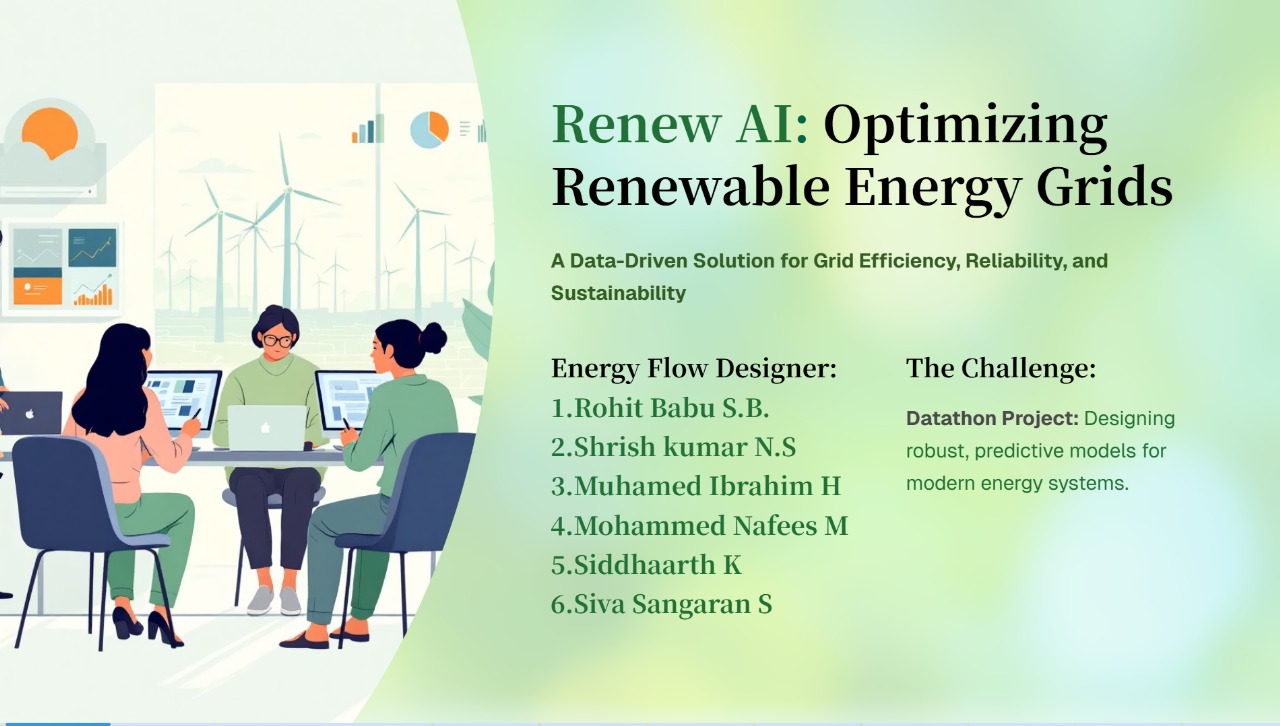
Team
-

Our Website
-

ThankYou


Problem Statement The transition to renewable energy is critical for a sustainable future, but it introduces significant challenges for electrical grid stability. Solar and wind power are inherently intermittent, leading to imbalances between supply and demand. Traditional grid infrastructure, designed for consistent power from fossil fuels, struggles with this variability, often resulting in energy curtailment during peak generation or reliance on backup fossil fuel plants during shortfalls. This project addresses the core challenge of optimizing energy flow within a modern grid to maximize the utilization of renewables and ensure a reliable power supply.
Project Inspiration The concept for this project was driven by the observed inefficiency in renewable energy management. The critical insight was that the problem is not a lack of generation capacity, but a lack of intelligent coordination. The vision was to develop a software-based solution that could act as a central decision-making unit, dynamically managing generation, storage, and consumption to create a more resilient and efficient energy system.
Project Development The PowerFlow Optimizer was architected as a modular simulation platform for a smart microgrid. The development process was structured in distinct phases:
Data Acquisition and Integration: The first step involved establishing a robust data pipeline. The system was designed to ingest real-time and forecasted data, including weather conditions (solar irradiance, wind speed), historical power generation from renewable sources, and simulated load profiles representing community energy consumption.
Predictive Analytics Module: A forecasting engine was developed using time-series analysis and machine learning models. This module analyzes incoming data to predict renewable energy generation and energy demand for upcoming time horizons. These predictions form the foundational input for the optimization core.
Optimization and Decision Engine: The core of the system is a real-time optimization algorithm. This engine processes the forecasts and continuously solves for the most efficient energy allocation. It makes automated decisions on:
Charging or discharging battery storage systems.
Drawing power from or selling excess power to the main grid.
Initiating load-shifting measures if simulated.
Simulation and Visualization Dashboard: A web-based dashboard was built to visualize the entire system's operation. It displays live data streams, forecast accuracy, battery status, grid interactions, and the decisions made by the optimizer, providing a clear window into the simulated grid's performance.
Key Challenges and Learnings Several technical challenges were encountered and overcome during development:
Data Volatility: Managing the noise and unpredictability in real-world weather and generation data required robust data processing and the implementation of probabilistic forecasting techniques to handle uncertainty.
System Latency and Performance: Ensuring the optimization algorithm could run sufficiently fast for near-real-time decision-making necessitated careful model design and solver selection to balance accuracy with computational speed.
Modeling Physical Constraints: Accurately simulating the limitations of physical assets, such as battery cycle life and power conversion losses, was crucial for creating a realistic and practical system model. This required integrating non-linear cost factors into the optimization logic.
This project demonstrated the viability of a software-driven approach to grid management. The PowerFlow Optimizer serves as a proof-of-concept for how data analytics and automated control can be leveraged to stabilize grids powered by renewable sources, ultimately supporting a more sustainable and reliable energy future.
Built With
- database
- jupyterlab
- machine-learning
- python

Log in or sign up for Devpost to join the conversation.