-
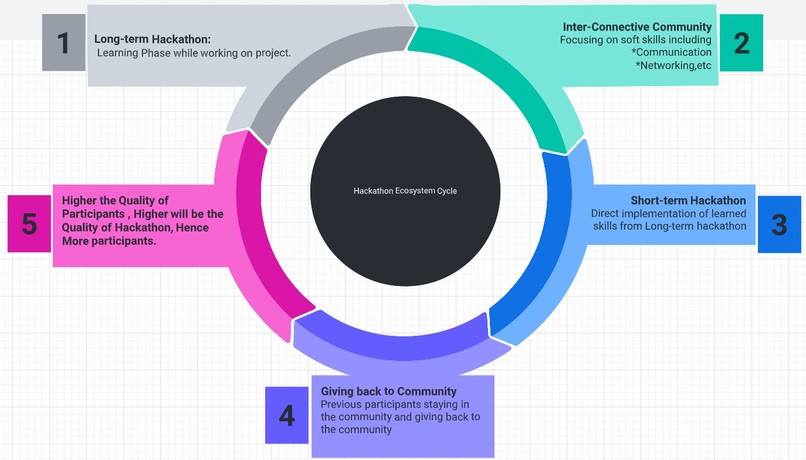
Visualized Plan of Hackathon Cycle.

I have reflected on my first semester hackathon experience and identified the areas where the host could have provided better support. And here I have discussed about my suggestion of involving mentors and providing required resources to help participants understand the problem statement is crucial for a successful hackathon.
Summary (But I would recommend reading the whole thing)
Effective communication and engagement between the hosts, mentors, and participants are essential to ensure that participants have a clear understanding of the problem statement and are equipped with the necessary skills and resources to solve it. The cycle of two hackathons plan that I have suggested can help address this issue, as it provides participants with the opportunity to learn and grow under the guidance of specialized mentors.
In short-term hackathons, the focus should be on providing participants with direct implementation opportunities and learning. In contrast, long-term hackathons should prioritize the learning phase, where participants can gain knowledge and skills in a structured environment and apply them to practical problems.
By creating an ecosystem of like-minded individuals, short-term hackathons can provide participants with a community to learn and grow together. In contrast, long-term hackathons can offer participants the opportunity to connect with specialized mentors and industry professionals, improving their hard and soft skills.
In conclusion, the hackathon host's involvement and connectivity with participants, as well as the availability of specialized mentors and resources, are essential for the success of any hackathon, whether short-term or long-term. The cycle of two hackathons plan that I have suggested can be an effective way to address the gaps in support for participants and ensure a better quality of output.
TO GO IN DETAILS Here is the Cycle of Two Hackathon :
Plan 1: Long-Term Hackathon
I. Pre-Hackathon Preparation
• Encourage participants to prepare for the hackathon well in advance.
• Provide participants with resources to help them learn the necessary skills and technologies, such as online courses, tutorials, and guides.
• Assign mentors to participants who can provide guidance and support throughout the hackathon.
• Encourage participants to form teams and collaborate with each other.
II. Planning and Execution
• Emphasize the importance of planning and execution during the hackathon.
• Encourage participants to brainstorm and ideate early on to ensure they have a well-defined problem to solve.
• Encourage participants to develop a clear roadmap and timeline for their project.
• Provide participants with access to tools, resources, and technology platforms to help them execute their ideas.
III. Learning and Feedback
• Provide participants with opportunities to learn and improve their skills during the hackathon.
• Offer workshops and training sessions on specific topics related to the hackathon theme.
• Assign mentors to participants who can provide guidance and feedback throughout the hackathon.
• Encourage participants to share their progress and receive feedback from others.
IV. Presentation and Awards
• Provide participants with an opportunity to present their final project to a panel of judges.
• Offer awards and recognition to winners and runners-up based on predetermined criteria.
• Encourage participants to network with other participants, mentors, and judges to build new connections.
Plan 2: Short-Term Hackathon
I. Pre-Hackathon Preparation
• Encourage participants to prepare for the hackathon at least one week before the event.
• Provide participants with resources to help them learn the necessary skills quickly, such as online courses, tutorials, and guides.
• Emphasize the importance of time management and encourage participants to plan their tasks and prioritize their work.
II. Direct Implementation
• Focus on direct implementation during the hackathon.
• Provide participants with code snippets, libraries, and frameworks that can help them implement their ideas quickly.
• Encourage participants to reuse existing code and avoid reinventing the wheel.
• Provide participants with access to APIs, datasets, and other resources that can help them implement their ideas faster.
III. Learning Opportunities
• Provide participants with opportunities to learn and improve their skills during the hackathon.
• Offer short workshops or mini-tutorials on specific topics related to the hackathon theme.
• Assign mentors to participants who can provide guidance and feedback throughout the hackathon.
• Encourage participants to collaborate and share their knowledge and expertise with each other.
Benefits for Host and Participants
Hosts
The host of the hackathon can benefit from the long term effects of this hackathon design in several ways. Firstly, by providing resources and support tailored to the needs of the participants, the host can attract a diverse range of individuals with varying levels of experience and skills. This can lead to a higher quality of participants who are motivated to learn and improve their skills, leading to better project outcomes.
By focusing on the learning phase in long term hackathons, the host can facilitate the growth of the participants, which can lead to a better brand recognition for the host. Participants who learn and grow through the hackathon are likely to share their positive experiences with others, which can increase the host's reputation and attract more individuals to future hackathons.
Furthermore, by providing direct implementation and learning opportunities in short term hackathons, the host can attract participants who are interested in gaining practical skills and applying them immediately. This can result in a higher quality of project outcomes, as participants can focus on implementing their skills rather than spending time on learning.
Overall, this hackathon design can result in a more positive and productive experience for participants, leading to better project outcomes and increased brand recognition for the host.
Participants
Participants of the long-term hackathon can benefit from the ecosystem created by the host in several ways. Firstly, they get the opportunity to network with people who have similar interests and mindsets, which can lead to potential job offers, collaborations, or partnerships in the future. The ecosystem can provide a platform for participants to showcase their skills, work on projects together, and collaborate on solving complex problems.
The ecosystem also provides an opportunity for participants to learn and grow under the guidance of specialized mentors. The mentors can provide valuable insights, feedback, and guidance to help the participants improve not only their hard skills but also their soft skills such as communication, teamwork, and time management.
By participating in the long-term hackathon, participants can also gain valuable experience and build a strong portfolio of projects that they can showcase to potential employers. This can help participants stand out from the crowd and increase their chances of landing a job or internship in the future.
And participants of a short-term hackathon can benefit from the event by gaining exposure to new technologies and ideas, developing their problem-solving and time-management skills, and building their professional network by collaborating with other participants and mentors.
Overall, the long-term and short-term hackathons provides participants with a supportive community, access to specialized mentors, and opportunities to learn, grow, and build their skills and portfolios.
Built With
- experience


Log in or sign up for Devpost to join the conversation.