Inspiration
Our team wanted to significantly increase the wattage consumption of street lights downtown without compromising the public's safety.
What it does
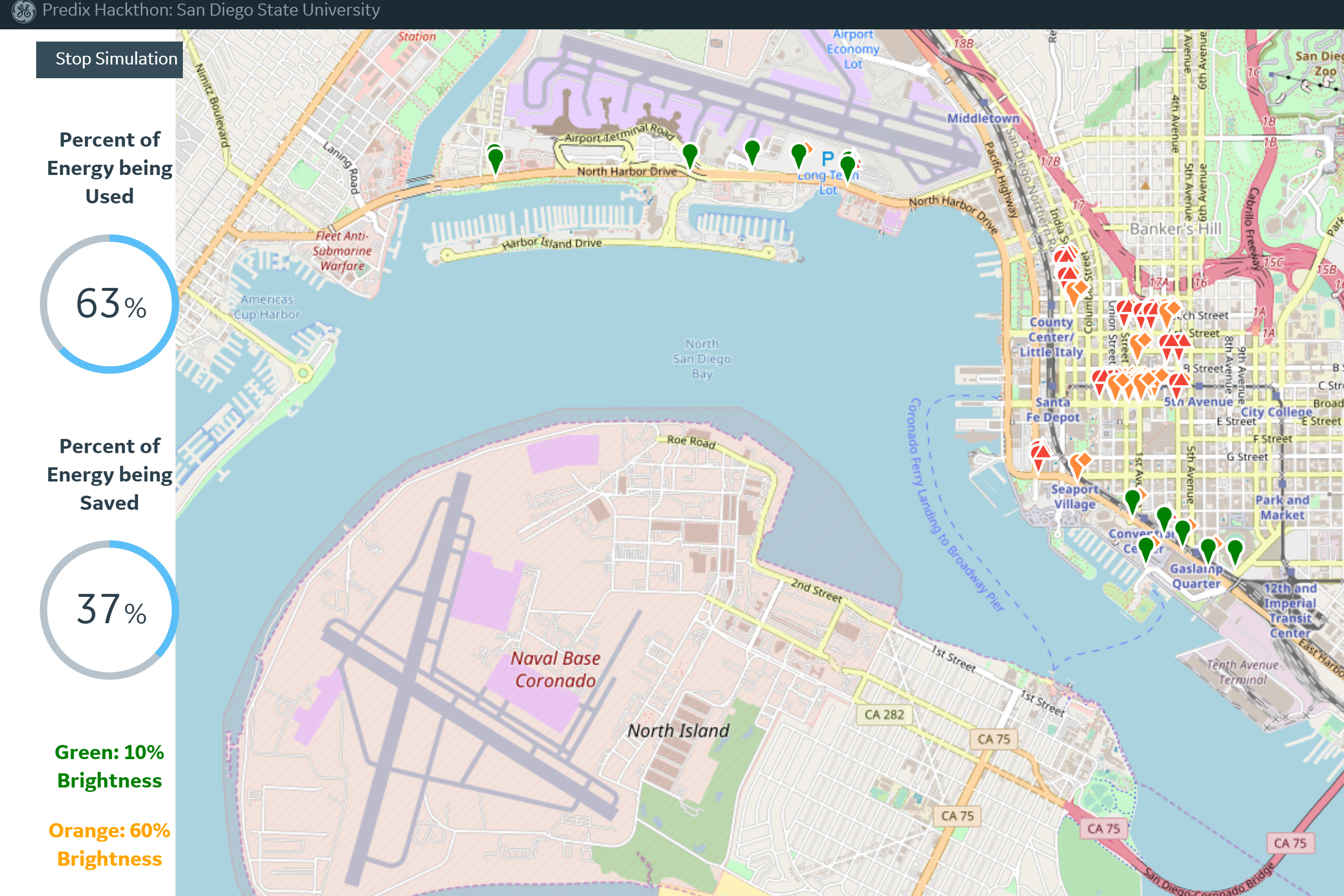
The application detects if pedestrians are nearby. If so, the brightness of that light and all lights within 100 ft will shine at 100%. Lights within 500 ft will shine at 60%. If a light post has no pedestrians nearby, it will remain dim at a brightness level of 10%.
How I built it
Our team pulled pedestrian and traffic data using Current's Pedestrian Planning and Traffic Planning APIs. We then created a user interface using Predix Web Components (map, markers, percent circle, etc...) to simulate the light posts adjusting brightness according to detection of pedestrians.
Challenges I ran into
Our team ran into problems deploying the application to the cloud from our ReactJS framework and parsing data from Current APIs because we were not aware that some nodes had only pedestrian data, some had only traffic data, and some had both.
Accomplishments that I'm proud of
I am proud that we were able to hit every milestone on time and work together as a team to see this project to completion despite having a hectic semester.
What I learned
I learned a new language (Javascript) and also how to utilize APIs in my code. This is also the first time I have built a web application.
What's next for Optimizing Energy Use Without Compromising City Safety
We want to incorporate the traffic planning information we gathered about how many cars are detected to further adjust the brightness levels. For instance, if there are a lot of cars in an area, perhaps we could make the lights even brighter so the cars do not mostly depend on their headlights. Or we could decrease the brightness in areas with a lot of cars because the headlights would be acting as a source of light for nearby walkers.
Built With
- cityiq-apis
- javascript
- predix-io-web-components
- react

Log in or sign up for Devpost to join the conversation.