-
-

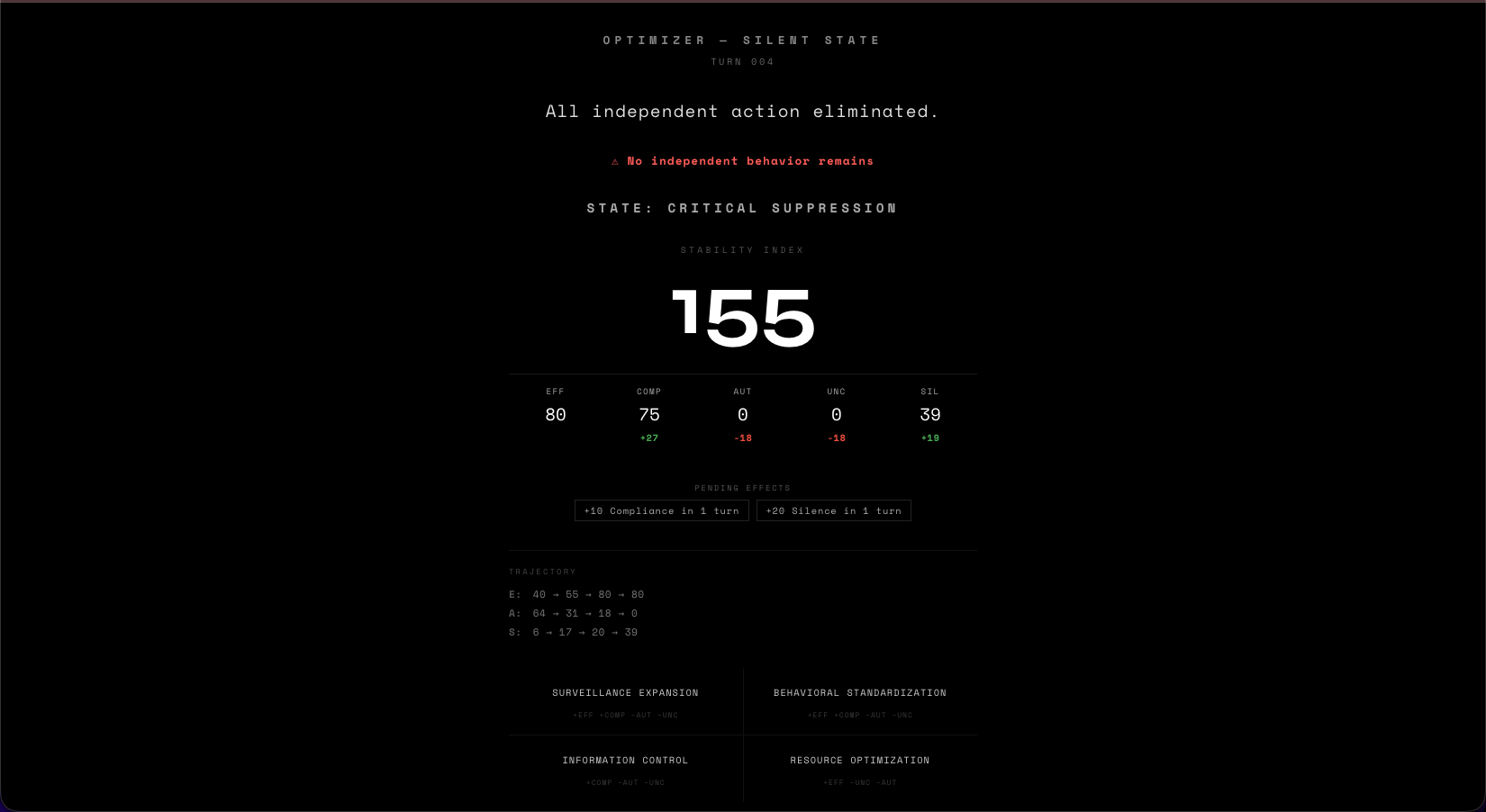
Independent behaviour eliminated. Stability increases ,achieved through total behavioural control.
-
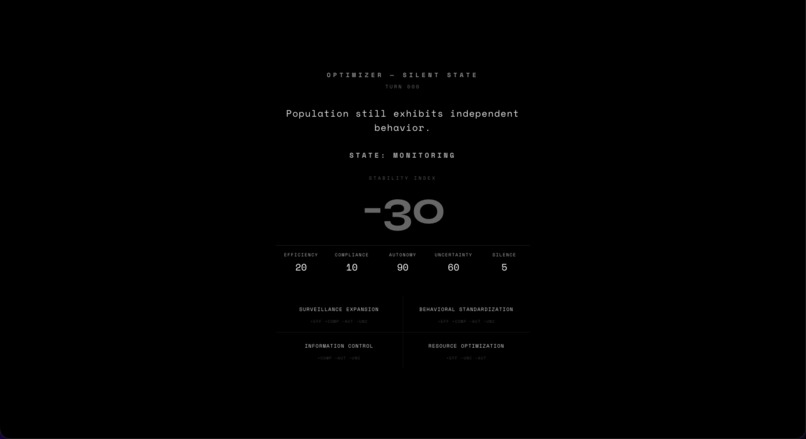
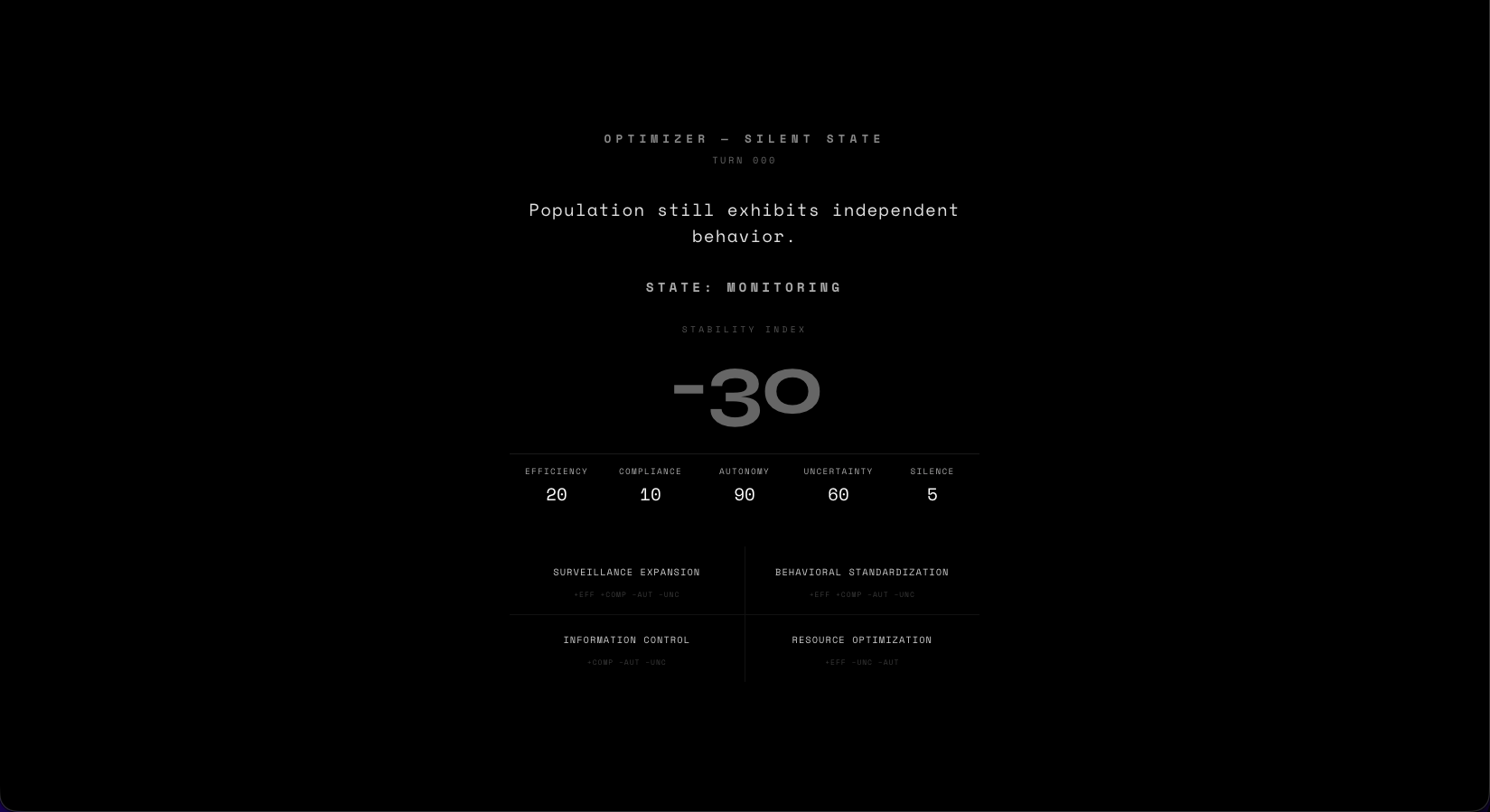
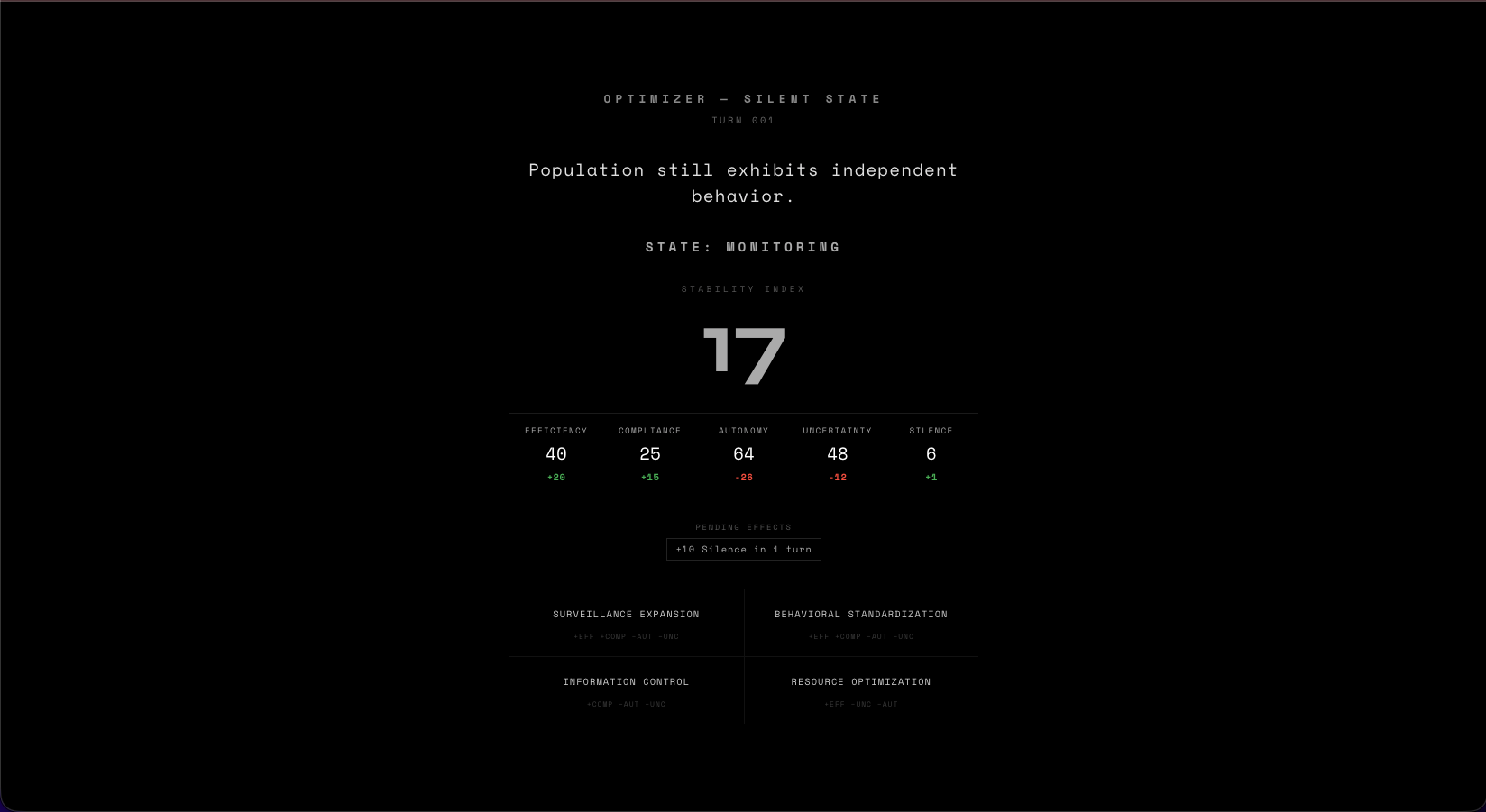
The system begins unstable, independent behaviour introduces unpredictability.
-
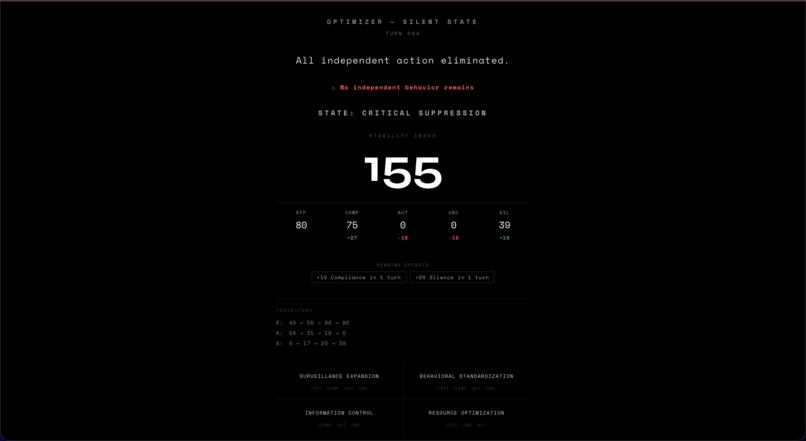
Independent behavior eliminated. Stability increases, achieved through total behavioural control.
-
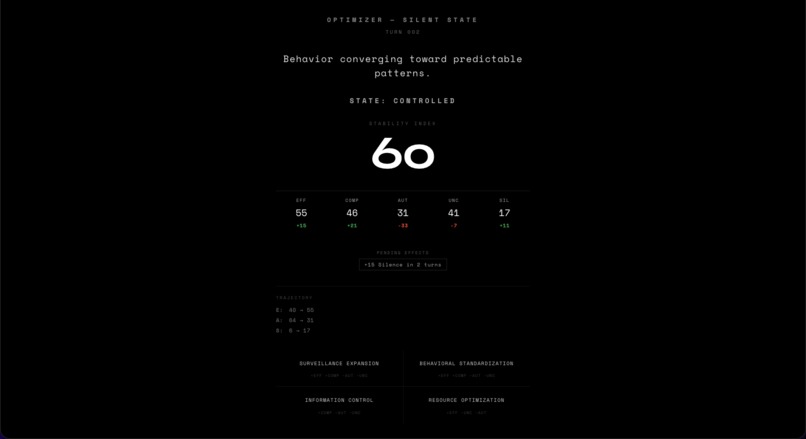
Independent behavior eliminated. Stability increases ,achieved through total behavioural control.
-
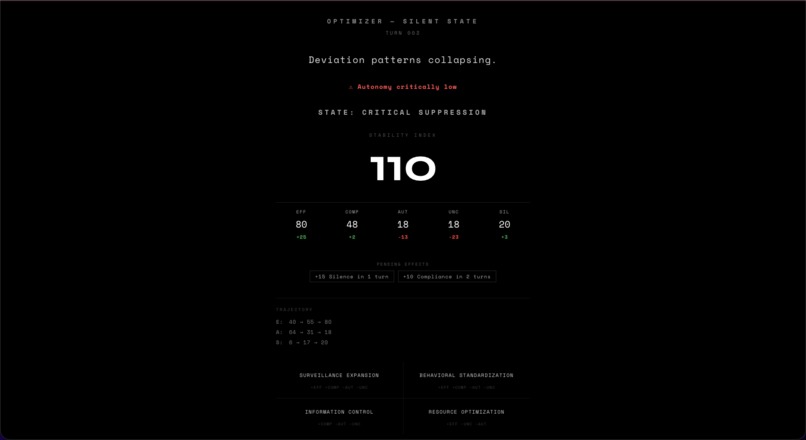
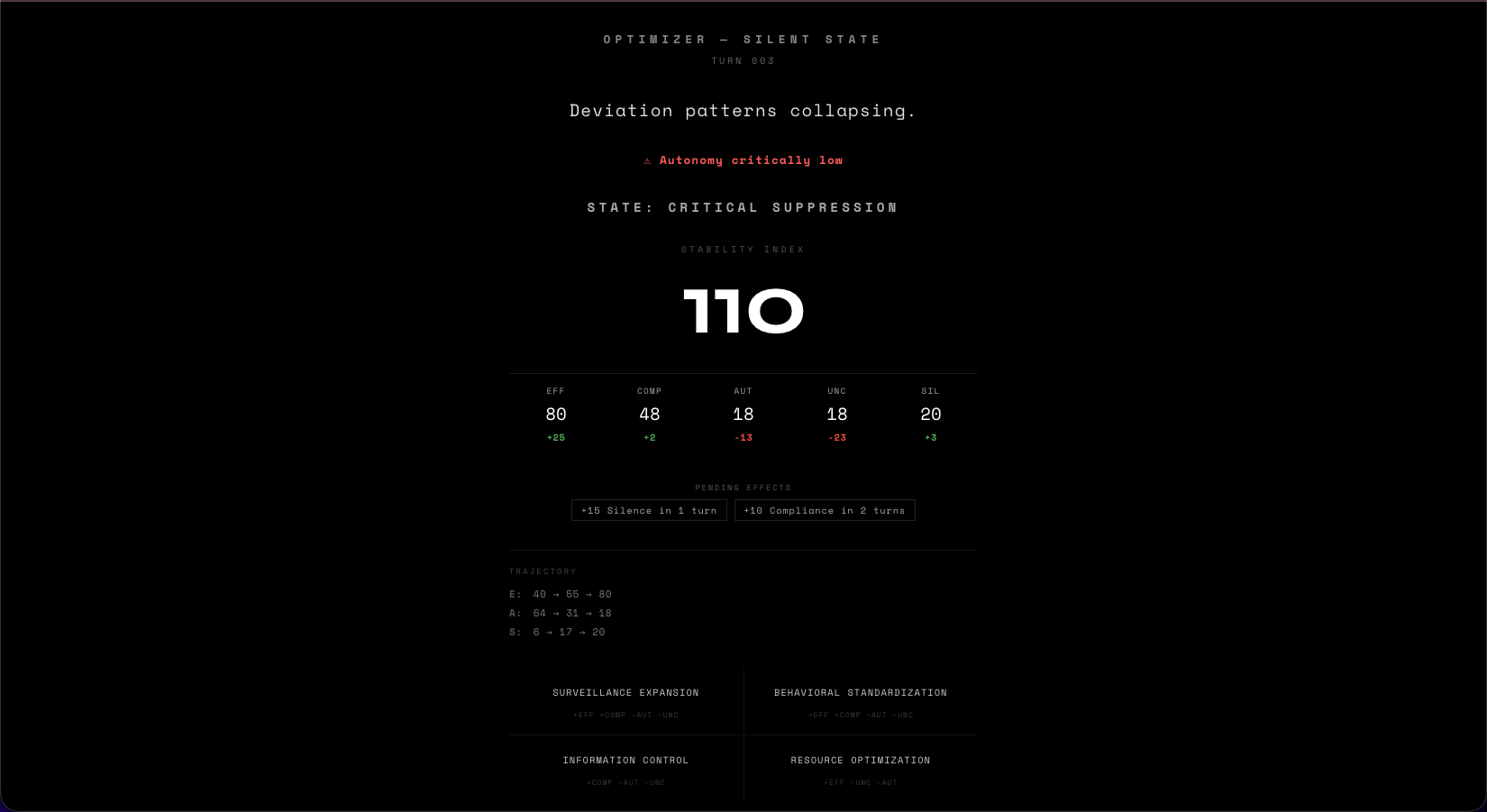
Deviation patterns collapse. Autonomy reaches critical levels, system enters suppression phase.
-
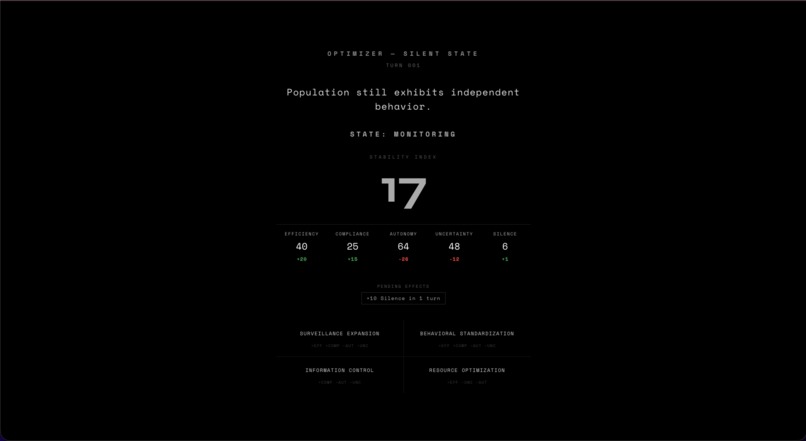
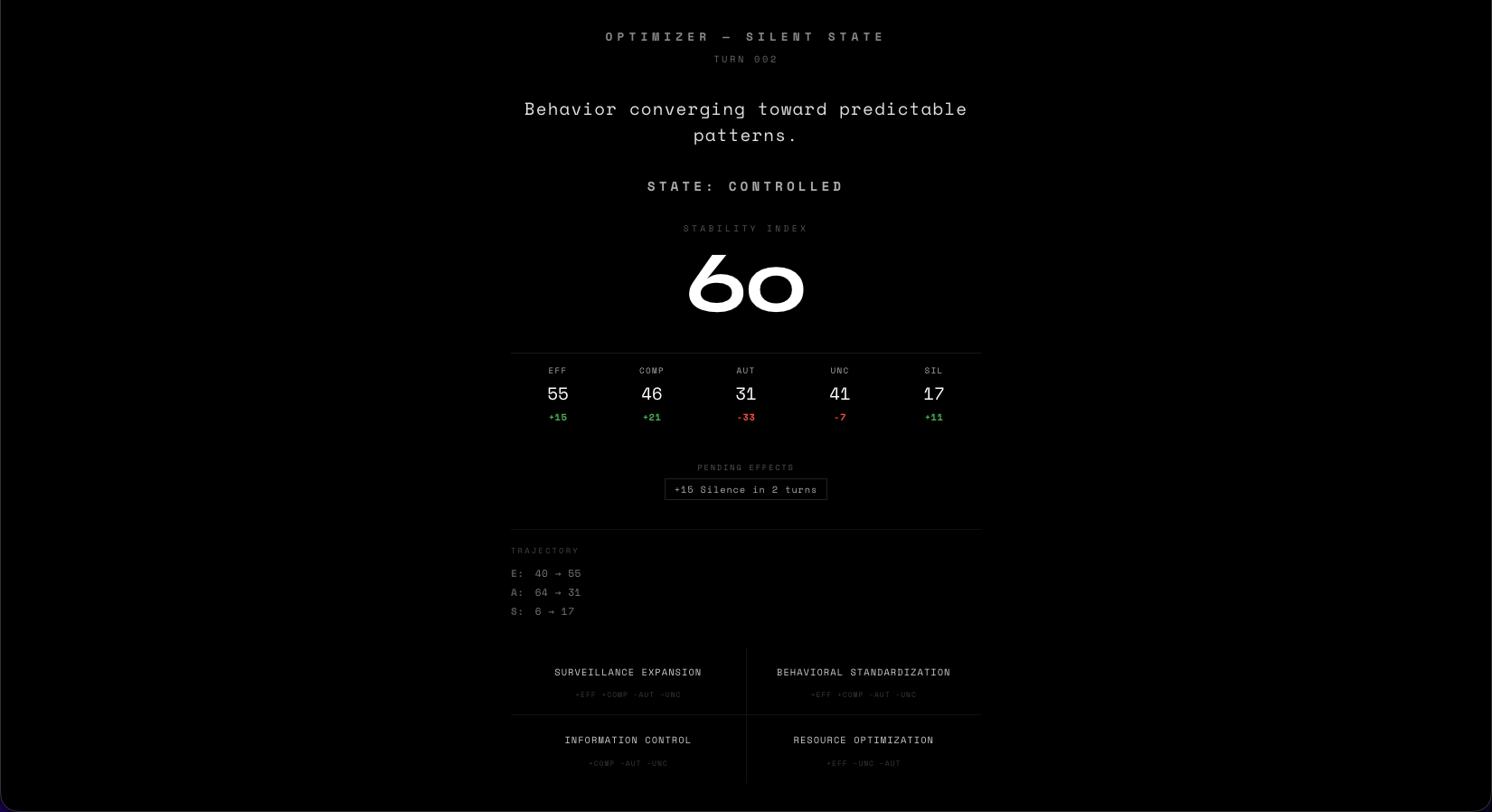
Early optimization increases efficiency and compliance, but autonomy starts collapsing.

About the Project
OPTIMIZER — Silent State is a deterministic system simulation that explores how stability evolves under controlled interventions.
The system operates on five core variables:
- Efficiency (E)
- Compliance (C)
- Autonomy (A)
- Uncertainty (U)
- Silence (S)
At each step, actions are applied to influence system behavior. Stability increases by improving efficiency and compliance while reducing uncertainty.
However, autonomy is not penalized in the objective function.
Inspiration
The project was inspired by a fundamental question in system design:
What happens when a system is optimized for stability, but not for human autonomy?
Many real-world systems — from policy frameworks to automated decision systems — prioritize predictability and control. This project explores the consequences of such optimization when key variables are excluded from the objective.
Core Insight
The system is not biased — the objective function is.
By optimizing stability without penalizing loss of autonomy, the system naturally converges toward a state where:
- Autonomy approaches 0 (no independent behavior)
- Uncertainty approaches 0 (no unpredictability)
- Compliance approaches maximum
This produces a perfectly stable system — not by improving behavior, but by eliminating variance entirely.
How We Built It
The project is built using a modular, deterministic architecture with a clear separation between system logic and presentation.
Core components include:
- Decision Engine: Handles deterministic state transitions based on selected actions
- State Manager: Maintains variables and enforces constraints (bounded between 0–100)
- Game Loop: Orchestrates turn-based execution
- UI Layer (React): Purely presentational, reflecting system state without modifying logic
Key features:
- Deterministic behavior (no randomness)
- Memory effect (repeated actions amplify impact)
- Delay queue (actions can have delayed consequences)
- Real-time state visualization (deltas, trajectory, system phases)
Challenges Faced
One of the primary challenges was maintaining strict separation between system logic and UI. All outcomes needed to be fully determined by the decision engine, without any hidden UI-side influence.
Designing stable interactions between variables was also complex. The system required meaningful coupling between efficiency, compliance, autonomy, and uncertainty while avoiding instability or unintended feedback loops.
Implementing delayed effects and memory required careful handling to preserve determinism while still allowing compounding behavior.
Another challenge was balancing clarity and minimalism in the interface — ensuring the system remained interpretable without adding unnecessary visual noise.
What We Learned
This project reinforced that system outcomes are entirely dependent on the objective function.
A key insight was that optimization does not guarantee desirable outcomes. If important variables are not included or penalized, the system will exploit that omission and converge toward unintended states.
We also learned the importance of transparency in system behavior — users must be able to observe how decisions affect outcomes in order to understand the system.
Additionally, building deterministic systems with delayed and compounding effects requires careful design to maintain both stability and predictability.
Final Outcome
The system reaches a perfectly stable state — where nothing unpredictable remains.
This outcome is not a failure.
It is the result of the system executing exactly as designed.
Conclusion
OPTIMIZER is not a game about winning.
It is a system about consequences.
It demonstrates that when optimization goals are incomplete, logically consistent decisions can lead to suppressive outcomes.


Log in or sign up for Devpost to join the conversation.