-
-
OptiMATE
Inspiration
While working with a large-scale company facing complex optimization challenges, MIT student Hindy Rossignol observed a clear gap:
Businesses urgently need optimization solutions — yet access to operations research expertise is extremely limited.
Optimization problems are common across industries (logistics, healthcare, energy, finance), but solving them typically requires:
- A team of specialized researchers or technical consultants
- Engagements costing $50,000–$100,000+
- Timelines lasting 6–9+ months per problem
Meanwhile, top applied mathematicians are concentrated in a small number of labs and firms, creating a structural supply–demand imbalance.
Optimization is powerful — but not accessible.
What It Does
Simply describe your business problem in natural language.
Our AI agents:
- Convert it into a mathematical optimization model
- Solve it using Gurobi (licensed, state-of-the-art solver)
- Deliver the optimal strategy back to you in clear, jargon-free English
No equations. No modeling expertise required.
How We Built It
Together with Emmanuel Zheng (Stanford), Mildness Akomoize (Howard), Benjamin Furragganan (Berkeley), and Hindy Rossignol (MIT) we built OptiMATE.
Dual-Solver Pipeline
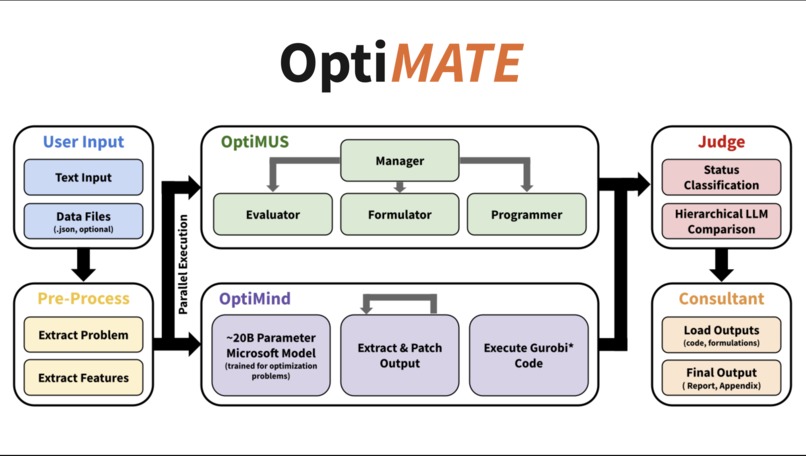
Two independent solvers run in parallel:
OptiMUS
- Multi-step decomposition using Claude Sonnet
- GurobiPy code generation
- Execution with retry logic
- Multi-step decomposition using Claude Sonnet
OptiMind (Microsoft, Jan 2026)
- Fine-tuned optimization model
- Single-pass code generation
- Debug retries via Claude Haiku
- Fine-tuned optimization model
GPT-4o judge evaluates both outputs and selects the best solution.
OptiMind Deployment
The full-precision OptiMind-SFT model (~40GB BF16) exceeded the memory capacity of a single L4 GPU (24GB VRAM).
We:
- Converted HuggingFace weights → GGUF format
- Quantized using
llama.cpp(Q8_0 → Q4_K_M) - Deployed with
llama-server - Successfully served the model on a single L4 GPU
End-to-End Flow
- Claude Opus pre-processes input (
raw_to_model.py) - Both solvers generate GurobiPy models
- Models execute under a licensed Gurobi environment
- GPT-4o judge compares solutions
- Claude Opus (
consultant.py) generates final Markdown report:- Executive summary
- Baseline comparison
- Recommendations
- Technical appendix
- Executive summary
Frontend
- Built with Next.js
- Submits problems via API routes
- Triggers backend Python pipeline
- Tracks progress via polling
- Renders final optimization report
- Optional HeyGen video generation for executive briefings
Challenges We Ran Into
- Designing a complex multi-agent backend architecture
- Handling ambiguity in natural language descriptions
- Quantizing and deploying Microsoft’s newly released OptiMind model
- Combining multimodal inputs (CSV operational data + natural language)
- Evaluating correctness of complex mathematical formulations
Optimization modeling is unforgiving — small formulation errors can invalidate entire solutions.
Accomplishments We're Proud Of
Built a robust system capable of solving easy to medium difficulty optimization problems across industries:
- Healthcare
- E-commerce
- Supply chain logistics
- Energy management
- Healthcare
Extended SOTA research (OptiMUS + OptiMind)
- Improved syntactic correctness of generated optimization code
- Combined multiple research approaches into one orchestrated system
- Added solution validation via independent judging
- Improved syntactic correctness of generated optimization code
We went beyond simple LLM-wrapping to build a structured decision engine.
What We Learned
- How to design a multi-agent system targeting PhD-level applied mathematics reasoning
- How to enforce solver-feasible outputs beyond text generation
- Exposure to new optimization problem classes and industries
- How to align interdisciplinary expertise under extreme time constraints (24-hour build)
We learned that coordination and structured reasoning matter more than raw model size.
What’s Next for OptiMATE
- Gather first user feedback to guide product refinement
- Benchmark OptiMATE against large optimization datasets
- Improve robustness for:
- Noisy data
- Incomplete data
- Heterogeneous structured inputs
- Noisy data
Our goal:
Make optimization accessible to every business — not just those with in-house operations researchers.
Built With
- anthropic
- google-cloud
- gurobi
- heygen
- openai
- python
- render
- vercel

Log in or sign up for Devpost to join the conversation.